Finding bed bugs early is mostly about knowing where to look and what “evidence” looks like. The fastest, most reliable bed bug detection combines a careful visual inspection with simple monitors that catch bugs you might never see in daylight. This guide walks you through the exact signs to confirm, the highest-yield hiding spots (many are not in the bed), and which traps work best for low-level infestations. If you are checking after travel, unexplained bites, or a used-furniture purchase, the steps below help you confirm quickly and avoid spreading them room to room.
Quick answer: how to confirm bed bugs fast
Bed bug detection is most accurate when you use two methods: a targeted inspection plus a monitor for at least a week.
Use this quick checklist to confirm:
- Look for physical signs (not just bites):
- Fecal spots: tiny black dots like pepper on seams, wood joints, or fabric
- Shed skins: pale, translucent “shells” from growing nymphs
- Eggs: pinhead-sized (about 1 mm), white, stuck in cracks
- Rusty stains: blood smears on sheets from crushed bugs
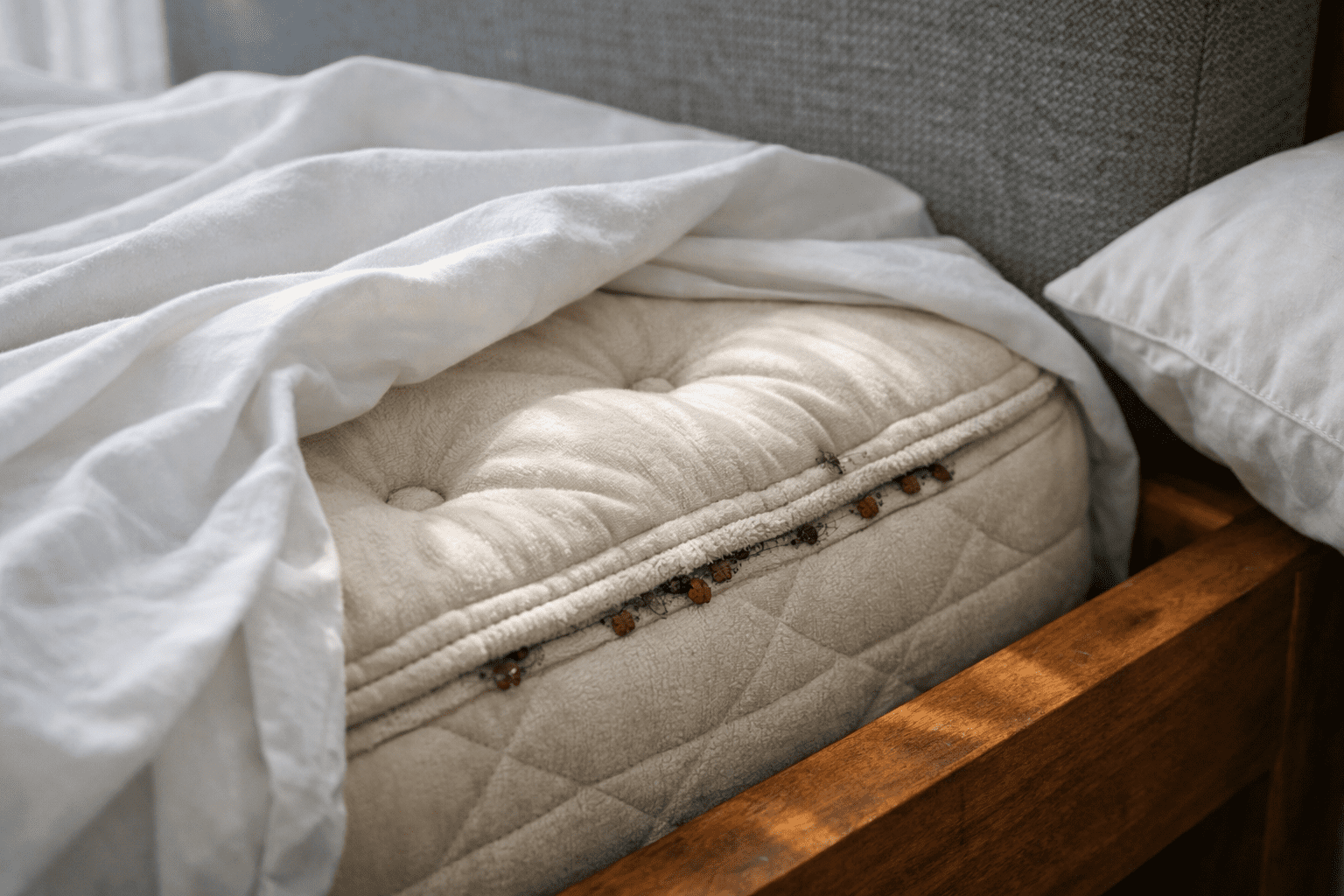
- Inspect the “bed zone” first: mattress seams, tags, box spring edges, headboard cracks.
- Add interceptors under legs: passive pitfall traps can detect low infestations over 7+ days. Research summaries from the Ohio State University bed bug resource report high detection rates for interceptor-style monitors in apartments.
- For rapid confirmation: CO2-based traps (like dry ice setups) can confirm light infestations in as little as 24 hours, based on guidance from Rutgers NJAES bed bug fact sheets.
If you find a bug, capture it in a sealed bag or tape it to paper for identification before treating.
Bed bug signs that actually confirm an infestation (and what not to trust)
Bed bug evidence can be frustrating because it is often tiny, scattered, and easy to mistake for lint or random specks. Think of bed bugs like expert pickpockets: they feed quickly, hide fast, and leave behind subtle clues instead of obvious damage.
Start with what counts as a confirmation. According to the EPA bed bug guidance on finding bed bugs, the most dependable proof is seeing the bug itself or finding multiple consistent signs in the same area.
The most reliable signs (ranked)
Use this “confidence ladder” to judge what you are seeing:
| Evidence | What it looks like | Confidence level | Where it shows up most |
|---|---|---|---|
| Live bed bug (adult or nymph) | Flat, oval, reddish-brown; adults about 4-5 mm (apple-seed sized) | Very high | Mattress seams, headboard cracks, couch seams |
| Fecal spots | Ink-like black dots that smear when damp | High | Seams, wood joints, screw holes, fabric piping |
| Shed skins | Pale, papery exoskeletons | High | Near hiding spots, under bed frames, along baseboards |
| Eggs | White, ~1 mm, glued into cracks | High | Tight crevices, behind trim, inside joints |
| Blood smears | Rust-colored stains on sheets | Medium | Bedding near where you sleep |
| Bites | Itchy welts, sometimes in lines or clusters | Low | Skin only – not proof |
What people commonly misread
A lot of “false alarms” come from three lookalikes:
- Flea dirt (especially with pets): also black specks, but often concentrated where pets rest.
- Random fabric lint: does not smear like bed bug fecal spotting.
- Mosquito bites or other insects: skin reactions vary widely and do not confirm bed bugs. If you are comparing bite patterns, see Mosquito Bites vs Bed Bugs, Fleas, Spiders & Ticks for a clearer side-by-side.
Actionable takeaway
If you only have bites, do not jump straight to treatment. Instead, aim to find two matching signs in the same zone (for example: fecal spots plus shed skins), then back it up with a monitor.
Bed bug detection step-by-step: a 30-minute inspection that finds most hiding spots
Hot Shot Bed Bug and Flea Killer, 1 Gallon
Hot Shot Bed Bug and Flea Killer 1 Gallon receives positive mentions across retailers for its non-staining, odor-free formula that effectively kills bed bugs, eggs, fleas, and ticks by contact with long-lasting protection, though no Amazon-specific ratings, reviews, or pricing were found in search results to confirm current performance or value[1][2][3][4].
A good inspection is less about searching everywhere and more about searching the right seams and cracks. Bed bugs (common bed bug, Cimex lectularius) prefer tight spaces where their bodies touch surfaces above and below. That “pressed in” hiding style is why mattress seams and wood joints are so productive.
Tools that make inspection easier
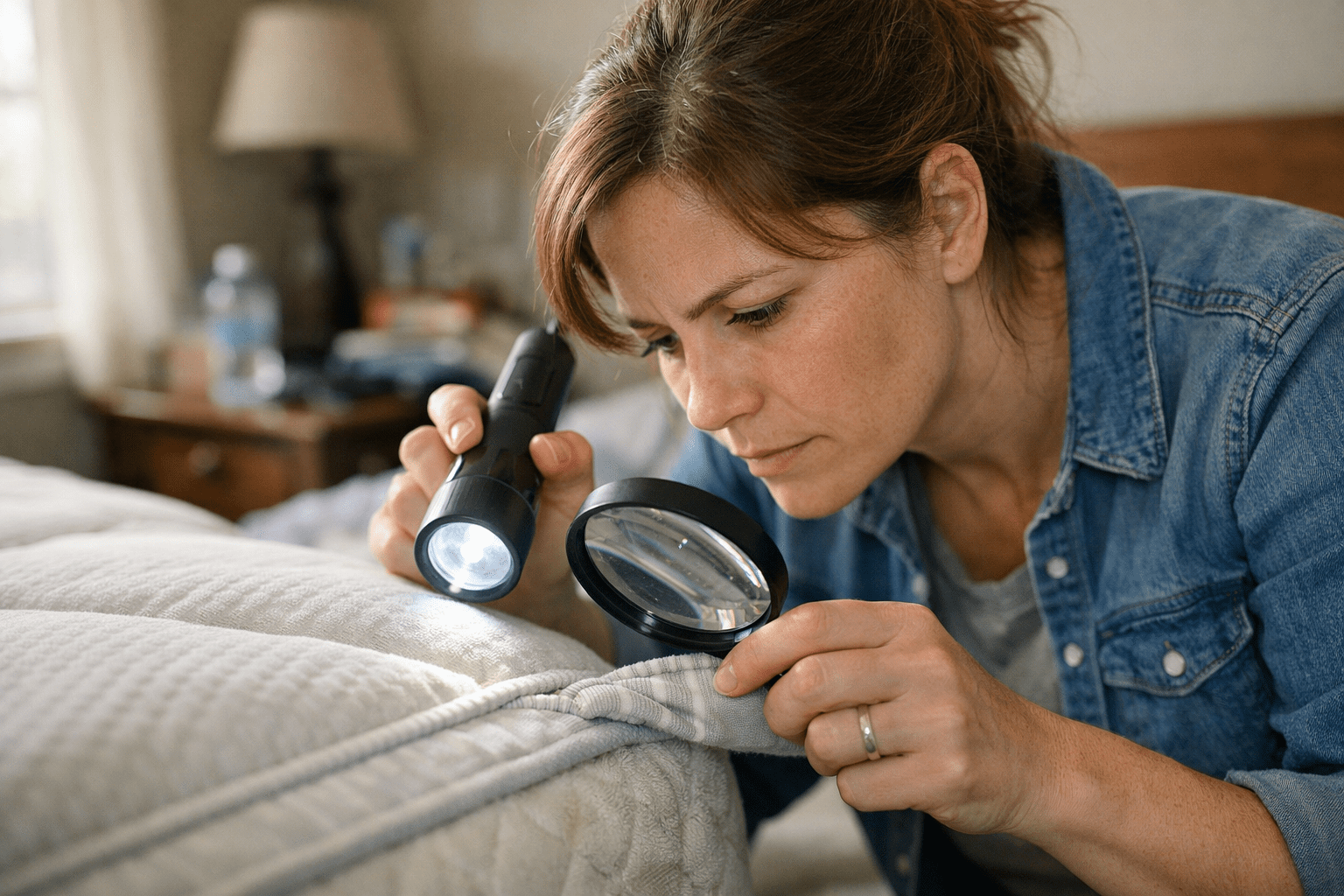
You can do a strong inspection with basic items:
- Bright flashlight (a focused beam helps)
- Thin card (old gift card) to scrape seams
- Magnifier (10x is ideal)
- Disposable gloves
- Clear tape and sealable bags for suspects
- Optional: UV light (helpful for some stains, but not a primary tool)
The highest-yield inspection route (in order)
Follow this route so you do not miss the “bed bug highway” from bed to wall:
-
Strip the bed completely
Put sheets and pillowcases straight into a bag. If you plan to launder, seal the bag until wash time. -
Mattress seams and labels
Focus on piping, tufts, and the label edge. Use the card to open the seam slightly. -
Box spring and bed frame joints
Box springs are often more productive than mattresses. Check the underside fabric if you can access it safely. -
Headboard and wall-side cracks
Headboards are prime real estate, especially where wood meets wall. Shine the flashlight from the side to reveal texture and spotting. -
Nightstand and nearby clutter (within 3-6 feet / 1-2 m)
Check drawer corners, screw holes, and the underside lip of furniture. -
Baseboards, outlet plates, and picture frames
Bed bugs can hide behind loose trim and in wall void edges. If you are not comfortable removing plates, leave this for a professional.
Quick “yes/no” decision table
| If you find… | Do this next |
|---|---|
| A live bug or multiple strong signs | Begin monitoring immediately and plan treatment or professional help |
| Only one weak sign (one spot or one stain) | Add interceptors and re-check in 7 days |
| Nothing, but bites continue | Monitor anyway – low-level infestations can be hard to spot |
Actionable takeaway
Inspection finds the obvious clusters. Monitoring finds the “invisible” early stage. Do both before you decide you are in the clear.
Monitors and traps: what works best for low-level infestations
Bed Bug Interceptor Traps, 4 Pack
These interceptor traps are designed to monitor and detect bed bugs, aligning perfectly with the article’s focus on detection methods.
EcoSMART Organic Bed Bug Killer, 14 oz
EcoSMART Organic Bed Bug Killer (14 oz) is a plant-based aerosol spray using 2-Phenethyl Propionate, peppermint oil, and rosemary oil to kill bed bugs and eggs on mattresses and carpets without synthetic toxins or harmful residues; it’s promoted as safe for children and pets with a fresh scent, though no Amazon ratings, reviews, or pricing data is available from search results[1][2][3].
Many infestations start with a few bugs, not a crawling mattress. That is why monitors matter. If visual inspection is a snapshot, monitors are the security camera footage.
Entomologists generally agree that no single tool is perfect, but combining inspection with monitors gives the best bed bug detection results. Research summaries compiled by the Ohio State University bed bug program and field guidance from Rutgers NJAES support two big categories: passive interceptors and active CO2-based traps.
Passive monitors (best for ongoing detection)
Interceptor-style pitfall traps (often placed under bed and sofa legs) catch bugs as they climb up or down.
What to know:
- Best for low-level infestations and ongoing confirmation.
- Typically need 7+ days to be meaningful, longer if activity is low.
- Keep them clean and properly installed so bugs cannot bypass them.
Placement checklist (do this exactly):
- Put interceptors under every leg of the bed and nearby upholstered furniture.
- Pull the bed slightly away from the wall so bedding does not touch the floor.
- Avoid letting dust, pet hair, or moisture build up inside traps.
- Re-check weekly during monitoring or treatment.
Active monitors (best for quick confirmation)
Active traps use CO2 (and sometimes heat or lures) to mimic a host. Bed bugs orient toward CO2 because it signals breathing.
Two common options:
- Dry ice CO2 traps: often very effective for fast confirmation in testing and field use.
- Sugar-yeast CO2 traps: can work for short windows, but output varies.
Safety notes:
- Keep CO2 setups away from kids and pets.
- Use in the evening when bed bugs are more likely to forage.
- Active traps do not replace inspection – they confirm activity.
Which should you use?
| Situation | Best choice | Why |
|---|---|---|
| You suspect a very light infestation | Interceptors + targeted inspection | Catches slow, intermittent movement over time |
| You need a fast “yes/no” | CO2-based active trap | Can confirm activity in 24 hours in some cases |
| You are mid-treatment | Interceptors long-term | Helps verify progress and catch survivors |
Actionable takeaway
If you can only pick one tool, choose interceptors. They are simple, evidence-based, and useful before, during, and after treatment.
Where bed bugs hide besides beds (the overlooked locations that keep infestations going)
Bed Bug Detection Kit with Lure and Traps
This kit helps users confirm the presence of bed bugs, supporting the article’s emphasis on effective detection methods.
The most persistent infestations often come from one mistake: focusing only on the mattress. Bed bugs are called bed bugs because we meet them in beds, not because they only live there.
The EPA’s bed bug prevention, detection, and control guide emphasizes that bed bugs can hide in many cracks and items near where people rest. In apartments, they can also move between units through wall voids and shared pathways.
The “resting zone” rule
A practical way to search is to follow where humans stay still for long periods:
- Beds and headboards
- Couches and recliners
- Reading chairs
- Guest rooms and daybeds
- Home offices (especially if you nap or lounge)
High-risk hiding spots checklist
Use this list when inspection of the bed comes up empty:
- Upholstered furniture seams: piping, zippers, stapled dust covers
- Bedside clutter: stacks of clothes, bags, books near the bed
- Curtain hems and pleats: especially near the bed
- Behind baseboards and loose trim
- Wall hangings: frames, mirrors, posters near sleeping areas
- Electronics near the bed: alarm clocks, power strips, laptop seams (less common, but possible)
- Luggage: seams, pockets, and hard-shell edges after travel
A quick room map that helps
Sketch the room and mark:
- Where heads rest (bed, couch)
- The 3-6 ft (1-2 m) ring around that spot
- Any cracks, seams, or clutter inside that ring
Then inspect in that order. This keeps the search focused and prevents you from missing obvious harborages.
Actionable takeaway
If you find signs in a couch but not the bed, treat the couch as the “main nest.” Many living-room infestations start with naps, guests, or luggage placed nearby.
What to do after detection: confirm, contain, and choose the right next step
Once you have evidence, the goal is to stop spread while you decide on treatment. Bed bugs are excellent hitchhikers. A single move of a blanket or backpack can relocate the problem.
Confirm with a simple evidence protocol
- Capture a sample: use clear tape or a sealed bag.
- Photograph it next to a coin for scale.
- Keep the evidence until you get professional confirmation if needed.
If you are unsure whether it is a bed bug, do not rely on a quick internet image match. Many small insects look similar at a glance.
Contain without making things worse
Do these immediately:
- Reduce movement of items out of the room. Do not carry loose laundry through the house.
- Bag textiles (bedding, nearby clothes) before moving to the washer.
- Heat-dry on high when fabrics allow. Many bed bug life stages die at sustained high temperatures, and dryers are often more reliable than washers alone.
- Vacuum carefully along seams and edges, then seal and discard the vacuum bag or empty the canister outdoors.
Avoid these common mistakes:
- Do not use bug bombs or foggers. They can push bed bugs deeper into walls and do not solve the problem reliably.
- Do not spray random pesticides on mattresses unless the label allows it and you understand safe use.
For broader household biting issues, it can help to rule out other pests too. If you are dealing with flying insects indoors, this guide on How to Get Rid of Mosquitoes Inside Your House can help you narrow the cause.
When to call a professional
Consider professional help if:
- You live in a multi-unit building (apartments, condos, dorms).
- You find bed bugs in multiple rooms.
- You have tried monitoring and activity continues for weeks.
- You cannot safely inspect wall voids, outlets, or complex furniture.
Professionals may use additional tools like canine teams or heat detection, but results can vary. That is why most pest management programs still rely on inspection plus monitoring as the backbone of confirmation and follow-up.
Actionable takeaway
After you confirm activity, focus on containment first. Treatment works better when you are not accidentally spreading bugs to new rooms.
Key takeaways for reliable bed bug detection
- The strongest proof is a live bug or multiple consistent signs (spots, skins, eggs) in the same area.
- Bites alone are not confirmation. Skin reactions vary and many pests cause similar marks.
- A good approach is inspection + interceptors for 7+ days, especially for low-level infestations.
- CO2-based traps can provide faster confirmation, but they work best as a supplement.
- Bed bugs often hide outside the bed, especially in couches, headboards, and nearby clutter.
Conclusion
Bed bug detection is most successful when you treat it like a checklist, not a guessing game. Inspect the high-yield seams and cracks, then back up what you saw with interceptors or an active trap so you can confirm low-level activity. Once you have evidence, contain items carefully and choose a treatment plan that fits your home and risk level.
If you are still unsure whether bites point to bed bugs or something else, revisit Mosquito Bites vs Bed Bugs, Fleas, Spiders & Ticks. For other indoor pest surprises, How to Get Rid of Mosquitoes Inside Your House is a helpful next read.
As an Amazon Associate, I earn from qualifying purchases. Product recommendations are based on real reviews and independent research.