
Finding tiny insects in the kitchen or a line of workers along a baseboard usually triggers the same question: what kind of ant is this, and what should you do next? Ant identification is the fastest way to get the right answer because different ants prefer different foods, nest in different places, and respond to different treatments. This guide walks you through the key body features entomologists use, what to look for in trails and nests, and a practical list of common household and yard ants found across North America.
n
Readers working through this usually open Pharaoh Ants: Complete Identification & Control Guide and How Do Ant Colonies Work? Social Structure Explained next.
Quick answer: how to identify an ant (fast checklist)
n
For reliable ant identification, focus on structure and behavior, not color alone. Use this quick checklist before you reach for a spray.
n
Fast ID checklist (60 seconds):
n
- n
- Confirm it’s an ant (not a termite): ants have a pinched waist and elbowed antennae; termites have a thick waist and straight antennae.
- Count “waist” nodes (petiole): look between the middle body and the abdomen
- n
- 1 node often includes odorous house ants, Argentine ants, field ants
- 2 nodes often includes pavement ants, fire ants, Pharaoh ants
n
n
n
- Estimate size: most household workers are 1/16 to 1/8 inch (1.5 to 3 mm); carpenter ants are much larger.
- Check for wings: winged ants are usually swarmers (queens/males), often seen seasonally.
- Note smell and behavior: some ants smell like rotten coconut when crushed; some move erratically; some sting.
n
n
n
n
n
n
Best quick tool: take a close-up photo (side view + top view) and compare it to a regional chart like the University of Minnesota Extension ant guide.
n
Ant anatomy that matters: the 6 features that separate look-alikes (with a mini key)
n
If you have ever tried to ID ants by “small brown ant,” you already know the problem: dozens of species fit that description. Entomologists rely on a short list of repeatable traits that show up even in phone photos, especially if you use good lighting and a steady hand.
n
The 6 most useful traits (in order)
n
Use this mini key like a decision tree.
n
- n
- Waist nodes (petiole nodes)
n
n
- n
- One node: the waist looks like a single bump.
- Two nodes: you’ll see two distinct bumps.nThis is one of the fastest ways to narrow possibilities, and it’s emphasized in extension resources such as the Texas A&M AgriLife Extension ant identification PDF.
n
n
n
- n
-
Thorax profile (side view)nThink of the thorax as the “shoulders.” Some ants have an uneven, lumpy profile; others look smooth and evenly arched. A side-view photo on a white background helps.
n
-
Antennae (segments and club)nAnt antennae are elbowed. Some pest species also have a noticeable club at the end (a thickened set of segments). Tiny ants like Pharaoh ants are often separated by these details.
n
-
Size range and polymorphismnSome species have workers in multiple sizes (polymorphic), while others are fairly uniform (monomorphic). Fire ants and carpenter ants can show noticeable size variation in the same trail.
n
-
Odor when crushednA few ants have distinctive odors:
n
n
n
n
n
n
- n
- Odorous house ants often smell like rotten coconut when crushed.
- Citronella ants can smell lemony, especially during swarms.
n
n
n
- n
- Behavior and nesting cluesnA trail on a countertop, a mound in the lawn, or ants coming from damp wood each points to different suspects. For example, carpenter ants often indicate moisture issues, not just “bad luck.”
n
n
Mini visual key (save this)
n
| What you see | Most likely group to check next |
|---|---|
| Thick waist, straight antennae | Termites (not ants) |
| 1 waist node + rotten coconut smell | Odorous house ant |
| 2 waist nodes + slow trails near pavement cracks | Pavement ant |
| Large ants (1/4 to 1/2 inch) near damp wood | Carpenter ant |
| Tiny yellow ants indoors, hard to control with sprays | Pharaoh ant |
n
Actionable takeaway: Take two photos – one side view (to see thorax and nodes) and one top view (to see head shape). This simple step prevents most misidentifications.
n
Ant identification guide to 20 common species (sizes, traits, and where you’ll find them)
nn
n
n Terro T300B Liquid Ant Baits, 12 Bait Stationsn
n
n
This product is relevant as it provides a solution for readers who may need to deal with ant infestations after identifying the species.
n n n n Check Price on Amazon →n n
n
n
nn
Most people don’t need to learn thousands of ant species. In homes and urban landscapes, a relatively small set shows up again and again, and the right ID often determines whether baits will work, where the nest is likely located, and whether you should call a pro.
n
Below is a practical field list of common ants and common “ant” look-alikes. For additional photo comparisons, pest-control image libraries can help, such as Western’s ant picture guide, but always cross-check with extension traits.
n
Quick comparison table (common North American ants)
n
| Common name | Worker size | Waist nodes | Key ID clues | Typical nesting / where seen |
|---|---|---|---|---|
| Argentine ant | 1/12 to 1/8 in (2 to 3 mm) | 1 | long legs, heavy trails, musty odor | outdoors, wall voids, along foundations |
| Odorous house ant | 1/16 to 1/8 in (1.5 to 3 mm) | 1 | rotten coconut smell when crushed | indoors for sweets, outdoors under mulch |
| Carpenter ant | 1/4 to 1/2 in (6 to 13 mm) | 1 (sometimes looks like 1) | very large, smooth back, wood galleries | damp wood, window frames, decks |
| Crazy ant | ~1/8 in (3 mm) | 1 | erratic running, long antennae | indoors, around moisture and electronics |
| Ghost ant | ~1/16 in (1.5 mm) | 1 | pale legs and body, darker abdomen | kitchens, bathrooms, humid areas |
| Field ant | 1/8 to 1/4 in (3 to 6 mm) | 1 | outdoor mounds, thatch nests | lawns, fields, under stones |
| Citronella ant (swarmer) | ~1/4 in (6 mm) | 1 | yellowish, lemon odor, winged indoors | under slabs, in soil; swarm indoors |
| Pavement ant | ~1/8 in (3 mm) | 2 | grooves on head, nests in cracks | sidewalks, driveways, foundations |
| Pharaoh ant | 1/16 to 1/12 in (1.5 to 2 mm) | 2 | tiny, yellow to light brown, antenna club | warm buildings, hospitals, kitchens |
| Thief ant | ~1/32 in (0.8 mm) | 2 | extremely tiny, hard to see details | near other ant nests, indoors |
| Little black ant | ~1/16 in (1.5 mm) | 2 | uniform black, slow trails | lawns, under rocks, indoors |
| Fire ant | 1/8 to 1/4 in (3 to 6 mm) | 2 | aggressive, painful sting, soil mounds | sunny lawns, parks, southern regions |
| Acrobat ant | 1/16 to 1/8 in (2 to 3 mm) | 2 | heart-shaped abdomen raised when disturbed | moist wood, tree cavities |
| Bigheaded ant | 1/16 to 1/8 in (2 to 3 mm) | 2 | some workers have oversized heads | soil, under debris, indoors edges |
| Harvester ant | 1/4 to 3/8 in (6 to 10 mm) | 2 | large head, seed collecting | dry soils, yards in arid regions |
| Pyramid ant | ~1/16 in (2 mm) | 2 | pyramid-like node | sandy soils, outdoors |
| Leafcutter ant | 1/12 to 1/2 in | 2 | spines, carries leaf pieces | warm regions, outdoor trails |
| Cornfield ant | ~1/16 in (2 mm) | 1 | small brown, mostly outdoors | fields, soil, near plants |
| Elliptical ant (regional) | varies | varies | oval-bodied look | southern areas, indoors/outdoors |
| Velvet ant (look-alike) | 1/4 to 3/4 in | none | fuzzy, wingless female wasp | outdoors; very painful sting |
n
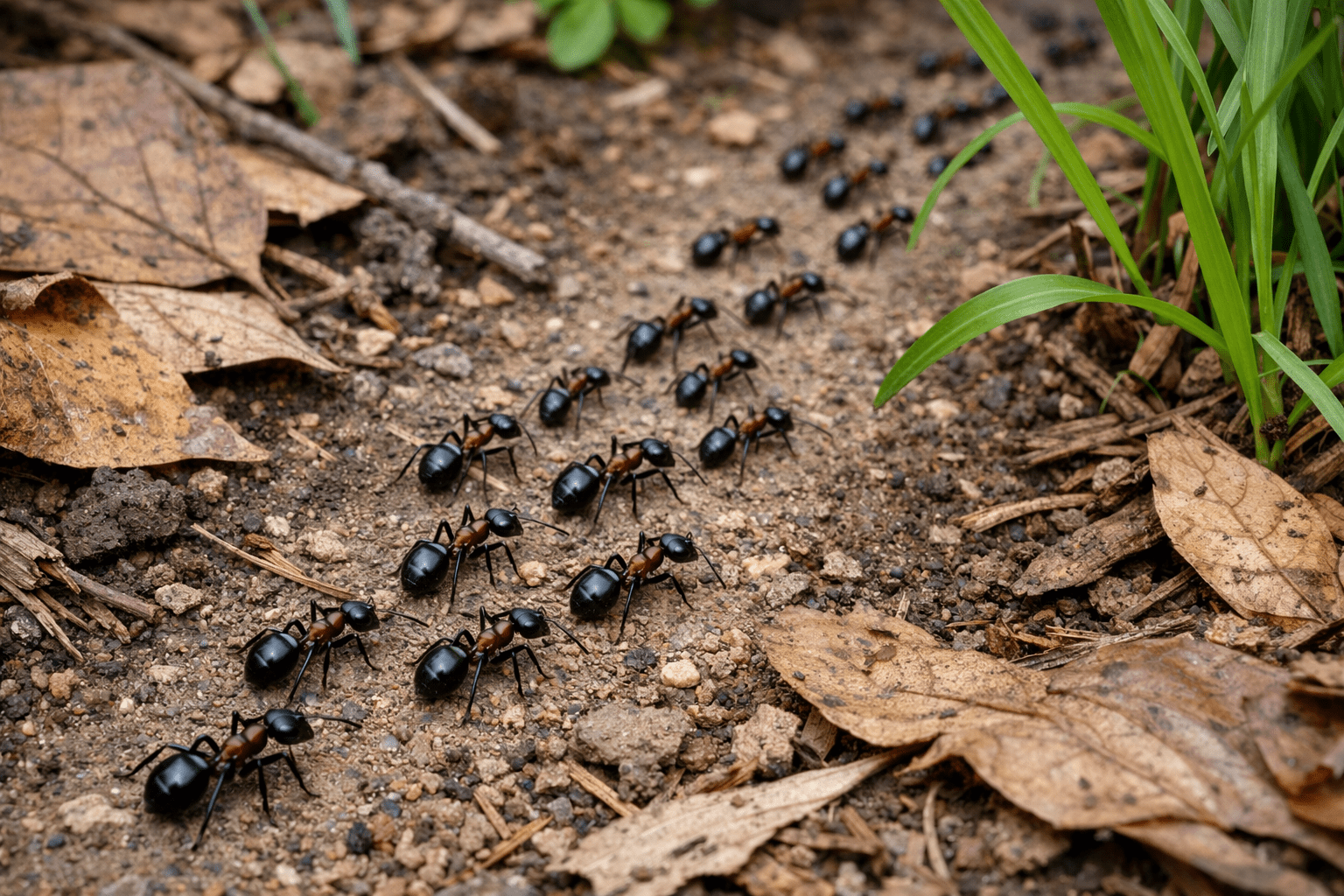
Actionable takeaway: If you’re choosing a bait, first decide whether the ants are likely after sugars (many trail-forming house invaders) or proteins/grease (often carpenter ants and some seasonal foragers). Correct food preference is often the difference between “bait worked” and “bait ignored.”
n
 n
nnn
Ants vs termites (and other common “ant” imposters)
nn
n
n Ortho Home Defense Insect Killer for Indoor & Perimeter, 1 Gallonn
n
n
This insect killer can be useful for readers looking for a way to manage ant problems in their homes after identification.
n n n n Check Price on Amazon →n n
n
n
nn
Misidentification is not just a trivia problem. It changes your next step. Treating termites like ants can delay real wood-damage control. Treating a velvet ant like a household ant can lead to painful handling mistakes.
n
Ant vs termite: the 3-second check
n
When swarmers show up at windows, people often ask whether they have “flying ants” or termites. Here’s the fastest way to tell.
n
Visual comparison chart
n
| Feature | Ant | Termite |
|---|---|---|
| Waist | pinched, narrow | thick, straight-sided |
| Antennae | elbowed | straight, bead-like |
| Wings (swarmers) | front wings longer than back | wings similar length |
n
For a deeper structural comparison, the University of Minnesota Extension explains the body differences clearly with household context.
n
Other “ant” look-alikes you might see
n
- n
- Velvet ants (cow killers): These are actually wingless female wasps, often fuzzy and brightly colored. They do not form indoor trails. Avoid handling.
- Spider beetles: Small, round-bodied insects that can resemble ants at a glance, but lack the pinched waist and elbowed antennae.
- Ant-mimicking spiders: Some spiders hold their front legs like antennae. A close photo reveals eight legs and no elbowed antennae.
n
n
n
n
What to do if you’re still unsure
n
If you can’t confidently separate ants from termites after the checklist:
n
- n
- Capture one specimen (tape works) or take clear photos.
- Compare to a university extension gallery or submit to a local extension office.
- If you suspect termites or see wood damage, schedule an inspection.
n
n
n
n
Actionable takeaway: Don’t rely on wing presence alone. Both termites and ants swarm. Body shape is the reliable signal.
n
How to identify ants in your home (step-by-step) and choose the right control
nn
n
n The Ant Book: A Guide to the Ants of North American
n
n
This is a field guide book on ants, not a supplement or health product, so it does not fit the affiliate recommendation criteria for supplements. No Amazon ASIN located for the exact title under standard search; consider searching Amazon directly for ‘Ants of North America Princeton’ which may yield similar titles like ‘Ants of North America: A Guide to the Genera’ with ASIN B000W3QJ8K, rated around 4.7 stars.
n n n n Check Price on Amazon →n n
n
n
nn
Correct identification pays off most when ants are indoors. That’s because control is species-specific: some ants readily take sweet baits, some prefer protein, and some (notably Pharaoh ants) can spread into more nests if you use repellent sprays.
n
Step-by-step home ID workflow (simple and repeatable)
n
Use this process whenever ants show up in a new room.
n
- n
-
Track the trailnFollow the line backward. Many household ants travel like commuters, sticking to edges, pipes, and baseboards.
n
-
Check the “where”
n
n
n
n
- n
- Kitchen counters and pantry edges often point to sugar-loving species like odorous house ants or Argentine ants.
- Bathrooms and near condensation can point to ghost ants or moisture-associated species.
- Near window frames, sills, or damp wood raises suspicion for carpenter ants.
n
n
n
n
- n
-
Do the node countnUse your phone camera zoom or a cheap clip-on macro lens. One node vs two nodes narrows the field quickly.
n
-
Test food preference (without guessing)nSet out two baits 3 to 6 feet from the trail:
n
n
n
n
- n
- A tiny smear of sugar (jam or sugar water)
- A tiny smear of protein/grease (peanut butter or a bit of tuna)nWatch which one recruits more workers in 20 to 40 minutes.
n
n
n
- n
- Choose control that matches the species
n
n
- n
- For most trail-forming house ants, baits outperform sprays because baits move back to the colony.
- For carpenter ants, you often need to address moisture-damaged wood and nest sites, not just foragers.
n
n
n
For product selection and bait strategy, see Best Ant Killers & Baits: Complete Buyer's Guide. If the ants are large and you suspect wood nesting, use Best Carpenter Ant Treatments and Baits for a carpenter-focused plan.
n
When to avoid sprays
n
Some ants respond poorly to repellent insecticides. For example, many professionals warn that spraying can cause budding in certain species (colonies split into multiple nests), making the problem harder. This is a common caution in pest ID and treatment guides like the DoMyOwn ant identification guide.
n
Actionable takeaway: If you don’t know the species yet, start with trail tracking + node count + food preference test. That trio usually points to the right bait strategy within an hour.
n
Common ant ID mistakes (and what to do instead)
n
Even careful homeowners fall into the same traps. The good news is that each mistake has an easy fix.
n
Mistake 1: Using color as the main clue
n
Plenty of unrelated ants are brown or black and about 1/8 inch long. Odorous house ants and Argentine ants can look similar in quick glances, but their behavior and odor cues can differ.
n
Do instead: Use at least two structural traits (node count + thorax profile) plus one behavior clue (trail pattern, nesting site, odor).
n
Mistake 2: Assuming all ants sting
n
Only some ants sting, and many common indoor invaders do not. Fire ants and harvester ants are well known for stings, while many house ants mainly bite or simply become a nuisance.
n
Do instead: If you’re in the southern US and see soil mounds with aggressive ants, treat it as a potential stinging species and avoid barefoot contact. Regional context matters, as highlighted in resources like the Texas A&M AgriLife Extension.
n
Mistake 3: Trusting apps without verification
n
Citizen science tools can be helpful, but species-level ant IDs often require close views of the head, antennae, and body texture. Even iNaturalist users note that photos often support genus-level ID, while species can require more detail.
n
Do instead: Use apps as a starting point, then verify using trait charts and expert communities like the iNaturalist ant identification discussion.
n
Mistake 4: Treating every ant problem the same way
n
One-size-fits-all control fails because ants differ in diet, nesting habits, and colony structure. Some species respond best to sweet baits, others to protein, and some require locating nests in wall voids or outdoors.
n
Do instead: Match the method to the ant. If you enjoy ID guides for other insects, the same “look for structure first” approach works well in How to Identify Ladybugs: Types, Colors & Look-Alikes and Types of Mosquitoes: Complete Species Identification Guide.
n
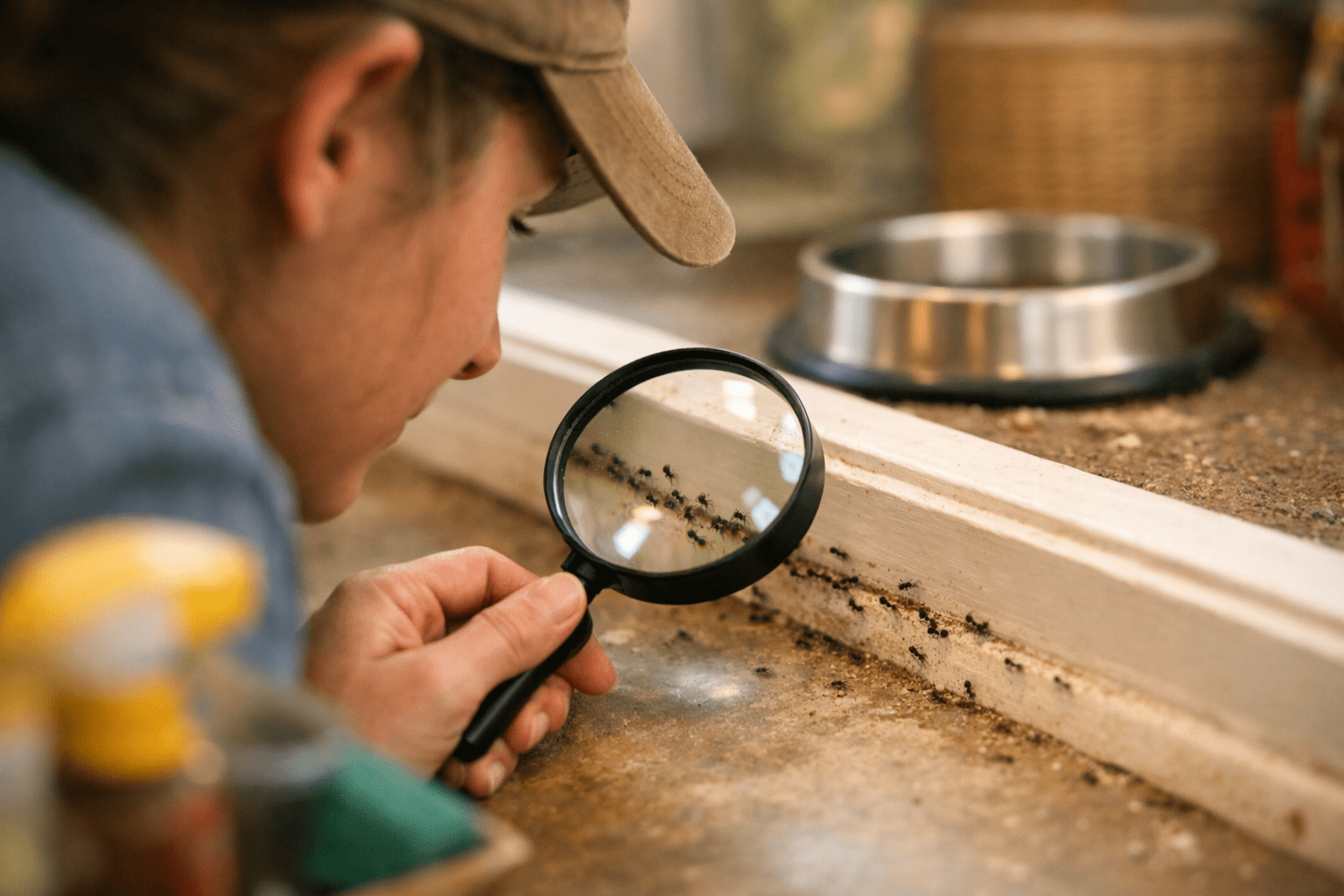
Actionable takeaway: The best “ID upgrade” is simple: take clearer photos. A bright light, a white background, and a side view can change everything.
n
 n
nnn
Conclusion: the fastest path to accurate ant ID (and fewer repeat infestations)
n
Ant problems get easier when you stop guessing and start observing. Focus on a few high-signal traits: confirm it’s an ant, count waist nodes, check thorax shape, and note behavior like trail patterns and odor. Then use food preference to pick a bait strategy that fits the species instead of fighting the wrong battle.
n
Next step: if ants are indoors, follow the trail and compare your photos to an extension guide, then choose a bait plan from Best Ant Killers & Baits: Complete Buyer's Guide. If the ants are large and showing up near damp wood, go straight to Best Carpenter Ant Treatments and Baits to prevent repeat activity.
If the thing you found is not on this page, our guide to working out what a bug is from what you saw starts from colour, place and movement instead.
n
As an Amazon Associate, I earn from qualifying purchases. Product recommendations are based on real reviews and independent research.

Pingback: Tiny Bugs in Your Car: What Gets In and Why
Pingback: Bugs Crawling on the Ceiling: What Gets Up There
Pingback: Types of Aphids: Colour, Plant and Where They Hide
Pingback: What Do Ant Eggs Look Like? Eggs, Larvae and Pupae