
Finding a trail of ants across your counter can feel random, but it usually isn’t. Ant colonies run on a tight system of communication and shared work that lets them locate food, defend a nest, and raise young with surprising efficiency. This guide explains how an ant colony is organized, what each ant “job” actually means, and why queens don’t “rule” the way many people assume. You’ll also learn how to spot a colony nearby and what to do if it’s becoming a pest problem.
\
Related guides worth having to hand: Pharaoh Ants: Complete Identification & Control Guide and DIY Ant Bait Recipes: Borax Traps That Work.
Quick answer: how ant colonies work (fast facts)
\
Ant colonies work because thousands of individuals follow simple rules – scent signals, touch, and routine behaviors – that add up to coordinated “group intelligence.”
\
Here’s the simplest way to understand it:
\
- \
- One (or more) queens lay eggs. They don’t give orders.
- Workers (sterile females) do nearly everything else: brood care, foraging, nest building, and defense.
- Males (drones) exist mainly to mate during swarms, then die soon after.
- Pheromones (chemical scents) guide trails, alarm responses, and nest recognition.
- Division of labor often follows age: younger workers stay inside, older workers forage and defend.
- Colony size ranges from a few dozen to millions, depending on species and habitat.
\
\
\
\
\
\
\
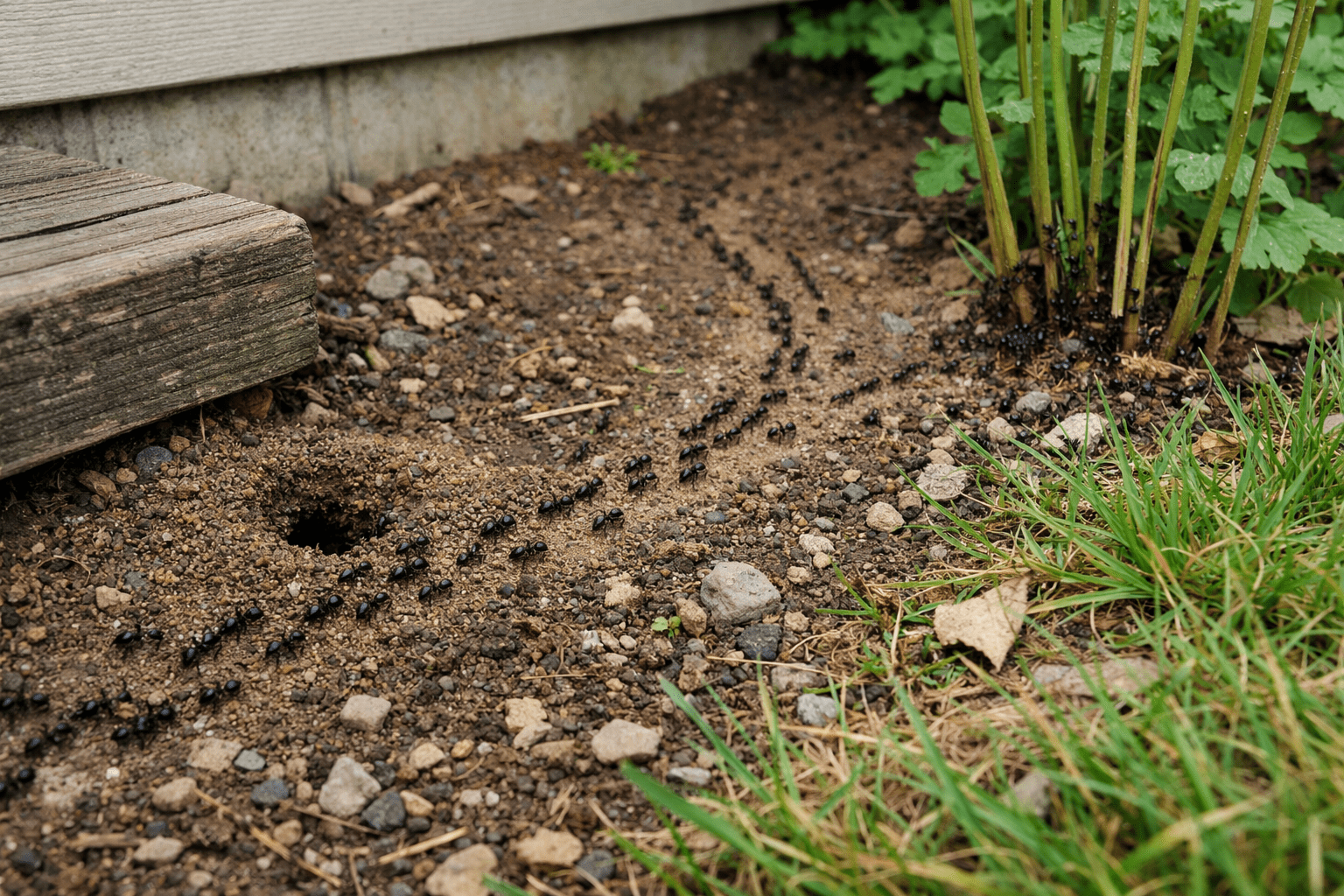
Quick signs a colony is nearby:
\
| What you notice | What it usually means |
|---|---|
| A steady line of ants along baseboards or counters | Active pheromone trail to food or water |
| Soil “volcano” mounds in lawns | Underground nest with excavated soil |
| Winged ants (swarmers/alates) indoors | A mature colony is producing reproductives |
\
Ant colonies as “superorganisms”: why the group acts smarter than the individual
\
If you’ve ever watched ants reroute around a spilled drink or suddenly “discover” a crumb that wasn’t there five minutes ago, it’s tempting to assume someone is in charge. In reality, ant success comes from self-organization. Each ant responds to local information – scent strength, contact with nestmates, temperature, humidity, and food quality. Add thousands of those tiny decisions together and you get something that behaves like a single living system.
\
Many biologists describe an ant colony as a superorganism: the colony functions like a body, and individual ants act like cells. This isn’t just a metaphor. Colonies regulate:
\
- \
- Resource flow (food in, waste out)
- Temperature and humidity in brood chambers
- Defense against predators and rival colonies
- Workforce allocation depending on need
\
\
\
\
\
A key mechanism is pheromone feedback. Foragers lay a chemical trail when they find food. If the food is good, more ants follow and reinforce the trail. When the food runs out, the trail fades and traffic drops.
\
For a reader-friendly mental model, think of it like crowd navigation in a busy store. No manager tells every shopper where to walk. People follow aisles, avoid congestion, and respond to what they see. Ants do a similar thing, except they “see” with chemistry.
\
What “collective intelligence” looks like in real life
\
Try watching a sidewalk trail for 60 seconds. You’ll often see:
\
- \
- Explorers moving irregularly, searching.
- Committed foragers moving fast in straight lines on a trail.
- Recruitment bursts after a new food source appears.
- Rapid rerouting if you wipe a section of trail.
\
\
\
\
\
For a deeper explanation of the superorganism concept, Arizona State University’s education site has a clear overview at the ASU Ask A Biologist superorganism resource.
\
Practical takeaway
\
If you’re dealing with ants indoors, you’re usually seeing the foraging “tip” of a much larger system. That’s why killing a few visible ants rarely solves the issue – the colony simply replaces them.
\
Ant social structure (castes): queen, workers, soldiers, and males
\
\
\
\
Ant colonies: roles, castes, and who does what
\
\
\
\
\
\
Ant Farm Kit – Live Ants Included\
\
\
No Amazon.com listing found for this exact AntsCanada ant farm kit with live ants in the search results, preventing affiliate recommendation. AntsCanada sells starter kits directly on their website starting at $133.74, praised for beautiful formicarium design, but ants ship via USPS in 3-5 weeks.[1][2][3]
\
\
\
\
Check Price on Amazon →\
\
\
\
\
\
\
\
\
\
\
Insect Lore Ants – Live Ants for Ant Farm\
\
\
These live ants can be used to populate an ant farm, providing a practical way for readers to engage with the concepts discussed in the article.
\
\
\
\
Check Price on Amazon →\
\
\
\
\
\
People often picture an ant colony as a tiny kingdom with a commanding queen. The reality is more like a factory that runs on rules and chemistry. Most species have castes – groups with different reproductive roles or body forms. But even when castes exist, ant “jobs” can be flexible.
\
Here’s the basic lineup you’ll see across many common species:
\
| Caste | What they do | What to know |
|---|---|---|
| Queen(s) | Lay eggs, produce colony pheromones | Can live years in many species |
| Workers | Forage, feed larvae, build, clean, defend | Sterile females; backbone of the colony |
| Soldiers (some species) | Defense, guarding entrances | Not present in all ants |
| Males (drones) | Mate during swarms | Short-lived; don’t forage |
\
A mature queen can lay hundreds of eggs per day in some species under good conditions. As the colony grows, the nest becomes more specialized, with chambers for brood, food, and waste. Over time, this structure helps the colony scale from thousands to massive populations.
\
Do queens “rule” the colony?
\
Queens matter, but they don’t micromanage. Workers decide what to do based on:
\
- \
- Age (young workers typically stay inside; older workers forage)
- Contact rates (bumping into nestmates can trigger task switching)
- Pheromone signals (food trails, alarm cues, brood cues)
- Environmental conditions (heat, dryness, flooding, food availability)
\
\
\
\
\
This is why removing a queen doesn’t always cause immediate collapse in every species, and why workers can rapidly reorganize after disturbance.
\
For a plain-language breakdown of colony roles and life stages, the Ant Shack guide to ant colony social structure offers a useful overview, and the broader biology context is summarized well in the ant colony overview on Wikipedia (helpful for terminology, though not a substitute for primary research).
\
Visual checklist: what you might see around your home
\
Use this quick checklist to connect “what you see” to “what’s happening”:
\
- \
- Tiny workers only: active foraging, colony likely established nearby.
- Different sizes of workers: could be a species with worker size variation.
- Very large-headed ants: may indicate soldier-like workers in some species.
- Winged ants indoors: colony maturity and reproductive season.
\
\
\
\
\
Practical takeaway
\
If you’re choosing a control method, match it to the caste you can influence. Sprays may kill workers on contact, but baits are designed to be carried back to the nest and shared, which targets the colony’s core.
\
 \
\\
\
How ants communicate: pheromone trails, touch, and “traffic rules”
\
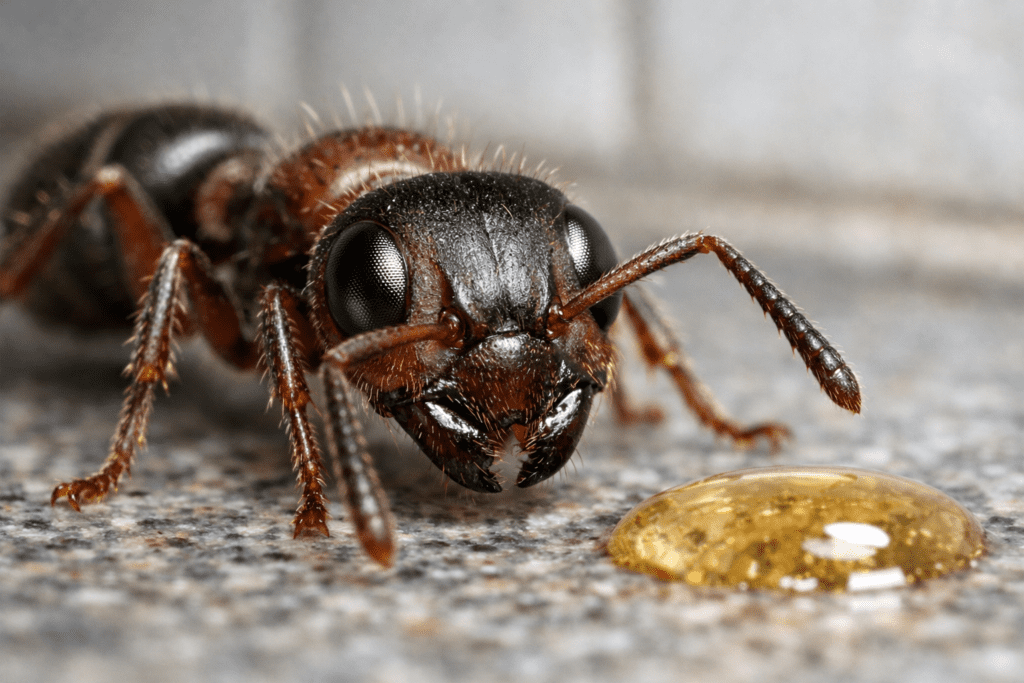
Ants don’t need a map to run a city underground. Their main coordination tool is chemistry. Pheromones are scent signals released from glands and detected by antennae. Different pheromones tell nestmates different things: “food this way,” “danger,” “this is home,” or “care for this brood.”
\
The trail system: why you keep seeing the same line of ants
\
A foraging trail is basically a chemical sidewalk. The more ants walk it, the stronger it becomes. This creates a feedback loop:
\
- \
- A scout finds food and lays a trail back.
- Nestmates follow and reinforce the scent.
- The trail becomes a high-traffic route until the food is gone.
- Without reinforcement, the trail fades.
\
\
\
\
\
That’s why wiping a trail can sometimes “reset” activity for a while – you removed the chemical instructions, not just the ants.
\
Other communication methods ants use
\
Pheromones are the headline, but ants also coordinate through:
\
- \
- Trophallaxis (mouth-to-mouth food sharing), which spreads nutrients and chemical cues
- Touch and antenna tapping, which can transfer information quickly
- Vibration and sound in some species (subtle, but real)
\
\
\
\
Visual: quick ways to disrupt indoor trail-following
\
If you want to reduce ant traffic while you address the source, these steps can help:
\
- \
- Clean the trail line with soap and water to remove scent residue.
- Remove attractants: crumbs, pet food, sticky spills, and standing water.
- Use physical barriers like diatomaceous earth in dry areas (follow label directions).
- Spot-treat entry points after cleaning, not before.
\
\
\
\
\
For readers who prefer low-tox options, InsectoGuide’s roundup of Natural Ant Repellents explains what tends to work, what doesn’t, and where repellents fit in a bigger plan.
\
Practical takeaway
\
Trail disruption is a short-term tactic. Long-term control comes from either removing the food and water the trail leads to, or using a method that reaches the nest.
\
Colony founding and life cycle: from a single queen to thousands of workers
\
Most people only notice ants when workers show up in kitchens or patios. But the colony story starts earlier, often with a brief seasonal event: the nuptial flight. This is when winged males and future queens (alates) leave the nest to mate. Timing varies by species and region, but swarms commonly occur in warm, humid conditions – often spring through late summer.
\
What happens after mating?
\
In many species, a newly mated queen:
\
- \
- Sheds her wings (a strong clue you’re looking at a queen).
- Finds a protected site – soil, under a rock, inside rotting wood, or a wall void.
- Lays her first eggs and raises larvae with stored body reserves.
- Produces the first workers, which then take over foraging and nest expansion.
\
\
\
\
\
Once workers begin feeding the queen regularly, egg production can ramp up dramatically. Over time, nests develop dedicated chambers for brood and food, plus refuse areas that help reduce disease risk.
\
Visual: life stages you can recognize
\
Ants go through complete metamorphosis:
\
- \
- Egg: tiny, white, often in clusters
- Larva: legless, grub-like, fed by workers
- Pupa: may be naked or in a silk cocoon depending on species
- Adult: worker, queen, or male
\
\
\
\
\
If you ever open damp wood or a wall void and see white “rice grains,” you may be looking at brood (larvae or pupae), which usually means the nest is close.
\
When to suspect a structural pest species
\
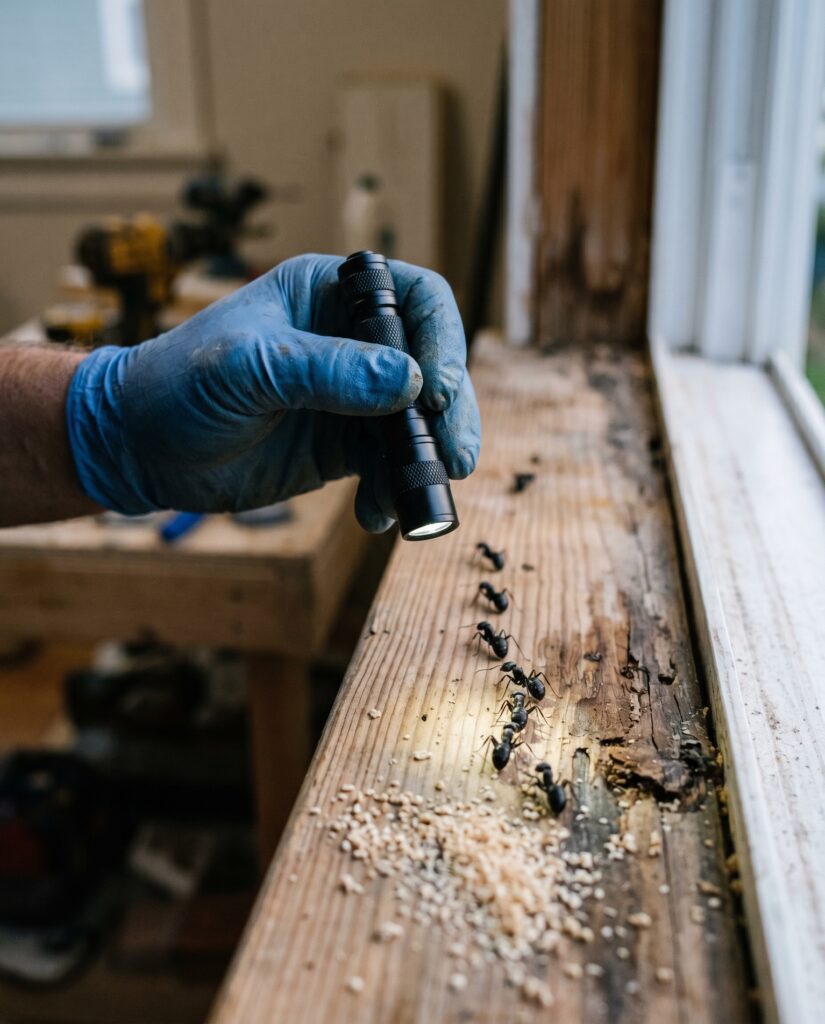
Some ants are more than a nuisance. Carpenter ants don’t eat wood like termites, but they excavate it to nest. If you’re seeing large ants (often 6-13 mm) plus wood shavings or rustling in walls, use a species-specific plan. Start with InsectoGuide’s Carpenter Ant Treatments and Baits guide.
\
Practical takeaway
\
Winged ants indoors often signal a mature colony in or near the structure. If swarms repeat in the same area each year, it’s worth locating the nest or bringing in a professional.
\
 \
\\
\
When ant colonies become pests: practical control that targets the nest
\
Ants play valuable ecological roles outdoors – soil mixing, seed dispersal, and predation on other insects. Problems start when a colony’s foraging overlaps with your living space, or when a species nests in structures, electrical equipment, or high-traffic yard areas.
\
The best approach is integrated pest management (IPM): combine sanitation, exclusion, monitoring, and targeted treatments. Broad spraying often backfires by scattering ants into multiple satellite nests in some species.
\
Step-by-step IPM plan (home-friendly)
\
Use this sequence for most household ant issues:
\
- \
-
Identify the ant type and where they’re going
Follow trails to entry points and food sources. Note whether activity is day or night.\
-
Remove food and water incentives
Store sweets and pet food in sealed containers. Fix leaks and wipe sticky residues.\
-
Seal access points
Caulk cracks, add door sweeps, and seal around pipes where trails enter.\
-
Choose the right control tool
\
- \
- Baits are usually best for colony-level control because workers carry food back.
- Non-repellent treatments can work in wall voids when applied correctly.
- Repellents may reduce activity but can also redirect trails.
\
\
\
\
-
Monitor and adjust for 7-14 days
Expect a temporary increase in activity with baits. That can mean sharing is happening.\
\
\
\
\
\
\
For product selection and bait types, see Best Ant Killers & Baits: Complete Buyer's Guide.
\
Yard colonies: when mounds are the main issue
\
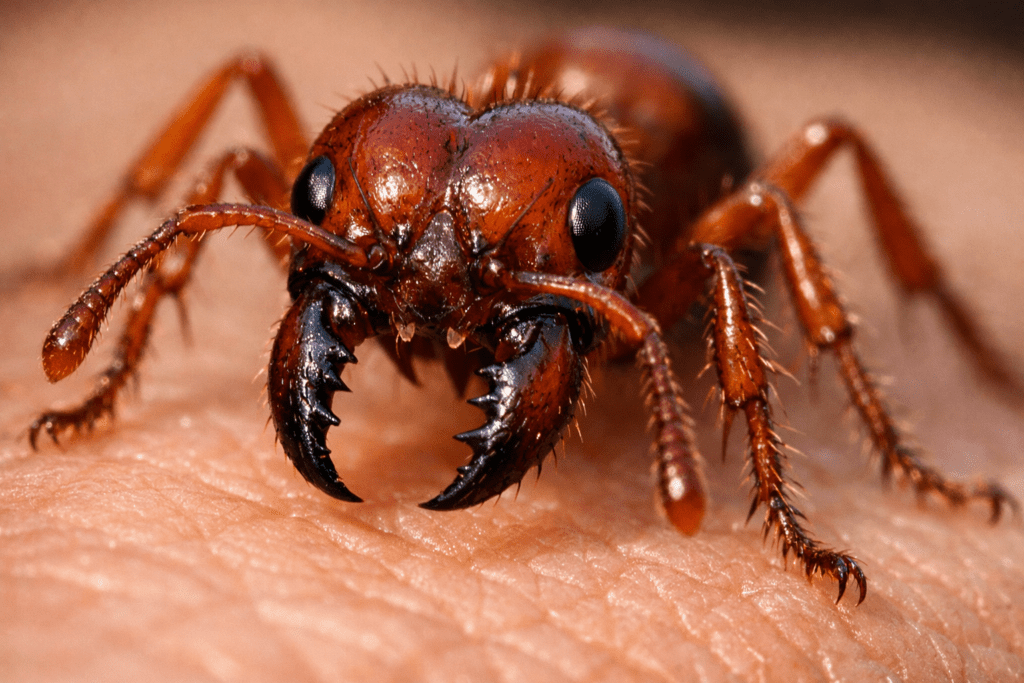
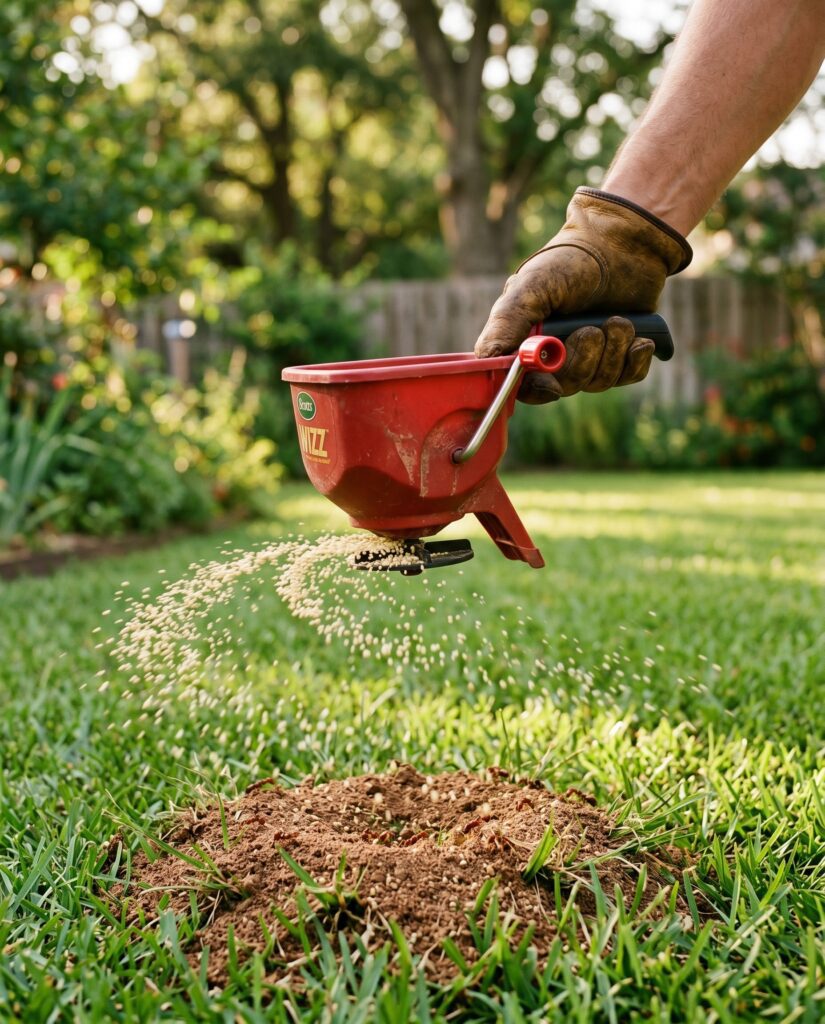
For mound-building species, especially in warm regions, yard treatments may be necessary. Fire ants can sting aggressively when nests are disturbed, and mound control often requires a different strategy than indoor ants. In that case, InsectoGuide’s Fire Ant Killers for Yards guide walks through broadcast baits vs mound drenches.
\
Visual: “Do this, not that” for faster results
\
- \
- Do use slow-acting baits so workers can share it.
- Don’t spray strong repellents right next to bait stations.
- Do clean trails with soap and water before placing baits.
- Don’t ignore moisture problems – many ants track water as much as sugar.
\
\
\
\
\
When to call a pro
\
Consider professional help if:
\
- \
- Ants are nesting in walls, ceilings, or electrical outlets
- You see repeated indoor swarms (winged ants)
- You suspect carpenter ants or can’t locate the nest
- Stinging ants are creating safety risks in the yard
\
\
\
\
\
For general IPM principles used by professionals, the U.S. Environmental Protection Agency’s integrated pest management guidance is a reliable reference.
\
Conclusion: the simplest way to think about ant colonies
\
Ant colonies succeed because simple behaviors – especially pheromone communication and flexible work roles – scale into a system that finds food, raises young, and defends a nest with no central commander. Queens are vital for reproduction, but workers run the day-to-day operation through self-organization. Once you understand that, ant problems make more sense: the line of ants in your kitchen is just the colony’s supply chain at work.
\
Next step: if ants are indoors, start with trail cleanup and sanitation, then choose a bait strategy that targets the nest. For help picking tools, review Best Ant Killers & Baits: Complete Buyer's Guide and, for low-tox options, Natural Ant Repellents.
\
As an Amazon Associate, I earn from qualifying purchases. Product recommendations are based on real reviews and independent research.
Pingback: Pharaoh Ants: Complete Identification & Control Guide