Finding a tick on your dog after a walk is unsettling, especially because ticks can transmit illnesses like Lyme disease, ehrlichiosis, and anaplasmosis. The most reliable tick repellent for dogs is the one that fits your pet’s lifestyle and is used exactly as directed – typically a long-lasting collar, a monthly topical, or (in some cases) a prescription chew paired with good yard habits. This guide compares today’s most common options, explains what “repel” vs “kill” really means, and helps you choose a plan you can stick with all season.
Quick Answer: What’s the best tick repellent for dogs right now?
The best tick repellent for dogs is usually a vet-recommended collar or monthly topical that either repels ticks before they bite or kills them fast after contact.
Here’s a snippet-friendly comparison to choose from:
| Best for | Product type | What to look for | Typical duration |
|---|---|---|---|
| Low-maintenance, long coverage | Collar | Continuous protection; good for most households | Up to ~8 months |
| Dogs that hate collars | Topical drops | “On-contact” action; dose by weight; waterproof after drying | ~30 days |
| Fast spot treatment and bedding | Spray | Useful for hikes, kennels, and touch-ups | Per application |
| Heavy tick pressure (ask your vet) | Prescription chew | Broad tick coverage; convenient dosing | 1-3 months |
Quick safety note: Some tick products for dogs are dangerous to cats (especially permethrin-based topicals). If you have cats at home, read labels carefully and ask your veterinarian.
For tick removal after a bite, keep a dedicated tool on hand – see our guide to Best Tick Removal Tools.
Tick repellent for dogs: How collars, drops, sprays, and chews actually work
Tick prevention can feel confusing because labels use words like “repels,” “kills,” and “prevents” interchangeably. In reality, products fall into two main strategies: repel ticks so they don’t attach, or kill ticks quickly after contact or after they bite. Both approaches can reduce disease risk, but they do it in different ways.
Think of a tick like a tiny climber looking for a warm ledge. Repellents make the “ledge” unpleasant, while killers make the ledge lethal after contact.
Repel vs kill: what matters for disease risk
Ticks transmit pathogens while feeding. The goal is to stop feeding from happening at all, or shorten it dramatically.
- Repellents (often pyrethroid-based topicals or some collars) can reduce tick attachment. This is helpful if you hike often, hunt with your dog, or live in dense tick habitat.
- Fast-killing products (many topicals and oral chews) aim to kill ticks quickly enough that disease transmission becomes less likely.
According to the American Kennel Club’s veterinary-reviewed guidance on flea and tick prevention, consistent use of an appropriate product is the foundation of protection, especially in high-risk regions and seasons like spring through fall.
Why no single product is “perfect” everywhere
Tick species vary by region, and their activity shifts with weather. Black-legged ticks (often called deer ticks), American dog ticks, and lone star ticks do not behave identically. That is why veterinarians often recommend a multi-step approach:
- Use an effective dog product consistently
- Do daily tick checks during peak season
- Reduce tick habitat in your yard and on trails you frequent
If you also need help preventing mosquito bites (another common warm-season issue), compare options in Best Mosquito Repellent for Dogs & Pets.
Quick checklist: pick the right format for your dog
Use this decision list before you buy:
- Does your dog swim weekly? Choose products labeled waterproof after drying; frequent swimming can shorten real-world duration.
- Do you have cats at home? Avoid dog products that can harm cats, and prevent cross-contact until fully dry.
- Is your dog mouthy or a chewer? A collar may get damaged or removed.
- Do you regularly hike in brushy areas? A repellent action can be especially useful.
Best dog tick collars and monthly topicals (what vets recommend and why)
Seresto Flea and Tick Collar for Dogs, 8 Month Flea and Tick Prevention
This collar provides long-lasting protection against ticks, making it a suitable option for dog owners looking for low-maintenance tick prevention.
Most dog owners want two things: strong protection and simple dosing. That’s why collars and monthly drops are so popular – they fit into routines. In product roundups from veterinary-reviewed outlets such as PetMD’s vet-verified flea and tick medication guide, collars and topicals consistently show up as practical first-line options for many households.
Collar option: long-lasting, low-maintenance protection
A widely used example is the Seresto collar, which uses imidacloprid and flumethrin and is designed to provide continuous protection for months. Many veterinarians like collars because owners are less likely to miss a dose compared with monthly schedules.
How to fit a tick collar correctly (fast steps):
- Place collar high on the neck.
- Tighten so you can fit two fingers between collar and neck.
- Trim excess length to reduce chewing risk.
- Wash hands after handling and keep packaging for dosing info.
Best for: busy schedules, multi-dog homes (with supervision), and dogs that tolerate collars well.
Watch-outs: collar damage, chewing, and close-contact households where kids handle the collar frequently.
Topical drops: strong coverage for dogs that hate collars
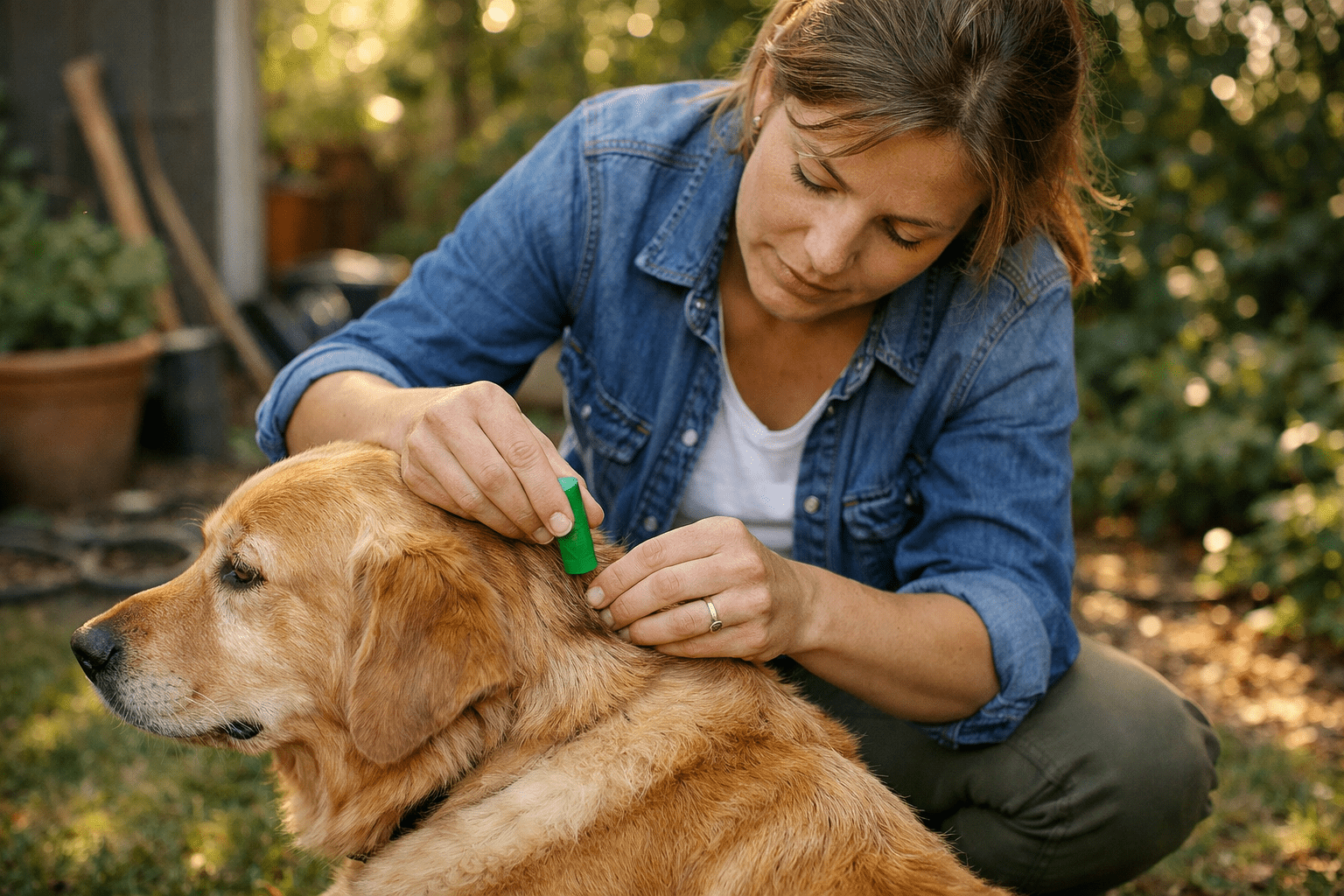
Monthly topicals are applied to the skin (not just the fur), typically between the shoulder blades and along the back. Examples often compared include fipronil-based products and combination formulas that add repellent activity.
How to apply topical tick prevention drops properly:
- Part the fur until you see skin
- Apply in 3 to 4 small spots along the upper back for larger dogs (follow label)
- Prevent bathing or swimming for about 48 hours (or per label) so it can spread in skin oils
- Dose strictly by weight range
Best for: collar-averse dogs, households that prefer non-oral options.
Watch-outs: incorrect placement, bathing too soon, and cat safety (some dog topicals are toxic to cats).
Mini comparison chart: collar vs topical
| Feature | Collar | Topical drops |
|---|---|---|
| Dosing | Set it and check it | Monthly schedule |
| Water exposure | Often water-resistant | Usually waterproof after drying |
| Household handling | Collar contact is frequent | Contact mainly right after application |
| Common failure point | Chewed/lost collar | Missed dose or applied to fur |

Internal tip: If you’re the type to forget monthly dates, set a phone reminder or choose a longer-duration option. Consistency matters more than brand hopping.
Dog tick spray: when it helps and when it disappoints
Frontline Plus Flea and Tick Treatment for Dogs, 3 Doses
Frontline Plus for Dogs (3 Doses) earns a solid 4.6/5 rating from over 12,400 Amazon reviews for its proven efficacy against fleas and ticks, lasting a full month per application. While generally reliable, beware of potential counterfeits on Amazon – reviewers note occasional irritation but laud its quick action. At ~$33, it’s pricier than generics, making it best for pet owners prioritizing brand trust over cost.
NexGard Chewables for Dogs, 3 Chews
NexGard Chewables for Dogs provide effective, vet-recommended monthly protection against fleas and ticks with fast kill times (fleas in 4 hours, ticks in 8 hours), beef-flavored palatability preferred by dogs, and dosing for puppies 8 weeks+ and 4 lbs+; however, as a prescription product, consult a vet, and no Amazon-specific data like ASIN, ratings, or price was found in available sources.
Sprays can be very useful, but they are often misunderstood. Many owners buy a spray expecting it to replace a collar or monthly topical. In most real homes, sprays work best as support, not the entire plan.
When a tick spray makes sense
A dog tick spray is most helpful in three scenarios:
- Before and after hikes: extra coverage on legs, belly, and chest (avoid eyes and mouth)
- Spot treatment: when you find ticks crawling but not attached
- Bedding and kennel support: especially during peak tick season
Some sprays use conventional insecticides (like fipronil-based formulas), while others rely on plant oils. Outdoor publications such as Field and Stream’s flea and tick prevention roundup often list both types, but they serve different needs.
Plant-oil “natural” sprays: set expectations
Plant-based sprays can provide short-term repellency for some dogs, but they typically do not match the duration or kill reliability of long-lasting collars and monthly topicals. If you choose a botanical spray, treat it like sunscreen – you may need to reapply, especially after water exposure.
Practical rule: If your dog is in a high-tick region or frequently in tall grass, rely on a proven primary product first. Use sprays as a backup layer.
Spray application checklist (safe and effective)
- Spray onto hands first for face and ears, then rub gently (avoid eyes, nose, mouth)
- Focus on tick “climb zones”: legs, belly, chest, and neck
- Treat bedding and crates if the label allows it
- Reapply after swimming or heavy rain if directions recommend
Quick “spray vs primary prevention” table
| Goal | Spray alone | Spray + collar/topical |
|---|---|---|
| Day-to-day protection | Unreliable | Strong |
| Hiking days | Helpful | Best option |
| Heavy tick pressure | Not enough | Better coverage |
| Owner consistency | Easy to skip | More forgiving |
For human protection on the same hikes, compare what works (and what doesn’t) in Best Tick Repellents for Humans: DEET, Picaridin & Permethrin.
Prescription chewables and combination strategies (when to ask your vet)
Adams Plus Flea and Tick Spray for Dogs and Cats, 16 oz
Insufficient data from search results to confirm Amazon listing, ratings, reviews, or price; product description from third-party retailer indicates it kills fleas, ticks, mosquitoes, eggs, and larvae with IGR for up to 2 weeks on pets and surfaces, but no Amazon-specific or third-party testing info available for recommendation.[1]
Some dogs do best with prescription oral preventives, especially when ticks are intense, the dog swims constantly, or topicals irritate the skin. Isoxazoline-class chewables (often dosed monthly or every few months depending on product) are widely used in veterinary practice.
Veterinary resources like PetMD’s vet-verified medication overview explain why many clinics recommend these products for broad tick coverage and owner convenience.
When oral prevention is a strong fit
Consider asking your veterinarian about prescription options if:
- Your dog swims frequently and topicals don’t last
- You struggle with monthly application routines
- Your dog has a history of skin sensitivity to topicals
- You live in a region with long tick seasons (mild winters)
Combine product + environment for better results
No single product controls every tick in every setting. Entomologists and veterinarians often emphasize pairing pet protection with habitat management.
Simple yard steps that reduce tick encounters:
- Mow regularly and keep grass short
- Remove leaf litter and brush piles near play areas
- Create a 3-foot barrier of gravel or wood chips between lawn and woods
- Keep wildlife attractants (like open compost) secured
For broader integrated pest management guidance, the EPA’s pesticide safety and pet guidance is a reliable place to check label basics and safety reminders.
Quick “ask your vet” list before switching products
Bring these details to your appointment:
- Dog’s weight, age, and any health conditions
- Tick exposure level (woods, hunting, daycare, travel)
- Cats or small children in the home
- Any prior reactions to flea/tick products
If you find attached ticks often despite prevention, it may signal missed doses, incorrect application, or unusually high exposure. That’s the moment to reassess the plan rather than simply changing brands at random.
Tick season habits that make any product work better (plus common myths)
Even the best product performs better when your daily habits reduce tick contact. This is especially true in spring and early summer, when smaller life stages can be easy to miss.
Daily tick check: where to look (60 seconds)
Ticks prefer hidden, warm, protected areas. Check:
- Around ears and under the collar
- Between toes and around paw pads
- Armpits, groin, and belly
- Base of tail and under tail
- Around eyes (carefully)
If you’re unsure whether a mark is a tick bite or something else, our visual comparison guide Mosquito Bites vs Bed Bugs, Fleas, Spiders & Ticks helps you sort look-alikes.
Myth-busting: what dog owners get wrong
Myth: “Natural repellents work just as well as conventional products.”
Reality: Many plant-oil options may repel for short periods, but they often lack the long-duration performance of collars and monthly drops.
Myth: “One application lasts all year.”
Reality: Most topicals require monthly reapplication. Collars last longer but can fail if lost or damaged.
Myth: “Dog and cat flea/tick products are interchangeable.”
Reality: Some dog products (notably permethrin-containing formulas) can be dangerous to cats. Keep cats away from treated dogs until the product is fully dry, and never use dog-only products on cats.
Myth: “Swimming ruins all tick protection.”
Reality: Many products are water-resistant or waterproof after drying, but frequent swimming can reduce real-world duration. Check the label and your dog’s exposure.
Quick action list: if you find a tick anyway
- Remove it promptly with fine-tipped tweezers or a tick tool
- Clean the bite site and wash hands
- Watch for unusual lethargy, fever, lameness, or appetite changes
- Save the tick in a sealed container if your vet wants identification
For tools and technique, revisit Best Tick Removal Tools and keep one in your car or hiking kit.
Conclusion: A simple plan that keeps ticks off your dog
For most households, the best tick repellent for dogs is a reliable collar or monthly topical used consistently, supported by quick tick checks and basic yard maintenance. Sprays can help on hiking days and for bedding, while prescription chewables are worth discussing with your veterinarian if exposure is heavy or routines are hard to maintain.
Next step: pick one primary prevention method you can follow without fail, then add a 60-second daily tick check during peak season. For warm-weather outings, pair your dog plan with Best Mosquito Repellent for Dogs & Pets and keep the human side covered with Best Tick Repellents for Humans: DEET, Picaridin & Permethrin.
As an Amazon Associate, I earn from qualifying purchases. Product recommendations are based on real reviews and independent research.