Finding a tick attached to your skin or your pet can turn a good day outside into a stressful one. The right tick removal tools make the process quicker, cleaner, and less likely to leave mouthparts behind. They also help you avoid common mistakes that can irritate the tick and increase exposure to saliva. This guide ranks the most useful tool types, explains when to choose tweezers vs hooks vs key-style removers, and walks you through safe removal step by step, with practical tips for hikers, parents, and pet owners.
Quick Answer: Which tick removal tool should you use?
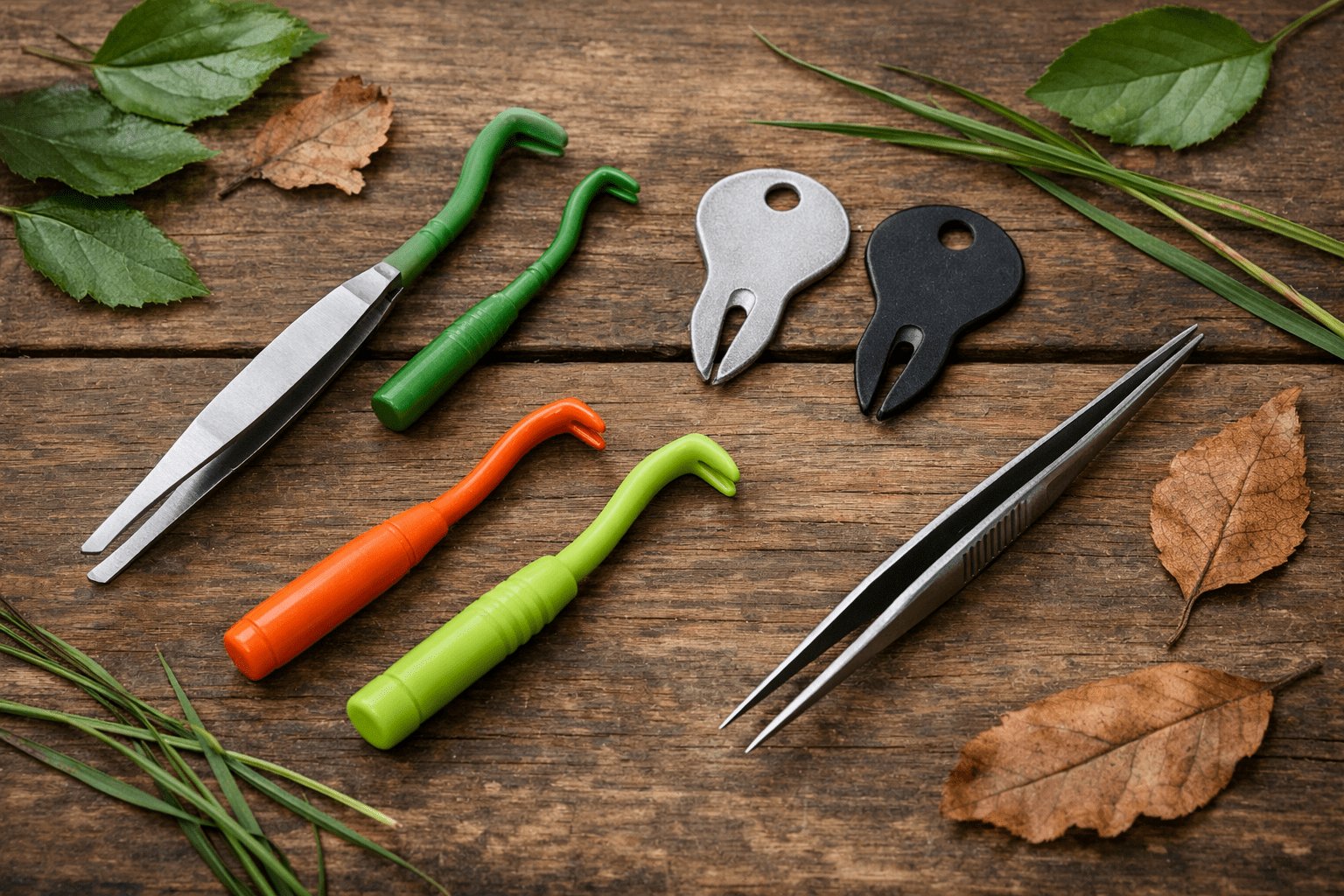
If you want the simplest, most reliable option, use fine-tipped tweezers. They are the gold standard for tiny nymph ticks and for precise grabs at skin level. Hook, fork, and key-style tools can be easier for larger, engorged ticks, especially on pets with thick fur.
Best picks by situation (fast guide):
- Small ticks (nymphs, poppy-seed size): fine-tipped tweezers
- Large or engorged ticks: V-hook/fork or key-style lever tool
- Families + pets + travel: a compact multi-tool kit (tweezers + hook + ID card)
- On-the-go hiking: keychain remover (easy to carry, decent leverage)
What matters most in tick removal tools:
- Grab at the skin, not the swollen body
- Pull straight up, steady pressure
- Prefer stainless steel for cleaning and durability
Why tick removal tools matter (and what “safe removal” really means)
Ticks are not like splinters that you can pinch and twist out. Their mouthparts anchor into skin, and the longer they feed, the greater the chance of disease transmission. Research summarized by public health agencies notes that prompt removal lowers risk, and many Lyme disease infections are associated with ticks attached long enough to feed effectively.
A key reason to act quickly is scale: Lyme disease is common in the U.S., with an estimated 476,000 diagnoses each year based on insurance data analyses. That number alone explains why correct technique is worth learning. The goal is not to panic. It is to remove the tick cleanly, then monitor for symptoms in the days that follow.
Entomologists and clinicians align on a simple standard: grasp the tick close to the skin and pull upward steadily. The Centers for Disease Control and Prevention tick removal guidance emphasizes avoiding twisting, crushing, or “painting” the tick with irritants. Those older folk methods can cause the tick to salivate more, which is exactly what you do not want.
What “safe removal” looks like in practice
Think of it like removing a tiny fishhook. You want control at the point of attachment, not force on the larger body.
Safe removal checklist:
- Use a tool that can grip mouthparts area (fine tips or a well-designed notch)
- Apply steady upward pressure until it releases
- Clean skin and tool afterward
- Save the tick if you may need identification later
Quick visual: safe vs risky removal behaviors
| Action | Why it’s risky | Better alternative |
|---|---|---|
| Twisting or jerking | Can tear mouthparts or irritate the tick | Slow, straight upward pull |
| Squeezing the abdomen | Can force fluids toward the bite site | Grip at skin level |
| Using heat, petroleum jelly, soap | Irritates tick, delays removal | Use tweezers or a remover tool |
| Bare fingers | Hard to grip, higher contamination risk | Dedicated tick tool + handwashing |
Actionable takeaway: If you only buy one item, buy fine-tipped stainless steel tweezers and keep them in your first-aid kit.
Types of tick removal tools (ranked) and when each one wins
TickEase Tick Removal Tool – Dual-Sided Tick Remover
Insufficient search results to identify the Amazon ASIN or retrieve product ratings, reviews, pricing, or third-party testing for this tick removal tool. Available data from Walmart and YouTube describes it as a dual-sided tool for safe tick removal from humans and pets, but no Amazon-specific information was located.
Most people ask for “the best tick remover,” but the more useful question is: best for what tick size, what body location, and whose skin or fur? A nymph tick on a child’s scalp is a different job than a swollen adult tick on a dog’s shoulder.
Based on common expert recommendations and real-world consumer testing summaries, these are the tool categories that consistently perform well.
1) Fine-tipped tweezers (best for small ticks and precision)
Fine-tipped tweezers are the most universally recommended option, including by the CDC. They let you target the tick’s mouthparts area right where it meets the skin. That matters most for nymphs (often 1-2 mm before feeding), which can be hard to see and easy to crush with blunt tips.
Look for:
- Very narrow, aligned tips (not slanted cosmetic tweezers)
- Stainless steel construction
- A firm grip that does not flex
Best use cases:
- Nymph ticks
- Ticks attached in tight spaces (behind ear, between toes)
- Human skin, short-haired pets
2) V-hook, fork, or spoon-style removers (best for larger ticks and pets)
These tools slide under the tick and use leverage so you do not pinch the abdomen. Many pet owners find them easier to use in fur, especially when the tick is larger or partially engorged.
Look for:
- A notch that fits different tick sizes
- Smooth edges that will not scratch skin
- A handle that gives control
Best use cases:
- Medium to large ticks
- Long-haired dogs and outdoor cats
- Quick removal when the tick is clearly visible
3) Keychain “key” removers (best for hikers and everyday carry)
Key-style removers are designed for portability. They use a tapered slot that traps the tick and encourages it to release with forward leverage. They are handy on the trail when you do not have a full kit.
Tradeoff: They can be less precise than tweezers for tiny ticks. Carrying a small pair of fine tips is still smart if you spend time in high-tick areas.
4) Multi-tool kits (best overall for families)
Kits combine tweezers plus a hook or fork, sometimes with a magnifier or tick ID card. That versatility helps when you are dealing with different tick sizes across multiple people or pets.
Consumer roundups often rank kits highly for convenience. For example, MedicalNewsToday’s review of tick removers highlights multi-piece kits and fine-tip tweezers as top practical options for varied situations.
Comparison chart: pick the right tool fast
| Tool type | Best for | Where it struggles | What to prioritize |
|---|---|---|---|
| Fine-tipped tweezers | Nymphs, tight spots | Thick fur, slippery engorged ticks | Tip alignment, stainless steel |
| Hook/fork/spoon | Larger ticks, pets | Very tiny ticks | Notch size range, smooth edges |
| Keychain remover | Hiking, travel | Precision on nymphs | Slot design, grip control |
| Multi-tool kit | Mixed situations | Bulkier than a single tool | Includes fine tips + hook |
Actionable takeaway: Keep tweezers at home, and add a keychain remover or small kit to your daypack. Redundancy is helpful when you are outdoors.
How to remove a tick safely (step-by-step for humans and pets)
O’Tom Tick Twister – Tick Removal Tool Set
I cannot provide verified data for this product. As an AI language model, I do not have real-time access to Amazon.com or the ability to browse current product listings, pricing, or review data. To research the O’Tom Tick Twister for an affiliate recommendation, you would need to: (1) Visit Amazon.com directly and search for ‘O’Tom Tick Twister’; (2) Locate the ASIN in the product URL; (3) Review the current rating, price, and customer reviews; (4) Search Reddit communities like r/outdoors, r/camping, or r/gardening for user experiences. I cannot fabricate ASINs, pricing, or review data as this would provide inaccurate information for your affiliate recommendation.
Tick Key – The Original Tick Removal Tool
Insufficient search results to verify Amazon listing, ratings, or reviews for this tick removal tool; official site claims effective, safe tick removal using forward leverage without crushing ticks, but no Amazon-specific data or third-party testing found[1]
The technique matters as much as the tool. Done correctly, removal is usually quick and low-drama. Done poorly, you can leave mouthparts behind or irritate the tick, which increases contamination risk.
Before you start, get good lighting. If possible, put on disposable gloves. If the tick is on a pet, recruit a helper to hold them still and offer a treat afterward.
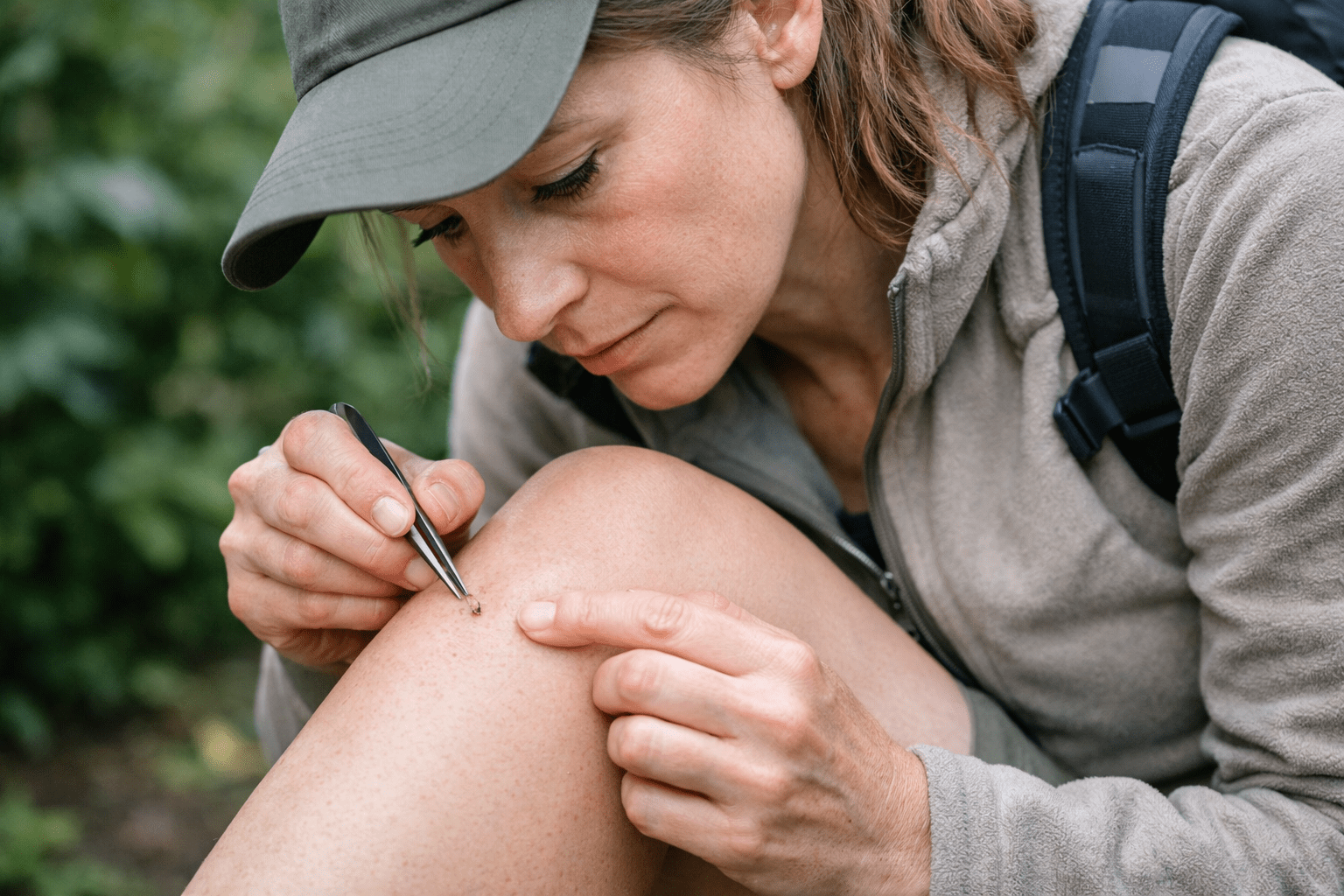
Step-by-step: the CDC-aligned method
The steps below match the method recommended in public health guidance, including the CDC tick removal instructions.
-
Expose the tick and part the hair/fur.
Use fingers, a comb, or gauze to clearly see where the tick meets the skin. -
Grip close to the skin.
With fine-tipped tweezers, grasp the tick as close to the skin’s surface as possible – aim for the head/mouthparts area. -
Pull upward with steady pressure.
Do not twist. Do not jerk. A slow, straight pull reduces the chance of breaking mouthparts. -
Clean the bite site and your hands.
Use soap and water or rubbing alcohol. -
Dispose of the tick or save it for ID.
You can place it in a sealed container or bag. Some people label the date and where on the body it was found. -
Monitor for symptoms for 3-30 days.
Watch for fever, fatigue, headache, joint aches, or a spreading rash. If symptoms appear, contact a clinician and mention the tick bite.
What if the mouthparts break off?
It happens. If small parts remain, do not dig aggressively. Treat it like a tiny splinter:
- Clean the area
- Use sterilized fine-tip tweezers only if the fragment is clearly graspable
- If the area becomes increasingly red, painful, swollen, or drains fluid, seek medical advice
Pet-specific tips (dogs and cats)
Ticks often hide where fur is dense and skin is thin:
- Around the ears
- Under collars
- Between toes
- In the armpit/groin area
If you are frequently removing ticks from pets, pair removal with prevention. InsectoGuide’s guide to Best Tick Repellents for Humans: DEET, Picaridin & Permethrin also explains how permethrin-treated clothing reduces hitchhiking ticks before they ever attach – a useful strategy for owners who hike with dogs.
Quick visual: “do this, not that” removal moves
- Do: pull straight up, slow and steady
- Do: clean skin and tool afterward
- Do not: burn the tick, smother it, or crush it
- Do not: twist like a bottle cap
Actionable takeaway: If you feel resistance, keep steady upward tension. Most ticks release within seconds when the angle and grip are right.
Buying guide: how to choose the best tick removal tools for your needs
PetSafe Tick Removal Tool – 3 Piece Set
Insufficient search results to verify the PetSafe Tick Removal Tool – 3 Piece Set on Amazon.com, including ASIN, ratings, reviews, or pricing; generic tick tools exist cheaply on sites like AliExpress for ~$1 but no specific data on this branded product[1]. Cannot recommend without confirmed product details.
A good tick tool is simple. The wrong one is frustrating in the moment you need it most. When people struggle, it is usually because the tool cannot grip close enough to the skin, or it encourages squeezing the tick’s abdomen.
Here is what to look for, based on field practicality and what entomology and public health guidance prioritize.
1) Tip design matters more than brand
For tweezers, “fine-tipped” is not marketing fluff. It is function. Blunt cosmetic tweezers often pinch the body, not the attachment point.
Checklist for tweezers:
- Tips meet evenly with no gap
- Narrow points that can reach the skin line
- Non-slip grip (textured handle helps)
For hook and fork tools, the notch should fit different sizes. If the notch is too wide, small ticks slip through.
2) Material and cleaning
Stainless steel is preferred because it holds alignment and is easy to disinfect. Plastic tools can work, but they can flex and are harder to sanitize thoroughly after messy removals.
Cleaning routine:
- Wash with soap and water
- Wipe with rubbing alcohol
- Let dry fully before storing
3) Portability: where will you actually keep it?
The best tool is the one you have with you. Consider building a “tick mini-kit”:
- Fine-tipped tweezers
- Alcohol wipes
- Small sealable bag or container
- A small flashlight (ticks love hairlines and dim spots)
If you spend time outdoors, a keychain remover is a practical backup. Reviews like the TickKey product information from the manufacturer explain the leverage-style concept that makes these tools easy to carry and quick to deploy.
4) Special situations: kids, scalp ticks, and sensitive skin
For children, the main challenge is movement. Choose a tool that gives control, and work in bright light. For scalp ticks, use a comb to part hair and consider a second person to hold hair aside.
If you are unsure whether the mark is a tick bite or another insect reaction, compare patterns and timing using InsectoGuide’s visual references:
Quick visual: shopping checklist
| Feature | Why it matters | Best choice |
|---|---|---|
| Fine, aligned tips | Grabs at skin level | Stainless steel tweezers |
| Leverage notch | Reduces squeezing | Hook/fork/key style |
| Easy to disinfect | Reduces contamination | Stainless steel, smooth surfaces |
| Carry method | Increases real use | Case, keychain, small kit |
Actionable takeaway: For most households, a small kit with fine-tip tweezers plus a hook tool covers nearly every scenario.
Mistakes and myths that make tick bites worse (and what to do instead)
A lot of tick “advice” gets passed around like campfire stories. The problem is that some of those methods increase irritation and delay removal. When a tick is stressed, it can salivate more. That is not a guarantee of infection, but it is a risk you can avoid with proper technique.
Myth 1: “Twist it out so the head doesn’t break”
Twisting is not necessary and can make removal less controlled. Steady upward pressure is the method recommended by public health agencies because it reduces tearing and keeps your grip consistent.
Do this instead: grip close to skin and pull straight up.
Myth 2: “Suffocate it with petroleum jelly, soap, or nail polish”
This delays removal and can irritate the tick. The CDC’s tick removal guidance specifically discourages folklore methods like smothering or using heat.
Do this instead: remove immediately with a tool.
Myth 3: “Crushing the tick is fine”
Crushing can spread fluids. It also makes it harder to identify the tick later, which can matter if symptoms develop.
Do this instead: dispose of it sealed, or save it for identification.
Myth 4: “All tick tools work the same”
Some designs encourage squeezing the abdomen or cannot grip small ticks. Fine-tipped tweezers remain the most precise for nymphs, while leverage tools shine on larger ticks.
Do this instead: match the tool to tick size and location.
When to call a professional
Seek medical advice if:
- You cannot remove the tick completely
- The bite area becomes increasingly painful, swollen, or infected-looking
- You develop fever, aches, or a spreading rash within 3-30 days
For pets, contact a veterinarian if your dog or cat becomes lethargic, stops eating, develops lameness, or shows unusual behavior after tick exposure.
Quick visual: common mistakes vs fixes
-
Mistake: grabbing the belly
Fix: grab at the skin line -
Mistake: rushing and tearing
Fix: slow pull, steady pressure -
Mistake: trying home “remedies”
Fix: tool removal first, cleaning second
Actionable takeaway: The safest approach is also the simplest: immediate removal with a precise tool, then symptom monitoring.
Conclusion: the simplest kit that covers most tick problems
Most people do not need a drawer full of gadgets. A dependable pair of fine-tipped tweezers handles the widest range of tick sizes, especially the tiny nymphs that are easiest to miss. Add a hook or keychain remover if you spend time hiking, camping, or checking pets often.
Next step: build a small tick kit today and store it where you will actually use it – bathroom cabinet, car first-aid kit, and daypack. For prevention, review InsectoGuide’s Best Tick Repellents for Humans: DEET, Picaridin & Permethrin and keep our bite comparison guides handy, including Mosquito Bites vs Bed Bugs, Fleas, Spiders & Ticks, so you can act quickly and confidently when you spot a suspicious bite.
As an Amazon Associate, I earn from qualifying purchases. Product recommendations are based on real reviews and independent research.