
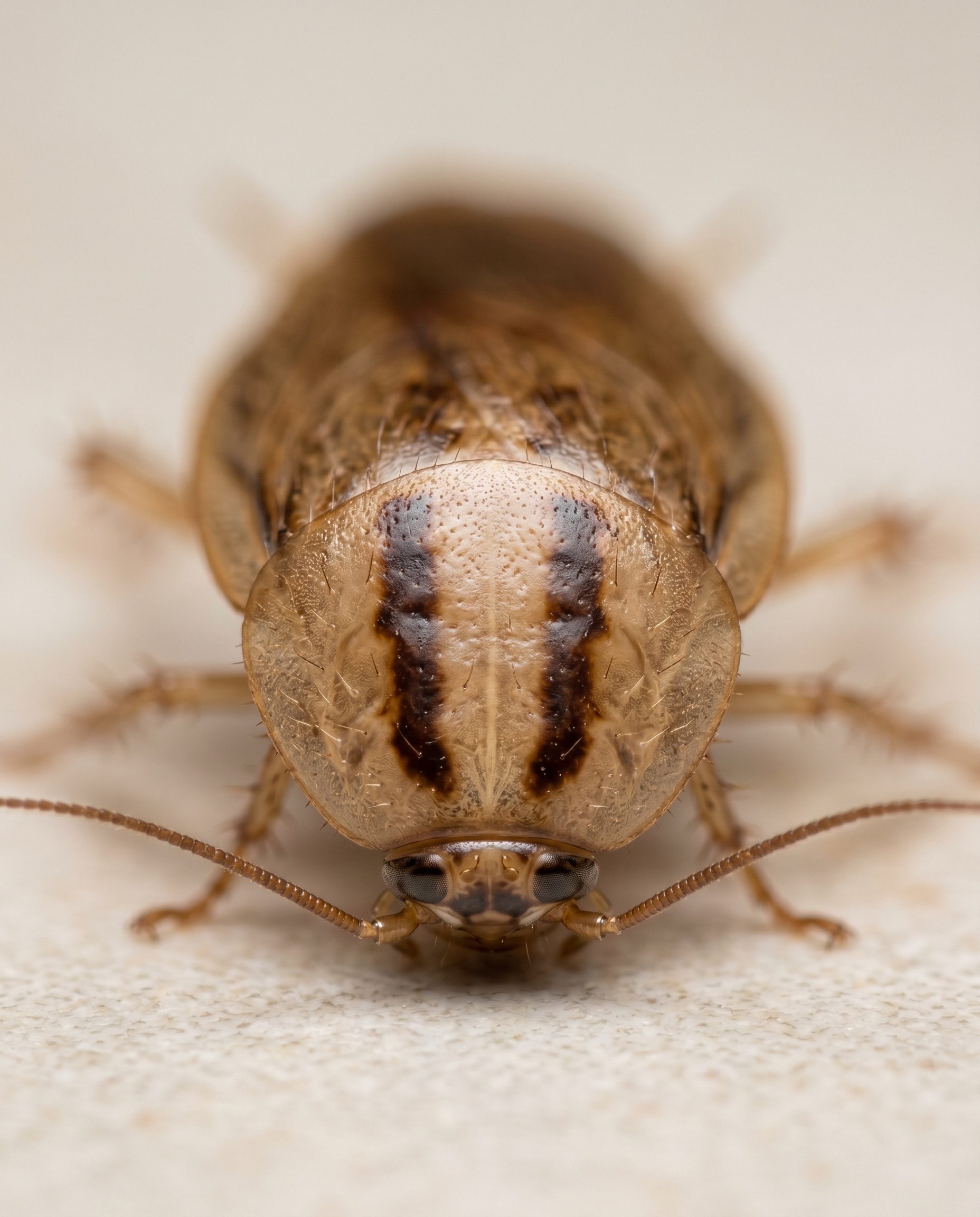
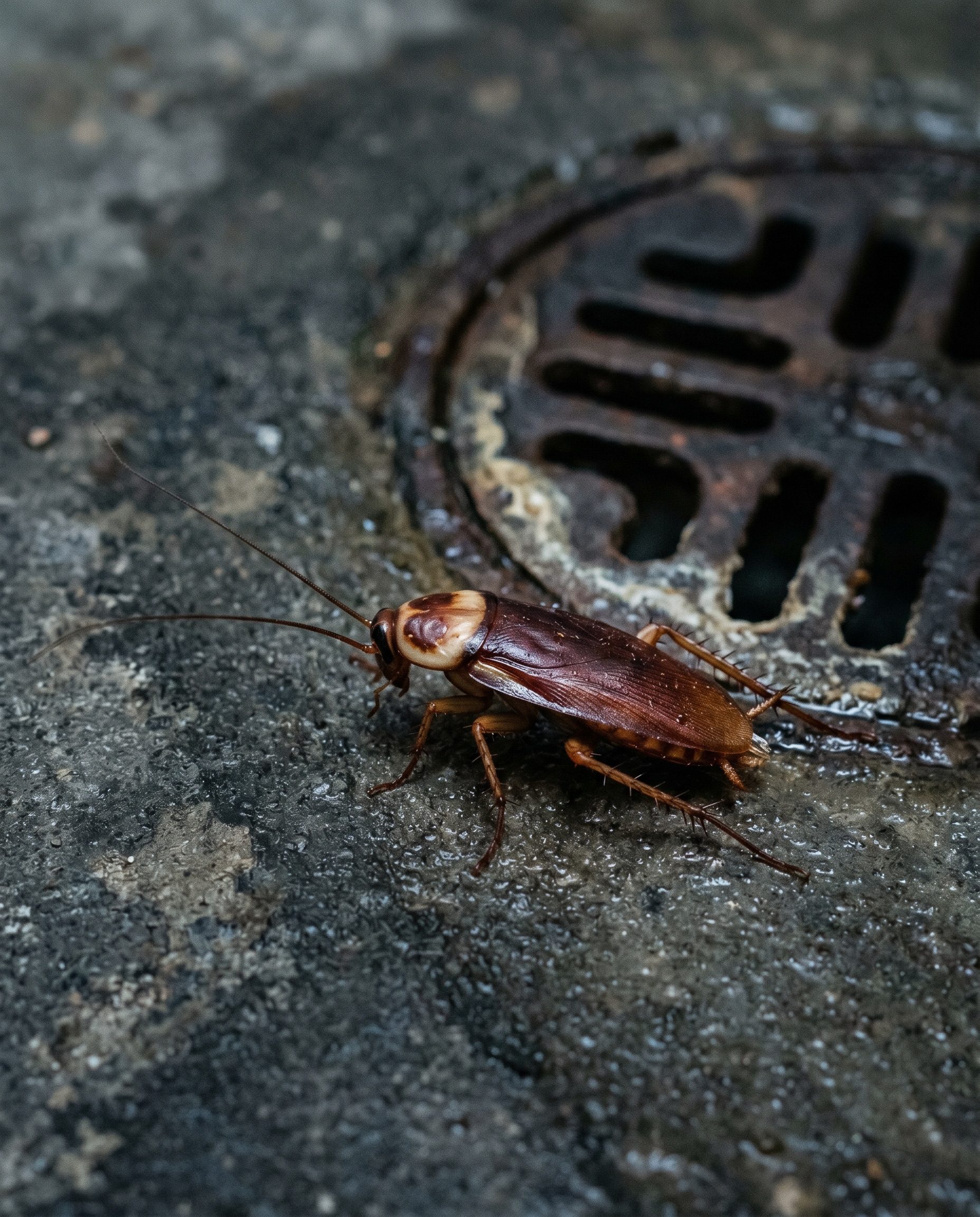
You found a cockroach and you want to know which one it is, because the answer decides what you do next. Here is the fast version. Look at the shield right behind the head. Two dark parallel stripes running back from the head means a German cockroach, a small tan insect about half an inch long that lives and breeds indoors. A big reddish-brown roach an inch and a half long with a pale yellow ring around that shield is an American cockroach, which mostly lives in sewers, drains, and basements and wanders in from outside. Same family, very different problem.
Two parallel stripes on the shield means German; a pale ring plus a big body means American. That one mark splits the fix: a German roach you bait at the source indoors, an American roach you stop at the drain.
- German: small, tan, two dark stripes, half an inch, breeds indoors in kitchens and bathrooms
- American: large, reddish-brown, yellow ring, 1.5 inches, comes in from sewers and drains
- Why it matters: one is an indoor breeding problem, the other is an outdoor pest you keep out
Tell them apart
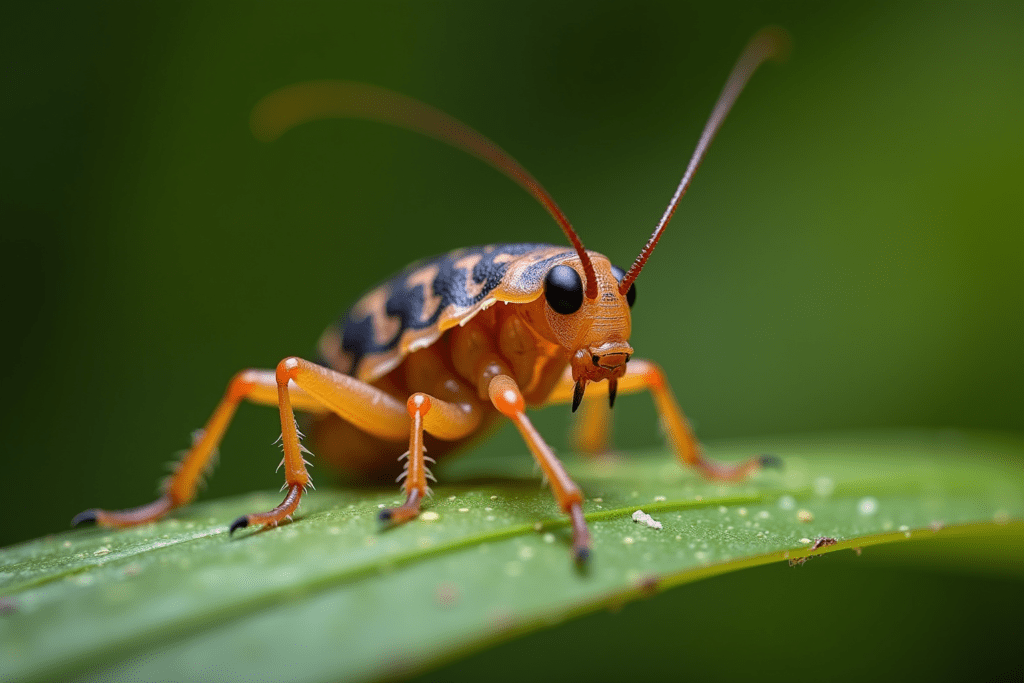
If you only check one thing, check the pronotum, the smooth shield-shaped plate covering the area just behind the head. On a German cockroach it carries two dark parallel stripes that run lengthwise toward the wings. On an American cockroach there are no stripes; instead the edge of that shield is rimmed with a pale yellow or tan band. You can read this difference on a roach standing still without measuring anything.
Size confirms it from across the room. The German cockroach is small, the American cockroach is one of the largest roaches you will ever find in a US home. Once you pair the shield mark with the body size, you almost never need anything else. Color, wings, and antennae are supporting evidence, not the deciding feature.
The fastest tell
The pronotum mark is the tell because it is visible, stable, and species-specific, while the features people reach for first are not. Color is the classic trap. Both species are brownish, lighting shifts the tone, and a young nymph looks darker than an adult, so “reddish versus tan” misleads people constantly. The stripes either are there or they are not.
The University of Florida describes the German cockroach as brown with two distinct parallel bands running the length of the pronotum, in their Featured Creatures profile of the German cockroach. The same program describes the American cockroach as reddish-brown with a pale brown or yellow band around the edge of the pronotum in its Featured Creatures profile of the American cockroach. Two stripes down the middle versus one ring around the rim is the cleanest contrast in the whole comparison.
Size is the backup. A German cockroach (*Blattella germanica*) runs about 10 to 15 mm, a bit over a third of an inch. An American cockroach (*Periplaneta americana*) reaches roughly 1.5 inches, two to three times longer. If the roach is clearly large, it is not German, full stop, and you can skip straight to the drain-and-exclusion approach.
Size and color at a glance
Here is the side-by-side once you have a roach in view. Read the shield first, then confirm with size.
| Feature | German cockroach | American cockroach |
|—|—|—|
| The fast tell | Two dark stripes on the shield | Pale yellow ring around the shield |
| Size | About 0.5 in (10-15 mm) | About 1.5-2 in |
| Color | Light brown to tan | Reddish-brown |
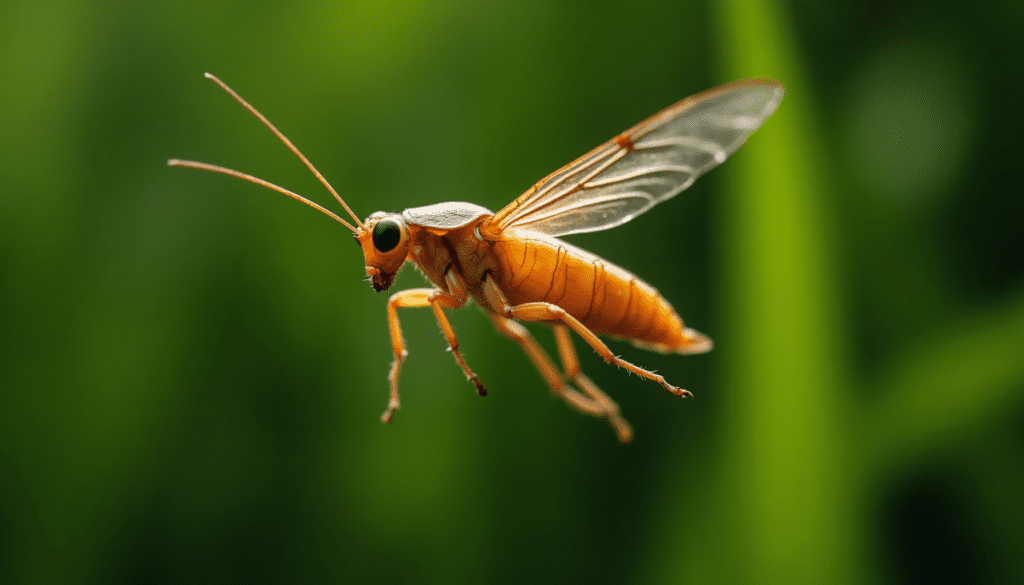
| Flight | Has wings, rarely flies | Glides, seldom true flight |
| Where you find it | Kitchens, bathrooms, indoors | Sewers, drains, basements, outdoors |
| What it means | Indoor breeding problem | Outdoor wanderer coming in |
If your roach has more than three features that do not fit either column, you may be looking at a third species such as the Oriental or brownbanded cockroach, and the broader guide to identifying and controlling cockroaches covers those look-alikes.
About the German cockroach
The German cockroach is the small tan roach that turns up in kitchens and bathrooms, and it is the one entomologists worry about most because it lives its whole life indoors. It does not need to come in from outside; a few hitchhikers in a grocery bag or a used appliance can seed a population. It favors warm, humid, tight spaces near food and water, which is why you see it around the stove, the sink, and the dishwasher rather than the basement.
Its reproductive math is what makes a small sighting a real problem. Each female carries an egg case, called an ootheca, holding 30 to 40 eggs, per the UF profile, and she produces several in a lifetime while protecting the case until it is nearly ready to hatch. That protected breeding is why catching a couple on the counter usually means many more in the crevices nearby.
Color on this species is genuinely variable between nymphs and adults, so do not lean on it. The two stripes hold across life stages, which is exactly why they are the feature to trust.
About the American cockroach
The American cockroach is the big reddish-brown roach, sometimes called a water bug or palmetto bug, and despite the name it is most at home in damp, dark, warm places rather than your pantry. The University of Florida lists its haunts as basements, sewers, steam tunnels, and drainage systems, plus outdoor spots like hollow trees, woodpiles, and mulch. When it shows up in your kitchen or bathroom, it usually traveled in rather than nested there.
Texas A&M is specific about the route. In its urban entomology page on the American cockroach, the program notes that adults and nymphs move through sewer pipes and enter through drainage pipes, which is why a dry, unused floor drain or a bathroom you rarely run water in becomes an open door. These roaches are strong gliders rather than true fliers, so one sailing off a high shelf is normal behavior, not a sign of a swarm.
Females here lay one egg case a month for about ten months, with roughly 16 eggs per case, a far slower indoor build than the German cockroach. That slower rate is part of why an American roach is usually an exclusion problem, not a breeding emergency.

Where you find them
Habitat often settles the ID before you even catch the insect. German cockroaches stay close to indoor food and moisture, clustering in kitchens and bathrooms, especially in apartments and multifamily buildings where they spread between units. American cockroaches live outdoors and in the wet underside of a building, then forage upward into the ground floor.
University of California entomologists draw the line cleanly. The UC IPM Pest Notes on cockroaches put German and brownbanded cockroaches in the group that “live and breed entirely indoors,” while American, Oriental, and Turkestan cockroaches “live outdoors but can temporarily invade indoor spaces.” Found it in a dry second-floor kitchen cabinet? Lean German. Found it by a basement floor drain after a warm rain? Lean American.
Both species like warmth, so both pick up indoors in late spring through summer across most of the US, and both push deeper indoors as nights cool in fall.
Why the ID matters
This is the part the size charts skip, and it is the whole reason to bother with the name. The two species hand you different jobs to do. UC IPM states it plainly: it is important to correctly identify the species “so that the most effective control method(s) may be chosen.” Getting the name right is the first IPM step, the same identify-then-act sequence the EPA’s integrated pest management principles put ahead of reaching for any product.
A German cockroach is an indoor breeding problem, so the answer is to bait the crevices where they live and shut off their food and water, the approach in our German cockroach control guide. Spraying baseboards mostly scatters them. An American cockroach is an outdoor pest coming in, so the answer is exclusion: cover and run unused drains, seal gaps around pipes and the foundation, and clear damp mulch and woodpiles off the wall. Bait works for both, but the work that actually fixes each one points in opposite directions.
There is also a health reason to take the German cockroach seriously indoors. The EPA notes that cockroach droppings, saliva, and body parts trigger asthma, and a species that breeds in your kitchen builds that allergen load far faster than an occasional visitor from the drain.
Common questions
Can I have both at once?
Yes. A home can have a German cockroach population breeding in the kitchen and the occasional American cockroach wandering up from a basement drain. Treat them as two separate jobs, one indoor baiting and one exclusion, because the same fix will not solve both.
Does a German cockroach grow into an American cockroach?
No. They are different species, and a German cockroach stays small its whole life. A small roach is not a baby big roach; if you want to be sure, check the shield stripes, which hold true even on nymphs.
Which one is worse to have?
For sheer numbers and difficulty, the German cockroach, because it breeds indoors and multiplies fast. The American cockroach is bigger and more alarming to see, but it is usually fewer in number and easier to keep out.
Are American cockroaches dangerous?
Neither species bites or stings in any meaningful way. The real concern is sanitation: roaches travel through drains and sewers and can carry that contamination onto surfaces, and their debris is an allergen, which is reason enough to keep them out.
Why do I only see the big ones at night?
Both species are nocturnal, but American cockroaches in particular are spotted at night near drains and basements when they come out to forage. Seeing one in daylight, especially several, can mean a larger hidden population.
Final verdict
Check the shield behind the head first: two dark parallel stripes means a German cockroach, a pale ring around the edge means an American cockroach, and body size confirms it in a second. That single ID is not trivia, because the German cockroach is an indoor breeding problem you solve with bait at the source while the American cockroach is an outdoor wanderer you solve by sealing it out at the drain. Name it right, then aim your effort where that species actually lives.

Pingback: How to Get Rid of German Cockroaches: The Hardest Species to Beat
Pingback: What Do Cockroach Eggs Look Like? The Ootheca Explained