Finding ant hills in your yard can feel like a never-ending game of whack-a-mole: you knock one down, and another pops up nearby. The good news is you can get lasting control without tearing up your lawn or defaulting to harsh chemicals. This guide explains what ant mounds really mean, how to tell which ants are likely responsible, and the most reliable ways to remove hills while targeting the colony underground – including natural options, bait-based strategies, and when a drench makes sense.
Quick answer: how to handle ant hills fast (and keep them from coming back)
To get rid of ant hills, you need to target the colony, not just the mound. Ant mounds are only the “front door” and ventilation for a much larger nest below ground.
Use this quick plan:
- If you have multiple mounds: broadcast a slow-acting bait across the yard first, then spot-treat any survivors 3-7 days later.
- If you have 1-3 small mounds: try boiling water or raking + flooding for a chemical-free attempt, then monitor weekly.
- If ants rebuild quickly or sting aggressively (possible fire ants): use a labeled mound drench or call a pro.
- Avoid “mound-only” fixes: flattening once or spraying the top usually fails because the queen stays protected deeper down.
Quick rule: Baits reduce colonies best; drenches kill fast; mechanical methods disrupt but often don’t finish the job.
What ant hills are (and what they reveal about the colony)
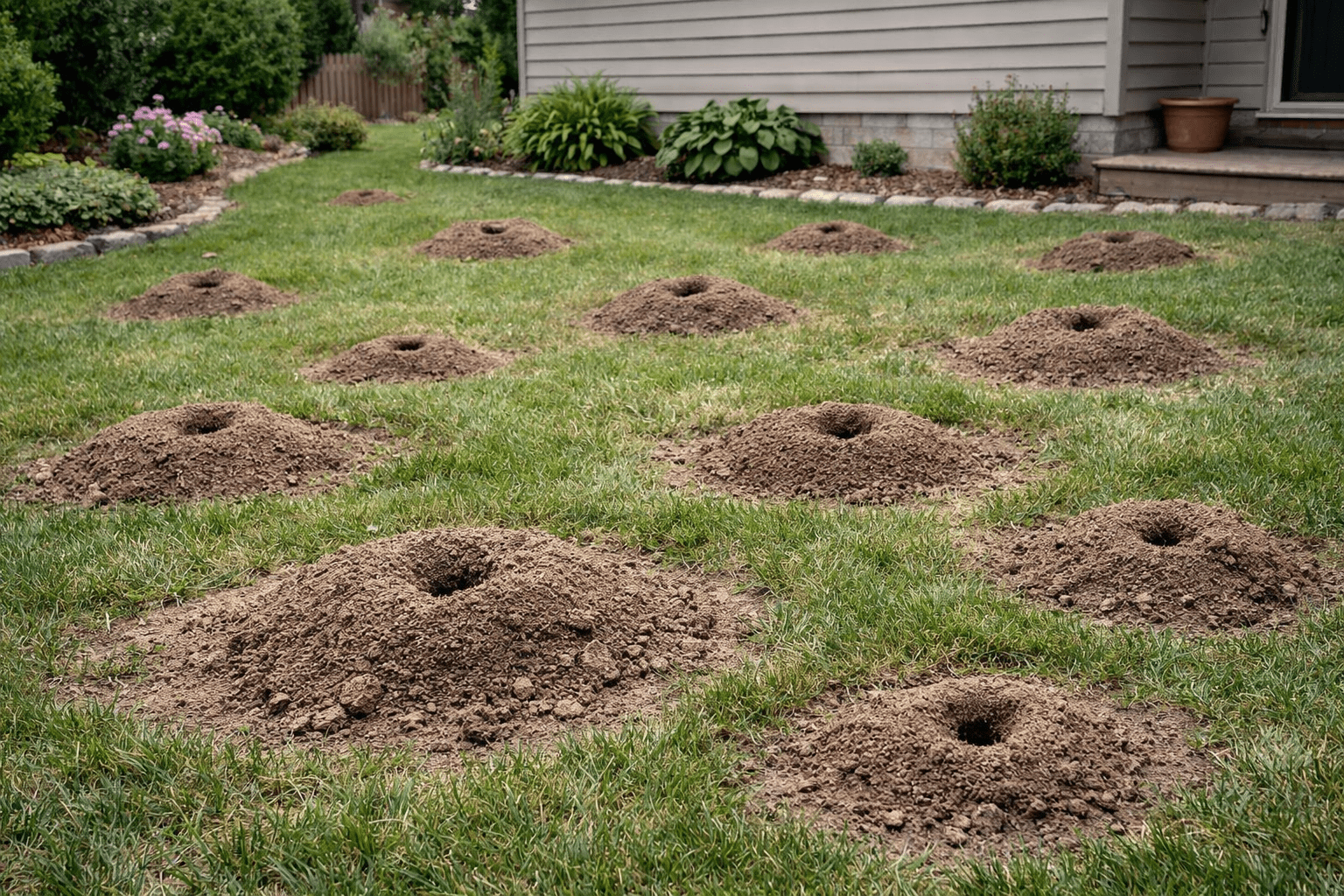
An ant hill is not the nest itself. It is excavated soil piled up as ants dig tunnels for brood chambers, food storage, and climate control. Think of the mound like the attic insulation coming out of a house renovation – it proves major construction is happening below, but it is not the structure that matters.
Different yard ants build different styles of mounds. Some create dome-shaped piles in open sun. Others make low, gritty mounds along pavement edges. Fire ants often build mounds that look “puffy” and may not have a single obvious entrance.
Why knocking down the mound often fails
Most colonies can shift entrances or rebuild quickly because:
- The queen and brood sit deeper underground
- Workers can excavate new vents in hours
- Many species maintain satellite nests nearby
That is why entomologists and extension programs typically recommend an integrated approach: disrupt habitat, use baits to reach the queen, and reserve drenches for stubborn mounds. For fire ants specifically, Texas-based extension guidance commonly promotes a two-step approach (broadcast bait, then treat remaining mounds) because it targets the whole foraging area, not just one pile of soil.
Quick ID clues: which ants are most likely making your mound?
Use this field-friendly table as a starting point:
| Clue in your yard | What you may be seeing | What it suggests |
|---|---|---|
| Mounds in full sun, ants rush out when disturbed | Fire ants (Solenopsis spp.) in many regions | Prioritize bait + targeted mound treatment |
| Small mounds near sidewalks or driveways | Pavement ants (Tetramorium spp.) | Often manageable with baits and crack control |
| Larger mounds in lawns, fields, or garden edges | Field ants (Formica spp.) | May be more nuisance than threat, treat only if needed |
Actionable takeaway
Before treating, spend 60 seconds observing:
- Do ants sting or aggressively swarm?
- Are there multiple mounds across the yard?
- Are mounds near foundation edges, garden beds, or pavement?
If you suspect fire ants or you have more than a few mounds, skip single-mound “quick fixes” and plan for yard-wide control.
How to get rid of ant hills: the most reliable methods (natural + chemical)
Ortho Fire Ant Killer Broadcast Granules, 10 lb
No Amazon ASIN or review data found in search results; product unavailable or not listed on Amazon.com. Ortho Fire Ant Killer Broadcast Granules effectively kills fire ant mounds in 15 minutes and protects lawns up to 6 months with bifenthrin active ingredient, suitable for broadcast lawn treatment when paired with mound killer, but not recommended without verified Amazon listing for affiliate purposes[1][2][3][4].
If you want results that last longer than a day or two, match the method to the problem size. A single mound can sometimes be handled mechanically. A yard sprinkled with mounds usually needs baits or a broadcast product, because workers from multiple colonies forage across the same turf.
Below is a practical menu of options, starting with the least chemical-intensive.
Option A: Boiling water drench (fast, chemical-free, inconsistent)
Boiling water can kill many workers instantly, but heat drops quickly underground. Field results often land around “sometimes it works, sometimes it doesn’t” unless repeated. It is best for small, isolated mounds away from plants.
How to do it safely and effectively
- Boil 1-3 gallons of water.
- Pour slowly into the mound’s main area (where activity is highest).
- Repeat in 2-3 days if ants rebuild.
Pros
- No pesticide residue
- Immediate knockdown
Cons
- Can burn turf and ornamentals
- Often misses the queen unless repeated
Option B: Rake and flatten (disrupts nesting, may trigger relocation)
Daily raking for several days can push some colonies to move. It works best when combined with habitat changes (less moisture, less cover) and follow-up baiting.
Simple 3-day disruption plan
- Day 1: rake flat and lightly flood with a hose
- Day 2: rake again, watch where ants regroup
- Day 3: place bait near trails or broadcast if you see multiple regroup points
Option C: Diatomaceous earth (DE) and boric acid (slow, maintenance-heavy)
Food-grade DE can abrade the ant’s waxy coating and contribute to dehydration. Boric acid (or borax-based baits) acts as a slow toxin workers can carry back. These approaches can help with ongoing pressure, but they rarely solve a large yard infestation alone.
Best practices
- Use food-grade DE only
- Reapply after rain
- Keep powders dry for best effect
For more low-toxicity options, see InsectoGuide’s guide to Natural Ant Repellents and Sprays.
Option D: Baits (best “colony-level” method)
Baits are often the most effective long-term tool because workers share food through the colony. That is how the active ingredient reaches the queen and brood.
Bait success tips
- Apply when ants are actively foraging: mild mornings or evenings
- Do not disturb the mound right before baiting
- Avoid placing bait where sprinklers will soak it immediately
- Be patient – many baits take days to weeks
If you are comparing products, InsectoGuide’s Best Ant Killers & Baits: Complete Buyer's Guide breaks down bait types and when to use them.
Option E: Mound drenches and broadcast granules (fastest knockdown, use carefully)
When you need quick reduction, a labeled drench can penetrate tunnels and kill ants more directly. Some yard programs also use broadcast granules to reduce reinfestation and prevent colonies from simply relocating a few feet away.
When to choose conventional treatments
- Aggressive stinging ants (possible fire ants)
- Multiple mounds reappearing weekly
- High-use areas: play sets, pet runs, garden paths
For product-style comparisons, see Best Outdoor Ant Killers for Lawns & Gardens.
Visual decision guide: pick the right method
| Your situation | Best starting method | Follow-up |
|---|---|---|
| 1 small mound, no stings | Boiling water or rake + flood | Monitor 7-10 days |
| 3-10 mounds across lawn | Broadcast bait | Spot-treat survivors |
| Many mounds, stings likely | Two-step: bait + drench | Recheck weekly for 1 month |
| Ants near foundation | Bait + perimeter exclusion | Seal entry points |
The two-step method for fire ants and heavy infestations (highest success)
Amdro Ant Block Granules, 24 oz
Amdro’s granules are designed to kill ants and their colonies, aligning with the article’s advice on using baits to target the queen.
If your yard has many mounds, treating each one individually is like bailing water with a cup. You might reduce one mound, but foragers from nearby colonies keep moving in. That is why many extension-style programs emphasize a two-step approach: broadcast bait first, then treat remaining mounds.
This strategy is widely recommended in fire ant country because it targets the colony network across the lawn. It also reduces pesticide use compared with drenching every mound.
Step 1: Broadcast bait across the yard
Broadcasting spreads bait where ants actually forage. Workers pick it up and share it back at the nest.
Best timing
- Spring and fall are often ideal because colonies forage actively and conditions are milder.
- Apply when the ground is dry and rain is not expected for at least a few hours.
Application checklist
- Measure your yard so you apply the correct amount
- Use a hand spreader or push spreader for even coverage
- Keep kids and pets away until the label allows re-entry
If your problem is specifically fire ants, InsectoGuide’s Fire Ant Killers for Yards: Mound Treatments explains mound-focused options and how to pair them with baiting.
Step 2: Spot-treat “survivor” mounds
After bait has time to circulate, you will usually see fewer active mounds. Treat only the ones still active.
Spot-treatment options
- A labeled mound drench applied to the full mound area (not just the peak)
- A dust applied under the right temperature and moisture conditions (follow label directions closely)
What success looks like (and how long it takes)
- 24 hours: you may see less surface activity in some mounds
- 3-7 days: noticeable reduction in active mounds
- 2-4 weeks: best time to judge overall yard improvement
If ants are still producing new mounds after a full cycle, you may be dealing with multiple colonies, bait avoidance, or repeated reinvasion from neighboring properties.
Visual checklist: two-step timeline
| Day | What you do | What you should see |
|---|---|---|
| 0 | Broadcast bait | Ants continue normal activity |
| 3-7 | Inspect and flag active mounds | Some mounds quiet down |
| 7-10 | Treat remaining active mounds | Rapid drop in activity |
| 14-28 | Recheck weekly | Few to no new mounds |
Prevention: stop ant hills from reappearing in the same spots
Hot Shot Bed Bug and Flea Killer, 1 Gallon
Hot Shot Bed Bug and Flea Killer 1 Gallon earns a solid 4.4-star rating from over 2,500 Amazon reviews, praised for quick-kill action and value in a large size, though users note the potent odor and need for repeat applications in severe cases; it’s a reliable over-the-counter option for spot treatments but pair with professional help for major infestations.
Even after you knock back colonies, your yard can still be attractive habitat. Ants choose nesting sites for the same reasons people choose neighborhoods: food nearby, safe shelter, and stable conditions.
Prevention is not about sterilizing your yard. It is about removing the easiest nesting opportunities so the next colony chooses a different location.
Reduce the “ant-friendly” features
Focus on these high-impact changes:
- Moisture control: fix leaky spigots, avoid overwatering, improve drainage in low spots.
- Food cleanup: pick up fallen fruit, rinse sticky drink spills on patios, secure trash lids.
- Shelter reduction: thin heavy mulch layers near foundations, move boards and stones that create protected voids.
- Edge management: keep grass trimmed along sidewalks and driveways where some species like to nest.
Lawn and landscape tactics that help
- Aerate compacted soil so water does not pool.
- Avoid thick thatch layers where insects and honeydew-producing pests can build up.
- Keep shrubs from touching siding to reduce “bridges” into structures.
Seal entry points (especially if hills are near the house)
Ant hills in the yard often connect to foraging trails toward kitchens, pet bowls, or wall voids. A few simple exclusion steps can reduce indoor problems:
- Seal cracks around pipes and foundation gaps with appropriate caulk
- Replace worn door sweeps
- Store pet food in sealed containers
Visual yard checklist: weekly 5-minute scan
| Where to look | What to look for | What to do |
|---|---|---|
| Sunny lawn patches | Fresh soil fans or domes | Flag and monitor activity |
| Pavement edges | Gritty soil piles | Bait near trails |
| Garden borders | Mounds under mulch | Reduce mulch depth, treat if needed |
| Near spigots/drains | Repeated mound rebuild | Fix moisture source |
When to call a professional
DIY works well for many yard infestations. Consider professional help if:
- You suspect carpenter ants nesting in structural wood
- Fire ant pressure is severe and recurring across property lines
- You have medical concerns about stings in the household
For broader product selection and strategy, revisit Best Outdoor Ant Killers for Lawns & Gardens.
Common myths about ant hills (and what actually works)
A lot of frustration comes from treating ant hills like weeds: pull the visible part and expect it to be gone. Ant colonies do not work that way. The mound is a symptom; the reproductive engine is the queen and brood below.
Myth 1: “If I flatten the mound once, the colony is gone.”
Flattening can reduce activity briefly, but most colonies rebuild quickly or shift entrances. Repeated disruption can help, but it is rarely a complete solution without baiting.
Myth 2: “Spot-treating one mound solves the yard.”
In many lawns, you are seeing multiple colonies or satellite nests. Treating one mound can even prompt relocation a short distance away. Yard-wide baiting addresses the foraging zone where colonies overlap.
Myth 3: “Vinegar or soap always eradicates the nest.”
Soapy water can drown surface ants and vinegar can repel, but neither reliably reaches deep chambers. These are best viewed as short-term knockdowns, not colony eliminators.
Myth 4: “Boiling water works every time.”
Boiling water can be effective on smaller nests, but it often fails to reach the queen. Many homeowners see partial success and need repeats.
Myth 5: “You must use insecticides first.”
Integrated pest management (IPM) encourages using the least intensive method that works, then escalating only if needed. Guidance from organizations like the EPA’s integrated pest management resources supports minimizing unnecessary pesticide exposure while still getting results.

Visual: myth vs reality snapshot
| Belief | Reality | Better approach |
|---|---|---|
| “Kill what I see” | Most ants are underground | Use bait to reach the queen |
| “One mound = one problem” | Often multiple colonies | Broadcast, then spot-treat |
| “Natural always means effective” | Many natural methods are limited | Combine disruption + bait |
Conclusion: the simplest plan that actually works
Ant hills are a sign of a working colony underground, so lasting control comes from colony-level tactics. For a few small mounds, boiling water or repeated raking can help, but it often takes follow-up. For multiple mounds, a bait-first strategy is usually the most efficient route, with spot drenches reserved for survivors.
Next step: choose one approach based on how many mounds you have, then stick with it for 2-4 weeks. If you want help picking the right bait or treatment style, start with Best Ant Killers & Baits: Complete Buyer's Guide and, for fire ant hotspots, review Fire Ant Killers for Yards: Mound Treatments.
As an Amazon Associate, I earn from qualifying purchases. Product recommendations are based on real reviews and independent research.