Finding trails across your beds or ants “tending” aphids on new growth can feel like your garden is being taken over. To get rid of ants without harming plants, focus on what ants need most: scent trails, easy food (often honeydew from aphids), and dry, protected nesting spots. This guide walks through plant-safe methods that work in real gardens – from diatomaceous earth barriers to simple sprays that erase pheromone trails – plus when it’s time to step up to baits or call a pro.
Quick answer: how to get rid of ants (without killing plants)
To get rid of ants in a garden safely, use a layered approach that targets trails, food sources, and nesting sites:
- Break the trail: Spray a 50/50 vinegar-water or lemon-water mix on ant trails (test leaves first).
- Block movement: Apply food-grade diatomaceous earth (DE) as a dry ring around beds and ant entry points. Reapply after rain.
- Remove the “reason” ants are there: Control aphids with insecticidal soap or neem so ants stop farming them.
- Change the habitat: Reduce mulch touching stems, water deeply but less often, and disturb small mounds.
- Escalate only if needed: Use targeted, garden-labeled baits away from blooms and pollinator activity.
Snippet-friendly checklist:
| Goal | Best plant-safe option | How fast it works |
|---|---|---|
| Stop trails now | Vinegar/lemon spray on trails | Minutes to hours |
| Keep ants off plants | Dry DE barrier | Same day |
| Reduce repeat visits | Treat aphids (soap/neem) | 2-7 days |
| Lower colony pressure | Habitat changes + mound disruption | 1-3 weeks |
Why ants are in your garden (and when they’re actually helpful)
Ants are among the most common insects in yards, and most of the time they’re not “attacking” your plants. Many species aerate soil, move organic material, and even prey on soft-bodied pests. The problem starts when ants behave like tiny livestock farmers.
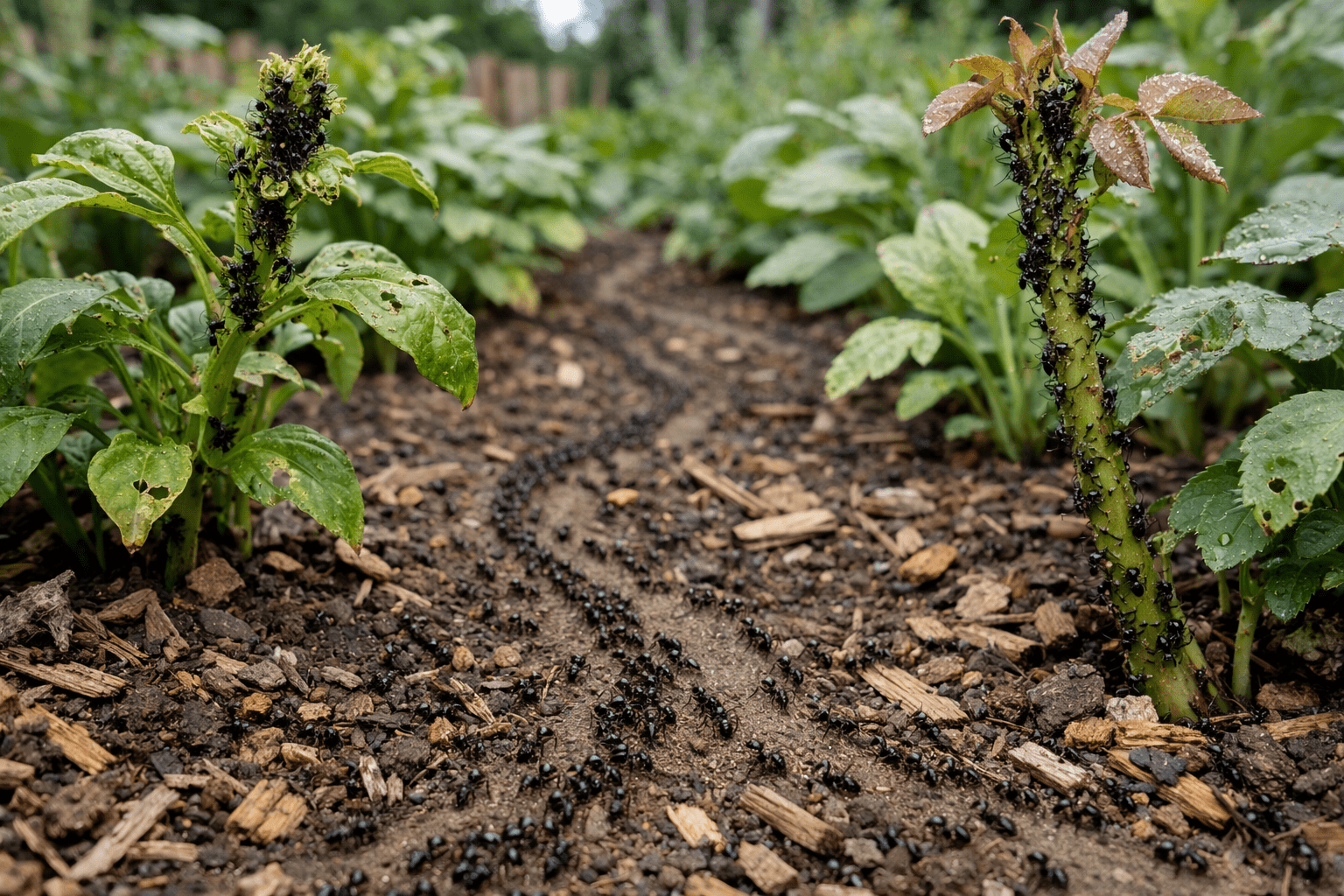
Here’s what’s usually happening: ants follow pheromone scent trails like a GPS highway. Once a scout finds food, it lays a chemical trail back to the nest. More workers follow, strengthen the trail, and suddenly you have a steady stream marching across your beds.
The most common garden ant scenario: ants + aphids
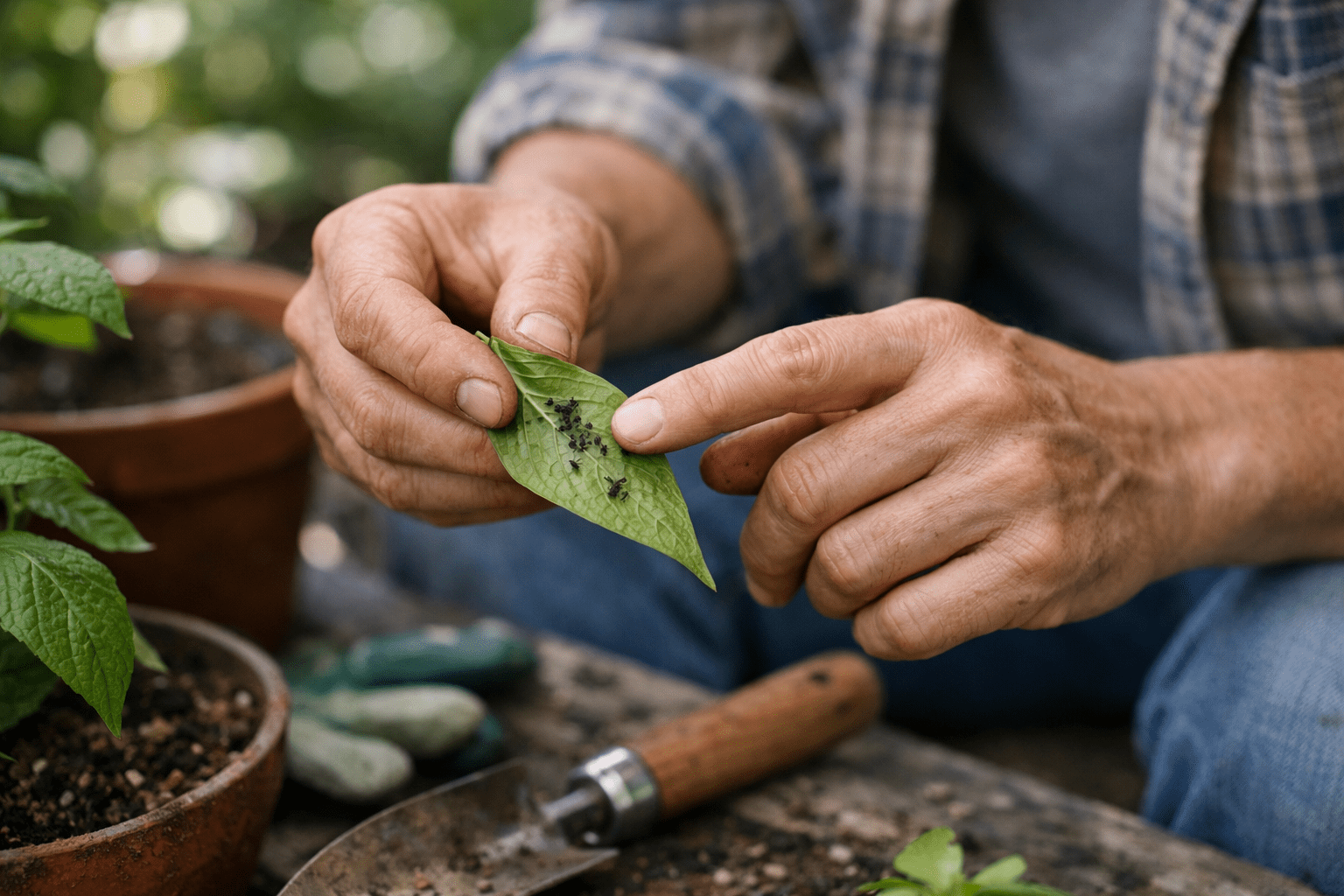
If you see ants clustered on tender tips, buds, or the underside of leaves, check closely for aphids. Ants protect aphids (and similar sap-suckers) because they drink the sugary honeydew aphids excrete. That protection can make aphid outbreaks worse.
A quick field check:
- Ants on soil only, no plant crowding: Often nesting or foraging. Usually low risk.
- Ants climbing stems repeatedly: Likely attracted to honeydew or a food source above.
- Ants “guarding” clusters of tiny green, black, or brown insects: Aphids are present.
For a deeper look at what ants are doing on plants and the best plant-safe options, see our guide to natural ant repellents and sprays.
When you should take action
Ant control makes sense when:
- Ants are farming aphids and your plants are curling, yellowing, or stunted.
- Mounds are pushing up soil around shallow-rooted seedlings.
- Ants are moving indoors from nearby beds.
- You suspect carpenter ants (large ants, often in damp wood) near structures.
According to the EPA’s guidance on integrated pest management, the goal is long-term prevention with the least risk to people, pets, and beneficial organisms. In gardens, that usually means controlling the cause (food and habitat) before reaching for broad insecticides.
Quick “helpful vs harmful” cheat sheet
| Ant behavior | Garden impact | What to do |
|---|---|---|
| Foraging on soil, occasional trails | Often neutral or beneficial | Monitor only |
| Building small mounds in paths | Minor nuisance | Rake and water area |
| Climbing plants to honeydew | Protects aphids, worsens damage | Treat aphids + block trails |
| Aggressive stinging ants (region-dependent) | Can harm people and pets | Use targeted control, consider pro help |
Get rid of ants by breaking trails and blocking access (fast, plant-safe wins)
Safer Brand 5110 Insect Killing Soap, 32 oz
This insecticidal soap is effective against aphids, which are often the reason ants are attracted to gardens. It provides a natural solution for pest control without harming plants.
If you want quick results, think like an ant. Trails are everything. Remove the trail, and the “ant highway” collapses. Add a barrier, and scouts can’t easily rebuild it.
Step-by-step: the 15-minute trail reset
Use this when you see a clear line of ants moving between a mound and a plant.
- Locate the trail from soil to plant, and note the main entry point.
- Spray the trail with one of these plant-friendlier options:
- 50/50 white vinegar and water (avoid soaking soil; test leaves first)
- 50/50 lemon juice and water (same precautions)
- A few drops of dish soap in a spray bottle of water for contact kill on hard surfaces and pots
- Wipe or rinse hard surfaces (pavers, raised bed edges) after 5-10 minutes.
- Apply a dry barrier once the area is dry.
Why it works: strong scents and surfactants disrupt pheromone trails, forcing ants to wander instead of recruiting. The Gardenia pest guide on ants notes that trail disruption is a practical way to reduce repeated foraging.
The best barrier for gardens: food-grade diatomaceous earth (DE)
DE is made from fossilized aquatic organisms and works mechanically, not chemically. It scratches and dehydrates insects that crawl through it.
How to apply DE correctly (most people apply too much):
- Choose food-grade DE only.
- Apply a thin, dry dusting – think powdered sugar, not piles.
- Create a ring around bed edges, pot rims, and around ant hills.
- Reapply after rain, irrigation, or heavy dew.
Practical tip: DE works best where it stays dry. Use it on raised bed borders, under eaves, and on sheltered soil lines.
Pepper, coffee grounds, and citrus: do they help?
These can help as short-term deterrents, especially when combined with trail disruption:
- Cayenne or black pepper: Dust lightly along trails or mix 2 tablespoons per cup of water and spray on hard surfaces.
- Used coffee grounds: Sprinkle in a narrow band. Results vary by garden, but it can discourage some trail rebuilding.
- Citrus peels: Place near problem spots as a mild repellent.
These are best as “supporting actors,” not the main strategy.
Quick comparison chart: sprays vs barriers
| Method | Best use | Pros | Cons |
|---|---|---|---|
| Vinegar/lemon spray | Visible trails | Fast, cheap | Can burn leaves if misused |
| Soap spray | Ants on pots/hard surfaces | Contact kill | Not a long-term barrier |
| DE barrier | Bed edges, mound area | Plant-safe, long-lasting when dry | Needs reapplication after rain |
| Pepper/citrus/coffee | Light pressure areas | Easy add-on | Inconsistent alone |
If you need a broader list of options (including what to avoid around pollinators), our roundup of outdoor ant killers for gardens breaks down choices by situation.
Control aphids first: the “ant magnet” most gardeners miss
Diatomaceous Earth Food Grade, 5 lb
Food-grade diatomaceous earth can be used as a barrier to block ant movement and is safe for use around plants, making it a perfect fit for the article’s recommendations.
Many gardeners fight ants for weeks, only to have them return the next day. The reason is simple: the ants are not there for your tomato plant. They’re there for the sugary honeydew produced by sap-feeding insects.
When ants “milk” aphids, they actively defend them from predators. That means you can have ladybugs, lacewings, and hoverfly larvae nearby, but the ants keep pushing them off the plant.
How to confirm you have an aphid-ant problem
Look for:
- Clusters of soft-bodied insects on new growth (often green, black, or gray)
- Sticky leaves or shiny residue (honeydew)
- Sooty mold (a black film that grows on honeydew)
- Curled or distorted leaves
If you see these signs, treating ants alone is like mopping the floor while the faucet is still running.
Plant-safe aphid controls that also reduce ants
Use one of these, then follow with a trail barrier like DE:
-
Insecticidal soap (or mild soap solution)
- Spray aphids directly, especially undersides of leaves.
- Apply early morning or evening to reduce leaf stress.
- Repeat every 4-7 days as needed.
-
Neem oil (label-directed dilution)
- Useful for repeated aphid pressure.
- Apply when temperatures are moderate to reduce plant sensitivity.
- Avoid spraying open flowers to protect pollinators.
-
Strong water spray
- A firm jet dislodges aphids from many plants.
- Follow with monitoring because aphids can rebound quickly.
Bring in beneficial insects (and stop ants from chasing them off)
Ladybugs can be excellent aphid predators, but they need access. Reducing ant traffic helps natural enemies do their job.
If you want to understand how predator insects fit into the food web, see ladybugs eat aphids and garden pests. It’s a good reminder that the best ant control often starts with restoring balance, not wiping everything out.
Mini action plan: 7-day reset
Here’s a simple schedule that works well in home gardens:
- Day 1: Treat aphids (soap or neem). Break ant trails.
- Day 2: Apply DE barrier once foliage and soil surface are dry.
- Day 3-4: Recheck new growth. Spot-treat aphids.
- Day 7: Reapply DE if rain or irrigation washed it away.
Visual: ant control is really a “triangle”
Reduce any two sides and pressure drops fast.
| Ant pressure driver | What it looks like | Fix |
|---|---|---|
| Food (honeydew, crumbs, pet food) | Ants climbing plants | Treat aphids, clean spills |
| Trails (pheromones) | Single-file lines | Citrus/vinegar wash, reroute |
| Shelter (dry nest sites) | Mounds near edges | Moisture management, disturbance |
Long-term prevention: habitat tweaks, repellent plants, and smart escalation
Vinegar – Bragg Organic Raw Apple Cider Vinegar, 16 oz
Bragg Organic Raw Apple Cider Vinegar is a top-rated, trusted product with the beneficial ‘Mother’ strand, earning 4.7 stars from over 25,000 Amazon reviews for supporting digestion, weight loss, and wellness when diluted in water or recipes; its organic certification and versatility make it a strong affiliate recommendation despite the pungent taste.
Once you’ve knocked down the active trails, prevention keeps the problem from restarting every warm week. Ant colonies can be large, and gardens provide ideal nesting spaces: loose soil, mulch layers, and warm borders.
Garden habits that reduce nesting
These small changes often make the biggest difference over a season:
- Keep mulch from touching plant stems. Mulch against stems creates a protected corridor for ants and aphids.
- Water deeply but avoid constant surface dampness. Some ants prefer stable moisture zones; others move into dry, protected soil under boards and stones. Regularly changing conditions discourages nesting.
- Remove ground contact bridges. Trim leaves and weeds that touch bed edges or walls.
- Disturb small mounds early. Raking and lightly flooding a fresh mound can encourage relocation before the colony expands.
A helpful overview of how and why ants show up in beds is described by MasterClass’s garden ant explainer. The key takeaway aligns with what many extension programs teach: persistence matters more than intensity.
Repellent plants: useful, but not magic
Aromatic herbs can reduce trail building near borders by interfering with ant scent cues. They’re best as a perimeter strategy, especially around raised beds and patio containers.
Good options include:
- Mint or peppermint (grow in containers – it spreads)
- Lavender, rosemary, thyme, basil
- Lemon balm, garlic, marigolds
If you like using plants as part of pest prevention, you’ll also enjoy our guide to plants that repel garden insects. Many of the same aromatic plants pull double duty in the yard.
Heat and smother methods for small mounds
For small, isolated mounds away from sensitive roots:
- Cover the mound with black plastic on a sunny day for several hours.
- Or place a clear container (like a cut bottle) over the mound to trap heat.
This can encourage ants to move. Follow up by improving soil structure with compost so the area is less attractive as a nesting site.
When to use baits or call a professional
If ants keep returning despite trail disruption and aphid control, the colony may be larger or located under hardscape.
Escalate to targeted baits when:
- Trails reappear daily for 1-2 weeks
- Mounds are numerous across the garden
- Ants are entering the home from the garden
Choose baits labeled for outdoor use, place them away from flowers, and follow label directions carefully. Avoid broad, non-target sprays over beds – they can harm beneficial insects and disrupt natural control.
Call a professional if:
- You suspect carpenter ants in structural wood
- You’re dealing with aggressive stinging ants
- Nests are under patios, retaining walls, or near utilities
Common mistakes to avoid (quick list)
- Spraying full-strength vinegar on plants
- Applying DE in wet clumps (it stops working when damp)
- Ignoring aphids while chasing ants
- Using broad insecticides during bloom when pollinators are active
Key takeaways (and the simplest next step)
To get rid of ants in your garden without harming plants, break pheromone trails, block access with a dry barrier like food-grade DE, and remove the food source that keeps ants coming back – usually aphids. Repellent plants and small habitat changes help prevent repeat invasions, but heavy pressure may require targeted baits placed carefully.
Next step: today, inspect one problem plant for aphids, treat them, then apply a DE ring once the surface is dry. For more options tailored to your setup, revisit our guides on natural ant repellents and sprays and outdoor ant killers for gardens.
As an Amazon Associate, I earn from qualifying purchases. Product recommendations are based on real reviews and independent research.