Finding mosquitoes in your yard often feels sudden, but the truth is more predictable. The mosquito life cycle follows a strict four-stage pattern – egg, larva, pupa, adult – and the first three stages happen entirely in water. That detail is the key to prevention. When you know where each stage develops, you can break the cycle before biting adults ever take flight. Below is a clear, stage-by-stage guide to what mosquitoes look like as they grow, how fast they develop, and what homeowners can do at each step.
Quick Answer: What are the 4 stages of the mosquito life cycle?
Mosquito life cycle (egg to adult): the big picture and why water matters
If mosquitoes seem to “appear” right after rain, it is usually because the water stage was already set. Every mosquito species depends on standing water for early development, and that dependence is your best leverage point for control.
Entomologists classify mosquitoes as holometabolous insects, meaning they undergo complete metamorphosis. The egg, larva, and pupa are all aquatic. Only the adult is airborne and terrestrial. A medical overview in the NCBI Bookshelf describes this complete metamorphosis as a full-body redesign, not just a growth spurt.
What controls how fast mosquitoes develop?
Development speed is not fixed. It swings with the conditions in the breeding site.
Main drivers that speed up or slow down development:
Temperature: Warm water accelerates hatching, larval molts, and pupation. Cool weather slows or pauses growth.
Food and water quality: More microorganisms and organic debris usually means faster larval growth.
Crowding: Too many larvae in a small container can reduce food and oxygen access, slowing development or increasing mortality.
These dunks are specifically designed to target mosquito larvae in standing water, making them highly relevant for controlling the mosquito life cycle discussed in the article.
These dunks are specifically designed to target mosquito larvae in standing water, making them highly relevant for controlling the mosquito life cycle discussed in the article.
Check Price on Amazon →
Mosquito control often fails because people focus on flying adults and ignore the egg stage hiding in plain sight. After mating, female mosquitoes typically take a blood meal to support egg production, then lay eggs on or near water. The exact placement depends on the genus and species.
According to the CDC’s Aedes mosquito life cycle guide, container-breeding Aedes mosquitoes often lay eggs on container walls just above the waterline, not directly in the water. Those eggs stick to surfaces and can survive drying for months, then hatch when rain or a hose refills the container.
Common egg-laying sites around homes
Use this as a checklist during warm months and after storms:
Buckets, watering cans, toys, and tarps that hold puddles
Plant saucers and self-watering pots
Birdbaths and pet bowls left unchanged
Clogged gutters and downspout extensions
Discarded tires (a classic Aedes habitat)
Tree holes and low spots that hold water for a week
Actionable takeaway: It is not enough to “dump the water.” For container breeders, scrub the container walls too, because eggs can remain glued above the waterline.
Egg survival myth that trips people up
Many people assume eggs die when water dries. Some do, but many do not.
Myth vs. fact (egg stage):
Myth: Dry containers cannot produce mosquitoes.
Fact: Many Aedes eggs tolerate drying and hatch when water returns, which is why “dry today” is not the same as “safe.”
If you want a site-by-site prevention guide, read Mosquito Life Cycle: From Eggs to Adults. It matches what most homeowners actually find: small, overlooked water sources beat big ponds in many neighborhoods.
<>
Larval stage (“wrigglers”): what mosquito larvae look like and how to stop them
Ortho Home Defense Insect Killer for Indoor & Perimeter (1 Gallon) is a widely used household pest-control spray with strong Amazon ratings and tens of thousands of reviews noting reliable effectiveness against common bugs, easy application with the included wand, and a relatively mild odor that dries clear. Complaints mostly focus on occasional issues with the sprayer hardware and less-than-complete control in severe infestations. For a general home-protection product to keep ants, roaches, and spiders at bay, it’s a popular, well-reviewed choice, but it’s not relevant as a health or dietary supplement and should be presented on a health blog, if at all, strictly as a household product with careful attention to safe use and label directions.
Pros: Very effective at killing and preventing common household insects (ants, roaches, spiders, etc.) for weeks to months · Easy-to-use wand/trigger with good coverage for both indoor baseboards and outdoor perimeter · Odor is mild to non-offensive and dries clear without staining most surfaces
Cons: Some users report defective or leaking spray wands and occasional clogging issues · Not 100% effective for severe or recurring infestations (especially certain roaches or spiders), sometimes requiring repeated applications or professional pest control
Ortho Home Defense Insect Killer for Indoor & Perimeter, 1 Gallon
Ortho · ⭐ 4.6 (80,000+ reviews) · $14–$20
Ortho Home Defense Insect Killer for Indoor & Perimeter (1 Gallon) is a widely used household pest-control spray with strong Amazon ratings and tens of thousands of reviews noting reliable effectiveness against common bugs, easy application with the included wand, and a relatively mild odor that dries clear. Complaints mostly focus on occasional issues with the sprayer hardware and less-than-complete control in severe infestations. For a general home-protection product to keep ants, roaches, and spiders at bay, it’s a popular, well-reviewed choice, but it’s not relevant as a health or dietary supplement and should be presented on a health blog, if at all, strictly as a household product with careful attention to safe use and label directions.
Pros: Very effective at killing and preventing common household insects (ants, roaches, spiders, etc.) for weeks to months · Easy-to-use wand/trigger with good coverage for both indoor baseboards and outdoor perimeter · Odor is mild to non-offensive and dries clear without staining most surfaces
Cons: Some users report defective or leaking spray wands and occasional clogging issues · Not 100% effective for severe or recurring infestations (especially certain roaches or spiders), sometimes requiring repeated applications or professional pest control
Check Price on Amazon →
The larval stage is where mosquitoes spend most of their pre-adult time, and it is usually the easiest stage to control. Larvae are aquatic and feed actively, filtering microorganisms and organic particles from the water. This feeding is also why “dirty” water often produces more mosquitoes than clean water.
You can often spot larvae without any special equipment. Look for tiny, comma-like bodies that jerk or wiggle when disturbed. Many species hang just below the surface to breathe, using a siphon or spiracles. That surface dependence is a practical weakness you can exploit.
Quick ID checklist: is it a mosquito larva?
Use this simple field checklist in a bucket, birdbath, or rain barrel:
Movement: quick wriggles when you tap the container
Location: near the surface, returning frequently to breathe
Shape: slender, segmented body with a distinct head
Behavior: clusters in still water, especially shaded containers
A Penn State Extension overview of mosquito development notes larvae pass through four instars, molting as they grow, and that temperature and food strongly influence how long they remain larvae. See Penn State Extension’s mosquito life cycle education for a practical, public-health oriented summary.
What to do when you find larvae (fast, realistic options)
Pick the approach that fits the water source.
1) Dump, drain, and dry (best for small containers)
Empty the water.
Scrub the sides to remove any stuck eggs.
Store items upside down or under cover.
2) Refresh water on a schedule (birdbaths, pet bowls)
Replace water every few days in peak season.
Brush surfaces to remove biofilm where eggs can cling.
3) Treat water you cannot dump (rain barrels, ponds, water features)
Use an approved larvicide when appropriate and legal in your area.
Products containing Bacillus thuringiensis israelensis (Bti) are commonly used for larval control in standing water.
Actionable takeaway: If you see larvae today, adults can follow soon. In warm weather, larval development can be short, and once pupae appear you are only days away from new flyers.
Pupal stage (“tumblers”): the short window right before adults emerge
Thermacell’s Patio Shield Mosquito Repeller is a highly rated, patio-friendly device that uses allethrin to create a roughly 15‑foot, scent-free protection zone without sprays or DEET on skin, and Amazon reviewers consistently praise its effectiveness and ease of use, especially for decks and outdoor dining, while the primary drawbacks are the ongoing cost of refills and reduced performance in windy or very open areas—making it a strong affiliate recommendation for readers seeking a clean, convenient way to reduce mosquitoes during outdoor relaxation.
Pros: Very effective at creating a noticeable mosquito-free zone when used as directed · No sprays, scent, or DEET on skin, making it more pleasant than topical repellents · Compact, easy to use, and attractive enough to leave on patio tables or decks
Cons: Ongoing cost of fuel cartridges and repellent mats can add up for frequent users · Performance is sensitive to wind or open, breezy areas and may feel less effective in those conditions
Thermacell Patio Shield Mosquito Repeller, 15-Foot Zone of Protection
Thermacell · ⭐ 4.5 (34,000+ reviews) · $19–$25
Thermacell’s Patio Shield Mosquito Repeller is a highly rated, patio-friendly device that uses allethrin to create a roughly 15‑foot, scent-free protection zone without sprays or DEET on skin, and Amazon reviewers consistently praise its effectiveness and ease of use, especially for decks and outdoor dining, while the primary drawbacks are the ongoing cost of refills and reduced performance in windy or very open areas—making it a strong affiliate recommendation for readers seeking a clean, convenient way to reduce mosquitoes during outdoor relaxation.
Pros: Very effective at creating a noticeable mosquito-free zone when used as directed · No sprays, scent, or DEET on skin, making it more pleasant than topical repellents · Compact, easy to use, and attractive enough to leave on patio tables or decks
Cons: Ongoing cost of fuel cartridges and repellent mats can add up for frequent users · Performance is sensitive to wind or open, breezy areas and may feel less effective in those conditions
Check Price on Amazon →
Mosquito pupae look and behave different from larvae. They are still aquatic and still need surface air, but they do not feed. Instead, this is the transformation stage where larval tissues reorganize into adult structures. If larvae are the “eating and growing” phase, pupae are the “rebuilding” phase.
Pupae are often called “tumblers” because of how they move when disturbed. Tap the container and they will tumble downward, then float back up to breathe using respiratory trumpets at the surface. The timing here matters: in many species the pupal stage lasts only 1–4 days, and sometimes around 2–3 days under favorable conditions for Anopheles, as shown in the CDC’s Anopheles life cycle fact sheet.
Why pupae are harder to control than larvae
Because pupae do not eat, methods that rely on ingestion do not work the same way. That is why prevention aimed at the larval stage is more reliable.
Pupa-stage realities:
They are mobile, so they can evade some predators and disturbances.
They are close to emergence, so timing is tight.
They still require standing water, so dumping and draining remains effective.
Rapid response checklist when you spot pupae
If you see pupae in a container, treat it like a countdown.
Dump the water immediately (if possible).
Scrub the sides (especially for containers that previously held water).
Refill with fresh water only if needed, and change it frequently.
For fixed water features, use appropriate larval control products and improve circulation.
Actionable takeaway: Do not wait for “one more weekend” to deal with standing water. Pupae can turn into adults in a couple of days.
Adult stage: which mosquitoes bite, how far they travel, and what reduces bites fast
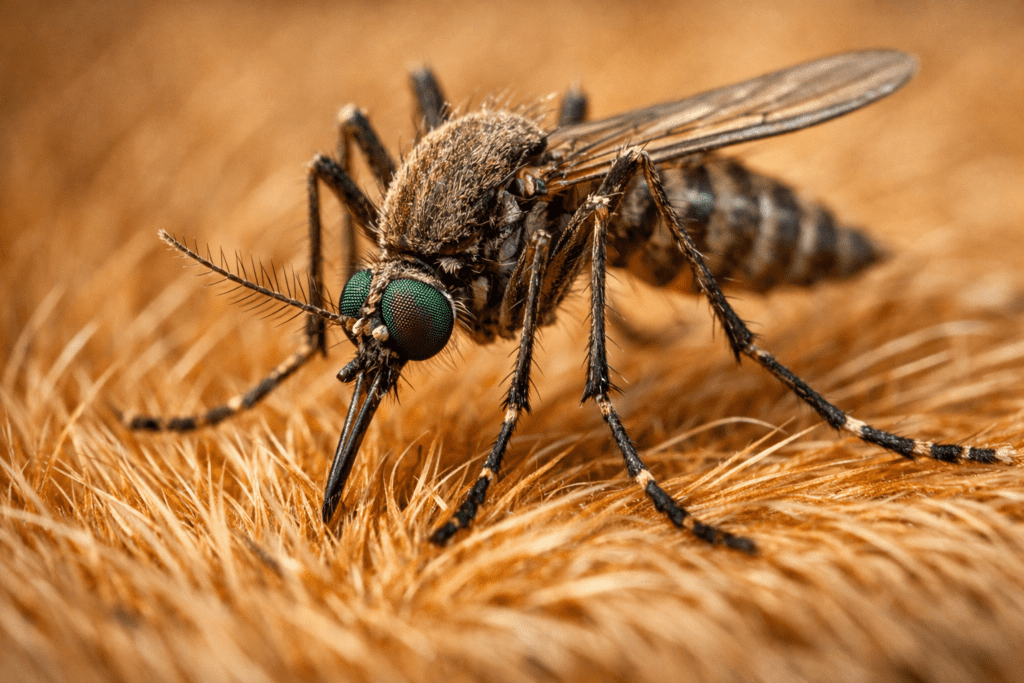
Adults are the only stage that flies, bites, and spreads mosquito-borne pathogens. When the adult emerges, it comes up at the water surface, climbs out of the pupal case, and rests briefly while its body hardens and wings dry. Then it can fly off to feed and mate.
Only female mosquitoes bite. Males feed on nectar and plant sugars. Females also use sugars, but many species need a blood meal to produce eggs. The EPA’s mosquito control guidance and many public-health agencies emphasize this point because it explains why bites increase when females are actively producing eggs.
How far do adult mosquitoes travel?
Many homeowners assume mosquitoes come from far away. Sometimes they do, but many of the most common container breeders stay close. The CDC’s Aedes life cycle resource notes that Aedes aegypti and Aedes albopictus often do not travel far, commonly only a few city blocks over their lifetime. That means your yard, and your immediate neighbors, can be the main source.
Bite reduction plan (adult stage)
Adult control works best when paired with water management. Here are practical steps that reduce bites quickly:
Personal protection
Use EPA-registered repellents as directed on the label.
Wear long sleeves and long pants during peak biting times.
Use well-fitted screens and keep doors from standing open.
Yard and home adjustments
Repair window and door screens.
Reduce dense vegetation near patios and entryways where adults rest in shade.
Run fans on patios – airflow makes it harder for mosquitoes to land and track scent.
persistent standing water you cannot access (storm drains, inaccessible gutters),
a nearby marshy area,
or heavy biting despite weekly source reduction,
a licensed mosquito control professional can help identify breeding sites and recommend targeted treatments. Adult-only spraying without water management often leads to quick rebound, because new adults keep emerging.
<>
The Mating Swarm
Male mosquitoes form swarms of dozens to thousands of individuals, hovering in a dancing cloud at dusk. These swarms form over visual markers – a bush, a fence post, a puddle edge, or even a person standing still. The swarm serves as a “singles bar” where females can find mates of the correct species.
Males detect approaching females by the sound of their wingbeats. Female Aedes aegypti buzz at about 484 Hz while males buzz at 588 Hz. When a male detects the lower female frequency, he flies toward her and harmonizes his wing frequency to create a matched tone – essentially an acoustic courtship display confirmed by a study published in Science.
One-Time Mating
Female mosquitoes mate only once. During mating, the male transfers a sperm packet along with accessory gland proteins that make the female unreceptive to future mating attempts. She stores the sperm in her spermatheca and uses small amounts to fertilize each batch of eggs for the rest of her life.
This one-time mating strategy has implications for mosquito control. The Sterile Insect Technique (SIT) releases millions of sterile males into wild populations. When females mate with sterile males (their one and only mating), they produce no viable offspring.
Conclusion: break the cycle by targeting water first
The mosquito life cycle is predictable: egg, larva, pupa, adult, with the first three stages tied to standing water. That single fact explains why weekly water checks work so well. Dumping, draining, scrubbing container walls, and treating water you cannot remove stops mosquitoes before they become biting adults.
Sophia Carter covers insect diversity and ecology on InsectoGuide: what a species is, how it lives, and what it is actually doing in a garden or a house before anyone decides it is a problem. The guides start from the assumption that most insects a reader meets are harmless, and say so where that is true. Biology and control practice are anchored to university extension entomology programmes, and the source is linked in the text rather than listed at the bottom.
You’ve been bitten, and the itching is relentless. Before you scratch that welt into a bleeding mess, grab the right product. The difference between a…
As an Amazon Associate, I earn from qualifying purchases. Product recommendations are based on real reviews and independent research. Finding a mosquito repellent dogs can…
4 thoughts on “Mosquito Life Cycle: From Eggs to Adults”

 Thermacell Patio Shield Mosquito Repeller, 15-Foot Zone of Protection

Pingback: Mosquito-Borne Diseases: Complete Prevention Guide | InsectoGuide
Pingback: Best Mosquito Repellent Plants for Your Garden | InsectoGuide
Pingback: Spring Pest Prevention Checklist
Pingback: How to Protect Babies from Mosquito Bites