Have you ever walked into a room, flipped on a light, and suddenly a mosquito seems to “appear” out of nowhere? That’s not magic. It’s timing. Mosquito sleep patterns are real in the scientific sense: mosquitoes enter sleep-like states with a recognizable posture, reduced responsiveness, and daily rest phases tied to their internal 24-hour clock. Understanding when mosquitoes are active vs. “offline” helps you predict bite risk, choose the best protection window, and even locate where they hide between meals.
Quick Answer: Do Mosquitoes Sleep?
Yes. Mosquitoes don’t sleep like humans, but researchers now describe sleep-like states that match standard criteria used for insect sleep.
Here’s the snippet-friendly breakdown of mosquito sleep patterns:
- What “sleep” looks like: prolonged inactivity plus a distinct posture (body closer to the surface, hind legs drooping).
- How scientists measure it: in lab monitoring, about 120 minutes of continuous inactivity is often used as a practical sleep proxy in multiple mosquito species.
- What changes during sleep-like states: mosquitoes become harder to rouse and respond less to host cues like odor and warmth.
- How long they rest: studies suggest mosquitoes can be inactive/asleep for roughly 16 to 19 hours per day, depending on species and conditions.
- Why it matters to you: sleep-deprived mosquitoes show less host landing and lower blood-feeding tendency, meaning timing affects bite risk.
If you’re trying to reduce bites, pair this timing knowledge with how mosquitoes track you using breath and body odor in How Mosquitoes Find, Bite & Feed on You.
What Scientists Mean by “Mosquito Sleep Patterns” (And How We Know It’s Sleep)
Mosquitoes spend a lot of time perched quietly on walls, vegetation, and shaded surfaces. For years, people called that “resting.” The twist is that modern experiments show it behaves like true sleep, not just stillness.
A study in the Journal of Experimental Biology documented sleep-like states in mosquitoes using the same core standards used across animal sleep research: long inactivity, a stereotyped posture, reduced responsiveness, and recovery sleep after deprivation. The work is summarized in the Journal of Experimental Biology paper on mosquito sleep-like behavior and expanded in a broader review of mosquito daily rhythms available through the National Library of Medicine (PMC) review on circadian rhythms in vector mosquitoes.
The “sleep posture” you can actually recognize
If you’ve ever watched a mosquito perched on a wall, you might notice two different looks:
| Posture | What you’ll see | What it usually means |
|---|---|---|
| Alert resting | Legs more braced, body angled, quick to fly | Pausing between activity bursts |
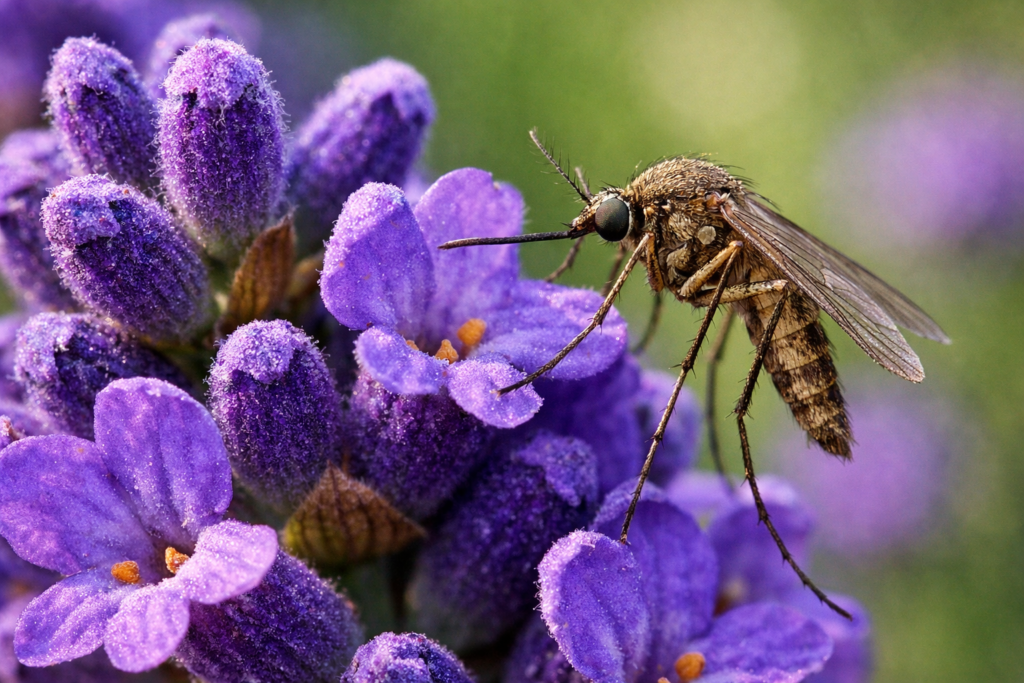
| Sleep-like posture | Body closer to the surface, hind legs droop downward | Reduced responsiveness and sleep-like state |
This posture is not just a fun detail. It gives researchers a visible marker that correlates with deeper behavioral changes.
How long must a mosquito be still to count as “asleep”?
In controlled activity monitoring, researchers often use 120 minutes of continuous inactivity as a working threshold. After that point, a large share of mosquitoes shift into the sleep-like posture and become less responsive to disturbance and host cues.
Actionable takeaway: If you’re seeing mosquitoes sitting motionless for long stretches in a dark corner, they may not be “gone.” They may be in a low-response state and can still wake if you provide strong cues like CO₂ from breathing.
Why you might “suddenly” notice mosquitoes
Think of mosquito sleep like a phone on low-power mode. It’s still there, but it reacts slower until a strong signal arrives. Walking into a space adds:
- carbon dioxide from breath
- body heat
- skin odor plumes
- air movement and vibration
Those cues can snap a resting mosquito back into host-seeking mode.
Mosquito Sleep Patterns by Species: Day Biters vs Night Biters vs Dusk Biters
Repel 100 Insect Repellent, 4 oz
This product is relevant as it provides protection against mosquito bites, which is crucial for readers looking to reduce their risk based on mosquito activity patterns.
One reason mosquito control advice feels inconsistent is that “mosquito” isn’t one schedule. Different species run on different clocks, and that clock determines when they sleep, when they hunt, and when they’re most likely to bite.
Here’s a practical comparison chart to keep the big three groups straight.
Quick comparison: when they’re active vs. when they’re mostly resting
| Mosquito type (example) | Typical peak activity | Typical main rest/sleep window | What that means for bite prevention |
|---|---|---|---|
| Diurnal (often Aedes aegypti) | Late morning through afternoon, often toward late day | More consolidated rest in the dark phase | Protect yourself during daytime, not only at night |
| Nocturnal (many Anopheles vectors) | Night, often dusk through midnight | Daytime resting in shaded sites | Bed nets and evening protection matter most |
| Crepuscular (often Culex pipiens) | Dusk and early night, sometimes dawn | Outside dusk/dawn peaks | Don’t skip protection at sunset, even if midday is quiet |
The same circadian machinery that shapes sleep also shapes flight, mating swarms, and blood-feeding. A helpful overview of this timing biology appears in the Berkeley Public Health feature on mosquito circadian rhythms.
Where these patterns show up in real life
- In many neighborhoods, Aedes aegypti is the mosquito that bites your ankles while you’re doing daytime chores. If your area has this species, “I only get bitten at night” advice can fail.
- In malaria regions, many Anopheles species are strongly night-active. Their daytime hours are often spent tucked into shaded indoor or outdoor refuges.
- Culex mosquitoes often feel like “sunset mosquitoes,” appearing right when you step outside to grill dinner.
Actionable takeaway: Match your protection to your local peak windows. If you’re not sure what those are where you live, use a seasonal timing guide like Mosquito Season by State: When Mosquitoes Peak to narrow the risk period, then watch when bites actually happen.
Why timing can shift (even for the same species)
Mosquito activity isn’t locked to the minute. It shifts with:
- light levels (indoor lighting can extend activity)
- temperature and humidity (warm, humid evenings boost flight)
- host availability (humans outside at dusk can pull activity earlier)
- local adaptation among populations
That last point matters. Research comparing Aedes aegypti populations has found meaningful differences in sleep amount and timing, even when the broad “day-biting” pattern holds.
What Happens If Mosquitoes Don’t Sleep? (Sleep Deprivation and Biting)
Thermacell Patio Shield Mosquito Repeller, 12 Hours of Protection
Thermacell’s Patio Shield Mosquito Repeller is a compact, DEET‑free device that uses allethrin to create an odorless, roughly 15‑foot protection zone, and reviewers consistently rate it highly for keeping patios and outdoor seating areas noticeably more mosquito‑free when wind is minimal.[1] The main tradeoffs are the ongoing cost of refill cartridges and somewhat reduced effectiveness in breezy conditions, but for readers seeking an easy, tabletop, no‑spray option for summer evenings, this is a strong, well‑reviewed choice at around $20 on Amazon, provided they are comfortable maintaining a supply of refills.
If you’ve ever pulled an all-nighter, you know your decision-making gets worse. Mosquitoes show a version of that too – and it changes their feeding behavior.
In experiments where mosquitoes were mechanically disturbed to prevent sleep (for example, gentle vibration during their normal rest window), researchers saw two consistent outcomes:
- They lose measurable sleep, then
- They try to “pay it back” with rebound sleep later (longer or more frequent sleep bouts)
This rebound effect is one of the strongest signs that the behavior is truly sleep-like, not random inactivity.
The bite-related result that matters most
Sleep-deprived mosquitoes are less likely to successfully blood-feed. In controlled comparisons highlighted by science reporting and laboratory findings, the proportion seeking a blood meal dropped sharply in sleep-deprived groups relative to controls. A clear summary of these findings appears in the Phys.org report on mosquito sleep and reduced biting, based on the peer-reviewed research.
That doesn’t mean you can “tire out” mosquitoes as a home strategy. But it does support a bigger point: biting behavior is tied to sleep-wake state and circadian timing, not just hunger.
Why sleep disruption reduces feeding
Several mechanisms likely stack together:
- lower responsiveness to host cues (odor, heat)
- reduced flight drive at the wrong circadian phase
- tradeoffs between recovery sleep and host-seeking time
In other words, a mosquito can be alive, present, and hungry – but still less motivated or less capable of completing a bite sequence.
Practical takeaway for households
Instead of trying to disrupt sleep directly, use the insight to time your defenses:
- Apply repellent before the local activity peak, not after bites start.
- Run a fan or use screens during the highest-risk window.
- If you’re trying to locate indoor mosquitoes, search likely resting spots during their off-peak hours, when they’re more likely perched.
For context on how long you might be dealing with the same individuals indoors, see Mosquito Life Cycle: From Eggs to Adults.

Where Mosquitoes “Sleep” in Your Home and Yard (And How to Find Them)
OFF! Deep Woods Insect Repellent, 6 oz
This insect repellent is specifically designed for outdoor activities, making it a practical choice for those who want to avoid mosquito bites during their active hours.
If mosquitoes have sleep-like states, the next question is obvious: where do they do it?
Most species prefer protected, shaded, low-wind spots. These locations reduce dehydration risk and help them avoid predators. Indoors, they also tend to pick areas with minimal disturbance.
Common indoor resting sites (easy to check)
Use this checklist as a quick “mosquito sleep spot” scan:
- behind curtains and drapes
- under sinks and inside dark cabinets
- closets, especially near hanging clothes
- under furniture (beds, couches)
- bathrooms and laundry rooms (humidity helps)
- near houseplants or damp areas
Common outdoor resting sites
- dense shrubs and tall grass
- under decks and porches
- shaded sides of buildings
- inside sheds, garages, and crawl spaces
- under leaf litter or in thick ground cover
A simple 5-minute inspection routine
If you’re trying to confirm whether mosquitoes are present indoors:
- Check the coolest, darkest room first (often a bathroom or closet).
- Look at walls near corners, behind doors, and under furniture edges.
- Move slowly – sudden motion can flush them.
- Use a flashlight at a low angle to catch body silhouettes.
- If you spot one, note the time. Repeated sightings at the same hour hint at the local activity cycle.
Actionable takeaway: If you only hunt for mosquitoes at peak biting time, you’ll mostly see them in motion. Checking during off-peak periods often reveals where they’re hiding.
Seasonal twist: winter changes everything
In temperate climates, mosquito activity patterns compress or pause as temperatures drop. Some species overwinter as adults in protected spaces, while others persist as eggs or larvae depending on species.
If you’re wondering where they go when it’s cold, How Mosquitoes Survive Winter: Hibernation, Eggs & Spring Emergence breaks down overwintering strategies and what it means for early-season surprises.
What Controls Mosquito Activity Cycles? Light, Temperature, and the Internal Clock
Mosquitoes do respond to day and night, but light alone doesn’t fully explain their timing. Like many insects, they run on an internal circadian clock that keeps roughly 24-hour time, then adjusts to environmental cues.
Researchers studying vector mosquitoes describe daily rhythms that coordinate:
- flight and host-seeking
- mating and swarming
- feeding and digestion
- sensory sensitivity (smell and heat detection)
A deeper dive into how mosquito clocks and daily rhythms are organized appears in the Frontiers in Physiology review on mosquito circadian rhythms.
The “zeitgebers” that set the schedule
Biologists call external time-setters zeitgebers. For mosquitoes, the big ones are:
- Light-dark cycle: dawn and dusk are powerful reset points.
- Temperature: warm evenings can extend activity; cool snaps can shut it down.
- Humidity: dry air raises dehydration risk, often reducing flight.
- Host presence: CO₂ and odor plumes can trigger activity even in quieter phases.
Timing happens inside the mosquito too
It’s not just behavior. Thousands of genes show daily rhythmic expression in mosquitoes, including genes in sensory tissues and salivary glands – the systems tied to biting and blood-feeding.
For example, research on malaria-vector biology has found strong time-of-day patterning in salivary gland gene activity, with many genes peaking around typical feeding windows. A detailed example of daily timing in mosquito sensory biology is discussed in a PNAS study on time-of-day changes in mosquito host-seeking.
Actionable takeaway: If your bite problem happens at a consistent time each day, that’s a clue you’re dealing with a predictable circadian peak, not random chance. Plan protection and yard time around that peak.

Common Myths About Mosquito Sleep (And What’s Actually True)
A few misconceptions keep people from using mosquito timing to their advantage. Clearing them up makes prevention simpler.
Myth 1: “Mosquitoes never sleep. They’re always active.”
Reality: Mosquitoes spend long stretches inactive in sleep-like states, often with a recognizable posture and reduced responsiveness. You just don’t notice them because they’re tucked away.
What to do: Search hiding spots during off-peak hours, not just when you’re being bitten.
Myth 2: “They’re just resting. That’s not real sleep.”
Reality: Sleep-like mosquito states meet major sleep criteria used in animal research, including rebound sleep after deprivation and higher arousal thresholds.
What to do: Treat quiet periods as “present but parked,” especially indoors.
Myth 3: “All mosquitoes bite at night.”
Reality: Many do, but major disease vectors differ. Aedes aegypti is often day-active; Culex often peaks at dusk; many Anopheles are night-active.
What to do: If you’re hearing buzzing at bedtime, you may be dealing with a night-active species, but daytime bites point to a different culprit. If the sound is what’s driving you crazy, Why Do Mosquitoes Buzz in Your Ears? explains the behavior and what reduces it.
Myth 4: “If I don’t see them, they’re not in the room.”
Reality: Resting mosquitoes often pick hidden, shaded spots. They can stay still long enough to be overlooked, then fly when cues appear.
What to do: Focus on entry points (screens, gaps) and resting zones (closets, under furniture), not just open air.
Conclusion: Use Timing to Outsmart Bites
Mosquitoes really do have sleep-like states, and mosquito sleep patterns track closely with species-specific activity cycles. When they’re in their low-activity phase, they’re more likely perched in hidden resting sites and less responsive to host cues. When their circadian peak hits, they shift into active flight and host-seeking.
Next step: Identify your highest-risk window this week. Then apply protection before that window starts and inspect likely resting spots during off-peak hours. For deeper planning, pair timing with seasonality using Mosquito Season by State: When Mosquitoes Peak and tighten your bite prevention strategy by reviewing How Mosquitoes Find, Bite & Feed on You.
As an Amazon Associate, I earn from qualifying purchases. Product recommendations are based on real reviews and independent research.