You found a bug crawling up the inside of a sunny window in October, and the first question is which one it is. Four very different insects cause nearly all fall home invasions, and telling them apart guides what you do next. They are the shield-shaped brown marmorated stink bug (Halyomorpha halys), the flat black-and-red boxelder bug (Boisea trivittata), the round orange Asian lady beetle (Harmonia axyridis), and the sluggish, larger gray cluster fly (Pollenia species). The good news is that the body shape alone separates all four in a second, and they share the trait that matters most: they come inside to overwinter and do not breed, bite, or damage your home.
Shape tells you which one it is: shield = stink bug, flat black-and-red = boxelder bug, round orange dome = Asian lady beetle, slow fuzzy gray fly = cluster fly. All four are overwintering nuisances that do not breed, bite, or damage your house indoors, so the response for every one is the same, exclude and vacuum, never spray your walls.
- The confirming feature: Body outline, shield, flat oval, round dome, or fly, settles the ID before you look at color.
- What they have in common: All are harmless overwinterers that wandered in for warmth, not an infestation.
- What it means: Seal entry points and vacuum the ones already inside; see our guide to pest-proofing your home against fall invaders.
Quick answer by shape
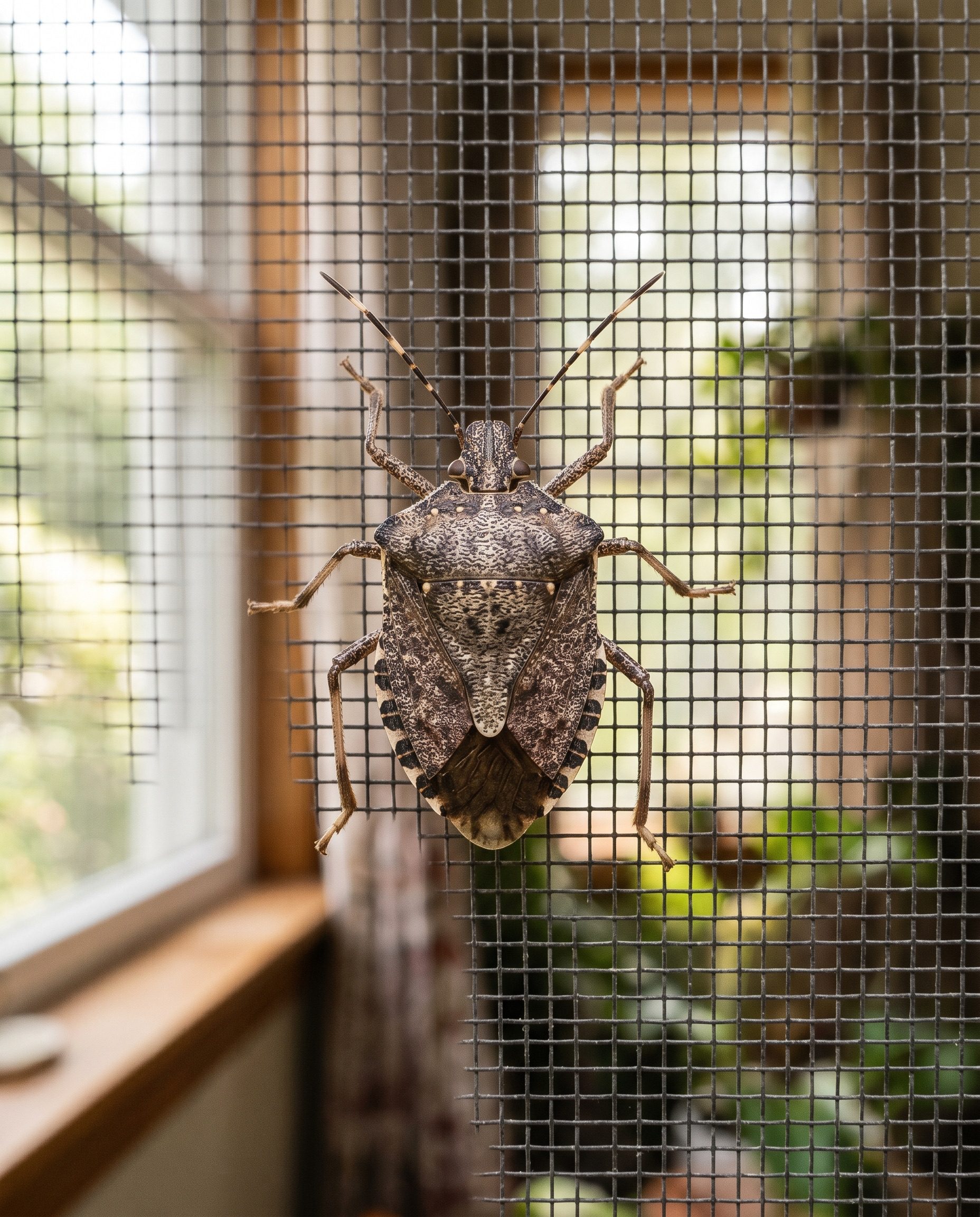
Start with the silhouette, because color varies and shape does not. A stink bug is a hard, flat shield about the size of a thumbnail, wider at the shoulders and narrowing to a point. A boxelder bug is a narrower flat oval, black with thin red lines, and noticeably more elongated than a stink bug. An Asian lady beetle is a small round, domed half-sphere, orange to red, that tucks its legs away when disturbed. A cluster fly is unmistakably a fly, bigger and slower than a housefly, gray, and sluggish on the glass rather than darting.
Once you have the shape, the color confirms it. Stink bugs are mottled brown and gray. Boxelder bugs read black and red. Lady beetles are orange. Cluster flies are dull gray with a faint golden sheen on the chest. That is the whole field key, and it works on a windowsill in under ten seconds.
The brown marmorated stink bug
The stink bug is the one people notice first, partly because of the smell. The confirming feature is the shield outline plus the banded antennae: look for alternating light and dark bands on the last two antenna segments and on the thin rim around the edge of the abdomen. That banding separates the brown marmorated stink bug from native brown stink bugs, which lack the clean alternating pattern. The body is roughly 17 millimeters, about the width of a U.S. dime.
It earns its name honestly. Crushing or even handling one releases a pungent odor from glands on the underside, which is exactly why vacuuming beats squashing indoors. According to Penn State Extension’s profile of the brown marmorated stink bug, this is an invasive species from Asia that gathers on warm south- and west-facing walls in fall, then slips through gaps into wall voids and attics to wait out winter. It does real damage to crops outdoors, but inside your home it is a nuisance, not a threat to the structure. For the full feature-by-feature breakdown, see our brown marmorated stink bug identification guide.
The boxelder bug
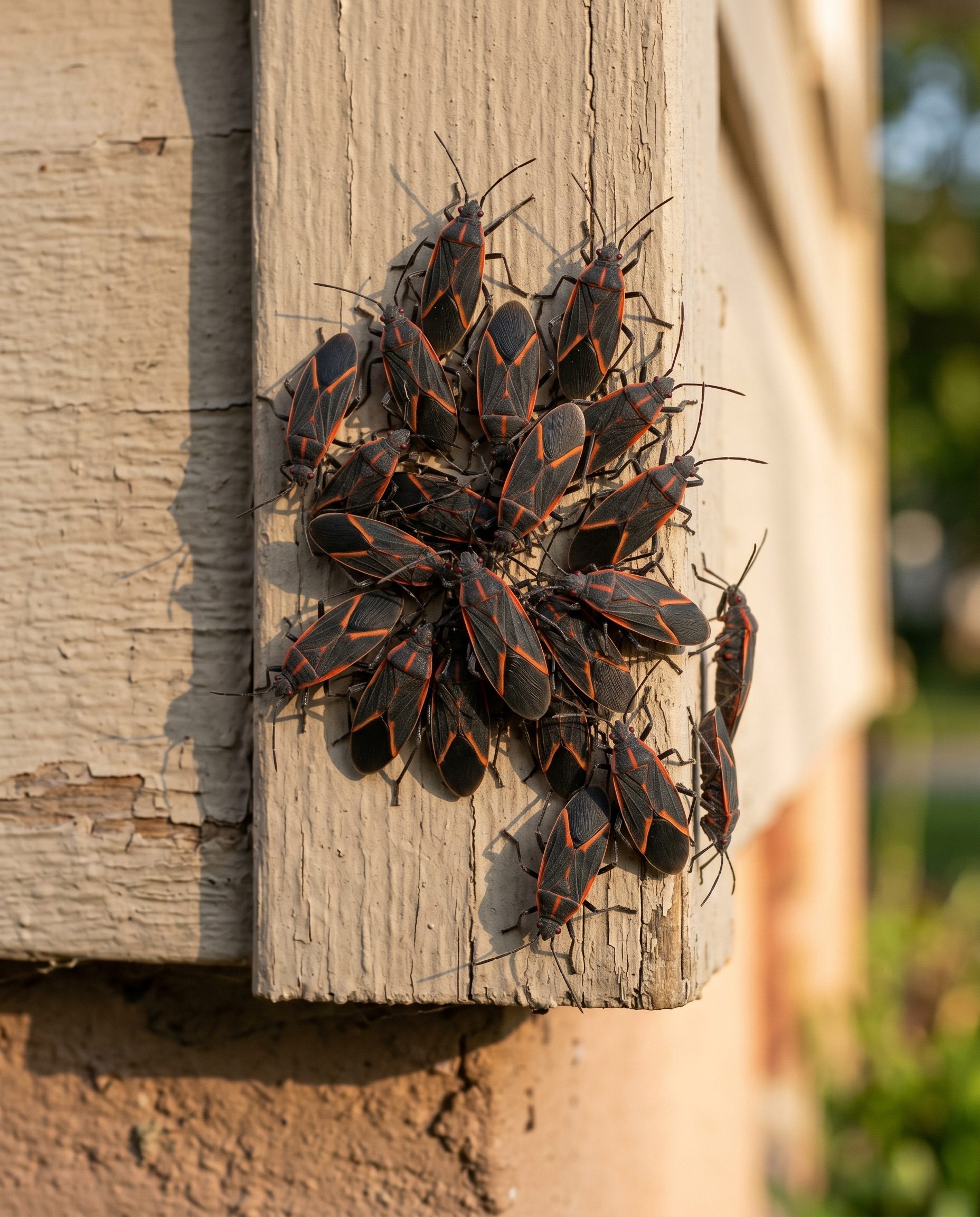
Set a boxelder bug next to a stink bug and the difference is obvious: it is flatter, narrower, and marked in red on black. The confirming feature is the red-orange line tracing the edge of the body and the three lengthwise stripes on the segment behind the head, with the wings folded into a red-bordered X or V across the back. Adults run about 13 millimeters, a touch smaller and far slimmer than a stink bug.
Boxelder bugs feed on boxelder, maple, and ash seeds through the summer and pose no risk to those trees. In fall they mass on sunny walls in the hundreds, which is alarming to see but harmless. They do not bite, do not chew wood, and do not reproduce indoors. University of Minnesota Extension on boxelder bugs notes the only real complaint indoors is the occasional reddish stain their droppings can leave on light fabrics or curtains, which is a laundry problem, not a pest emergency. If they are already clustering on your siding, our guide to getting rid of boxelder bugs covers the outdoor steps that actually reduce the numbers.
The multicolored Asian lady beetle
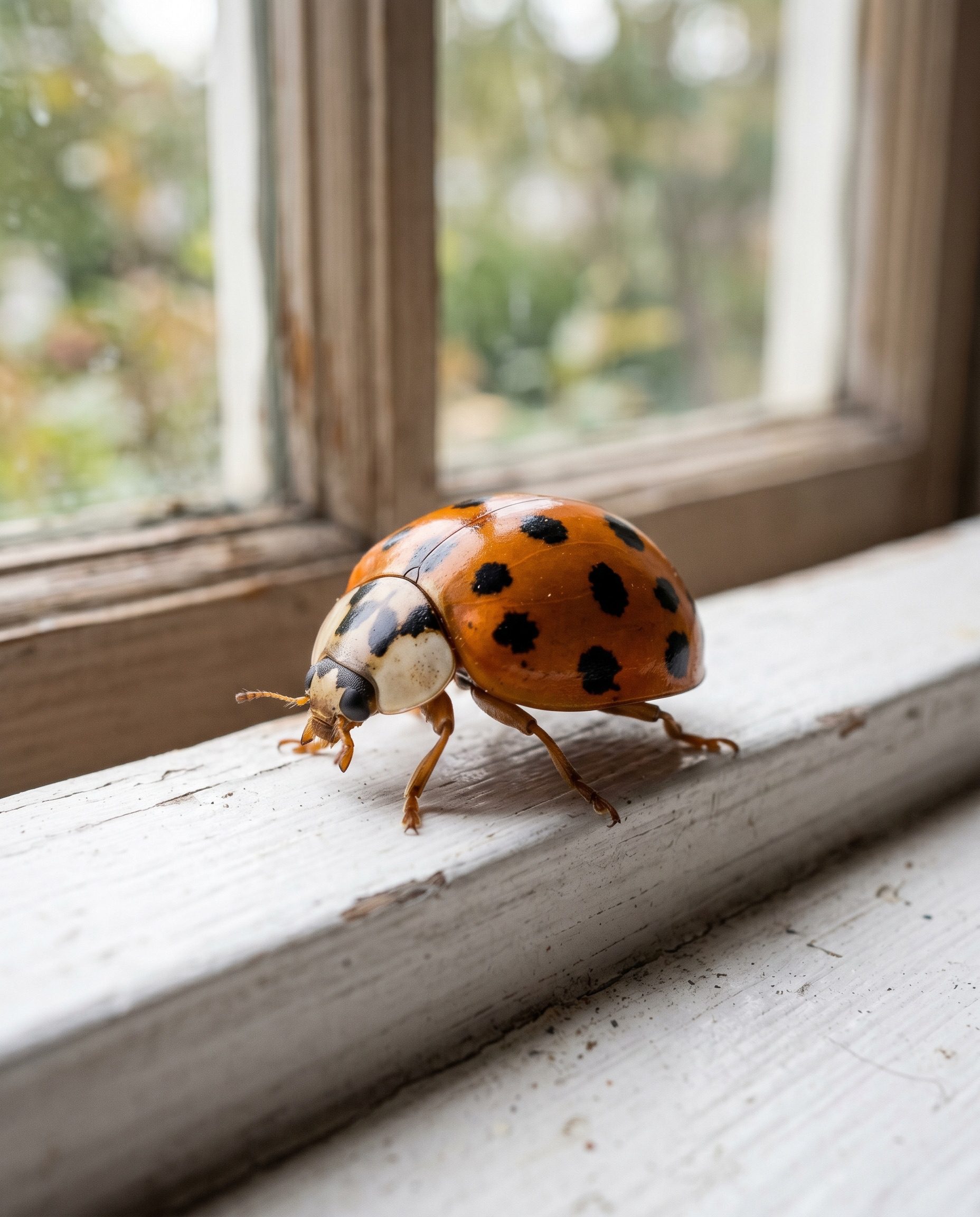
This is the one most people mistake for a harmless native ladybug, and the distinction matters. The confirming feature is the whitish patch behind the head bearing a dark M-shaped or W-shaped mark, depending on which way you look at it. Native ladybugs lack that marking. The Asian lady beetle is also more variable in color, ranging from pale orange to deep red with anywhere from zero to nineteen spots, and it has a rounder, slightly larger dome than the familiar garden ladybug.
Worth saying plainly: lady beetles are partly beneficial. All summer they eat aphids and other soft-bodied pests, which is why they were introduced in the first place. The complaint is purely seasonal, as University of Minnesota Extension on multicolored Asian lady beetles explains, they swarm warm walls in fall, work their way indoors, and can leave a yellowish defensive fluid that stains and smells if handled. A few people react to that fluid or to the beetles’ presence with mild allergy symptoms. Vacuum them rather than crush them, and you avoid both the stain and the odor.
The cluster fly
The cluster fly is the odd one out, because it is a true fly rather than a true bug or a beetle, but it shows up on the same windows for the same reason. The confirming feature is size and sluggishness plus golden hairs on the thorax: it is noticeably larger than a housefly, dull gray with a faint checkered abdomen, and it crawls slowly across glass instead of buzzing around. When several are present they tend to gather, hence the name.
Cluster flies have an unusual life history. Their larvae are parasites of earthworms in the soil, so they are tied to lawns and fields, not to garbage or food, which is why a clean kitchen does nothing to prevent them. The UC IPM Pest Notes on cluster flies and other overwintering home invaders describes how adults move to buildings in fall and settle in attics and wall voids, then reappear on warm winter days when the heat fools them into thinking it is spring. They do not lay eggs indoors and they do not spread disease the way filth flies can. A vacuum and a fly swatter handle the few that wake up.
How to tell them apart at a glance
If you only remember one thing, remember that shape decides it. Here is the four-way key.
| Insect | How to ID | Notes |
|---|---|---|
| Brown marmorated stink bug | Hard brown shield, banded antennae and abdomen edge | Smells if crushed; vacuum, do not squash |
| Boxelder bug | Flat black oval with red edge lines and stripes | Can stain fabric; harmless to home and trees |
| Asian lady beetle | Round orange dome, M-mark behind the head | Partly beneficial; eats aphids all summer |
| Cluster fly | Large slow gray fly, golden hairs on thorax | Earthworm parasite as larva; not a filth fly |
The single shared lesson across all four is the response. Because none of them breed, bite, or damage your home from the inside, the fix is exclusion and a vacuum, not a chemical assault on your walls. Sealing the gaps where they enter is the durable answer, and the EPA’s guidance on safe pest control and exclusion puts caulking, screening, and physical removal ahead of spraying for exactly this kind of nuisance invader.
Common questions
Do any of these fall invaders bite or sting?
No. None of the four bite, sting, or carry disease into your home. Boxelder bugs and lady beetles can occasionally pinch with their mouthparts if you press one against skin, but it is harmless and not a true bite. The worst any of them do indoors is leave a stain or a smell when crushed, which is the best argument for vacuuming instead.
Will they lay eggs and multiply inside my house?
No. All four come indoors only to overwinter, a dormant state called diapause, and none of them reproduce inside. The ones you see in spring are the same individuals that came in last fall, now trying to get back outside. There is no growing infestation to treat, just a fixed group waiting out the cold.
Should I spray insecticide on the bugs I find inside?
No, and Extension programs are consistent on this. Spraying interior walls does not stop new ones from entering through gaps, and dead insects in wall voids can attract carpet beetles later. Vacuum the ones you see and seal the entry points instead. Save any outdoor perimeter treatment decisions for the relevant control article.
Are Asian lady beetles the same as the helpful garden ladybug?
Not quite. The Asian lady beetle is a distinct species with the telltale M-shaped mark behind its head, and it is the one that swarms homes and releases a staining fluid. Native ladybugs rarely invade in large numbers. Both eat aphids and are beneficial outdoors, so the goal is to keep them out, not to wipe them out.
Why do they keep showing up on warm winter days?
Because your heating system fakes them out. Insects tucked into wall voids and attics sense the warmth, mistake it for spring, and crawl toward light, which lands them on your windows. They are trying to leave, not invade further. Let them out or vacuum them, and the trickle stops once outdoor temperatures rise for good.
Final verdict
Four insects cause nearly every fall home invasion, and shape sorts them instantly: a hard brown shield is a stink bug, a flat black oval with red lines is a boxelder bug, a round orange dome is an Asian lady beetle, and a big slow gray fly is a cluster fly. What unites them matters more than what separates them. Every one is an overwintering nuisance that wandered in for warmth, none breed or bite or damage your home from the inside, and a couple of them, the lady beetle especially, are genuinely useful in the garden. So the answer is the same regardless of which one you have. Vacuum the ones already inside, skip the wall spray, and seal the gaps they used to get in, because exclusion is the only fix that keeps next October quieter.
Next steps:
– Confirm a shield-shaped bug with our brown marmorated stink bug identification guide.
– Cut the numbers on your siding with our guide to getting rid of boxelder bugs.
– Close the gaps for good with our guide to pest-proofing your home against fall invaders.