Finding out you’ve been hit by a bullet ant sting is usually not a slow realization. It’s immediate, intense, and strangely “deep,” like the pain is traveling through the limb instead of staying on the skin. People search this topic for one reason: they want to know what’s happening, how long it lasts, and what to do next. This guide explains how to recognize a bullet ant encounter, why the sting hurts so much, what symptoms are normal vs concerning, and the most practical first aid and prevention tips for travelers and rainforest workers.
Quick answer: what a bullet ant sting feels like and what to do first
A bullet ant sting is widely considered the most painful insect sting in the world, with pain that can last up to 12 hours. It is rarely life-threatening, but it can be miserable and sometimes triggers severe reactions in sensitive individuals.
Fast, snippet-friendly checklist
- Where it happens: Lowland rainforests from Honduras through the Amazon Basin (Central and South America).
- What you feel: Immediate, searing pain that becomes deep and “drilling”, often with shaking or sweating.
- Typical timeline: Symptoms often peak within ~30 minutes, then slowly ease over hours.
- First steps (field-friendly):
- Move away from the nest area and sit down.
- Cold compress/ice pack for 10-15 minutes at a time.
- Ibuprofen or acetaminophen if you can take them safely.
- Clean the site with soap and water.
- Get urgent medical help if: trouble breathing, facial swelling, widespread hives, fainting, or progressive weakness.
If you’re comparing bite or sting reactions across pests, see our guide to Mosquito Bites vs Bed Bugs, Fleas, Spiders & Ticks for what “normal” looks like and when a reaction is not.
Bullet ant identification: how to recognize the ant and avoid a second sting
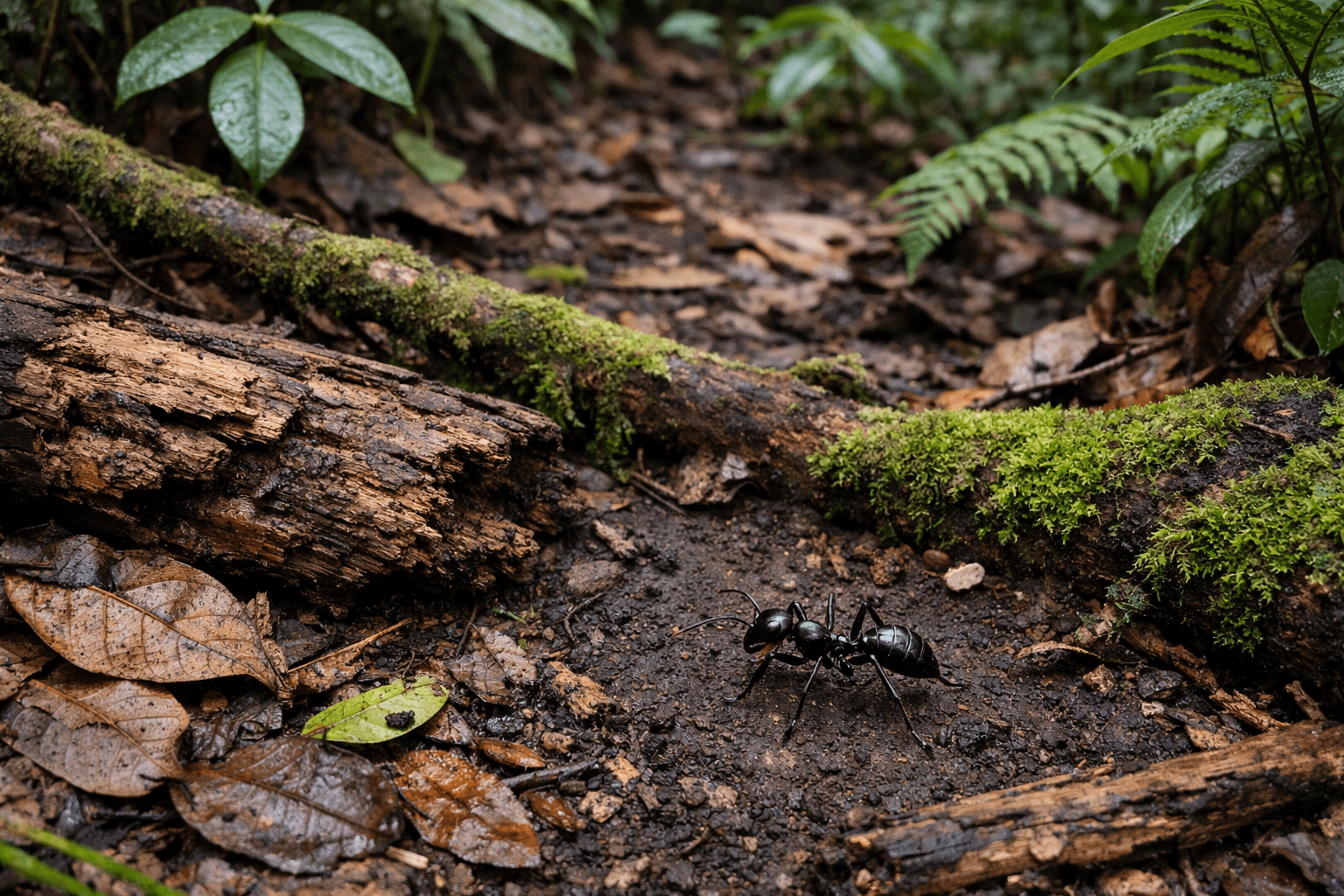
The first challenge with bullet ants is that they don’t look “exotic” at a glance. In the dim understory of a rainforest, a large dark ant on a tree trunk can blend into the background. The second challenge is behavior: bullet ants can be calm while foraging, then turn defensive fast if you get too close to a nest area.
What a bullet ant looks like (quick ID table)
| Feature | What to look for in the field |
|---|---|
| Common name | Bullet ant |
| Scientific name | Paraponera clavata |
| Size | Large worker ants, often 18-30 mm (about 0.7-1.2 in) |
| Color | Dark brown to black, sometimes with a reddish tint |
| Body shape | Robust body, strong legs, noticeable stinger at the tip of the abdomen |
| Where you’ll see them | Tree bases, buttress roots, trails on trunks, forest floor near roots |
| When stings happen | Most often when the ant is pressed against skin, trapped in clothing, or nest is disturbed |
Where bullet ants live and when you’re most likely to encounter them
Bullet ants are associated with humid, lowland tropical forests, especially near large trees and root systems. Travelers often run into them during:
- Hiking and fieldwork on narrow jungle trails where you brush vegetation
- Setting down packs against tree bases or roots
- Putting on boots or gloves that sat on the ground
- Night walks when visibility is low and ants may be on trunks or gear
Practical avoidance tips that actually reduce risk
A few habits prevent most stings:
- Shake out boots, gloves, and clothing before putting them on.
- Wear tall socks and closed footwear when walking off-trail.
- Avoid leaning on tree bases or stepping onto root mats without looking.
- If you see large ants moving in a purposeful line, don’t stand in the trail. Step away and let them pass.
If you’re camping or staying in a lodge and ants become a recurring indoor problem, don’t rely on random sprays. Use targeted methods from our Best Natural Ant Repellents and Sprays guide, and consider baits if you can identify the foraging routes.
Why a bullet ant sting hurts so much (and why it lasts)
AmazonBasics Reusable Cold Compress, 1 Count
A cold compress can help alleviate the pain and swelling from a bullet ant sting, making it a practical first aid item for travelers.
The pain isn’t just “more venom.” It’s a specific kind of venom chemistry that keeps pain signals firing longer than your nervous system expects. Entomologists often compare it to a doorbell that gets jammed. Instead of a quick ring, it keeps buzzing.
The science in plain language: venom that keeps nerves “on”
Bullet ant venom contains poneratoxin, a peptide that targets voltage-gated sodium channels in nerve cells. Those channels help start and stop electrical signals. When toxins interfere with them, nerves can fire too easily or for too long.
Research highlighted by the University of Queensland news release on ant neurotoxins and reporting summarized by Nature Communications coverage via Phys.org describes how certain ant venom peptides can hyperactivate sensory neurons. In effect, the nervous system keeps broadcasting pain messages even after the initial injury moment has passed.
A helpful way to think about it:
- A typical sting is like a match flare: bright, sharp, then fading.
- A bullet ant sting is more like a stuck accelerator: the signal stays elevated, and your body reacts accordingly.
What the Schmidt Sting Pain Index really tells you
The famous benchmark here is the Schmidt Sting Pain Index, developed by entomologist Justin Schmidt. In his descriptions, bullet ant pain ranks at the top, often summarized as “pure, intense” pain with a long duration. The Natural History Museum’s overview of the Schmidt pain index explains how the index compares stings across many insects and why duration matters as much as intensity.
Comparison chart: pain and duration (context, not bravado)
| Insect | Schmidt rating (0-4) | Typical feel (short summary) | Common duration |
|---|---|---|---|
| Bullet ant | 4+ | Intense, deep, relentless | Up to 12 hours |
| Tarantula hawk wasp | 4 | Lightning-bolt sharpness | Minutes to hours |
| Honey bee | ~2 | Burning, localized | Minutes to an hour |
| Fire ant | ~1 | Sharp, then itchy pustules | Hours to days (itch) |
For a readable overview of how Schmidt described these stings, see BBC Science Focus coverage of bullet ant pain.
Bullet ant sting symptoms: what’s normal, what’s not, and how long it lasts
Advil Pain Reliever/Fever Reducer, 200 mg, 100 Tablets
Ibuprofen is recommended for pain relief after a bullet ant sting, making this product highly relevant for those seeking relief.
Pain is the headline, but it’s not the only symptom. Many people also experience whole-body stress responses that feel alarming if you’re not expecting them. Knowing the “usual” pattern can prevent panic and help you decide when to seek care.
Common symptoms (most people)
Expect a mix of local and systemic effects:
- Immediate severe pain at the sting site
- Swelling and redness around the puncture
- Sweating and goosebumps
- Trembling or shaking in the affected limb
- Nausea or a general sick feeling
- Tender lymph nodes near the area (for example, in the armpit after a hand sting)
Many accounts and summaries, including Encyclopaedia Britannica’s bullet ant overview, note that the effects are intense but typically resolve without lasting harm.
Timeline: what to expect hour by hour (quick visual)
- 0-5 minutes: Immediate, sharp pain. People often reflexively jerk away.
- 5-30 minutes: Pain ramps up and spreads deeper. Sweating and shaking may begin.
- 30 minutes-2 hours: Peak discomfort for many stings. Sleep and walking can be difficult.
- 2-12 hours: Pain gradually declines but can surge in waves.
- 12-24 hours: Most symptoms fade. Local tenderness may linger.
Red flags: when a sting becomes a medical problem
A bullet ant sting is not known for causing direct fatalities, but all stings can trigger allergic reactions. Seek urgent care if you notice:
- Trouble breathing, wheezing, or throat tightness
- Swelling of lips, tongue, face, or around the eyes
- Widespread hives or intense itching away from the sting site
- Dizziness, fainting, confusion, or rapid heartbeat
- Progressive weakness or symptoms that keep worsening after several hours
If you’ve had anaphylaxis before from bees, wasps, or ants, treat this as higher risk. In remote areas, that means carrying an epinephrine auto-injector if prescribed and having a plan for evacuation.
A common misconception: “It must be deadly”
It’s understandable to assume extreme pain equals extreme danger. In reality, the bullet ant’s sting is infamous for pain, not lethality. The bigger risk is secondary issues: falls, dehydration, panic, or an allergic reaction in a sensitized person.
Bullet ant sting treatment: first aid that helps (and what to avoid)
Neosporin Original Antibiotic Ointment, 0.5 oz
Cleaning the sting site is crucial, and applying an antibiotic ointment can help prevent infection, making this product a good recommendation.
When pain is overwhelming, it’s tempting to try anything. But the best approach is simple: reduce inflammation, protect the skin, and watch for red flags. There is no special “antivenom” used for routine bullet ant stings.
Step-by-step first aid (field-tested basics)
- Get to a safe spot away from the nest or trail. Bullet ants may recruit nestmates if disturbed.
- Wash the area with soap and clean water. This reduces infection risk from scratching later.
- Cold therapy: Apply an ice pack wrapped in cloth for 10-15 minutes, then remove for 10 minutes. Repeat.
- Pain control:
- Ibuprofen can help with inflammatory pain.
- Acetaminophen can help with pain if you can’t take NSAIDs.
Follow label directions and personal medical guidance.
- Elevate the limb if swelling is building.
- Avoid scratching. If itching follows later, an oral antihistamine may help some people.
What not to do (common mistakes)
- Do not cut the skin or try to “bleed out” venom.
- Do not apply heat as a default. Heat can worsen swelling and discomfort.
- Do not use harsh chemicals (gasoline, bleach, concentrated alcohol) on the sting site.
- Do not wrap tightly with tourniquets. This can create additional injury.
If bullet ants are around your lodging: control options
Bullet ants are mostly a rainforest problem, but other aggressive ants can cause stings around homes, patios, and camps. If you’re dealing with recurring ant activity, use targeted strategies:
- Baits are often more effective than contact sprays because workers carry the toxicant back to the colony.
- Perimeter exclusion (sealing gaps, reducing food residue) prevents repeat foraging.
For product-style guidance and safe placement tips, see Best Ant Killers & Baits: Complete Buyer's Guide. If you prefer low-toxicity approaches first, start with our Best Natural Ant Repellents and Sprays guide.
When to call a professional
If ants are nesting in structural voids, repeatedly stinging pets or children, or you can’t locate the colony, professional help is reasonable. A licensed technician can identify species, use baits correctly, and reduce exposure to broad-spectrum sprays.
Prevention and context: where bullet ants fit among “painful insect stings”
People often ask whether bullet ants are “the worst sting on Earth,” and by many entomology comparisons, they are among the worst for pain. But context matters: different insects excel at different “problems” – pain, toxicity, or allergic risk.
Where bullet ants live (and why travelers get surprised)
Bullet ants are native to Central and South America, especially humid forest regions. Encounters are often accidental. You don’t need to “mess with” the ant to get stung – you only need to press one against your skin while grabbing a vine, pulling on a boot, or leaning on a trunk.
Cultural note: the glove ritual (and why it’s not a stunt)
Some people learn about bullet ants through the Sateré-Mawé initiation ritual involving woven gloves containing ants. It’s a cultural practice with specific meaning. It’s also a controlled context with community knowledge and support. It should not be copied as a dare or tourist challenge.
Quick comparison: bullet ant vs other common “sting” concerns
If your goal is to decide what’s likely in your area, here’s a practical snapshot:
- Bullet ant: rainforest regions; sting pain is the main issue; usually a single sting incident.
- Fire ants: common in many warm regions; multiple stings; itchy pustules and secondary infection from scratching.
- Bees/wasps: widespread; allergic reactions are a major concern for susceptible people.
If you’re trying to identify what bit or stung you based on symptoms and timing, our comparison guide Mosquito Bites vs Bed Bugs, Fleas, Spiders & Ticks helps you narrow it down with visual patterns and reaction timelines.
Why scientists care about bullet ant venom
Beyond the shock factor, ant venoms are scientifically valuable because they reveal how pain pathways work. Reporting summarized by Live Science’s explanation of ant venom and nerve targets notes parallels between some ant toxins and other venomous animals in how they influence nerve signaling. That kind of research can inform future pain therapies, even if the sting itself is nothing anyone wants to experience.

Conclusion
A bullet ant sting hurts so intensely because its venom targets nerve signaling in a way that keeps pain messages firing for hours. The good news is that, for most people, symptoms fade within a day and serious complications are uncommon. Use cold compresses, basic pain relief, and careful wound hygiene, and watch closely for allergic red flags.
If ants are becoming a recurring problem where you live or travel, focus on prevention and targeted control. Start with Best Natural Ant Repellents and Sprays, and if you need a stronger approach, review Best Ant Killers & Baits: Complete Buyer's Guide for practical, safer placement strategies.
As an Amazon Associate, I earn from qualifying purchases. Product recommendations are based on real reviews and independent research.