Finding a line of ants in the kitchen can feel like they appeared overnight, but the fix is usually straightforward once you understand what’s driving them. This guide explains how to get rid of ants by combining fast relief with longer-term control, the same approach pest pros use: remove the food and water “reward,” break the trail, and use baits that reach the colony. You’ll also learn how to spot the most common house-invading ants and when it’s smarter to call a professional.
Quick answer: how to get rid of ants (fast, without making it worse)
To get rid of ants, focus on the colony, not the ants you can see. Here’s the quickest, most reliable game plan:
- Stop the trail: Clean the ant path with soap and water, then wipe with a 1:1 vinegar-water solution.
- Remove attractants: Store food airtight, rinse recyclables, and dry sinks and counters nightly.
- Use slow-acting bait: Place gel or station baits along trails and near entry points. Avoid spraying the trail.
- Seal entry points: Caulk cracks, add door sweeps, and weatherstrip windows after baiting starts.
- Track moisture: Fix leaks and damp wood, especially if you suspect carpenter ants.
Do this today: Put bait where ants walk, not in the middle of open floors. If you need product guidance, see our picks for best ant killers and baits and ant traps for kitchen and bathroom.
Why ants keep coming back: what’s really happening in your walls
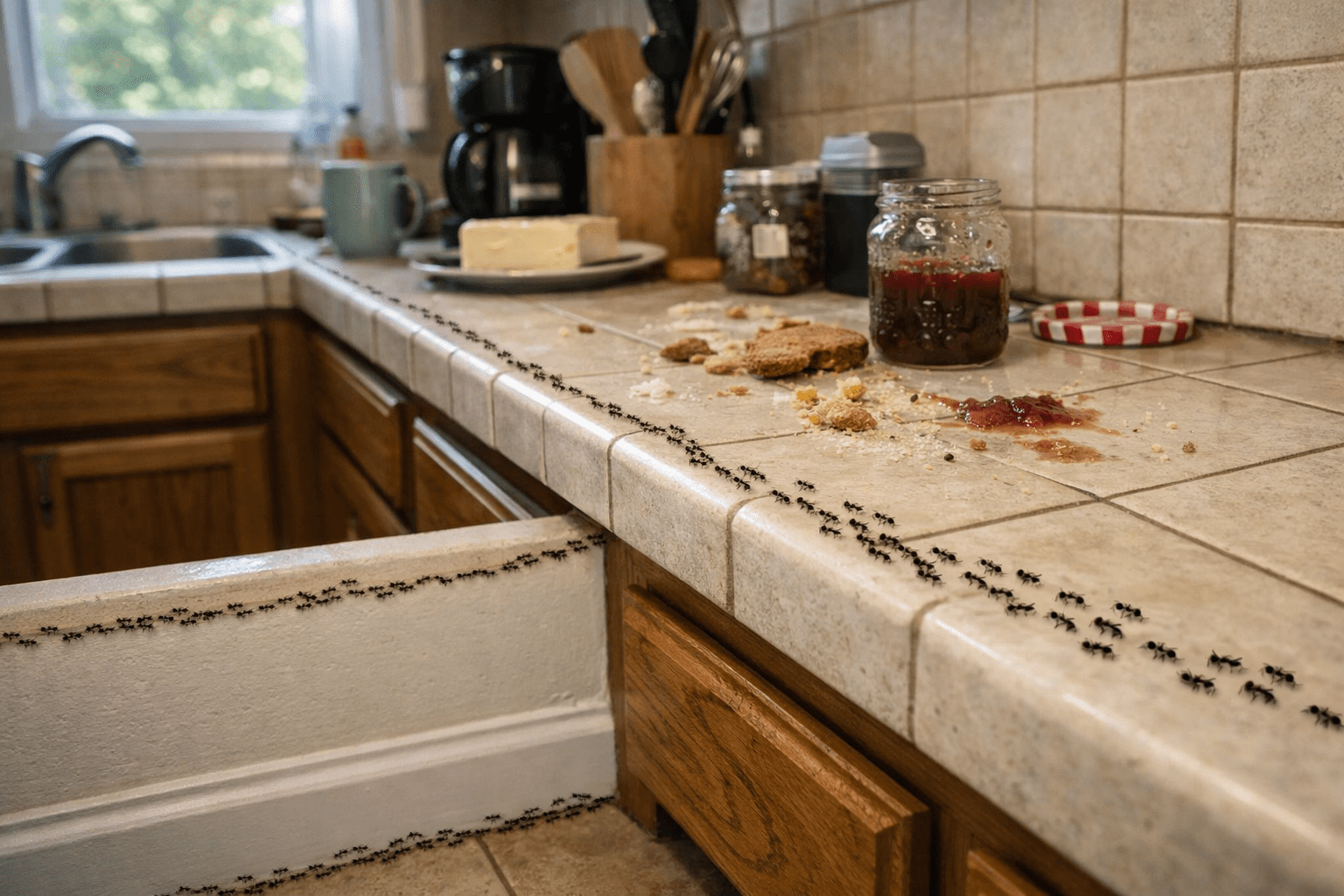
A few ants on the counter are rarely “random.” Ant colonies run like a supply chain. A scout finds food or water, then lays a pheromone trail that guides more workers to the same spot. If the reward stays available for even a day or two, that trickle can become a steady stream.
This is also why killing visible ants often feels satisfying but doesn’t solve the root problem. You’re only removing workers, not the queen or the brood. Many species can also reroute quickly, so the trail “moves” to a new spot after a spray or a wipe-down.
According to the National Pest Management Association (NPMA) ant survey summary, ants are among the most common pests professionals treat, and multiple visits are often needed for full control. That lines up with what entomologists see in the field: ant control works best when you combine sanitation, exclusion, and baiting instead of relying on one tool.
The 3 drivers that make ants invade homes
Think of ants as following a simple checklist:
| Driver | What ants are seeking | Common household examples | What to do first |
|---|---|---|---|
| Food | Sugars, grease, proteins | crumbs, pet food, syrup, trash | deep clean + airtight storage |
| Water | moisture and humidity | leaky pipes, wet sponges, plant trays | fix leaks + dry surfaces |
| Shelter | safe nesting sites | wall voids, damp wood, mulch near foundation | reduce moisture + seal gaps |
Actionable takeaway
If you only do one thing, remove the reward (food and water) for 48 hours while bait is out. That makes bait far more attractive and speeds colony collapse.
Identify the ant first: different ants require different strategies
Raid Ant and Roach Killer, 17.5 oz
Raid Ant and Roach Killer 17.5 oz earns a strong 4.6-star rating from over 12,400 Amazon reviews for its reliable contact and residual kill on ants and roaches, making it a top choice for household pest control at an affordable ~$10 price point; users praise its effectiveness and ease of use, though the potent odor requires good ventilation—recommended for quick, proven pest elimination.
Most U.S. homes are invaded by a small group of species, even though North America has hundreds of ant species overall. Identification matters because the “best” control can change. For example, carpenter ants point to moisture-damaged wood, while pharaoh ants can split into more colonies if you use the wrong approach.
Use this quick field guide before you treat:
| Ant type (common) | Size | Color | Clues you’ll notice | Typical nesting |
|---|---|---|---|---|
| Carpenter ant (Camponotus spp.) | 1/4 to 1/2 inch (6-13 mm) | black or red-black | sawdust-like frass, rustling in walls, activity at night | damp wood, wall voids, attics |
| Odorous house ant (Tapinoma sessile) | 1/16 to 1/8 inch (1.5-3 mm) | brown to black | smell like “rotten coconut” when crushed | under sinks, near moisture |
| Pavement ant (Tetramorium immigrans) | 1/8 inch (3 mm) | brown-black | trails along baseboards, enters from cracks | under slabs, foundations |
| Pharaoh ant (Monomorium pharaonis) | 1/16 inch (2 mm) | yellow to light brown | multiple trails, hard to eliminate, can spread germs | warm indoor voids, multi-nest |
A simple “where are they coming from?” checklist
- Kitchen trail to pantry or pet bowl: odorous house ants or pavement ants are common.
- Bathroom trail to tub or sink: moisture-loving ants often follow plumbing.
- Sawdust piles or tiny wood shavings: suspect carpenter ants.
- Tiny yellow ants in multiple rooms: treat cautiously, could be pharaoh ants.
Actionable takeaway
If you see frass (sawdust-like debris) or hear faint rustling in a wall, skip the guesswork and use carpenter-ant-specific methods from our carpenter ant treatments guide. Structural moisture is usually part of the story.
How to get rid of ants using IPM (the method pros trust)
Terro T300B Liquid Ant Baits, 12 Baits
These liquid ant baits are designed to attract and kill ants, targeting the colony as suggested in the article.
If you want the most dependable results, use an Integrated Pest Management approach. IPM isn’t a buzzword. It’s a practical order of operations: reduce what ants need, block access, then use targeted products that reach the colony. The EPA’s integrated pest management guidance emphasizes prevention and least-risk control first, which is especially important indoors.
Here’s the step-by-step plan that works for most “ants in house” situations.
Step 1: Sanitation that actually changes ant behavior (15 minutes)
Ants recruit more workers when food is easy. Your goal is to make your home a low-reward environment.
- Vacuum edges of floors, under appliances, and cabinet corners.
- Wipe counters with soap and water, then dry.
- Store cereal, sugar, and snacks in sealed containers.
- Rinse recyclables and take out trash frequently.
- Wash pet bowls daily and avoid leaving food out overnight.
Pro tip: Don’t forget the “invisible” foods. Grease film near the stove and sticky residue inside trash lids can keep ants motivated.
Step 2: Break trails without broadcasting danger
After cleaning, wipe trails with a vinegar-water mix or mild detergent solution. This helps remove pheromone cues.
Avoid strong-smelling cleaners directly on bait placements. You want ants to keep walking to the bait.
Step 3: Bait correctly (this is where most DIY fails)
Baits work because workers carry a slow-acting toxicant back to nestmates and the queen. That’s how you eliminate the colony instead of chasing trails.
Bait placement rules:
- Place bait along edges and trails, not in the center of a room.
- Use multiple small placements rather than one big one.
- Do not spray near bait. Sprays can repel ants and reduce bait pickup.
- Be patient. Expect 3-7 days for noticeable decline, sometimes 2 weeks.
For product-type comparisons, see our best ant killers and baits and room-specific options like ant traps for kitchen and bathroom.
Step 4: Exclusion (seal them out after baiting begins)
Once ants are feeding on bait, start sealing entry points so new foragers don’t replace the ones you’re removing.
- Caulk gaps around baseboards, pipes, and cabinets.
- Add door sweeps and repair torn screens.
- Seal exterior cracks in foundation and siding.
Step 5: Fix moisture and outdoor pressure
Moisture is a major driver for many species, and damp wood is a red flag for carpenter ants. Repair leaks, improve ventilation, and replace water-damaged materials.
Actionable takeaway
If ants are actively trailing, bait first, seal second. Sealing too early can cause trails to shift and slow control.
Natural and conventional ant control options (what works, what doesn’t)
Hot Shot Bed Bug and Flea Killer, 1 Gallon
Hot Shot Bed Bug and Flea Killer 1 Gallon earns a solid 4.5-star rating from over 2,500 Amazon reviews for its effective contact killing of bed bugs, fleas, and eggs, with the large size offering great value at around $25. Reviewers love its fast action and ease of use, though the strong fumes and need for prep work are common drawbacks. Ideal for severe infestations as a reliable over-the-counter option, but pair with professional advice for ongoing issues.
Many homeowners want lower-toxicity options, especially around kids and pets. That’s reasonable, but it helps to separate “repels a few ants” from “eliminates the colony.”
Natural options that can help
Natural methods are best used for trail disruption and short-term deterrence, not as a stand-alone solution for a large colony.
Options with practical use:
- Soap and water: physically removes trail pheromones and food residue.
- Vinegar-water wipes: helps reduce trail-following behavior on hard surfaces.
- Diatomaceous earth (food grade): can kill ants by abrasion when applied as a dry dust in wall voids or along cracks (keep it dry to work).
- Plant-based repellents: some essential oil blends repel foragers temporarily.
For recipes and safer placement tips, use our guide to natural ant repellents and sprays.
Conventional options that solve bigger infestations
When ants are established, baiting is usually the most effective indoor tool. Insecticidal sprays have a place, but mainly as crack-and-crevice or perimeter treatments, not as a “trail killer.”
What to choose (general guidance):
- Baits (gel or stations): best for colony elimination indoors.
- Non-repellent liquid treatments (pro-style): useful in voids and entry points, depending on species.
- Repellent sprays: can scatter some ants and reduce bait uptake if misused.
If you’re treating outdoors to reduce pressure indoors, focus on nests, trails, and perimeter zones. Our guide to outdoor ant control for lawns and gardens walks through timing, placement, and common mistakes.
What doesn’t work well (common time-wasters)
- Spraying a visible trail and assuming the problem is solved
- Randomly switching products every day (it disrupts baiting)
- Using strong cleaners directly on bait placements
- Treating without addressing leaks, crumbs, or pet food routines
Actionable takeaway
Use repellents to steer ants away from a spot, but use baits to end the infestation. Repelling without baiting often turns into an endless cycle.
When to call a professional (and what to do until they arrive)
Some ant problems are stubborn even with good DIY technique. That’s not a failure. It’s often a species issue, a hidden nest, or a moisture and structural condition that needs tools beyond a typical household kit.
Situations where professional help is recommended
- Carpenter ants: especially if you see frass, soft wood, or repeated indoor activity.
- Pharaoh ants: spraying can cause “budding,” where colonies split and spread.
- Recurring infestations: ants return every few weeks despite baiting and sanitation.
- Swarmers (winged ants) indoors: may indicate a mature colony nearby.
- Multiple rooms with heavy trails: suggests satellite nests or widespread access points.
The NPMA notes ants are among the most frequently treated pests, and repeat service is common for full control. That matches real-world outcomes: colonies can be large, and nests can be hidden in wall voids, under slabs, or in damp structural wood.
What to do before the appointment (so treatment works faster)
Use this short prep list:
- Don’t spray trails for 3-5 days before service (it can interfere with baiting and inspection).
- Document activity: take photos and note times (morning vs night).
- Mark entry points: painter’s tape near cracks or gaps helps technicians.
- Reduce clutter under sinks and in pantries for access.
- Fix obvious leaks if possible, or at least dry the area daily.
Actionable takeaway
If you suspect pharaoh ants (tiny, yellow, multiple trails), avoid DIY spraying. Use baits and get a professional identification if activity persists.
Key takeaways (printable checklist)
- Ants follow food, water, and shelter. Remove the reward and control becomes easier.
- Baits beat sprays for most indoor infestations because they target the colony.
- Clean trails to reduce pheromones, but don’t sabotage bait with sprays or harsh cleaners nearby.
- Seal entry points after baiting starts, and fix moisture issues to prevent repeat invasions.
- Call a pro for carpenter ants, pharaoh ants, or recurring infestations.
Conclusion
The most dependable way to get rid of ants is to treat the cause and the colony at the same time: tighten up sanitation, place slow-acting baits where ants actually travel, then seal entry points and fix moisture. Most infestations fade quickly once the trail loses its reward and the colony starts feeding on bait.
For next steps, compare options in our best ant killers and baits guide, or if you prefer lower-toxicity approaches, start with natural ant repellents and sprays.
As an Amazon Associate, I earn from qualifying purchases. Product recommendations are based on real reviews and independent research.