Finding the best ant killers comes down to one thing: choose a product that reaches the colony, not just the ants you can see. If you have a trail across the counter, a mound in the lawn, or “mystery ants” that keep returning after you spray, you are dealing with a social insect that shares food and information fast. This guide breaks down which ant baits, sprays, and granules work best for common household situations, how to place them correctly, and what to do if the infestation keeps bouncing back.
Quick answer: which ant killers work best?
If you want long-term control, bait is usually the best first choice because it can spread through the nest. Sprays are best for quick knockdown and barrier protection, but they rarely solve the root problem alone.
Use this quick picker:
| Your situation | Best option | Why it works | What to expect |
|---|---|---|---|
| Ant trail indoors (kitchen, bathroom) | Liquid bait or gel bait | Workers carry slow-acting toxin back to the colony | More ants at first, then fewer in 3-7 days |
| Ants around doors, windows, baseboards | Residual perimeter spray + bait | Spray blocks entry; bait targets colony | Immediate reduction plus longer-term control |
| Ants nesting in yard soil | Granular bait (broadcast) | Foragers take bait into outdoor colonies | Improvement in 1-3 days, may need reapply after rain |
| Fire ant mounds | Fire ant-specific granules | Targets mound and surrounding workers | Fast mound decline, often within days |
| Ants keep returning after treatment | Species ID + rotate bait type | Different ants prefer sweets vs proteins | 1-2 weeks for a real trend line |
Rule of thumb: if you can follow a line of ants, place bait directly on the trail and avoid spraying near it.
Why bait beats sprays for long-term ant control (most of the time)
If you have ever sprayed a line of ants and watched them disappear – only to return the next day – you have already seen the core problem. Most sprays kill the workers you hit, but the colony keeps producing new workers. The queen stays protected in a nest wall void, under a slab, or deep in soil.
Baits work differently. Ants are built for cooperation. Foragers collect food, then share it back at the nest through trophallaxis (mouth-to-mouth food exchange). When the “food” is a slow-acting toxicant, it spreads like a shared meal at a family gathering. That is why entomologists and pest managers typically recommend baiting as the backbone of ant treatment, especially indoors.
According to the University of California Statewide Integrated Pest Management Program, sanitation and exclusion paired with targeted baiting is the most reliable approach for household ants. That combination is also safer for beneficial insects than blanket outdoor spraying because you are not coating large areas with insecticide.
What makes a bait actually work?
A good bait has three traits:
-
It matches the ants’ appetite
Many invasive home invaders (like Argentine ants) strongly prefer sweets. Others switch between sugars and proteins depending on season and brood needs. -
It is slow acting
Fast-kill products can stop sharing behavior. Slow-acting ingredients give foragers time to distribute the dose. -
It is placed where ants already travel
Ants are commuters. Put bait on their “highway,” not in the middle of an empty room.
Bait vs spray at a glance:
- Baits: best chance of colony-level elimination; slower; requires correct placement.
- Sprays: fast knockdown; useful as a barrier; often misses the queen and brood.
Practical takeaway: start with bait for active trails, then add a perimeter barrier only where ants enter.
Best ant killers by type: baits, sprays, and granules (and when to use each)
Terro T300B Liquid Ant Bait Ant Killer, 12 Baits
This product is a liquid bait that effectively targets ant colonies by allowing workers to carry the bait back to the nest, aligning perfectly with the article’s emphasis on baiting for long-term control.
Walk into a hardware store aisle and it is easy to overbuy. The label promises “kills on contact,” “kills the queen,” “works in minutes,” and more. The trick is matching the tool to the job and the environment – indoor, outdoor, wet, dry, pet-accessible, and so on.
Here is a clear comparison of the main categories, including what they do well and where they disappoint.
1) Liquid ant baits (best for sweet-seeking indoor ants)
Liquid baits are often the most reliable choice for indoor trails because they stay attractive and easy to drink. Many use borax or boric acid salts at low concentrations, which can be effective when ants feed and share it over time. Health guidance and common DIY ratios for borax-based mixtures are widely discussed in consumer medical resources like Healthline’s overview of ant control options.
Best uses:
- Kitchen and bathroom trails
- Window sill and baseboard traffic lanes
- Persistent sweet-feeding ants
Common mistakes to avoid:
- Putting bait “near” ants instead of on the trail
- Spraying cleaner or insecticide next to the bait (repels or kills foragers before they share)
- Wiping away the bait too soon because you see more ants on day 1
2) Gel baits (great for cracks, corners, and small placements)
Gel baits shine when you need precision. You can place pea-sized dots in corners, behind appliances, or along a crack where ants disappear. Many gel formulas use modern active ingredients designed for colony transfer.
Best uses:
- Apartments and condos (shared walls mean shared ants)
- Tight spaces where a bait station will not fit
- Ants traveling along cabinet seams or tile edges
3) Granular baits (best for outdoor nests and perimeter foraging)
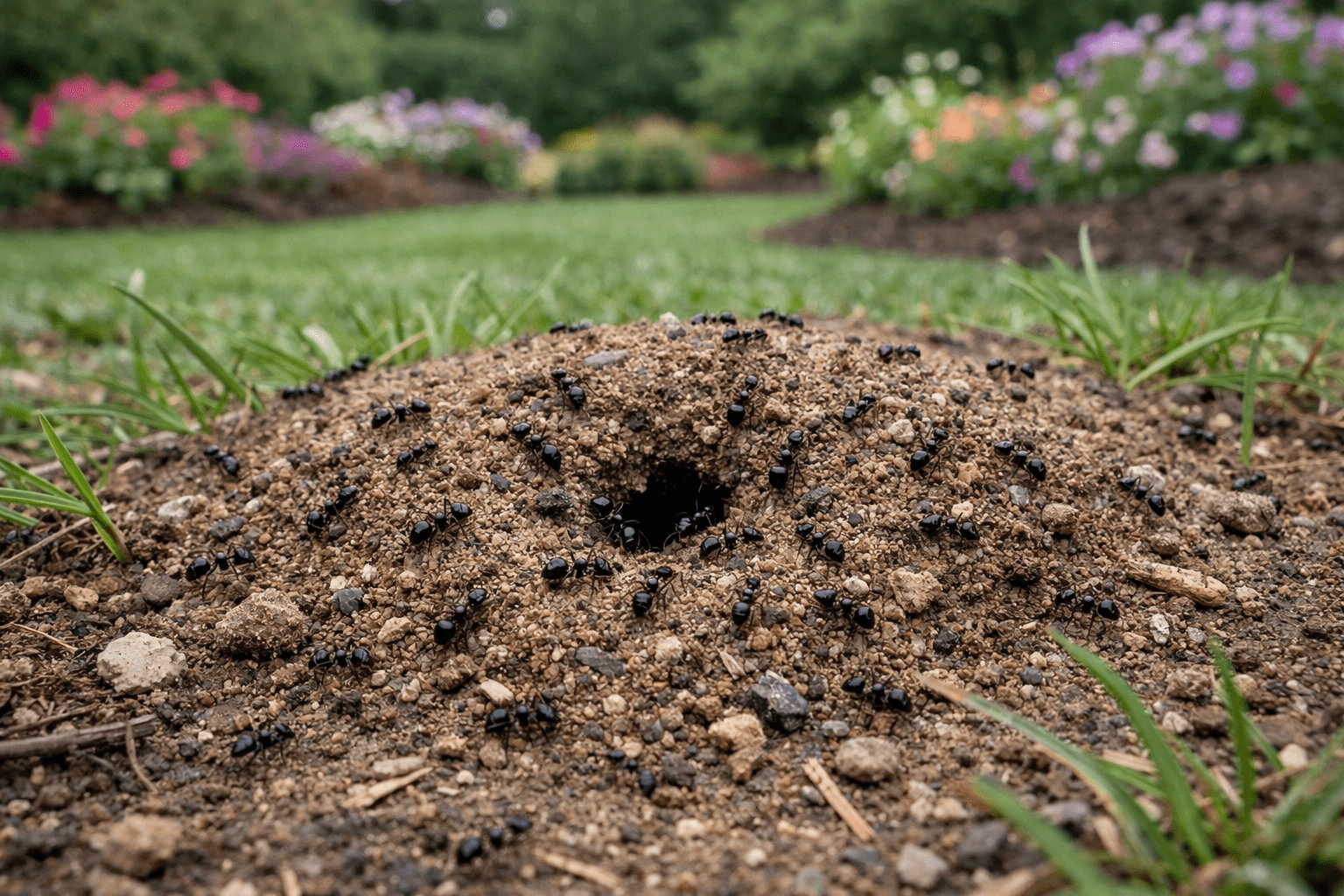
Granules are designed for outdoor foragers. Think of them as “take-home meals” that workers carry back to the nest. They can work very well, but moisture is the enemy. Rain, irrigation, and heavy dew can reduce attractiveness or break down the bait.
Best uses:
- Yard infestations and ant activity along sidewalks
- Colonies under mulch or landscape stones
- Fire ant programs (with fire ant-labeled products)
4) Residual sprays (best for entry points and quick relief)
Sprays have a place, especially when ants are actively entering through a door threshold, weep holes, or a foundation crack. A residual barrier can reduce incoming workers, buying time while bait does the deeper work.
A practical overview of why baiting and liquid applications are used differently in the field is discussed in pest control education resources like this ant bait vs liquid application explainer from a pest control training article.
Best uses:
- Exterior entry points (doors, windows, utility penetrations)
- Immediate knockdown of visible ants
- Preventing re-entry after you remove a food source
Key caution: do not spray directly over active bait placements. You want ants to keep feeding and sharing.
How to use ant baits correctly (placement, timing, and a DIY option)
Ortho Home Defense Insect Killer for Indoor & Perimeter2, 1 Gallon
Ortho Home Defense Insect Killer for Indoor & Perimeter2 receives positive feedback for effectively killing common household pests like ants, roaches, and spiders while creating a long-lasting indoor barrier that dries clear without fumes, though Amazon-specific data like ASIN, ratings, and price could not be verified from available sources; suitable for affiliate recommendation where bug control is needed based on Walmart and product site reviews.
Most bait failures are not product failures. They are placement failures. Ants follow pheromone trails like a GPS route. If your bait is not on that route, it is background noise.
Here is a simple, repeatable method that works for most indoor infestations.
Step-by-step baiting plan (10 minutes, then short check-ins)
-
Follow the trail to the “decision point.”
Look for where ants split directions, disappear into a crack, or turn a corner. That spot is prime bait real estate. -
Place bait directly on the trail.
Use a station if you have kids or pets. If using gel, place small dots every 6-12 inches along the route. -
Do not clean the trail for the first 24 hours.
It feels wrong, but it helps more workers find the bait quickly. -
Expect a surge on days 1-3.
Increased activity usually means recruitment is happening. That is what you want. -
Refresh bait as it empties or dries.
Many indoor trails need replenishment over 7-14 days. -
After activity drops, clean and exclude.
Now wipe with soapy water, then seal entry points with caulk.
DIY borax bait (when it makes sense)
A classic DIY approach is a low-dose borax sugar bait. One commonly shared ratio is:
- 1/2 teaspoon borax
- 8 teaspoons sugar
- 1 cup warm water
Soak cotton balls and place them in shallow lids near trails. Wear gloves, keep it away from children and pets, and clean up residue afterward. DIY baits can work, but commercial stations are usually easier to manage safely and consistently.
Small but important details that change results
- Match the food type: if ants ignore sweet bait, try a protein or dual bait formula.
- Avoid repellent cleaners near bait: strong scents can reduce feeding.
- Do not block the trail with spray: you want foragers alive long enough to share.
If you are building a broader home plan, it helps to think in “zones” – indoor baiting plus outdoor prevention. Homeowners often apply that same layered logic for other pests too, like these mosquito control methods that combine source reduction with targeted tools.
Ant species clues that change which product works (Argentine, carpenter, fire ants)
Amdro Fire Ant Bait, 1 lb
Amdro Fire Ant Bait 1 lb is a granular pesticide praised for easy mound treatment and fast-acting colony elimination by killing the queen, as described on manufacturer and retailer sites; however, no Amazon ASIN or ratings found in available data, and some users report inconsistent results.
Ant control gets much easier when you stop treating “ants” as one problem. Different species forage differently, prefer different foods, and nest in different places. That is why one bait can work beautifully in one home and fail in another.
Here are quick field clues you can use without a microscope.
Common household ant types and what they usually respond to
| Ant type (common) | Typical nesting site | What you often see | Best starting approach |
|---|---|---|---|
| Argentine ant (Linepithema humile) | Soil, wall voids, under slabs | Dense trails, sweet preference | Sweet liquid bait; consistent replenishment |
| Odorous house ant (Tapinoma sessile) | Wall voids, under debris | Smells “musty” when crushed | Sweet bait; seal entry points |
| Pavement ant (Tetramorium immigrans) | Under concrete edges | Trails along sidewalks/driveways | Gel or granular bait; perimeter exclusion |
| Carpenter ant (Camponotus spp.) | Damp wood, wall voids | Large ants, sawdust-like frass | Find moisture source; bait plus targeted treatment |
| Fire ants (Solenopsis spp.) | Soil mounds | Aggressive mound defense | Fire ant-labeled broadcast granules + mound treatment |
Why Argentine ants often need persistence
Argentine ants are a major invasive species in many regions and can form large, interconnected colonies. That can make control feel slow if you only treat one trail. The good news is that slow-acting baits are designed for exactly this kind of social network.
The University of California IPM guidance on ants notes that baiting and habitat changes are central strategies, especially for invasive ants that readily recruit nestmates.
When “ants” might be a bigger structural issue
Carpenter ants do not eat wood, but they excavate it to build galleries. If you see:
- large ants (often 6-12 mm)
- piles of frass (wood shavings mixed with insect parts)
- activity near a window frame, tub, or roof leak
…then moisture control and nest location matter as much as any product. In those cases, professional help can be worth it if you cannot locate the satellite nest.

Integrated pest management: make ant killers work better (and know when to call a pro)
Baits and sprays work best when you remove the reasons ants are inside. Ants are not wandering randomly. They are scouting for calories and water, then marking routes for others.
Integrated pest management (IPM) is the practical framework many extension programs teach: reduce food and water, block entry, monitor, then use the least-broad chemical option that gets the job done. It is not complicated, but it is consistent.
The IPM checklist that improves results fast
Sanitation (same day):
- Store sugar, cereal, and pet food in sealed containers.
- Wipe counters with soapy water, especially along edges.
- Fix drips under sinks and around fridge water lines.
Exclusion (within a week):
- Caulk cracks where ants disappear (baseboards, backsplash gaps, pipe penetrations).
- Add door sweeps and repair torn screens.
- Trim branches touching the house – they act like ant bridges.
Monitoring (ongoing):
- Place bait and track activity daily for 7-10 days.
- If a bait is ignored after 24-48 hours, switch formulation rather than doubling down.
Common myths that cause repeat infestations
-
Myth: “If I spray more, they will stop coming.”
Reality: sprays often kill only the visible workers. Without colony impact, trails return. -
Myth: “Vinegar or peppermint oil solves infestations.”
Reality: these can disrupt trails and repel temporarily, but they rarely eliminate nests. Use them as support after baiting, not as the main plan. -
Myth: “Bait is not working because I still see ants.”
Reality: successful baiting often increases activity briefly due to recruitment.
When professional ant treatment is the smarter move
Call a licensed pro if:
- you still have heavy activity after 14 days of correct bait placement
- ants are nesting in structural voids you cannot access
- you suspect carpenter ants and cannot find the moisture source
- you have recurring fire ant mounds across the yard
Professionals may use commercial-grade baits and non-repellent actives, and they can identify nest sites faster. Trade guidance and field trends are often discussed in industry publications like PCT’s pest management articles.
If you are also building a yard-wide prevention plan, it helps to combine targeted ant work with broader outdoor strategies used for other pests. These guides on pest control traps and backyard pest control show the same principle: reduce attractants, then use the right tool in the right place.
Key takeaways and next steps
The most effective ant killers are usually the ones ants willingly carry home. For most households, that means starting with bait on active trails, then backing it up with cleaning, exclusion, and limited perimeter treatment at entry points.
Do this today:
- Place a sweet liquid bait directly on the main trail and let it work for several days.
- Avoid spraying near bait so ants keep feeding and sharing.
- After activity drops, clean pheromone trails and seal cracks to prevent re-entry.
If you want to expand your home pest plan beyond ants, compare tool types in our guide to mosquito control methods and review outdoor options like pest control traps for patios and yards.
As an Amazon Associate, I earn from qualifying purchases. Product recommendations are based on real reviews and independent research.