Finding ants in your kitchen or bathroom can feel like you are losing a tiny war – until you use the right ant traps. The best traps do not “zap” ants on contact. They feed foragers a slow-acting bait that gets carried back and shared through the colony, including the queen. This guide shows how to pick the right bait for the ant species you likely have, where to place it for maximum pickup, and what to avoid so you do not accidentally make the problem worse.
Quick Answer: Which ant traps work best indoors?
The best ant traps are slow-acting baits placed directly on active trails so workers carry the toxicant back to the nest.
Use this quick rule: match bait to what the ants want today.
- Seeing ants in kitchens, around sugar, fruit, or spills? Choose a sugar-based liquid or gel bait (common for Argentine, odorous house, pavement, and little black ants).
- Seeing larger ants near damp wood, basements, or wall voids? Choose a protein/grease-based bait (often better for carpenter ants).
- Not sure what they prefer? Put out both types (separated by a few feet) and keep the one they recruit to.
Fast buyer-style comparison (indoor use)
| Situation | Best bait format | Why it works | Good fit examples |
|---|---|---|---|
| Busy kitchen trails | Liquid station or gel | Easy feeding and high sharing | Terro-style liquid baits, gel syringes |
| Cracks, crevices, baseboards | Gel bait | Precise placement where ants travel | Advion-style gels, precision gel applicators |
| Moist wood areas, basements | Protein/grease bait | Matches carpenter ant feeding cycles | Protein-based ant baits |
| “They keep coming back” | Combo approach | Ants may switch sugar to protein | Kits that include multiple bait types |
For a deeper product breakdown, see our guide to best ant killers and baits.
How ant traps actually eliminate a colony (and why sprays often fail)
If you have ever sprayed a line of ants and watched them vanish, only to return the next day, you have seen the difference between “killing ants” and solving an ant problem. Ant traps work because they use the colony’s own food-sharing system against it.
Most indoor baits rely on a delayed-action active ingredient. That delay matters. It gives foragers time to eat, return to the nest, and share food through trophallaxis (mouth-to-mouth feeding) and food distribution to larvae. Entomologists consistently recommend baiting as a cornerstone of indoor ant management because it targets the reproductive center of the colony, not just the workers you see.
According to guidance commonly echoed in integrated pest management programs such as the University of California Statewide IPM Program, successful ant control focuses on sanitation, exclusion, and targeted baits rather than routine broad spraying indoors.
Why “instant kill” can backfire
Many aerosol sprays and strong cleaners can:
- Repel ants from trails, reducing bait pickup
- Fragment colonies (some species bud into multiple nests)
- Kill only foragers, leaving queens and brood untouched
The simple bait timeline (what to expect)
Here is a realistic indoor timeline when bait is matched and placed well:
- Day 1-2: Ant activity may increase as recruitment ramps up.
- Day 3-7: Trails thin as more workers are affected.
- Week 1-2: Colony pressure drops sharply, sometimes disappearing.
Visual checklist: signs your traps are working
- Many ants feeding calmly at the bait (good sign)
- Fewer ants each day after initial recruitment
- Trails shift toward bait stations, then fade out
Actionable takeaway: If you need immediate relief, spot-clean visible ants with soapy water, but keep sprays away from baited areas. The goal is to keep ants feeding, not fleeing.
Choosing the best ant traps for kitchens and bathrooms by ant behavior
Terro T300 Liquid Ant Bait, 12 Baits
This product is a sugar-based liquid bait that is effective for common kitchen ants, making it highly relevant for the article’s focus on kitchen ant control.
Most people shop by brand first. Pest professionals shop by ant biology first. Kitchens and bathrooms attract ants for predictable reasons: sugars, crumbs, pet food, condensation, and tiny water sources. Species such as Argentine ants (Linepithema humile), odorous house ants (Tapinoma sessile), pavement ants (Tetramorium immigrans), and little black ants (Monomorium minimum) commonly forage indoors for sweets and liquids, especially along baseboards and plumbing lines.
The key is to match bait to what the colony is collecting right now. Ants are not picky in the human sense, but colonies do shift between carbohydrate-heavy and protein-heavy foraging depending on brood needs and season.
Kitchen vs bathroom: what ants are really looking for
| Location | Common attractants | What to fix alongside baiting |
|---|---|---|
| Kitchen | Syrup, fruit, soda drips, trash, pet bowls | Wipe sticky residues, seal food, rinse recyclables |
| Bathroom | Condensation, leaky traps, damp towels, soap residue | Fix leaks, dry surfaces, improve ventilation |
Bait formats: which is best where?
- Liquid stations: Great for kitchens because many household ants want sugars and water. They are also tidy and low-mess.
- Gel baits: Best for tight placement in cracks, corners, and behind toilets or vanities. Gel shines when you can see the trail but cannot fit a station.
- Granular/protein baits: Useful when ants ignore sweets, or when you suspect carpenter ants or other protein-focused foragers.
A practical selection guide (no guesswork)
Use this decision tree:
- Ants on sweets or around sink edges? Start with a sugar-based liquid or gel.
- Ants near damp wood, window frames, or basement sill plates? Add a protein/grease bait.
- Ants ignore one bait after 24 hours? Offer the other type, but do not remove the first yet.
- Multiple trails in different rooms? Use several small placements rather than one big “bait hub.”
If you are also working on long-term prevention, pair baiting with exclusion and deterrents from our guide to natural ant repellents.
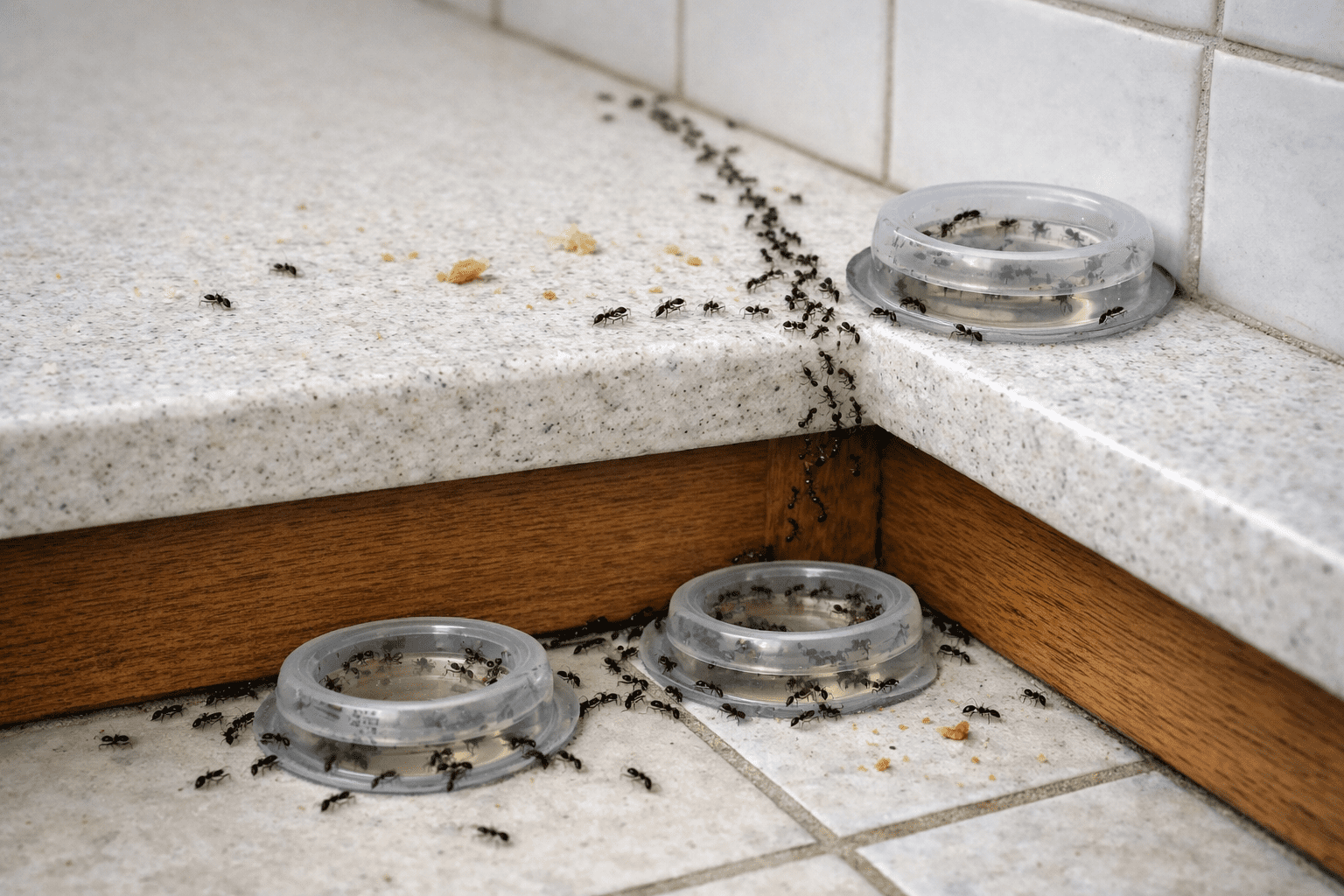
Suggested image alt text: “Ant bait station placed along a kitchen baseboard trail for indoor ant control”
Where to place ant traps so ants actually take the bait
Advion Ant Gel, 30 Grams
This gel bait is suitable for precise placement in cracks and crevices, aligning with the article’s recommendations for effective ant control.
Hot Shot Bed Bug and Flea Killer, 1 Gallon
Hot Shot Bed Bug and Flea Killer 1 Gallon receives positive mentions across retailers for its non-staining, odor-free formula that effectively kills bed bugs, eggs, fleas, and ticks with long-lasting protection, though no Amazon-specific ratings, reviews, or pricing were located in search results and no third-party testing data exists; not recommended as an affiliate product without verified Amazon ASIN and review metrics.
Placement is the difference between “ants ignored it” and “the colony collapsed.” Ants navigate using scent trails, edges, and consistent routes. Think of them like commuters: they prefer the same “highways” along baseboards, countertop seams, and plumbing penetrations.
The 10-minute placement routine (high success rate)
- Follow the trail backward from the food or water source.
- Place traps directly on the edge line they are using – baseboard, cabinet lip, or pipe.
- Use multiple placements: one every 6-10 feet along active trails is often better than one station.
- Keep baits accessible: do not hide them so well ants cannot find them.
- Protect from moisture: bathrooms can dilute liquid baits if placed under drips.
Best indoor placement spots (kitchen and bathroom)
- Under the kitchen sink near plumbing penetrations
- Along baseboards behind trash cans and refrigerators
- Inside cabinet corners where trails hug edges
- Around bathroom vanity plumbing and behind toilets
- Near window sills if ants are entering from outside landscaping
What not to do (these mistakes reduce bait pickup)
| Mistake | Why it fails | Better option |
|---|---|---|
| Spraying near bait | Repels or kills foragers before they share | Keep a 3-6 ft “no spray zone” |
| Cleaning trails aggressively right away | Removes the trail ants follow to bait | Clean food sources, not trail highways |
| Moving baits daily | Breaks recruitment and feeding | Leave in place 3-7 days |
| Placing bait on open counters | Risky around food prep | Use corners, under appliances, or gel in crevices |
Safety notes for kids and pets
Most consumer bait stations are designed to reduce contact, but they are still pesticides. Place them:
- Behind appliances or inside cabinets with child locks
- Away from pet bowls and litter areas
- Not on food-prep surfaces
For broader household pest strategy (especially if you are juggling multiple indoor invaders), see our guide on getting rid of indoor pests. The same principles apply: remove attractants, block entry, then target the pest where it travels.
Actionable takeaway: If you can only place three traps, put them at (1) the strongest trail, (2) the main entry point, and (3) near water.
When ant traps are not enough: carpenter ants, pharaoh ants, and recurring invasions
Combat Max Ant Killing Gel, 4 Count
This product offers a combination of bait types, which is suggested in the article for ongoing ant problems, making it a good fit for readers looking for a comprehensive solution.
Sometimes traps work perfectly for kitchen ants, but a different ant problem is hiding in the structure. Two scenarios deserve extra attention: carpenter ants and pharaoh ants.
Carpenter ants (Camponotus spp.) do not eat wood like termites, but they excavate it to build galleries. They are strongly associated with moisture problems: leaking windows, damp crawl spaces, and softened framing. If you keep baiting but see large ants near baseboards in a basement or near a wet window frame, you may be dealing with a satellite nest indoors.
Pharaoh ants (Monomorium pharaonis) are small, pale to yellowish ants that can nest in wall voids and warm areas. They are notorious because some control methods can cause colonies to split into multiple nests (budding). That is one reason baiting and careful product choice matter.
According to ant management principles described by the Texas A&M AgriLife Extension, sanitation, exclusion, and targeted baits are preferred approaches, while indiscriminate spraying can complicate control for certain ant species.
Red flags you should not ignore
| Sign | What it can mean | Next step |
|---|---|---|
| Large ants (1/4 to 1/2 inch), especially at night | Carpenter ants foraging | Inspect for moisture and wood damage |
| Ants coming from wall outlets or inside cabinets | Nest in voids | Use gel baits in cracks, avoid repellent sprays |
| Ants return every few weeks | Outdoor colony pressure | Combine indoor baiting with outdoor control |
| You see frass (sawdust-like debris) | Carpenter ant excavation | Consider professional inspection |
Outdoor pressure creates indoor problems
Many “indoor” ant issues are actually outdoor colonies foraging inside. If you bait indoors but do not reduce outdoor nesting, you can get repeat invasions during warm months and droughts.
A smart next step is perimeter control with baits designed for outdoor conditions. Our guide to outdoor ant control solutions walks through lawn, foundation, and garden strategies that reduce the number of scouts reaching your kitchen in the first place.
Suggested image alt text: “Carpenter ant worker near damp wood indicating moisture-related nesting risk”
When to call a professional
Consider professional pest control if:
- You suspect carpenter ants and find moisture-damaged wood
- Ants are nesting in walls and bait placements are limited
- You have recurring infestations despite correct baiting for 2-3 weeks
Actionable takeaway: If ants are large and tied to moisture, traps alone are rarely the full solution. Fix the water problem first.
Key takeaways (and a simple plan for this week)
Ant control is usually straightforward once the bait matches the ant’s diet and the placement matches the ant’s travel routes.
The 5-step plan
- Identify the “why here” factor: sweets, water, or damp wood.
- Start with slow-acting bait in stations or gel, not sprays.
- Place along trails and edges: baseboards, plumbing, cabinet corners.
- Offer sugar and protein options if you are unsure, and keep what they recruit to.
- Prevent the next wave: seal entry points, store food tightly, fix leaks, and reduce outdoor pressure.
If you want to compare bait types and formulations in more detail, revisit our best ant killers and baits guide. For low-odor deterrents you can combine with baiting, see natural ant repellents.
The main point: ant traps work when you let ants do what ants naturally do – recruit, feed, and share. Your job is to give them the right bait in the right place, then stay patient long enough for the colony to collapse.
As an Amazon Associate, I earn from qualifying purchases. Product recommendations are based on real reviews and independent research.