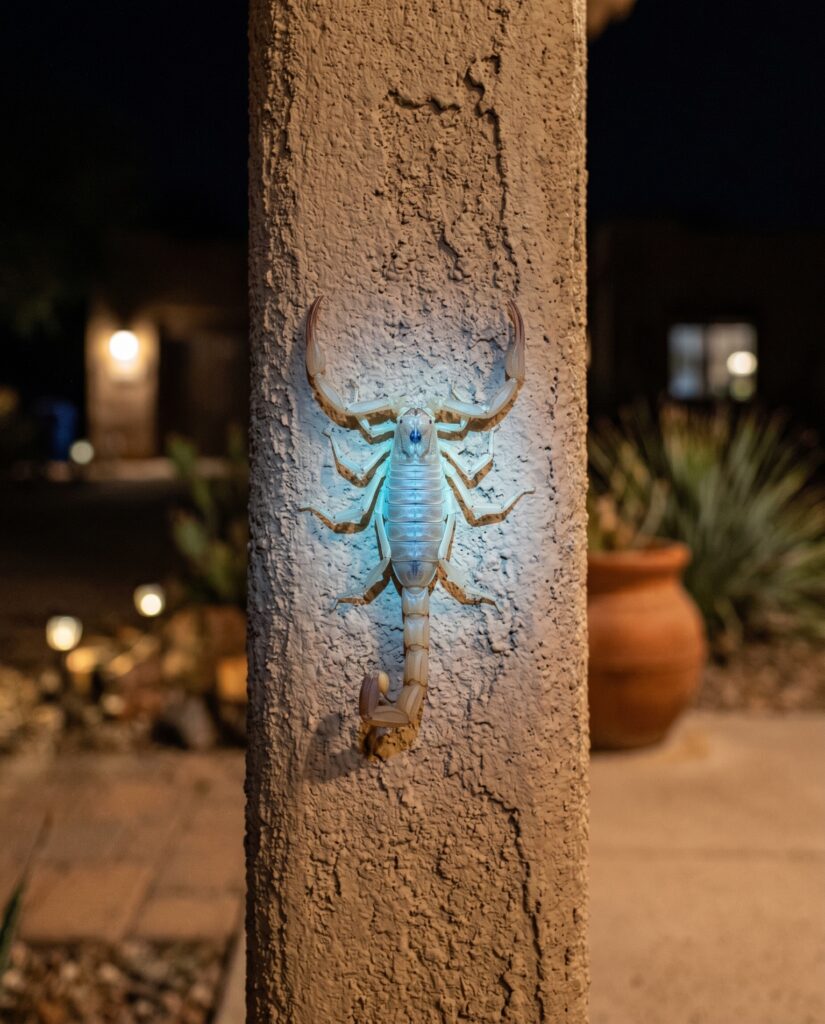
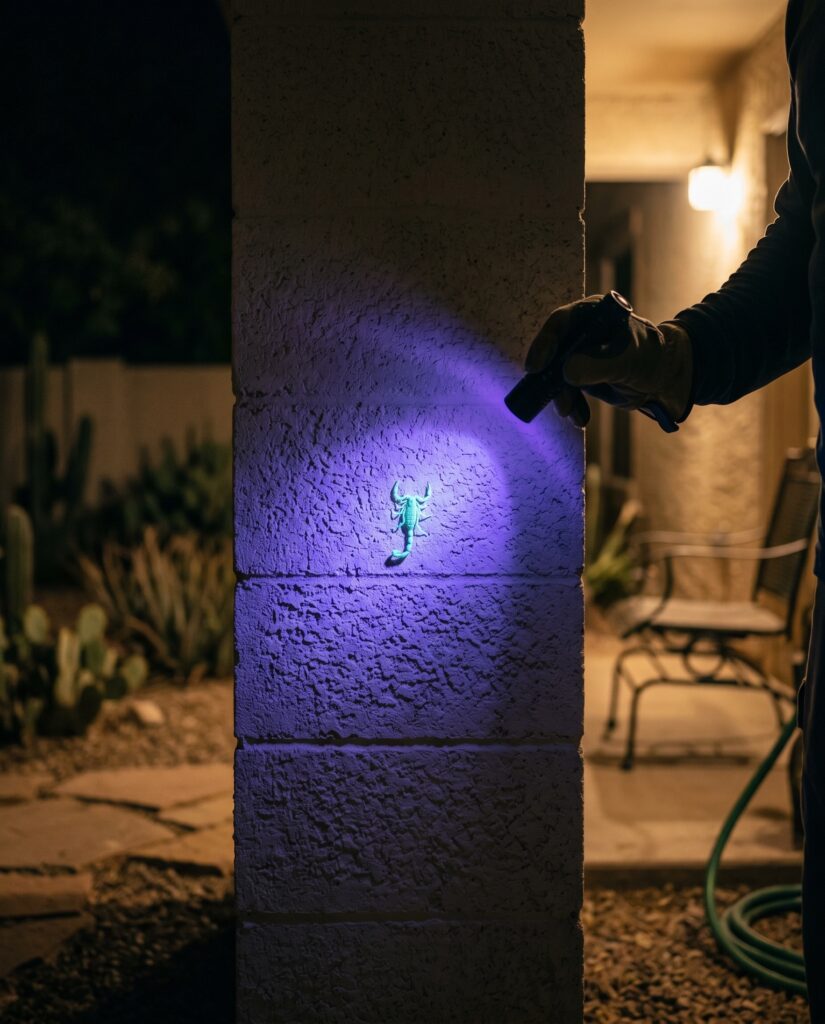
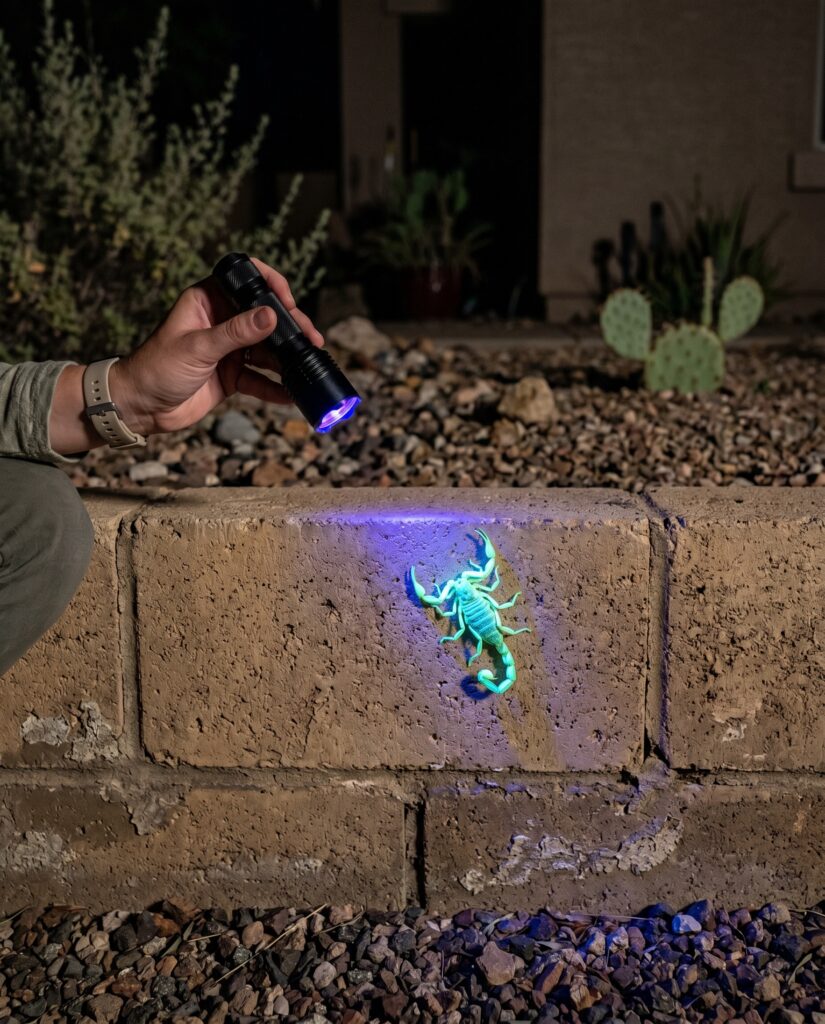
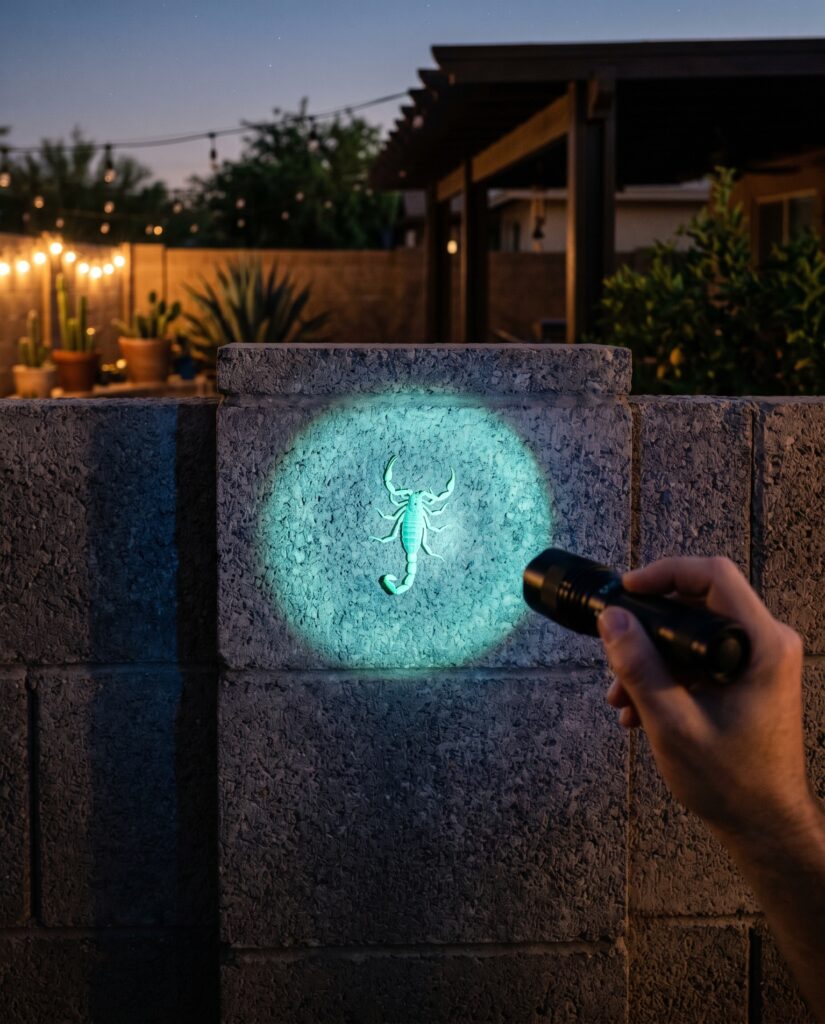
If you live in scorpion country, the fastest way to find them is not to flip over rocks in the daylight. Scorpions fluoresce a vivid blue-green under ultraviolet light, so a cheap black-light flashlight turns an invisible pest into an easy target after dark. Wait until a couple of hours after sunset, then grid-search the baseboards inside, then the yard, foundation, and block walls outside, sweeping the beam slowly across every surface until a glowing shape jumps out at you. When you spot one, remove it with long tongs and never bare hands. It is the most effective scorpion tactic most people have never tried.
A black-light flashlight makes scorpions glow blue-green in the dark, so hunt them a couple of hours after sunset by sweeping the beam slowly along baseboards, then the foundation, block walls, and yard, and remove each one with long tongs.
- Do first (free): Wait until after dark, kill the room lights, and sweep a UV flashlight slowly along the baseboards and floor edges.
- Best for the common case: A 365 nm UV flashlight plus long tongs and a jar, working the foundation, block walls, and yard a couple of hours after sunset.
- Skip: Grabbing a glowing scorpion by hand or with a paper towel; use long tongs every time.
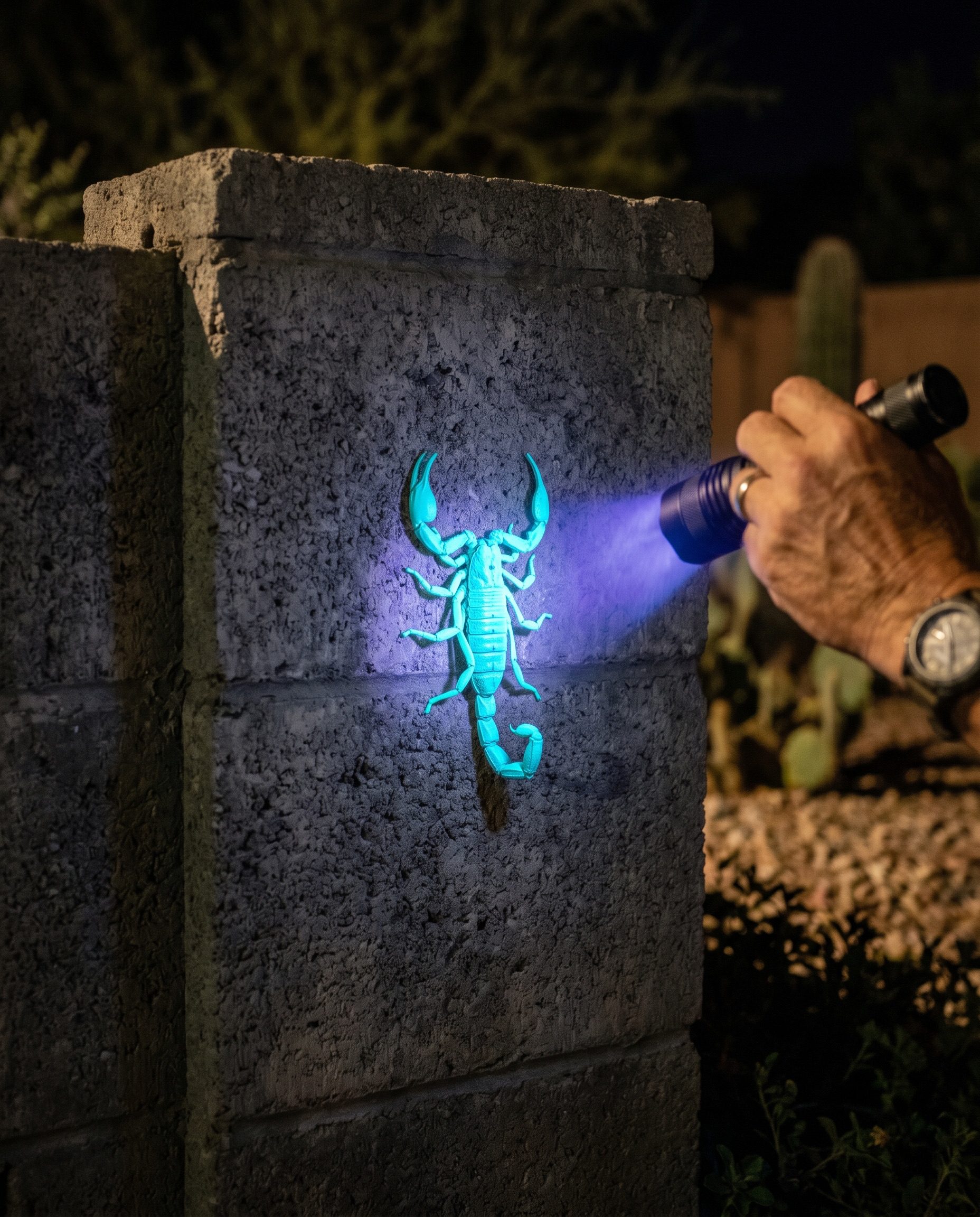
Why scorpions glow under UV
Scorpions have a thin outer layer in their cuticle, called the hyaline layer, that absorbs ultraviolet light and re-emits it as visible blue-green light. You do not need to understand the chemistry to use it; you just need to know that a scorpion that is nearly impossible to see against gravel or stucco in daylight lights up like a tiny lantern under a black light. The UC IPM Pest Notes on scorpions describe this fluorescence and note that it makes nighttime surveys far more reliable than daytime searching.
That matters because scorpions are nocturnal and they hide hard during the day. They wedge into cracks, under bark, beneath rocks, and inside block-wall voids where you will never spot them with a regular flashlight. The glow is the whole trick: instead of hunting the pest, you hunt the light it gives off. One thing to know up front is that very young scorpions and ones that have just molted glow faintly or not at all, so a clean sweep does not guarantee zero scorpions. It just finds the overwhelming majority of them.
What you need for a UV hunt
The gear list is short and cheap, which is part of why this works so well. The one piece that actually matters is the flashlight, and the spec to look for is wavelength. A UV light in the 365 nm range produces a cleaner, brighter scorpion glow with less visible purple haze than the cheaper 395 nm lights, so pay for the lower number if you can. You want enough LEDs to throw a usable cone of light across a wall or a patch of yard, not a single weak diode.
Beyond the light, keep it simple: a pair of long-handled tongs or feeding tongs, a jar or sealable container, and closed-toe shoes. Never reach for a glowing scorpion with your hand, a paper towel, or a short pair of kitchen tongs that puts your fingers within striking range. For a side-by-side look at flashlight wavelengths and the catch tools worth owning, our best scorpion UV flashlights and glue traps breakdown sorts the gear that earns its place from the gimmicks.
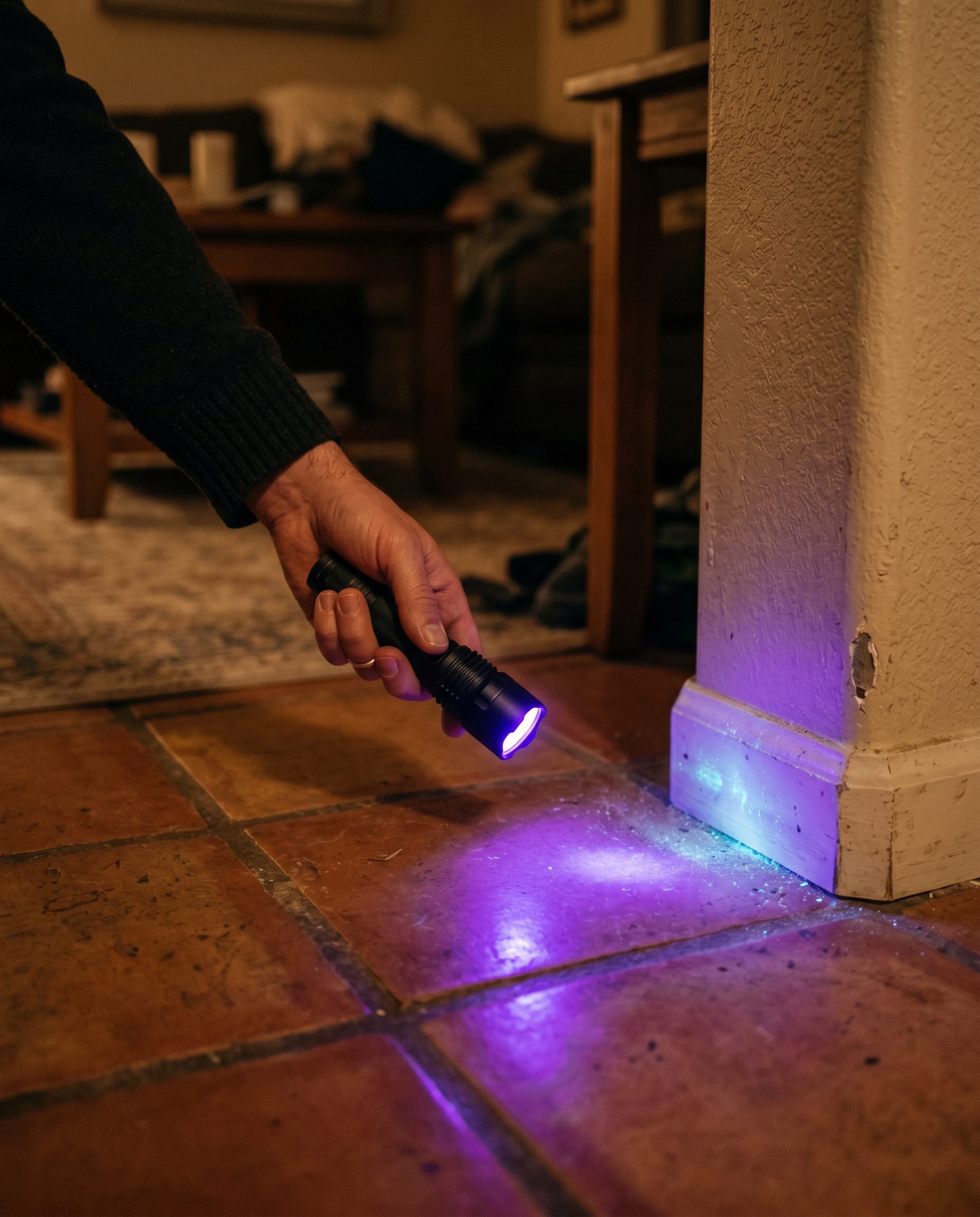
How to grid-search a room
Inside, the method is a slow, disciplined grid, not a random wave of the beam. Turn off the room lights first, because UV reads best in real darkness, and give your eyes a minute to adjust. Then start at one corner and sweep the beam slowly along the baseboard, the floor-wall joint, and behind furniture, moving maybe a foot per second so a faint glow has time to register. Scorpions favor the edges of a room and the dark gap under and behind things, so work the perimeter before the open floor.
Pay extra attention to the places that combine moisture, warmth, and a hiding spot: under the kitchen and bathroom sinks, around the water heater, inside the garage along the bottom plate, and in closets against an exterior wall. Check shoes, folded laundry, and anything left on the floor overnight, because a scorpion that wandered in will tuck into the first dark fold it finds. The Texas A&M AgriLife scorpion fact sheet notes that indoor scorpions are usually following prey insects, so a room with a lot of other bugs is a room worth sweeping carefully.
Where to hunt outside
The yard is where a UV hunt pays off most, because that is where the population actually lives. Go out a couple of hours after sunset on a warm, dry night, since scorpions are most active when the ground is still warm and they are out foraging. Work the foundation line of the house first, then the block walls, then woodpiles, landscape rock, the base of trees, and the edges of any irrigation. Sweep low and slow, and check the vertical faces of walls too, because scorpions climb.
Here is the quick map of where to point the beam for the common situations.
| Where to look | Best approach | Watch out for |
|---|---|---|
| Foundation and block walls | Slow vertical and horizontal sweeps along seams and weep holes | They climb, so check up high too |
| Woodpiles, rock, mulch | Light the edges and gaps, lift nothing by hand | Use tongs to move cover, not fingers |
| Patios, gravel, walkways | Sweep open ground a foot per second | Glow is faint on light gravel, go slow |
| Doorways and thresholds | Check both sides of every exterior door | This is the entry point to seal later |
Remove each scorpion with long tongs into a sealed jar, and keep kids and pets well back while you work. A nighttime sweep also doubles as reconnaissance: clusters of scorpions at one wall corner or one woodpile tell you where to focus the real fix, which is removing harborage and sealing entry points. If you find more than a handful on a single pass, our how to get rid of scorpions guide covers the exclusion and sanitation steps that bring the count down for good. For chemical control, follow the EPA’s safe pest control and IPM guidance and treat the product label as the rule, because under federal law the label is the law.
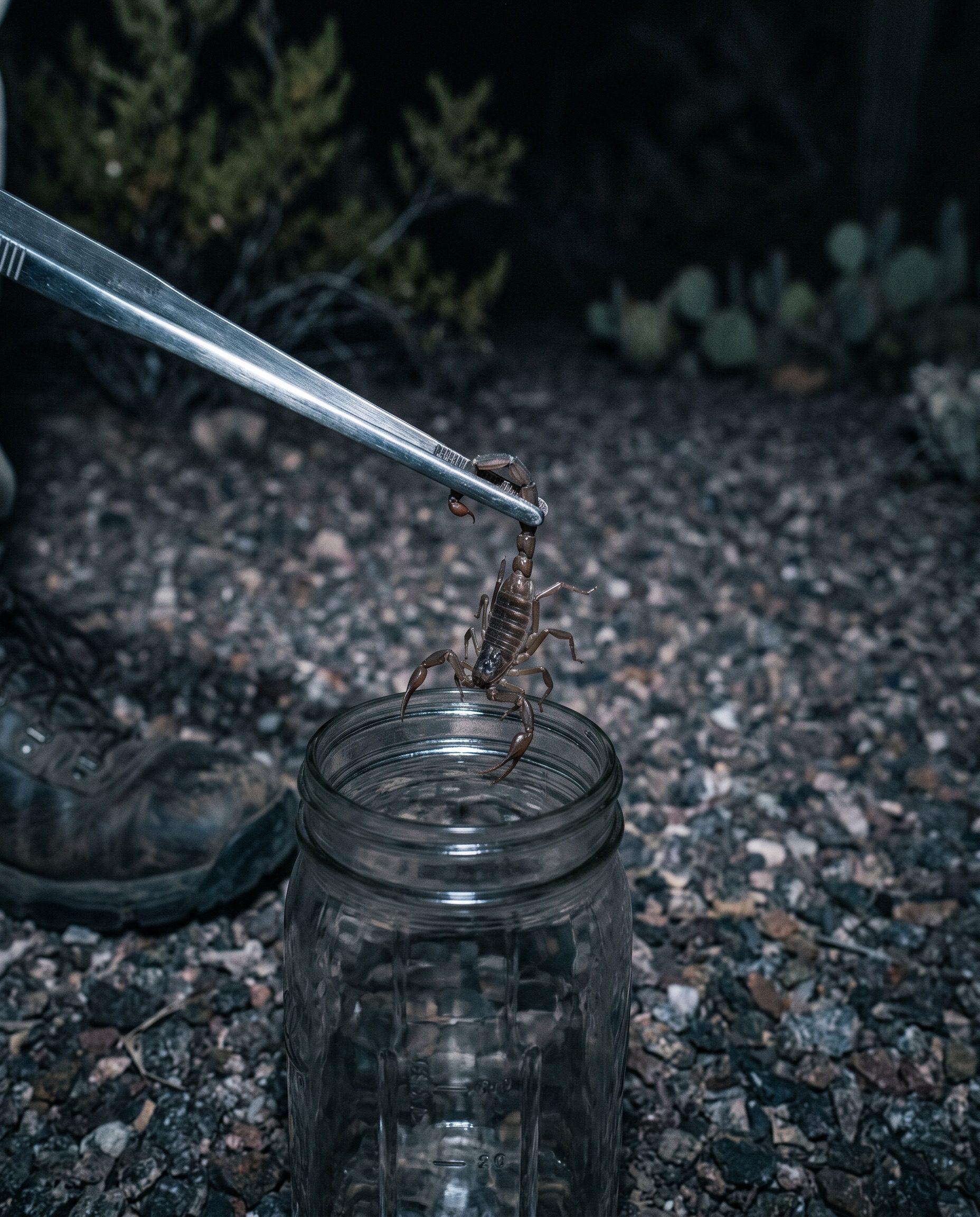
Stay safe while you hunt
A scorpion hunt is low risk if you respect two rules: do not touch them, and watch where you put your feet. Always wear closed-toe shoes outside at night in scorpion country, never go barefoot or in sandals, and use long tongs to lift both the scorpion and any cover it is hiding under. Most US scorpion stings hurt like a bad bee sting and nothing more, but the Arizona bark scorpion is the exception, and its sting can be serious, especially for young children.
Know the warning signs without trying to diagnose or treat anything yourself. MedlinePlus on scorpion stings and when to seek care lists symptoms like difficulty breathing, muscle twitching, drooling, and trouble swallowing as reasons to get emergency medical help right away. Get emergency care for any severe reaction, for a sting in a young child, or if a known severe allergy is involved, and do not try to dose medication on your own. For an everyday sting with only local pain, contact a doctor or your local poison control center if you are unsure.
Common questions
What color do scorpions glow under UV light?
Blue-green, sometimes closer to a pale cyan or teal, against whatever surface they are on. The glow is bright and obvious once your eyes adjust to the dark, which is the whole reason UV hunting works so well. Freshly molted scorpions and very young ones glow faintly or not at all, so do not assume a dark spot is empty ground.
What wavelength UV flashlight is best for scorpions?
A 365 nm light gives the cleanest, brightest scorpion glow with the least purple haze, so it is worth paying a little more over a 395 nm light. Either will find scorpions, but 365 nm makes them pop against busy backgrounds like gravel and stucco. Look for one with several LEDs so you can light a whole wall or patch of yard at once.
When is the best time to hunt scorpions?
A couple of hours after sunset on a warm, dry night, when scorpions are out foraging and the ground is still warm. They are nocturnal, so daytime UV searching mostly finds them tucked deep in cracks where you cannot reach them anyway. Warm summer nights are the most productive.
Can I just catch the scorpion when I find it?
Catch it, but only with long tongs into a sealed jar, never with your hand or a paper towel. Keeping a few captured for identification is useful, since knowing whether you have the Arizona bark scorpion changes how cautious you need to be around kids and pets. Our scorpion identification guide for common US species shows how to tell them apart.
Final verdict
The fastest way to find scorpions is the one most people never try: a UV black-light flashlight that makes them glow blue-green in the dark. Buy a 365 nm light for the cleanest glow, then hunt a couple of hours after sunset, sweeping slowly along the baseboards inside and the foundation, block walls, and yard outside. Remove every scorpion you find with long tongs into a sealed jar, never by hand, and keep closed-toe shoes on and kids and pets back while you work. Treat a nighttime sweep as both removal and reconnaissance, because the corners where scorpions cluster tell you exactly where to seal and clean next. The Arizona bark scorpion is the one to take seriously, so know the warning signs and get emergency care for any severe reaction.
Next steps:
– Pick the right light and catch tools with our best scorpion UV flashlights and glue traps breakdown.
– Bring the population down for good with our how to get rid of scorpions guide.
– Find out which species you are dealing with using our scorpion identification guide for common US species.