Finding fire ants in your yard usually feels like a sudden takeover – one day the lawn looks fine, the next you are dodging fresh mounds and painful stings. The good news is you can get control without turning your whole property into a chemical zone. This guide walks you through what actually works (and what wastes time), using the same integrated approach recommended by university extension entomologists: slow-acting baits to collapse colonies, plus targeted mound treatments for quick relief.
Quick answer: how to eliminate fire ants in a yard (fast + long-lasting)
If your main goal is to eliminate fire ants in a typical home lawn, the most reliable plan is the two-step method: broadcast a fire ant bait over the whole yard, then treat the remaining active mounds a few days later.
Do this first (best overall results):
- Broadcast a fire ant bait across the lawn (dry ground, late afternoon/evening).
- Wait 3-10 days (depends on bait active ingredient).
- Treat active mounds with a drench (hot water or labeled insecticide), or a fast-acting mound product.
What to expect (realistic timeline):
- Many baits reduce colonies in 1-3 weeks, with suppression lasting months when applied correctly.
- Boiling or scalding water can work for small infestations but often only achieves partial control (about 20%-60%) and usually needs repeat applications.
Best choice by situation:
| Situation | Best approach | Why it works |
|---|---|---|
| Lots of mounds or you suspect hidden colonies | Broadcast bait + mound follow-up | Hits visible and invisible colonies |
| Fewer than ~20 mounds per acre | Treat individual mounds | Preserves native ants that compete with fire ants |
| Need immediate relief in one spot | Fast mound treatment (then bait later) | Quick knockdown, then colony-level control |
Fire ant identification: make sure you are treating the right ants
Fire ants (imported fire ant, Solenopsis invicta) do not just “look like ants.” Their behavior and nest structure are often the biggest clues. Misidentification is one reason people think a product “didn’t work” when it was never aimed at the right target.
What fire ants typically look and act like
Here is a quick field checklist you can use before treating:
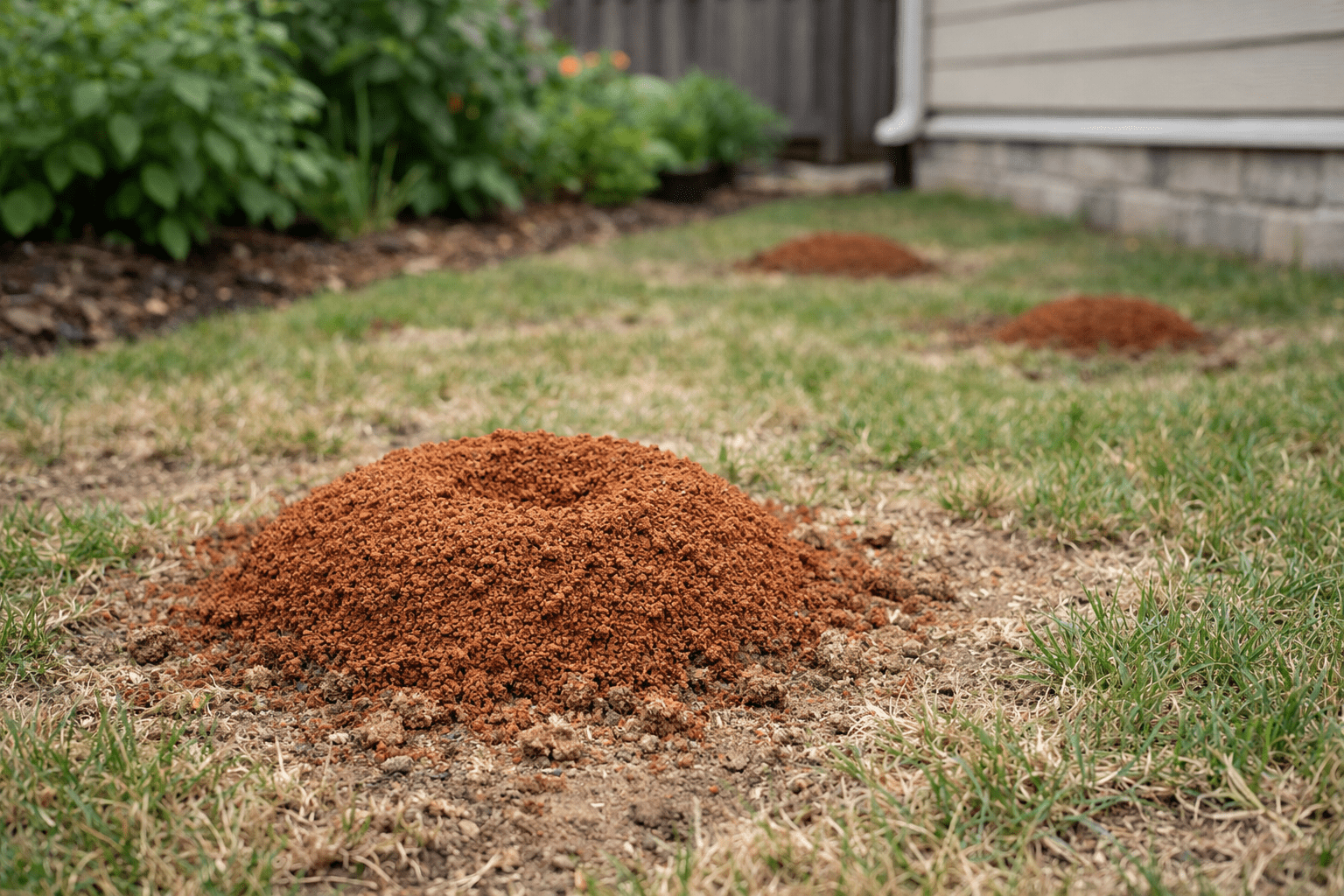
- Mound appearance: Loose, fluffy soil mound, often without a visible center hole. Mounds can be 6-18 inches wide, sometimes larger after rain.
- Ant size: Mixed worker sizes in the same colony (roughly 1/16 to 1/4 inch long).
- Color: Often reddish-brown with a darker abdomen, but color varies.
- Temperament: Disturb the mound and workers rush out quickly and climb upward.
- Sting behavior: They tend to sting repeatedly, often leaving small pustules later.
Common “look-alikes” that change the control plan
Some ants form mounds but are less aggressive and can even help by competing with fire ants.
| Look-alike | Key difference | Why it matters |
|---|---|---|
| Pyramid ants | Cone-shaped crater, less aggressive | Often beneficial competitors |
| Field ants | Larger, may spray formic acid | Different products and expectations |
| Harvester ants | Very large, cleared “disk” area | Different nesting and foraging |
Actionable takeaway: If you are seeing painful stings and fast swarming from a mound, treat as fire ants. If you are unsure, start with a bait labeled for fire ants and monitor activity for a week.
For product comparisons focused on mound knockdown, see Best Fire Ant Killers for Yards: Mound Treatments.
How to get rid of fire ants in your yard: the two-step method entomologists recommend
Ortho Fire Ant Killer Broadcast Granules, 10 lb
Ortho Fire Ant Killer Broadcast Granules effectively kills fire ant mounds in 15 minutes and protects lawns for up to 6 months, covering up to 5,650 sq. ft. with a 13 lb bag, but no Amazon ASIN or ratings found in search results; recommend for fire ant control in outdoor lawns with proper safety measures[1][3][4].
If you only treat the mounds you can see, you are usually playing whack-a-mole. Fire ant colonies can be spread out, and new mounds pop up as colonies move or as hidden nests become obvious. That is why many extension programs recommend an integrated approach built around baits.
According to guidance from the Texas A and M AgriLife Extension fire ant program, the most consistent yard strategy is a broadcast bait application, followed by individual mound treatments as needed. The University of Florida IFAS Extension also emphasizes bait-based, integrated fire ant control for longer-lasting suppression with less environmental disruption than frequent contact sprays.
Step 1: Broadcast a fire ant bait (the colony-level “queen problem” solution)
Baits work because foraging workers carry the treated food back and share it. Think of it like a slow-acting “delivery system” that reaches the queen and brood.
How to apply bait correctly (this is where most failures happen):
- Choose a fire ant bait labeled for broadcast use (granular).
- Apply on dry ground, ideally late afternoon or evening when ants are actively foraging and bait oils stay attractive longer.
- Use a hand spreader or push spreader for even coverage.
- Do not dump bait directly on the mound unless the label specifically says to. Disturbing mounds can trigger relocation.
Typical active ingredients and timing (general expectations):
- Indoxacarb: often 3-10 days to noticeable colony decline.
- Hydramethylnon: often 7-14 days for mound decline, 2-3 weeks when broadcast.
- Insect growth regulators (IGRs) like methoprene or pyriproxyfen: slower, often weeks, but can suppress reproduction longer.
Step 2: Treat the remaining active mounds (the “fast relief” follow-up)
After the bait starts working, you will usually have a few stubborn mounds or newly noticed ones.
Good follow-up options:
- Hot water drench (least-toxic, small scale)
- Labeled mound drenches (liquid insecticides)
- Fast-acting mound granules (watered in, depending on product)
A simple two-step schedule you can copy
- Day 1: Broadcast bait across the yard.
- Day 4-10: Treat active mounds you still see.
- Day 14: Re-check and spot-treat any survivors.
- Every 6-12 months: Re-bait for maintenance (timing depends on pressure and label).
Actionable takeaway: If you want fewer mounds for months, start with bait. If you want fewer stings today, follow with mound treatments after bait has time to spread through colonies.
Mound treatments that work (and the truth about boiling water)
Amdro Fire Ant Bait, 1 lb
Insufficient search data to confirm Amazon ASIN, ratings, or reviews for Amdro Fire Ant Bait 1 lb; price listed at $9.97 via third-party link but cannot verify as Amazon product page. Not a supplement, so no relevant Reddit or testing info. Not recommended due to lack of verifiable Amazon details.
Sometimes you need immediate control around a patio, playset, garden bed, or pet area. Mound treatments can help, but they are not all equal. The big difference is whether the method reaches the queen and enough of the brood to prevent rebound.
Hot water drench: low-tox option with limits
Hot water can kill many workers quickly, but success depends on volume, temperature, and whether the water reaches deep galleries.
Research-based extension guidance commonly notes that scalding hot water treatments (about 190 F to 212 F) can achieve roughly 20%-60% elimination success, often requiring multiple applications and at least 3 gallons per mound to have a chance of reaching the queen and brood. Boiling water drenches are often cited as around 60% effective for small-scale use when done well. These figures align with recommendations summarized by the University of Florida IFAS Extension and echoed in practical guidance from experienced horticulture educators.
How to do a hot water drench correctly:
- Heat water to near-boiling.
- Carry it carefully in a sturdy container.
- Slowly pour 3+ gallons over the mound, covering the entire dome and immediate surrounding soil.
- Re-check in 24-48 hours and repeat if activity remains.
Tradeoffs to know:
- It can scald turf and ornamentals near the mound.
- It is labor-intensive and risky to handle.
- It often works best as a follow-up after baiting, not as your only strategy.
Contact insecticides: fast knockdown, shorter-term control
Contact products (certain granules or sprays) can kill exposed workers quickly. They are useful when a mound is in a high-traffic area, but they can miss deeper nest chambers if not applied exactly as directed.
What to watch for:
- Some active ingredients provide longer residual than others.
- Overuse can disrupt beneficial ants and other insects.
- Certain long-residual actives (such as fipronil in some lawn products) should be used sparingly – many extension programs advise limiting to once per year in a yard setting.
If you want a broader lawn-and-garden comparison beyond fire ants, see Best Outdoor Ant Killers for Lawns & Gardens.
“Natural” mound drenches and essential oils: occasional help, not a main plan
Products like orange oil or strong essential-oil mixes may kill some workers on contact, but they often do not eliminate the colony. They can also burn plants and irritate skin.
For safer, realistic options, browse Natural Ant Repellents and Sprays and use them as part of a plan – not the entire plan.
Actionable takeaway: Use hot water or a labeled mound product for immediate relief, but rely on baiting to reduce the number of new mounds long-term.
Prevention and long-term fire ant control (so they do not come right back)
Hot Shot Bed Bug and Flea Killer, 1 Gallon
Hot Shot Bed Bug and Flea Killer 1 Gallon is a ready-to-use insecticide available at retailers like Home Depot and Walmart, featuring a non-staining, odor-free, pyrethroid-resistant formula that kills bed bugs, eggs, fleas, and ticks with long-lasting protection; however, no Amazon ASIN, ratings, or pricing could be verified from search results, limiting affiliate recommendation potential.
Fire ants are persistent partly because yards provide what they need: open sun, workable soil, moisture, and food. After you knock populations down, prevention becomes a maintenance routine, not a one-time event.
Yard conditions that favor fire ants
Fire ants often build where soil stays warm and workable. You will commonly see new mounds:
- After rain followed by warm weather
- Along sidewalk edges, driveways, and mulch borders
- In irrigated lawns and sunny open areas
Practical prevention checklist (low effort, high payoff)
Use this as a monthly warm-season scan:
- Walk the yard weekly during peak season and flag new mounds early.
- Keep debris and wood piles tidy so you do not create sheltered nesting zones.
- Avoid overwatering. Fix leaks and reduce constantly soggy areas.
- Mow regularly, but do not scalp the lawn (stressed turf opens bare soil patches).
- If pressure is high, broadcast bait 1-2 times per year (follow label timing).
Protecting beneficial native ants (a smart, often overlooked tactic)
Native ants compete with fire ants for food and territory. When you blanket-spray contact insecticides repeatedly, you can remove that competition and accidentally make reinfestation easier.
A good rule of thumb from extension IPM programs:
- If you have only a few mounds, treat individual mounds rather than broadcasting harsh contact insecticides.
- If mounds are widespread, broadcast a fire ant bait, then spot-treat.
When to call a professional
DIY works for most homeowners, but professional help is worth it when:
- You have allergic reactions in the household or frequent stings.
- Mounds are dense across a large property.
- Fire ants are invading sensitive areas (daycare yards, dog runs, community spaces).
- You need a documented plan for multi-unit properties.
Actionable takeaway: The best “prevention” is scheduled baiting plus quick spot treatments. It is easier to maintain low numbers than to recover from a full rebound.

Safety, sting first aid, and common mistakes to avoid
Fire ants are not just a lawn nuisance. Their stings can be medically significant for some people, and many popular “home remedies” create more risk than results.
Sting safety basics (especially for kids and pets)
Most stings cause burning pain and later develop into small pustules. Avoid scratching to reduce infection risk.
Seek medical care urgently if any of these occur:
- Trouble breathing, wheezing, swelling of face or throat
- Dizziness, widespread hives, vomiting
- A history of severe allergic reactions to stings
For general pesticide and label safety, the EPA pesticide safety guidance is a reliable reference for storage, application, and exposure steps.
Common mistakes that sabotage control
These are the patterns seen again and again in yards that “never get better”:
- Treating only the mound you see: Hidden colonies keep producing new mounds.
- Using harsh, unproven chemicals: Gasoline, bleach, and similar products are dangerous and can contaminate soil.
- Baiting at the wrong time: Wet ground, midday heat, or old bait reduces pickup.
- Expecting instant results from baits: Many baits take days to weeks because they must spread through the colony.
- Overusing contact sprays: Quick kills feel satisfying, but often do not solve the queen problem.
What about ants inside the house?
Fire ants mostly nest outdoors, but workers can wander inside for food or moisture. Indoor ant control relies heavily on sanitation, exclusion, and targeted baits.
If you are seeing ants indoors too, follow How to Get Rid of Ants in the House for a room-by-room plan.
Actionable takeaway: The safest, most consistent strategy is to use labeled baits correctly, keep people and pets away during application, and avoid dangerous home chemicals.
Conclusion: the simplest plan that works
To get lasting control of fire ants, treat the yard like a system, not a single mound. Broadcast a fire ant bait to reach queens and hidden colonies, then follow up with targeted mound treatments for the spots that still pose a sting risk. Hot water can help on a small scale, but it rarely solves the problem alone.
Next step: choose a bait labeled for broadcast use, apply it on a dry evening, and schedule a mound follow-up in a week. For more targeted help, compare options in Best Fire Ant Killers for Yards: Mound Treatments and broader lawn products in Best Outdoor Ant Killers for Lawns & Gardens.
As an Amazon Associate, I earn from qualifying purchases. Product recommendations are based on real reviews and independent research.