A female tick lays one mass of hundreds to thousands of tiny spheres, translucent amber to reddish brown, glistening and clumped together like a heap of miniature caviar. She lays it once, on the ground in leaf litter or dense vegetation, and then dies. She does not lay on a host, and with one uncommon exception she does not lay indoors, which closes off the fear that brings most people to this page.
- A single clumped mass, not scattered eggs: hundreds together, on the ground outdoors.
- Never on a person or a pet. A fed female drops off before laying.
- Almost never indoors. The brown dog tick is the exception, and it is uncommon in homes.

This search is usually driven by a specific worry: that a tick found on a person or a dog has laid eggs somewhere. It has not, and the reason is worth understanding because it settles the question permanently.
What they look like
A tick egg mass is unmistakable when you see one, because it is a mass rather than individual eggs. Hundreds to several thousand spheres, each well under a millimetre, translucent amber to reddish brown, glistening and stuck together in a heap.
The colour deepens as the eggs develop. A fresh mass is paler and more translucent; one close to hatching is darker.
Where you find it, if you find one at all: on the ground, in leaf litter, under dense low vegetation, at the base of long grass, or in a sheltered spot at a woodland edge. These are the same places ticks wait for hosts, which the CDC’s overview of ticks and tick-borne disease covers.
The life cycle, which answers the real question
A female tick attaches to a host, feeds for days until fully engorged, and then drops off. Only then, on the ground, does she lay her single egg mass. She dies shortly afterward.
That sequence has three consequences, and they are the reassurance people are looking for.
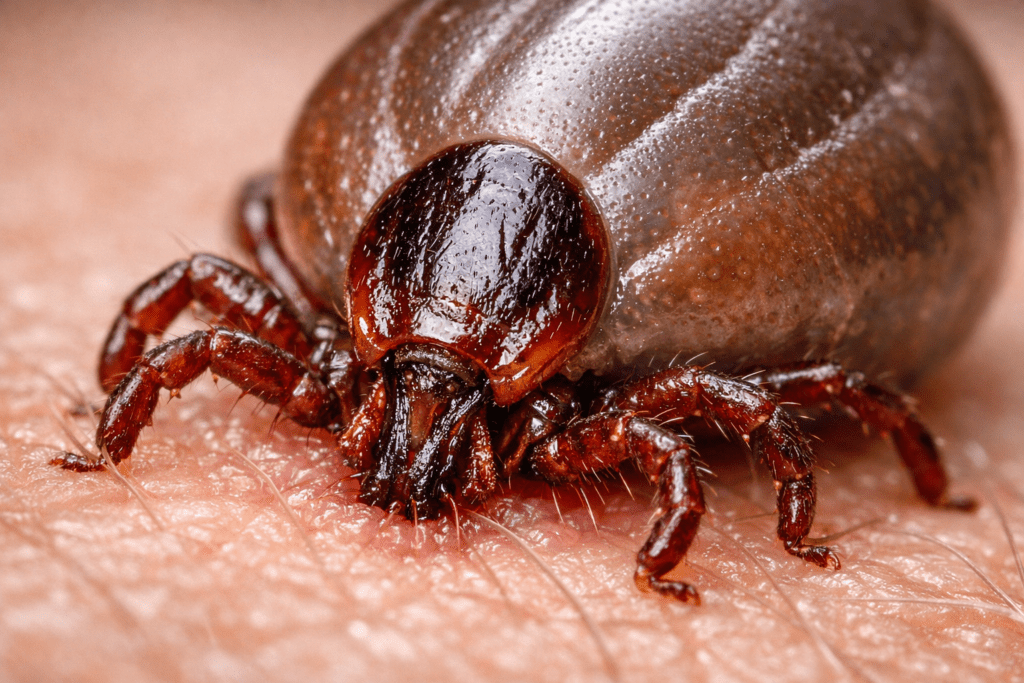
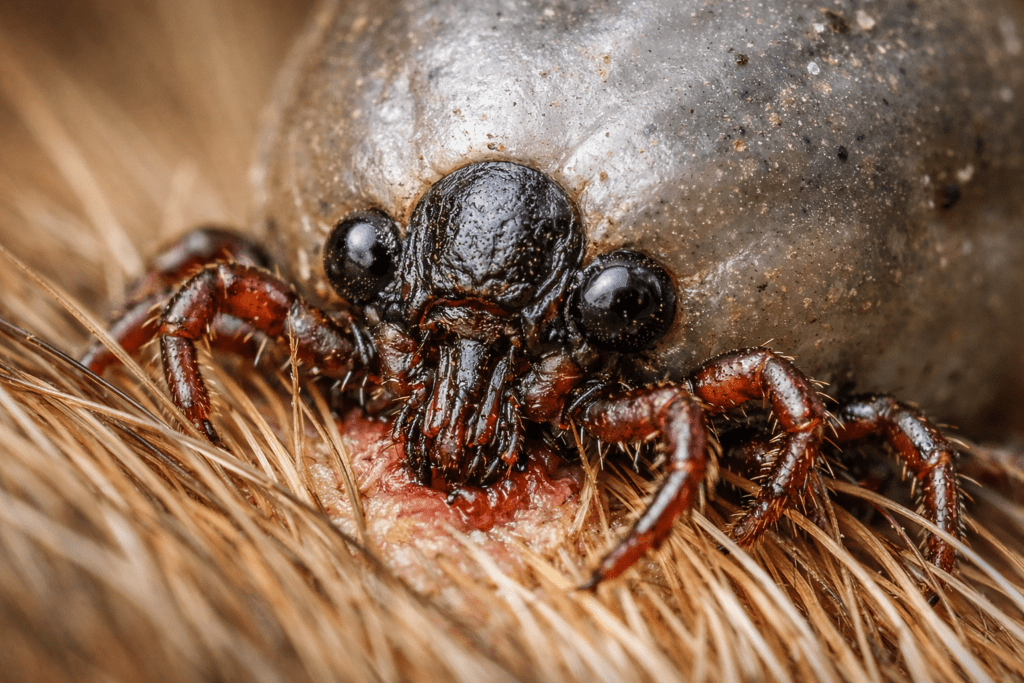
Ticks do not lay eggs on a host. A tick found attached to you or a dog is feeding, not laying. Removing it ends the matter for that tick.
A tick removed before it finished feeding will not lay at all.
The larvae that hatch are six-legged and stay on the ground, questing for a small first host. They do not hatch onto a person.
Our removal guide covers the technique, and the aftercare guide covers what to watch for afterwards, which is the part that actually matters.

The indoor exception
One species genuinely can complete its life cycle indoors, and it is worth knowing about precisely so it can be ruled out.
The brown dog tick can live and breed inside a house or a kennel, using dogs as hosts at every stage. In an infestation, engorged females drop off and lay in cracks: behind skirting, in crevices, along the edges of dog bedding, and in gaps around door frames.
The signature is ticks appearing indoors repeatedly, at multiple life stages, in a household with a dog. That is different from finding one tick after a walk, which is the overwhelmingly common situation and means nothing about the house.
Our guide to whether ticks can live indoors covers the distinction, and the guide to ticks on dogs covers the animal side.
What people find instead
Most things reported as tick eggs are not. Under a phone camera in macro mode against white paper, these separate quickly:
Spider egg sacs are silk parcels, papery or fluffy, rather than visible individual spheres. Our sac guide covers reading them.
Insect eggs on leaves, laid in neat rows or patches, are usually moths, butterflies or true bugs. Ticks never lay on foliage.
Slug and snail eggs in soil are larger, clear and gelatinous.
Fertiliser prills, seeds and mineral granules account for a fair share, and they do not deform when pressed.
Our egg identification chart sorts the whole group by where it was found.

If you actually find one
Outdoors, in leaf litter or long grass, and you are confident: it is a single mass and the practical response is straightforward. Remove it physically rather than treating the area, and improve the habitat, because that is what reduces ticks over a season.
Keep grass short and maintain a gap between lawn and woodland edge.
Clear leaf litter from the boundary, which is where the humidity ticks need sits.
Move woodpiles off the ground and away from the house.
Our tick-proof yard guide covers the work, and the tick tube guide covers the approach that targets the small mammal hosts the larvae depend on, which is more effective than treating open ground.
Indoors, and repeatedly, with a dog in the household: that is the brown dog tick situation and it is worth professional help, because the crevices they use are hard to reach and the population rebuilds from anything missed.
Common questions
A tick was on me for a day. Could it have laid eggs?
No. It was feeding. Laying happens on the ground after it drops off fully engorged, and a tick removed while attached never gets there.
I squashed an engorged tick and it burst. Were those eggs?
Almost certainly blood rather than eggs. An engorged female that has not yet dropped off has not begun laying.
Do tick eggs hatch into something that bites straight away?
The larvae are six-legged, minute, and quest at ground level for a small first host. Human contact with them is uncommon and produces the clustered bites sometimes called seed ticks.
Final verdict
Tick eggs are one clumped mass of hundreds of tiny amber spheres, laid once, on the ground outdoors, by a female who then dies. She never lays on a host, so a tick found on you or a dog has not laid anything anywhere. The only indoor exception is the brown dog tick, and its signature is repeated indoor findings at several life stages in a household with a dog, not one tick after a walk.