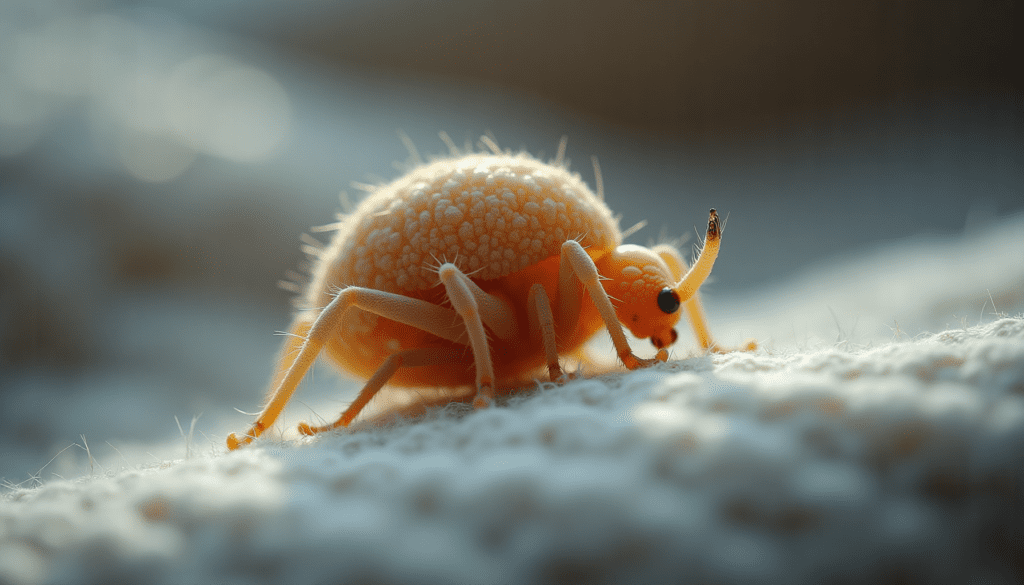
Five mites bite people and they divide sharply. Chiggers, bird mites, rodent mites and straw itch mites are environmental: remove the source and the problem ends by itself. Scabies is different in every way that matters, because the mite lives in the skin, spreads between people and needs a prescription. Working out which group you are in decides whether to call a pest controller or a clinician.
- Clustered welts where clothing pressed, after grass: chiggers, and the mite has already dropped off.
- Sudden onset indoors with a nest in the roof: bird or rodent mites, self-limiting once the nest goes.
- Itch worst at night, finger webs and wrists, spreading in the household: ask a doctor about scabies.

All of these are too small to identify by looking, so the identification is entirely circumstantial: where you were, when it started, whether anyone else has it, and whether there is a nest somewhere in the structure. Those four questions separate them cleanly.
The environmental four
Chiggers are larval mites picked up outdoors from grass, brush and woodland edges. They attach, feed for a few hours through a hardened tube, and drop off. The itch peaks a day or two later, which is why people search after the mite has gone.
The signature is location: clusters of welts where clothing pressed against skin, around sock lines, waistbands and behind the knees. They do not burrow and do not lay eggs in skin, despite the story. Our guides to what chiggers are, whether they burrow and treating the bites cover it.
Bird mites come from a nest in an eave, soffit or chimney and disperse into the rooms below when the birds fledge or the nest is abandoned. The pattern is unmistakable once you know it: sudden onset, no pet, often late spring or early summer, and a nest somewhere above. They cannot sustain themselves on people, so removing the nest ends it. Our bird mite guide covers the search.
Rodent mites work the same way from a mouse or rat nest, and typically appear shortly after a rodent problem was resolved, which is what makes the timing so confusing. Our rodent identification guide covers finding the nest, which is the actual treatment.
Straw itch mites come from stored grain, hay, straw and occasionally from insect-infested material indoors. Exposure produces itchy welts, often on covered skin, and it stops when the source is removed.

Scabies, which is not in that group
Scabies belongs on this page and behaves unlike everything above it. The mite burrows into the outer layer of skin and completes its life cycle there, so there is no environmental source to remove.
The CDC describes scabies as an infestation of the skin by a burrowing mite causing intense itching, and MedlinePlus notes the characteristic pattern of itching that is often worse at night.
The pattern identifies it without seeing anything:
Intense itch, worse at night. Concentrated in finger webs, wrists, elbows, armpits, waistline and around the belt line. Spreading between people in a household, because transmission is prolonged skin-to-skin contact. Sometimes thin irregular burrow tracks.
It does not resolve on its own and does not respond to ordinary anti-itch products. It needs a prescription treatment, household contacts are usually treated at the same time, and it is common and unremarkable rather than shameful. If that description fits, the useful next step is a doctor rather than a pest controller.
Dust mites, which do not bite at all
Worth stating plainly because they take up an enormous share of the searching. Kentucky is clear that house dust mites are microscopic and do not bite people. They cause allergic reactions, not bites.
If the real problem is waking congested rather than bitten, the management is humidity, mattress covers, hot washing and vacuum filtration rather than anything aimed at a pest. Our dust mite allergy guide covers it.
Clover mites are another non-biter that gets caught by this search: tiny, red, on windowsills in spring and autumn, and completely harmless. Our clover mite guide covers them and the red bugs guide covers the wider group.

The four questions that sort it
Where were you before it started? Grass, brush or a field points at chiggers or straw itch mites. Nowhere in particular points indoors.
Is there a nest above you? Eaves, soffit, chimney, loft. A bird or rodent nest explains a sudden indoor onset better than anything else.
Does anyone else in the house have it? Spreading between people points at scabies and away from the environmental four, which affect whoever is exposed rather than passing person to person.
Where on the body? Clothing lines after outdoors is chiggers. Finger webs, wrists and waistline with night itch is the scabies pattern.
Our guide to things on skin you cannot see covers the honest non-insect explanations too, several of which are common and none of which is embarrassing.
This page describes patterns and is not medical advice. If the itch is severe, spreading, or not resolving, that is a reason to see a clinician rather than to keep searching.
Common questions
Can I see any of them?
Barely. Chiggers are around a quarter of a millimetre and usually gone before the itch starts. Scabies mites are inside the skin. Bird and rodent mites are visible as moving specks in good light if you look at a windowsill.
Should I treat the house?
For bird and rodent mites, remove the nest and clean; that is the treatment. For chiggers and straw itch mites there is nothing indoors to treat. For scabies, laundering bedding and worn clothing at a hot temperature is proportionate, and the treatment is on the person.
Nothing is found and the sensation persists.
That is common and has a long list of real causes, from dry skin to medication effects. It deserves a proper look rather than more searching, and our guide to invisible causes covers them.
Final verdict
Ask where you were, whether there is a nest above you, and whether anyone else has it. Clothing-line welts after grass are chiggers and the mite is already gone. A sudden indoor onset with a nest in the eaves is bird or rodent mites, and removing the nest ends it. Itch that is worst at night, sits in the finger webs and wrists, and is spreading through the household is the scabies pattern, and that one is a prescription rather than a pest problem.