Aphid colour is close to useless for identification, because a single species runs from green to black to pink depending on host and season. What identifies them is the plant they are on and where on it they sit: shoot tips, the undersides of leaves, or below the soil on the roots. The root ones are the only group that does serious damage before you notice anything.
- Dense clustering at a shoot tip: the normal case, and rarely fatal to an established plant.
- Sticky leaves and black sooty mould: honeydew, which is the sign people notice first.
- Wilting despite watering, white waxy roots: root aphids, which need the plant out of the pot.
Aphid guides usually open with a colour chart, which is the least reliable thing about them. Green peach aphids can be green, pink or yellow. Black bean aphids are black but so are several unrelated species. The colour changes with host plant, temperature and generation.
Where the insect is sitting is stable, and it decides what to do.
Sorted by position
| Where they are | Group | What it means |
|---|---|---|
| Shoot tips and new growth | Most garden species | Cosmetic on an established plant |
| Undersides of leaves, dense | Cabbage, peach, melon aphids | Sprays must reach the underside |
| Stems and woody shoots | Rose, bean aphids | Often tended by ants |
| On roots, white and waxy | Root aphids | The damaging group, and hidden |
| Curled or distorted leaves | Feeding damage, aphids may have gone | Check inside the curl |
| Galls on leaves or stems | Gall-forming species | Alarming, usually harmless |
What an aphid is, in the features that matter
One to three millimetres, soft-bodied, pear-shaped, with long thin legs and antennae. The feature worth knowing is a pair of cornicles: short tubes projecting from the rear of the abdomen, like tiny exhaust pipes. Almost nothing else has them, and they separate aphids from the small soft insects people confuse them with.
Most of a summer population is wingless and female, reproducing without mating and giving birth to live young rather than laying eggs. That is why a colony appears so suddenly: it does not have to wait for eggs to hatch.
Winged forms appear when a colony gets crowded or the host declines, which is how they arrive on a plant that was clean yesterday.
Honeydew, and what it brings
Aphids feed on sap, which is rich in sugar and poor in protein, so they process large volumes and excrete the excess as honeydew.
That is usually the first thing people notice: leaves that feel sticky, a shine on the foliage below the infestation, and sometimes a sticky film on a patio or a car parked under a tree.
Two things follow from it. Sooty mould grows on the honeydew, a black surface film that does not attack the plant but blocks light. And ants farm aphids for the honeydew, defending them from predators, which is why an ant trail up a stem is often really an aphid problem. Our ant identification guide covers the species that do this.
Root aphids, the group that matters
These are the ones worth knowing about, because they do real damage and the symptoms point somewhere else entirely.
They live below the soil line on the roots, and they are often coated in a white waxy powder that makes an infested root ball look dusted with flour.
The symptoms from above are non-specific: wilting despite adequate watering, stunted growth, yellowing, a general failure to thrive. That overlaps almost exactly with overwatering and root rot, which is why it gets misdiagnosed for months.
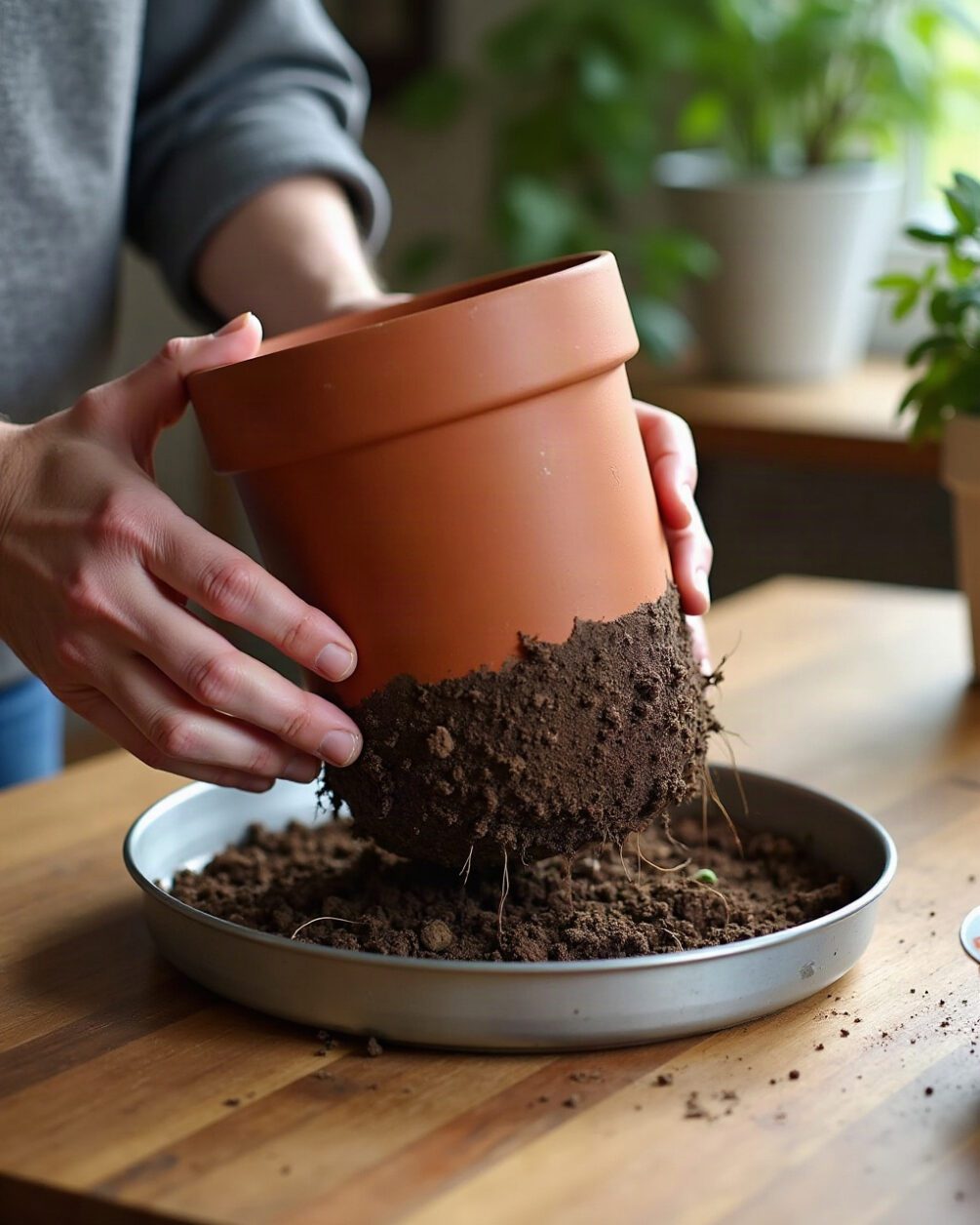
The check is direct and takes a minute. Slide the plant out of its pot and look at the root ball, particularly where the roots meet the pot wall and at the base. White waxy deposits and small pale insects confirm it.
Our aphid control guide covers treatment, and the houseplant soil guide covers the other things in compost, most of which are harmless decomposers. Penn State’s description of springtails feeding on mould and decaying material covers the commonest of those, and killing them achieves nothing.
The look-alikes
Mealybugs are the closest confusion: soft, oval, covered in white waxy fluff, clustering in leaf joints. Related, similar treatment, and our mealybug guide covers them.
Whiteflies fly up in a cloud when a plant is disturbed, which aphids do not. Our whitefly guide covers them.
Scale insects are immobile bumps on stems and leaf undersides, often mistaken for part of the plant. Our scale guide covers them.
Spider mites cause fine pale stippling and webbing rather than clustering, and our spider mite guide covers them. Our guide to translucent bugs covers the pale ones indoors generally.
What to do, in proportion
Usually less than people think. An established shrub with aphids at the shoot tips in spring is not in danger, and the population typically collapses on its own once predators arrive.
Water first. A jet of water dislodges most of a colony and costs nothing. Repeat rather than escalate.
Check for ants. If ants are farming them, dealing with the ant trail lets the natural predators work.
Leave the predators alone. Ladybirds, hoverfly larvae, lacewings and parasitoid wasps all eat aphids, and a broad-spectrum spray removes them along with the aphids, which usually makes the next outbreak worse. Our guide to beneficial insects covers what arrives when there is something to eat, and the guide to buying them covers when that is worth doing.
Thresholds, not sightings. UC IPM’s approach to garden insects is built on deciding by damage rather than by presence, and our integrated pest management guide covers applying that at home.
Root aphids are the exception. There the answer is repotting into fresh compost with the roots washed clean, because a surface treatment cannot reach them.
Common questions
They are black. Is that a different species?
Possibly, and possibly the same one on a different host. Colour varies within a species, so it is the weakest thing to identify by.
Curled leaves but no insects.
Common. The feeding caused the distortion and the colony has moved or been eaten. Check inside the curl before treating anything.
Do aphids bite people?
No. They feed on plant sap and have no interest in animals.
Final verdict
Ignore the colour. Aphids at a shoot tip on an established plant are usually a cosmetic problem that resolves when predators arrive, and a jet of water plus patience beats a spray that kills the predators too. Sticky leaves mean honeydew, and an ant trail up the stem means the ants are protecting the colony. The one case that deserves urgency is a plant wilting despite watering, and that one is settled by sliding it out of the pot and looking at the roots.