Measure before you guess. Droppings under 1 mm are insect; 3 to 7 mm with pointed ends is mouse; 12 to 19 mm and capsule shaped is rat. Then read the ends and the surface: blunt with ridged sides is cockroach, glittering when crumbled is bat, chalky white streaks are bird. Uniform size across a scattering is what separates droppings from crumbs, and it is the single most useful thing on this page.
- Size first, always. A ruler settles more of this than any description of shape.
- Uniformity is the giveaway. One animal produces one size; kitchen debris does not.
- Never sweep or vacuum rodent or bat droppings dry. Dampen, wipe, bag.
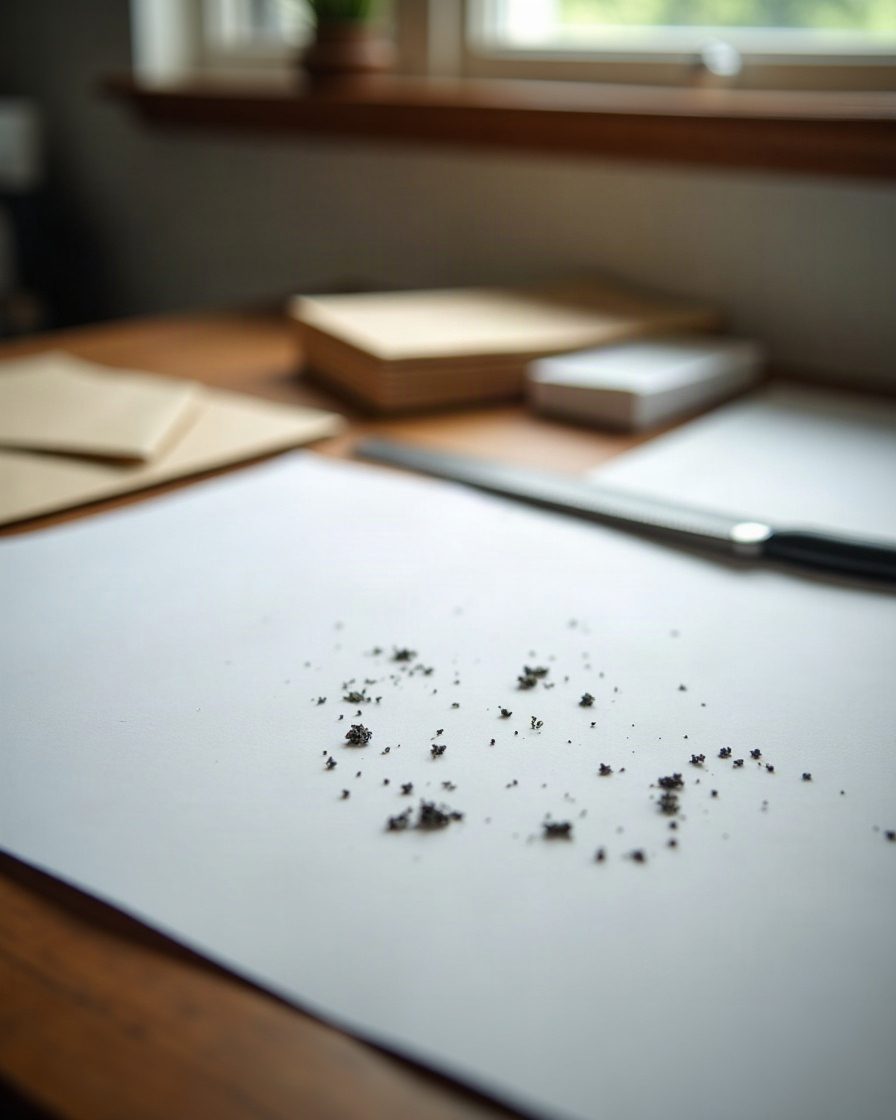
Droppings are better evidence than a sighting. A glimpse of something moving lasts a second and is remembered badly. Droppings sit still, accumulate in the place the animal actually spends its time, and can be measured. Most people arrive at this page having found specks and having no idea whether they are looking at an insect, a rodent, or the remains of a biscuit.
That last possibility is worth taking seriously. A good share of what gets photographed and worried over turns out to be crumbs, soil, coffee grounds or the black grit that collects in any drawer joint. The test that separates them is not shape. It is uniformity: a scattering of droppings from one animal is strikingly consistent in size, because it came out of one animal. Debris is not.
The chart
Work down it with a ruler. Every measurement below is length, not width.
| What you found | Size | Shape and surface | Most likely |
|---|---|---|---|
| Fine dark grit, almost dust | under 0.5 mm | irregular, powdery | Booklice, mites, or ordinary dust |
| Pepper-like specks | 1 to 2 mm | blunt ends, ridged sides | German cockroach |
| Small dark cylinders | 2 to 3 mm | blunt, ridged, larger | American or Oriental cockroach |
| Black dots that smear | 1 to 3 mm | ink-like when damp | Bed bug |
| Green or brown pellets | 1 to 5 mm | six-sided, uniform | Caterpillar or drywood termite |
| Tapered grains | 3 to 7 mm | pointed at one or both ends | House mouse |
| Capsules | 12 to 19 mm | blunt or tapered by species | Rat |
| Crumbling dark pellets | 6 to 12 mm | glitters when crushed | Bat |
| Barrel-shaped pellets | 8 to 12 mm | rounded ends, lighter with age | Squirrel |
| White chalky streaks | variable | no segments, splashed | Bird |
Two rows on that chart matter more than the rest, because they change what you do rather than what you know. Anything in the rodent or bat rows means a cleanup protocol, not a dustpan. Everything else is an identification problem.
Reading the ends
Once size has narrowed it, the ends of a dropping do the fine work.
Pointed at one or both ends is rodent, and the smaller the more likely mouse. Our guide to mouse droppings and what to do about them covers the size range and the cleanup in detail.
Blunt with ridges running along the sides is cockroach. The ridges are the reliable part; people expect them to be smooth and they are not. UC IPM’s overview of cockroaches in and around the home covers the species differences that the size row implies.
Six flat sides is unusual and diagnostic. Drywood termite pellets are hexagonal in cross section, which is a shape almost nothing else produces. See termite frass identification for what that means and what it rules out.
No distinct ends at all, just a chalky splash, is bird.
The smear test
Bed bug droppings are the one entry on the chart that is not really a dropping in the usual sense. They are digested blood, and they behave like ink. Press a damp white cloth or a cotton bud against a suspect dot on fabric and it bleeds outward into a rusty brown halo.
Nothing else on this list does that. A crumb stays a crumb, a cockroach speck stays a speck. If it smears reddish brown, read what bed bug droppings on a mattress mean next, because the location will tell you more than the dot.
Where you found them narrows it further
Placement is close to as informative as size.
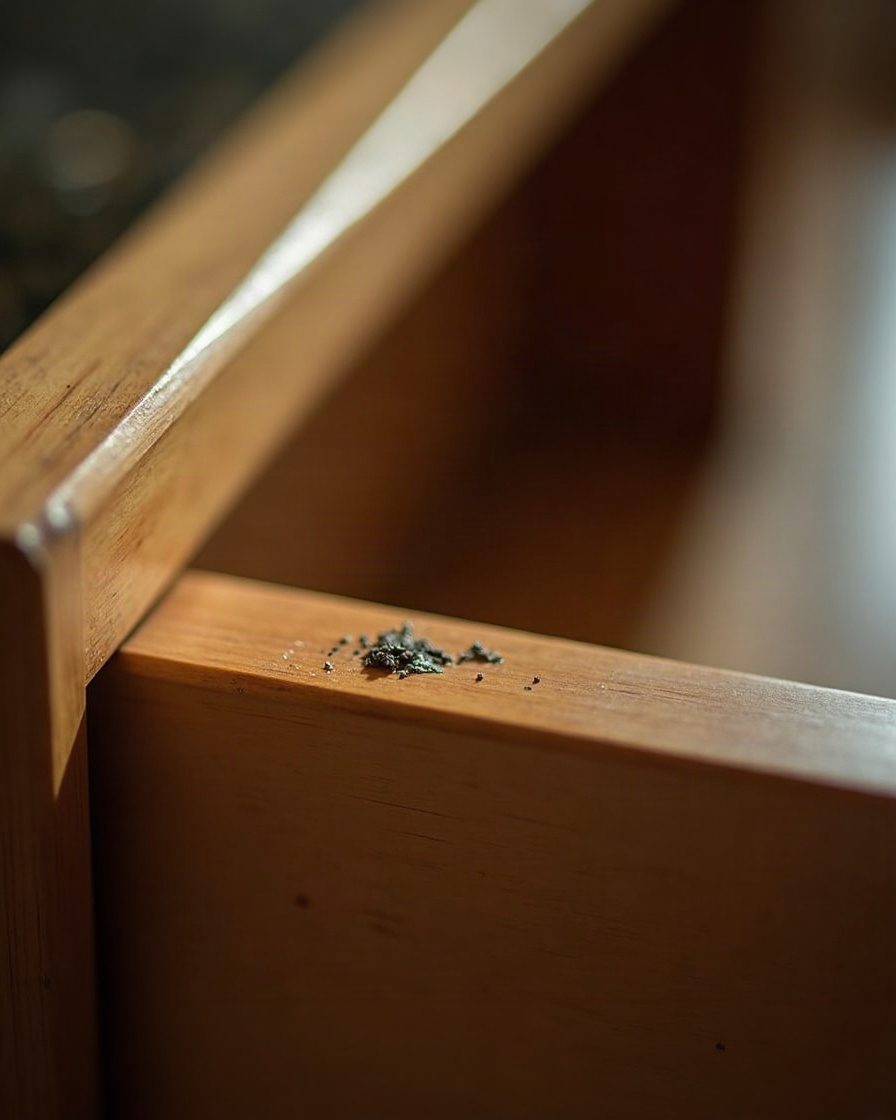
Along a wall or a skirting board suggests something that travels with one side touching a surface, which is most rodents and many insects. Inside a cupboard, on the shelf rather than the food suggests cockroach. Concentrated in one spot under a beam or in a loft suggests a roost: bat or bird. Scattered evenly over a horizontal surface with no path to them is often not droppings at all.
If the specks came from a kitchen, droppings in kitchen cupboards works through the four realistic candidates. If they came from a loft, the noise is usually the better witness, and attic pests identified by sound covers that.
Cleaning up without making it worse
This is the part that gets skipped, and it is the only part with a health dimension.
Do not sweep and do not vacuum dry. Both aerosolise dried rodent and bat droppings. The CDC’s guidance on rodents and the diseases they carry is built around avoiding exactly that.
The sequence that works: ventilate the room first, put on disposable gloves, dampen the droppings thoroughly with a disinfectant solution and leave it to soak, wipe up with paper towel, bag it, wash your hands. For a large accumulation in an enclosed space such as a loft or crawl space, this stops being a household job.

When droppings are not the useful evidence
Sometimes the droppings are ambiguous and something else in the room is not. Gnaw marks date activity better than droppings do, because fresh gnawing is pale against weathered wood. Reading gnaw marks covers that, and the pest damage chart covers the wider set of traces.
Common questions
How old are these droppings? Fresh rodent droppings are dark, soft and slightly shiny. They dry, harden and dull within a few days, and go grey and crumbly over weeks. A mix of fresh and old means ongoing activity.
Can I tell how many animals there are? Not reliably from droppings alone. A single mouse produces a surprising number, often fifty or more a day, so a large quantity is not evidence of a large population.
They keep appearing after I clean. That is the useful experiment. Clear an area completely, note the date, and check in three days. Anything new means current activity rather than a historic problem.
Is it dangerous just to be in the room? Intact, undisturbed droppings in a ventilated room are a low risk. The risk comes from disturbing dried material in an enclosed space.
The bottom line
Measure first, look at the ends second, and consider where you found them third. That order identifies the great majority of household droppings without needing to see the animal. And whatever the answer, dampen before you clean, because the one genuinely avoidable harm on this page comes from a dustpan and brush.