
\
\
\
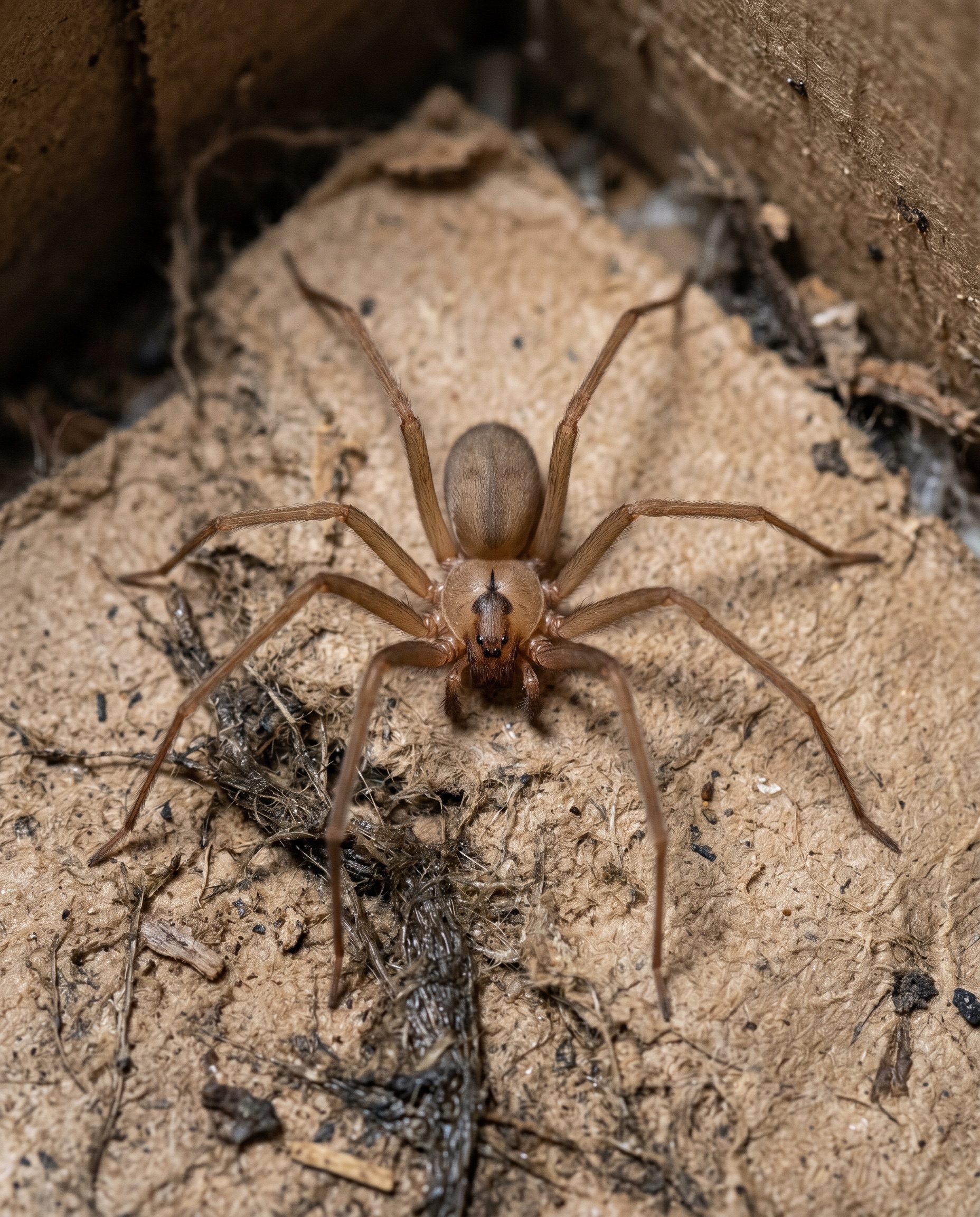
You found a flat tan spider in the basement and the first word that comes to mind is recluse. Before you panic, get the name right: a true brown recluse (Loxosceles reclusa) is confirmed by a dark violin shape on its back and, definitively, six eyes arranged in three pairs instead of the eight most spiders carry. Just as important, it lives only in a specific central-US range, so a great many “recluse” sightings on the coasts are simply a different, harmless spider. Nailing the ID is what keeps you from both needless fear and a missed risk.
\
\
\
If a uniformly tan spider has a dark violin mark pointing toward its abdomen and six eyes in three pairs, and you live in the central or south-central US, it is a brown recluse. Outside that range, it almost certainly is not.
\
- \
- The confirming feature: Six eyes in three pairs, not eight; the violin shape is a supporting clue, not proof on its own.
- Most-confused look-alike: Wolf, grass, and common house spiders, separated by their eight eyes and patterned, often banded, bodies.
- What it means: Venomous but shy; for what a bite looks like and when to seek care, read our guide to spider bites and when to worry.
\
\
\
\
\
\
\
\
For the neighbouring question, see Spider Egg Sac Identification: What’s in That White Ball.
Quick answer
\
\
A brown recluse is a small, uniformly sandy-to-tan spider, roughly the size of a quarter with its legs spread, and it has no spines and no stripes on its legs. The fastest reliable tell is the eye count: six eyes set in three pairs, a feature almost no look-alike shares. The violin marking on the front body section is the famous clue, but it is the eyes that settle it. If you can see a smooth tan body, a faint dark fiddle aimed backward, and only six eyes, you are looking at a recluse and not a wolf spider. The other half of the answer is geography. Recluses are a central-US spider, so if you are in California, Florida, or New England, the odds are overwhelming that you have a harmless look-alike instead.
\
\
The six eyes that confirm it
\
\
Most people try to identify a recluse by the violin and stop there, which is exactly where the mistakes start. Several brown spiders carry a vague dark patch that reads as a fiddle to a worried eye, and on a juvenile or a faded specimen the recluse’s own violin can be hard to see at all. The feature that actually holds up is the eye arrangement. According to the University of Kentucky entomology profile, the recluse is one of the few spiders with the dark violin marking and the six eyes set in three pairs, a layout called dyads: one pair in front and one pair on each side, with a small gap between them.
\
\
Checking it takes a little magnification. With a phone macro lens or a cheap loupe, look at the front of the head for two eyes flanked by two more on each side, six total, never eight. Six eyes in three pairs is the single feature that confirms a recluse. A captured or photographed specimen makes this far easier than a live spider scurrying along a baseboard, and it is worth the trouble, because the eye count rules out almost every harmless brown spider in one look. The violin supports the ID; the eyes prove it.
\
\
Full description
\
\
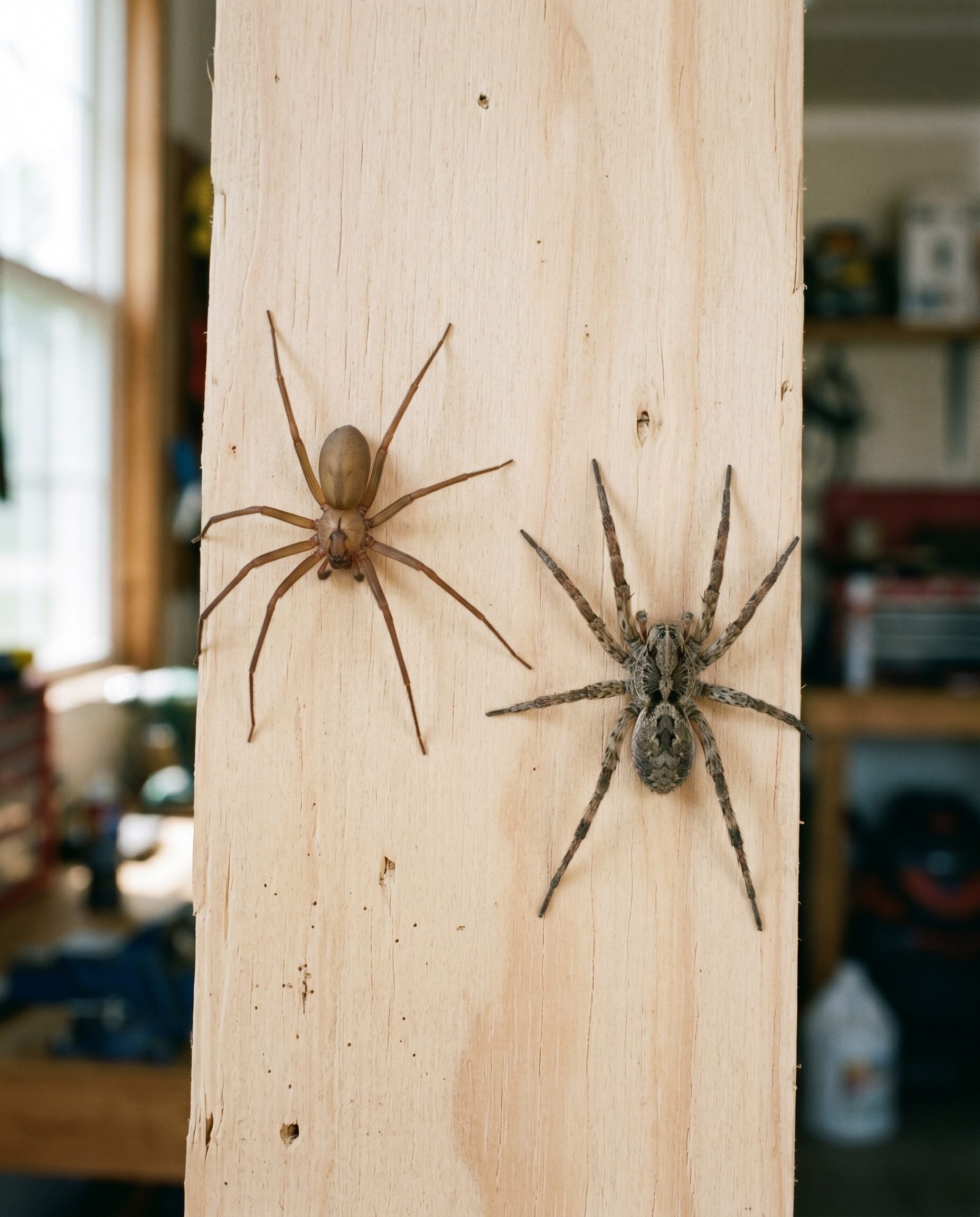
Run down the recluse the way an entomologist does, feature by feature. Size: small, with a body about the length of a pencil eraser and a legspan close to a quarter; anything noticeably hairy or chunky is probably not a recluse. Color: a single, even tan to light brown across the whole body and legs, with no spots, bands, or two-tone pattern. That uniform color is itself a clue, because most look-alikes are mottled.
\
\
Markings: the dark violin sits on the front body section, the cephalothorax, with the narrow “neck” of the violin pointing back toward the abdomen. It is subtle and matte, not glossy. Legs: long, thin, and smooth, with no spines and no banding; a recluse holds its legs in a low, flattish posture rather than the tall stance of a wolf spider. Web: recluses do not build a showy snare. They spin a loose, irregular retreat of off-white silk in dark, undisturbed spots, so a tidy orb web in a window is not their work. As Purdue’s extension guidance notes, most spiders found in homes are harmless and bite only when trapped against skin, and the recluse fits that pattern: it hides, it does not hunt people.\
\
\
\
Look-alikes and how to separate them
\
\
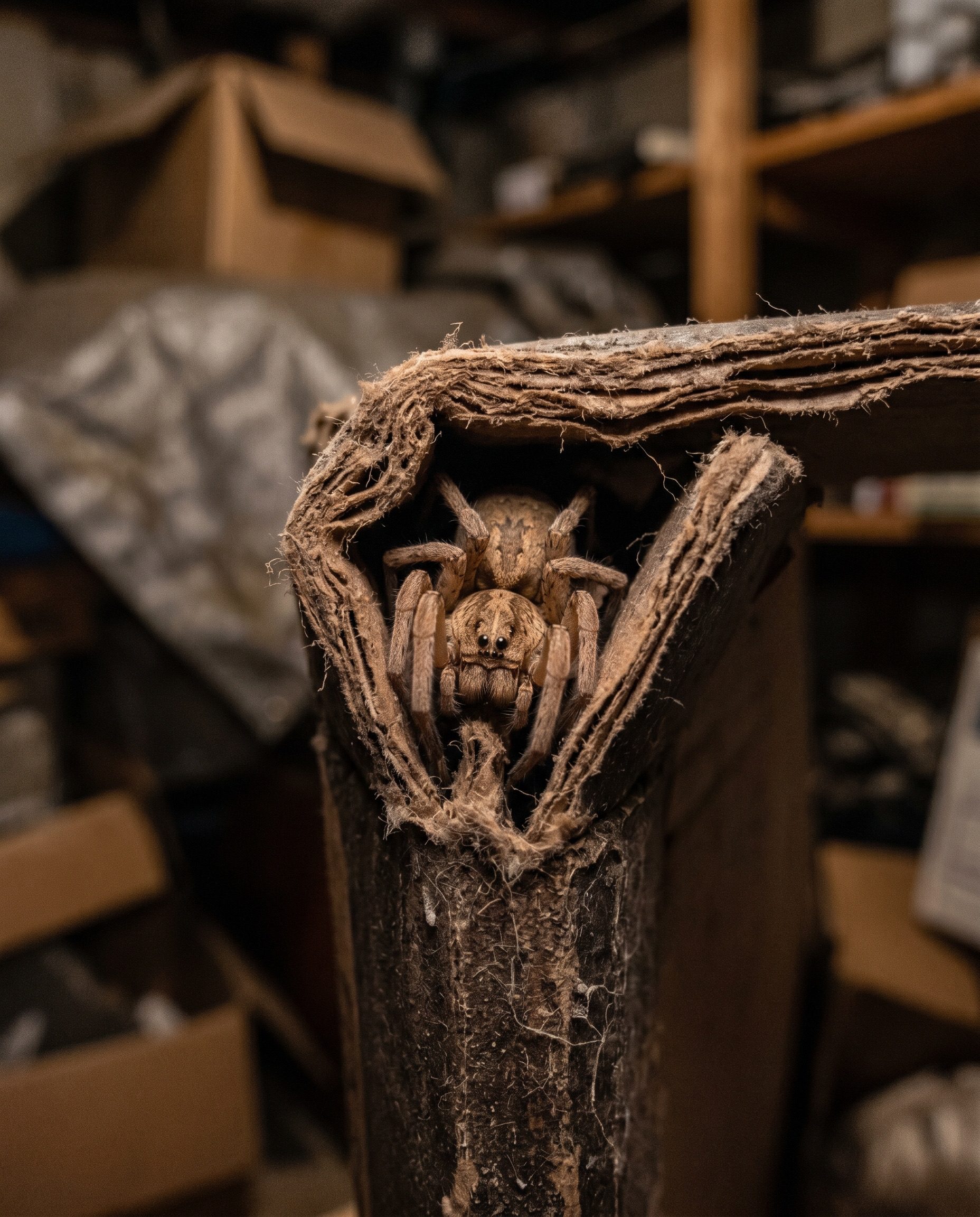
People confuse the recluse with three common brown spiders, and each is separated by one feature. The most frequent mix-up is the wolf spider, which is bigger, hairier, and patterned, with two large forward eyes you can spot without a lens. Grass spiders and common house spiders also get mistaken for recluses, but both carry the usual eight eyes and a patterned or banded body rather than the recluse’s plain tan. The single difference that resolves almost every case is the eye count, with body pattern as the backup. For a broader walk through the brown spiders that turn up indoors, see our guide to common house spider identification.
\
\
| Spider | Key feature | Where found |
|---|---|---|
| Brown recluse | Six eyes in three pairs, plain tan body, faint violin | Central and south-central US |
| Wolf spider | Eight eyes, two large; hairy, patterned, fast | Across the US, indoors and out |
| Grass spider | Eight eyes, banded legs, funnel web | Across the US, lawns and foundations |
| House spider | Eight eyes, mottled body, messy cobweb | Across the US, corners and basements |
\
\
Range, habitat, and why geography matters
\
\
Geography does more work in this ID than any single body part, which is why it belongs at the center of the answer. The brown recluse’s native range covers the central and south-central states, roughly from Nebraska and Iowa down through Texas and east to western Georgia, with the southern Midwest as its stronghold. UC IPM is blunt about it: the recluse’s range is limited to the central and south-central states, and established populations are absent from California, the Pacific Northwest, and most of the Northeast. If you are well outside that range, your spider is almost certainly a harmless look-alike.
\
\
Inside its range, the recluse earns its name by hiding. It favors dark, dry, undisturbed places: cardboard boxes, stacked firewood, attics, crawl spaces, behind baseboards, and inside seldom-worn shoes or folded clothes in storage. Clutter is its preferred address, which is also why reducing piles is the most effective non-chemical step in recluse country. Bites typically happen when a spider gets pressed against skin inside a sleeve or a sheet, not from a spider crossing a floor. The University of Kentucky lab makes the same point about misidentification from the other direction: Extension labs report that most submitted recluse specimens from outside the range are something else, often a wolf or grass spider mailed in by an anxious homeowner.
\
\
\
\
Is it dangerous?
\
\
The brown recluse is genuinely venomous, so do not wave the risk away, but it is also shy and rarely bites unless cornered. Get emergency medical help right away for signs of a severe allergic reaction such as trouble breathing, swelling of the throat or tongue, dizziness or fainting, or hives spreading quickly, and use an epinephrine auto-injector if one has been prescribed. For a suspected recluse bite that worsens, develops an expanding or darkening wound, or comes with fever, contact a healthcare provider.
\
\
I identify spiders; I do not diagnose bites, and neither should a web page. Many wounds blamed on recluses turn out to be infections or other conditions, especially outside the spider’s range. MedlinePlus describes what a brown recluse bite looks like and when to seek care without you needing to guess. For how to tell a worrying bite from a harmless one, our spider bites identification guide lays out the red flags. If your real worry is the other notorious US spider, the black widow identification guide covers its very different look.
\
\
Common questions
\
\
Does a brown recluse always have a clear violin?\
No. The violin is a supporting clue, not proof. It fades on young spiders and on faded specimens, and several harmless brown spiders carry a vague dark patch that mimics it. When the violin is unclear, fall back on the eye count: six eyes in three pairs is the feature that actually confirms a recluse.
\
\
Can I have brown recluses if I live on the coast?\
Almost certainly not as an established population. The recluse’s range is the central and south-central US, and it is absent from California, the Pacific Northwest, and most of the Northeast. A stray can occasionally hitchhike in a box, but a coastal spider that looks like a recluse is far more likely to be a wolf or grass spider.
\
\
How do I tell a wolf spider from a recluse?\
Look at the eyes and the body. A wolf spider has eight eyes, two of them large and forward-facing, plus a hairy, patterned body and a tall-legged stance. A recluse has six eyes, a smooth uniform tan body, and a low, flat posture. The wolf spider is the single most common false alarm.
\
\
Do brown recluses jump or chase people?\
No. They are reclusive ambush spiders that flee from disturbance and hide in dark, undisturbed clutter. Bites happen when a spider is trapped against skin in clothing or bedding, not because it pursued anyone. Shaking out stored shoes and clothes in recluse country handles most of the risk.
\
\
Final verdict
\
\
Confirm a brown recluse with the eyes, not the legend. Six eyes in three pairs, on a uniformly tan body with a faint backward-pointing violin, is the combination that settles it, and the violin alone is not enough. Then check the map: this is a central and south-central US spider, so outside that range the smart bet is a harmless look-alike. Get the ID right and you avoid both the panic of treating every brown spider as a recluse and the mistake of dismissing a real one.
\
\
Next steps:
\
\
– Tell a worrying bite from a harmless one with our spider bites identification guide.
\
– Match a mystery brown spider against the usual indoor suspects in our house spider identification guide.
\
– Rule out the other dangerous US spider with the black widow identification guide.
\
\

Pingback: Bugs That Look Like Spiders: Count the Legs First