nnn
You flip on the kitchen light at midnight and something the size of a half dollar sprints across the floor and disappears under the stove. Big, hairy, fast, and apparently headed straight for you. That spider is almost always a wolf spider, and almost everything your instincts scream about it is wrong. It is not aggressive, it did not come inside to nest, and its bite is close to a non-event for most people. It is a ground hunter that took a wrong turn during its busiest season, which is exactly now, in late summer and early fall.
nn
n
A wolf spider indoors is a lost outdoor hunter, not the start of an infestation. It is fast and hairy but not aggressive, bites are rare and mild, and the fix is a cup, a piece of card, and a door, followed by sealing the gap it used to get in.
n
- n
- Confirm the ID: A robust, hairy body that runs instead of sitting in a web, eyes that shine back at a flashlight, and sometimes an egg sac or a load of babies riding on the mother’s back.
- The real risk: Bites are rare, defensive, and usually no worse than a bee sting; see a clinician only if a bite shows spreading redness, pus, or fever.
- The fix: Catch and release with a cup and card, then add door sweeps, caulk, and glue boards so the next wanderer never makes it inside.
n
n
n
n
nn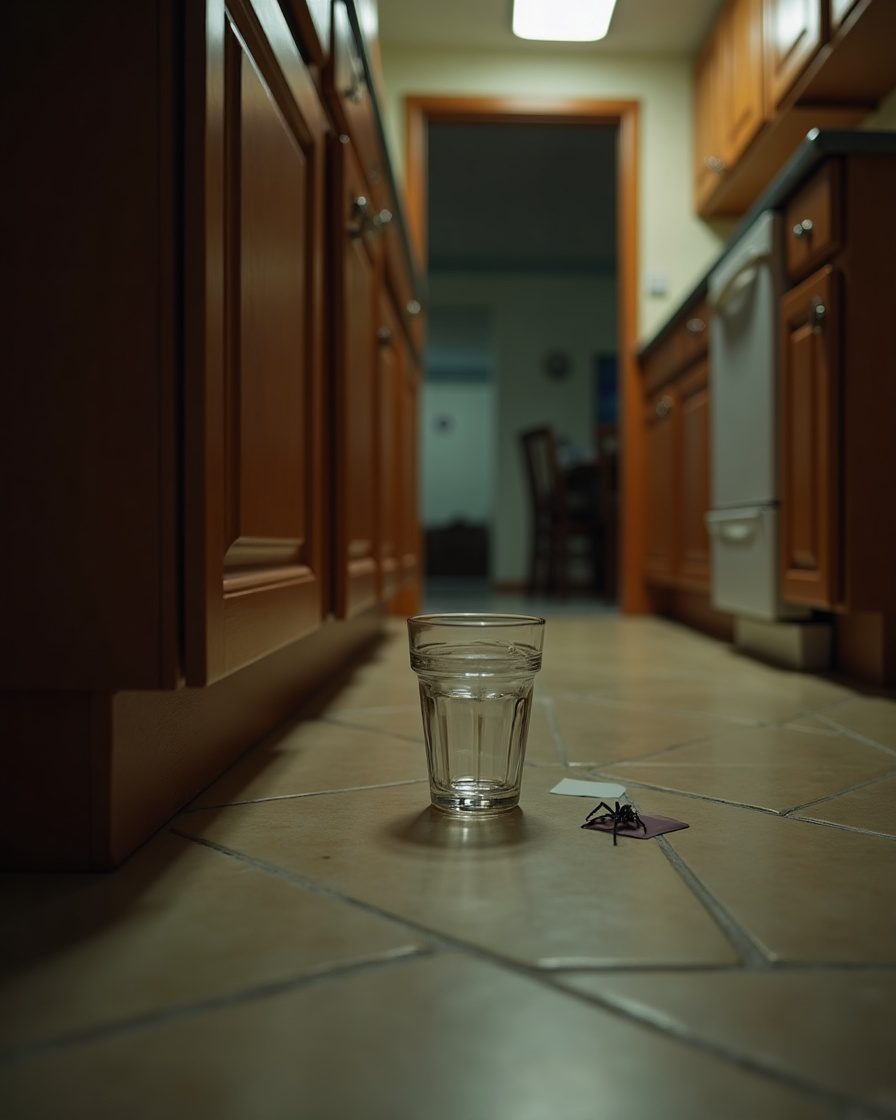 nn
nn
How to know it is a wolf spider and not a brown recluse
nn
Start with the build and the behavior. A wolf spider is a stocky, hairy, athletic spider with a body roughly a quarter inch to an inch long, in gray, brown, black, or tan with darker markings. It does not hang in a web waiting; it patrols. The Missouri Department of Conservation’s field guide notes that wolf spiders do not spin webs to catch prey and instead run it down, hence the sprint across open floor instead of a web in a corner.
nn
Two field marks settle the identification. First, the eyes: a wolf spider has a row of four small eyes below two enlarged center eyes, and those big eyes reflect light, so if you sweep a flashlight across the floor at night the eyes shine back at you like a cat’s. Second, the babies: a female carries her round egg sac attached to her rear, and after hatching she carries the spiderlings themselves on her back for up to two weeks. No other spider in a North American house does that. If you see a big hairy spider that appears to be wearing a lumpy, moving backpack, the ID is finished.
nn
Here is how it separates from the lookalikes people fear.
nn
| Trait | Wolf spider | Brown recluse | Funnel weaver (grass spider) |
|---|---|---|---|
| Build | Stocky, hairy, often large | Slender, smooth, uniform tan | Slim with long spinnerets |
| Web | None; hunts on foot | Small, hidden, irregular retreat | Flat sheet web with a funnel |
| Marking | Dark stripes or mottling | Single dark violin near the head | Striped, sits in its web |
| Movement | Fast sprints across open floor | Shy, stays in undisturbed clutter | Retreats into the funnel |
nn
A big, fast, hairy spider crossing your living room in September is far more likely to be a harmless wolf spider than anything medically significant. If you were bitten by something you did not see, our guide to spider bite identification and when to worry walks through the honest warning signs.
nn
What a wolf spider bite actually does
nn
Here is the part the horror reflex gets most wrong. Wolf spiders are not aggressive toward people, and biting is a last resort for a spider whose entire strategy is to outrun trouble. The University of Kentucky’s guide to spiders around homes describes wolf spiders as fierce looking but notes a bite happens only if the spider is disturbed or pinched, with results similar to a wasp or bee sting. Missouri’s field guide goes further and calls the bites of North American wolf spiders harmless to people. The fear is real; the danger mostly is not.
nn
The mechanics back that up. UC IPM’s statewide pest note points out that the jaws of most spiders are too small to bite humans at all, and that bites generally happen when a spider is trapped against skin, in a shoe, a glove, or a towel on the floor. Do not grab one bare handed and shake out shoes that sit in the garage, and you have removed nearly every realistic bite scenario.
nn
This is information, not medical advice. If a bite does happen, wash it with soap and water and treat it like any minor sting. See a clinician if the site develops spreading redness, warmth, pus, or you run a fever, since those point to a skin infection rather than venom. Any severe reaction with trouble breathing or widespread swelling is an emergency, so get emergency medical care right away.
nn
Why they wander inside in late summer and fall
nn
The popular story is that spiders feel the first cold nights and head indoors to warm up. Extension entomologists tell a less dramatic story. The University of Kentucky describes wolf spiders indoors as accidental invaders that entered around doors, windows, or other openings, and notes that they do not persist inside. Most of the spiders that genuinely live in your house year round are a different cast of house-adapted species, cobweb spiders and cellar spiders that never see the outdoors at all.
Bugs that look like spiders goes further into eight legs is not enough on its own.
nn
What changes in late summer is traffic. Wolf spider populations peak after a season of breeding and hunting, mature males roam widely in search of females, and cooling nights push the insects they hunt toward the warm, lit faces of buildings. More spiders moving more distance past more prey equals more wrong turns under your door. The spider on your kitchen floor was hunting the same crickets and beetles that are also drifting indoors right now, which is why our overview of fall invaders and how to pest-proof against them treats spiders and their prey as one problem, not two.
nn
The indoors is actually a poor deal for a wolf spider. It is dry, food is scarce, and there is no soil or leaf litter to burrow into. Left alone, most either find their way back out or die within days. You are not defending the house from a colonist, you are dealing with a lost tourist.
nn nn
nn
The cup and card method: out the door in two minutes
nn
Because a wolf spider hunts on open ground rather than hiding in a web, it is one of the easiest spiders to evict humanely. UC IPM’s recommended technique is the classic one: place a jar over the spider and slip a piece of paper under it, then carry the sealed container outside. In practice it goes like this:
nn
Take a wide cup, jar, or food container and a stiff piece of card, junk mail works fine. Approach slowly; wolf spiders bolt from fast movement, not slow shadows. Set the cup over the spider in one smooth motion, slide the card underneath, keep light pressure on the card, and walk it outside. Release it at the yard edge, near a woodpile, rock border, or leaf litter well away from the foundation, the habitat it was hunting in the first place. If the spider is a female with an egg sac or young on her back, the cup method is doubly worth it, since crushing or vacuuming her can scatter live spiderlings.
nn
If you cannot get that close, a vacuum is the honest second option, but spiders are soft bodied and rarely survive it, so treat that as a kill, not a relocation.
nn
One wolf spider does not mean an infestation
nn
Wolf spiders are solitary. They do not form colonies, they do not build communal webs, and they do not set up nurseries behind your drywall. One spider means one spider came in. Even a female carrying young is not an established population; her spiderlings cannot survive long indoors.
nn
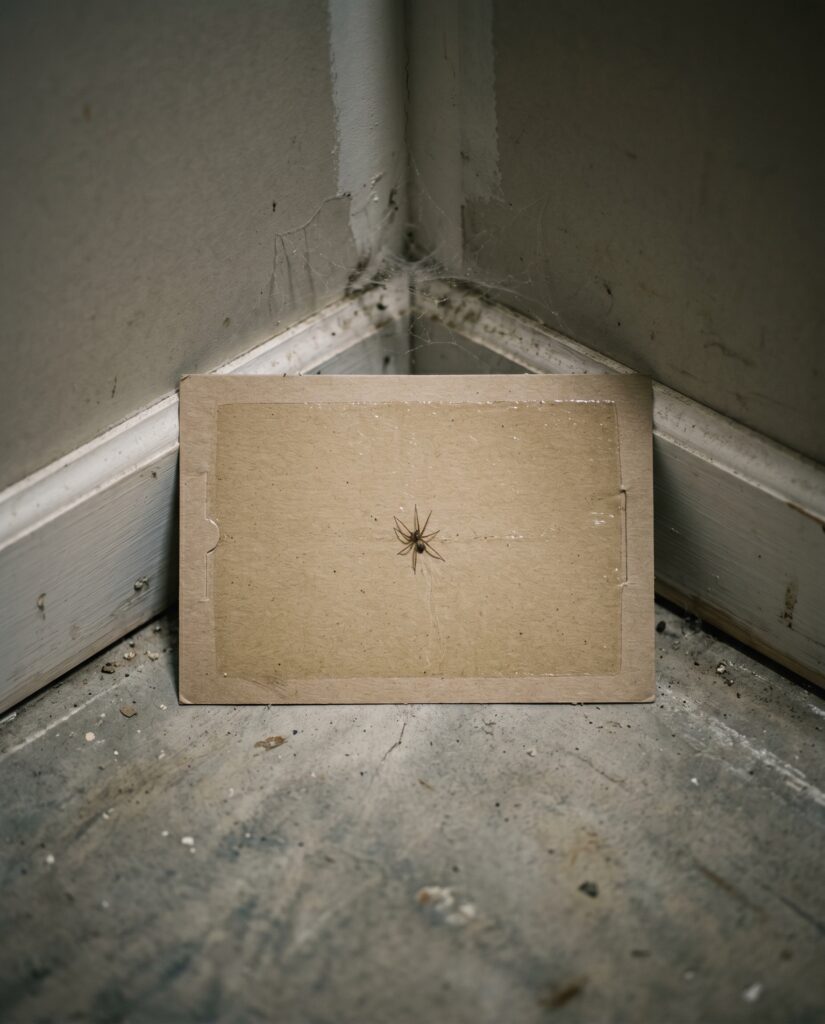
The useful question is not how many spiders you have but how they are getting in and what they are eating. The University of Kentucky’s guide to eliminating spiders recommends glue boards placed flush along the bottom of walls and in corners as a detection tool, and the same boards double as a census of the prey insects wandering your baseboards. A board that fills with crickets tells you why hunters keep visiting; our guide to camel crickets covers the most common basement culprit. A board that catches long, many-legged sprinters instead has found the house’s other resident hunter, and our piece on house centipedes explains why that one is also more helpful than harmful.
nn
If boards keep catching wolf spiders week after week, you do not have a breeding problem. You have an open door somewhere, and that is a sealing job, not a spraying job.
nn
Sealing and yard work that actually keeps them out
nn
The lasting fix is the same one that works for nearly every autumn invader. The University of Kentucky’s pest-proofing guide urges homeowners to block entry before pests end up inside, and its checklist is short and cheap: install door sweeps on exterior doors, since door gaps are a highway for ground hunters; caulk around windows, fascia, and the openings where pipes, wires, and vents pass through the wall; repair torn window screens; and cover attic and crawl space vents with quarter inch hardware cloth.
nn
Those same quarter inch gaps matter beyond spiders. A pencil-diameter opening is enough for a mouse, so an afternoon of sealing pays double when the rodents start testing the foundation in October. Our walkthrough on mouse-proofing a house covers the rodent side of the same job, and our step-by-step fall pest-proofing guide puts the whole sequence in weekend order.
nn
Outside, think like a ground hunter. Wolf spiders live in low vegetation and leaf litter, so the strip where your lawn meets the foundation decides how much traffic reaches the wall. Keep grass mowed, rake leaf litter and mulch back from the foundation, move firewood and debris away from the siding, and trim shrubs so they do not touch the house. Kentucky’s spider guidance adds one more lever: swap bright white exterior bulbs for yellow bug bulbs, which draw fewer night-flying insects and therefore fewer of the hunters that follow them. Indoors, routine vacuuming of corners and floor edges does more than any spray; the same guide is blunt that total-release foggers are seldom effective against spiders.
nn nn
nn
Common questions
nnDo wolf spiders climb into beds?n
Rarely. They are ground hunters that patrol floors and low edges, and they have no reason to seek out a sleeping person. Keeping bedding off the floor removes the ramp for the rare climber.
nnWhat attracts wolf spiders into a house?n
Prey and openings, in that order. Crickets, beetles, and other insects drifting indoors in fall are the draw, and gaps under doors are the entrance. Fix the food supply and the door gap and the visits mostly stop, which is why sealing beats spraying.
nnShould I just kill it?n
You can, but there is little reason to. Wolf spiders eat pest insects, are not aggressive, and do not survive long indoors anyway. The cup and card method takes two minutes and puts a free pest controller back to work in your yard instead of leaving a smear on the wall.
nnA wolf spider exploded into dozens of babies when I hit it. Is my house infested now?n
No. That was a female carrying spiderlings on her back, and the scattering looks far worse than it is. The babies need outdoor prey and moisture, and nearly all die indoors within days. Vacuum them up and put the incident behind you.
nnWhen should a spider bite worry me?n
Watch the site rather than the species. See a clinician for spreading redness, warmth, pus, red streaks, or fever, which suggest infection. Seek emergency care for any severe reaction such as trouble breathing or widespread swelling.
nn
Final verdict
nn
A wolf spider in the house is a big, fast, harmless hunter that wandered in during its busiest season, and it neither wants to stay nor can. Confirm the ID by the stocky hairy build, the sprint instead of the web, the flashlight eye-shine, and the egg sac or babies on the mother’s back. Skip the panic about bites; they are rare, defensive, and usually no worse than a bee sting, with a clinician visit reserved for signs of infection. Evict the visitor with a cup and a piece of card, then spend your energy where it compounds: door sweeps, caulk around pipes and windows, screens and vent mesh, glue boards along the baseboards, and a mowed, raked yard edge. One spider is a wrong turn. The gap it used is the actual problem, and it is the one thing on this page you can permanently fix.
nnThis article is for information only and is not medical advice.n