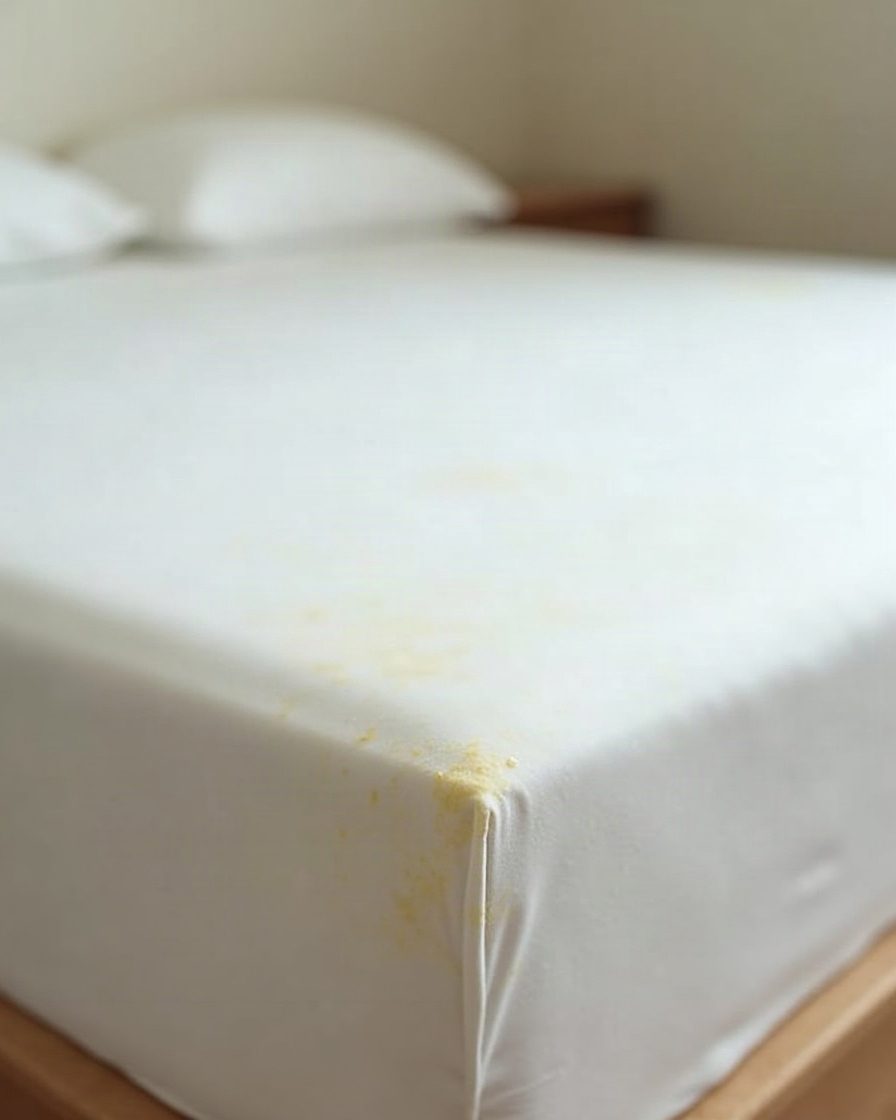
Most yellow staining on bedding and mattresses is body oil, perspiration and skin proteins oxidising over time, and it has nothing to do with insects. It spreads over an area, concentrates where the body rests, and deepens gradually. Pest evidence looks different: discrete dark dots that bleed rusty brown into a damp cloth, concentrated along seams and frame joints rather than in the middle of the bed, and accompanied by shed skins.
- Spread and gradual: not a pest. Discrete dots at a seam: worth investigating.
- The damp cloth test settles it in seconds and costs nothing.
- A stain on its own is never enough. Look for skins and live insects.
This is a search that usually ends in reassurance, and it is worth doing properly so that the reassurance is real rather than assumed.
What yellow staining usually is
Body oil and perspiration. Sebum and sweat transfer into fabric nightly, oxidise on exposure to air, and yellow over months. The pattern follows the body: heaviest around the head and shoulders, lighter elsewhere, and roughly symmetrical. Pillows show it first and most.
Skin proteins and dead skin cells, which accumulate in the same places.
Product residue. Skin creams, hair products and sunscreen all stain fabric yellow over time, and some sunscreen ingredients react with hard water minerals to produce a strong orange-yellow that resists laundering.
Detergent and residue interaction, particularly with insufficient rinsing or hard water.
Age and storage. Cotton and linen yellow over years, and stored textiles yellow faster in a warm loft than in a cool cupboard.
None of these is a pest. All of them produce diffuse, spread staining that deepens gradually and follows the shape of a sleeping body.
What pest evidence looks like instead
Discrete dark dots, 1 to 3 mm. Not yellow, and not spread. Bed bug faecal marks are dark brown to black, small, and clustered.
They bleed when damp. Because the material is digested blood, pressing a damp white cotton bud or cloth against the dot produces a rusty brown halo spreading into the cloth. Nothing on the list above does that. This is the whole test, and it takes ten seconds.
They are on the seam, not the middle. Bed bugs harbour in tight crevices and come out to feed, so the marking concentrates along piped mattress seams, in the divan base, in bed frame joints and screw holes, and behind a headboard. Marking in the open middle of a mattress is uncharacteristic.
Shed skins nearby. Amber, hollow, translucent, in a range of sizes. These are the strongest available evidence, because a range of sizes means a population growing through stages. See bed bug shed skins.
UC IPM’s guide to bed bugs and the University of Kentucky’s bed bugs guidance both cover the inspection method, and bed bug droppings on a mattress covers this in detail.

Small blood spots, which are a third thing
Occasionally there are small fresh red or brown spots on sheets. These are not droppings and not oil. They are blood, either from a bug crushed after feeding or from a bite site.
On their own they prove very little: a scratched insect bite of any kind, a nosebleed or a small cut all produce the same thing. They are worth noting only alongside the seam inspection.
The inspection, in order
Do this before concluding anything either way. A negative result in the wrong place is worthless.
1. Strip the bed completely.
2. The piped mattress seam, all four sides, top and bottom, with a torch held at a low angle. Open the piping slightly with a fingernail.
3. The divan base or box spring, especially the underside and the stapled dust cover. Frequently more productive than the mattress.
4. Every joint, bolt hole and screw recess in the frame.
5. The headboard, both faces, and the wall behind it. Stains on walls from insects covers marking that appears there.
6. Within two metres of the bed: bedside drawer runners, the skirting joint, the carpet edge.
Ten minutes, and it settles the question far more reliably than looking at a stain.
What else lives in a bed and does not stain
Worth mentioning because it comes up constantly.
Dust mites. Microscopic, present in every home, feed on shed skin, and do not bite, do not stain and are not visible. They are an allergen rather than a pest in the usual sense.
Carpet beetle larvae. Occasionally in bedding, feeding on wool and on shed skin and hair. They leave cast skins rather than stains. See tiny black bugs in bed that are not bed bugs.
Fleas. Bite, but harbour in carpet and on animals rather than in a mattress, and leave flea dirt that also turns red when damp, though the location differs.

Removing the ordinary stains
Since this is the likely answer: enzyme-based laundry products work on protein and oil staining, and an overnight soak does more than a hot wash. Oxygen bleach is effective on cotton and linen. Sunlight is genuinely effective on white cotton.
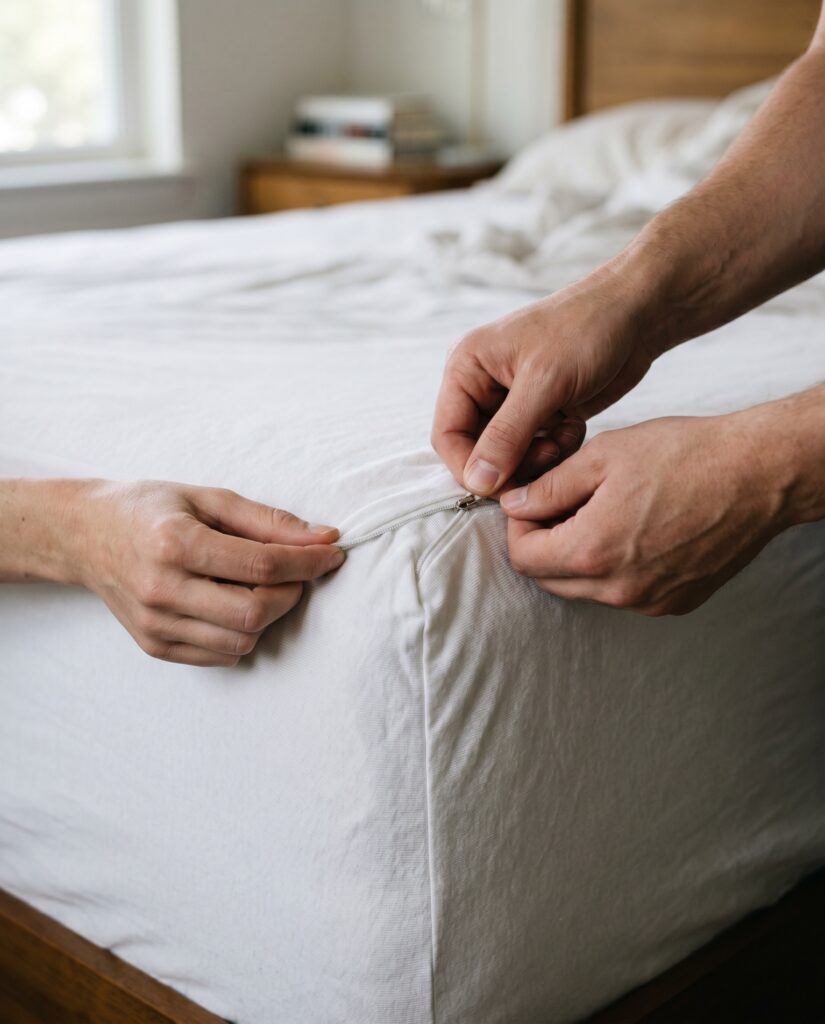
For a mattress, which cannot be washed: blot rather than soak, use an enzyme cleaner sparingly, and dry it thoroughly, because a damp mattress core is its own problem. A washable protector fitted afterwards prevents recurrence and, if a zipped encasement is chosen, doubles as a bed bug measure and makes any future inspection a two-minute job.
Common questions
The stains are only on my side. Consistent with body oil and with nothing else on this page.
They appeared suddenly. Sudden means a spill, a product or blood, rather than the gradual oxidation of oils.
A yellow ring with a defined edge. A liquid spill that dried, not an insect.
No stains but I have bites. Bites alone establish very little; reactions vary enormously and many people show none. Do the seam inspection anyway.
The bottom line
Diffuse yellowing that follows the shape of a sleeping body is oil and perspiration, and it is the answer most of the time. Before accepting it, spend ten minutes on the seam, the base and the frame joints with a torch, and put a damp white cloth on anything dark and discrete. If nothing bleeds rusty brown and there are no hollow amber skins, this is a laundry problem.