
If you’re seeing tiny yellowish ants marching in neat lines across a countertop, you may be dealing with pharaoh ants. The good news: they’re identifiable with a few simple body clues, and they’re controllable without turning your home into a chemical zone. The catch is that the “obvious” approach – spraying visible ants – often backfires. This guide shows how to confirm the ID, why these ants spread so easily indoors, and the bait-first steps that actually reach the queens.
\
If you want the wider context, How Do Ant Colonies Work? Social Structure Explained and DIY Ant Bait Recipes: Borax Traps That Work are the natural next reads.
Quick identification / quick answer
\
Pharaoh ants (Monomorium pharaonis) are tiny, pale indoor ants that are best controlled with slow-acting, non-repellent baits – not sprays. Use this fast checklist to confirm what you’re seeing.
\
Quick ID checklist (snackable version):
\
- \
- Size: Workers are 1.5-2 mm (about 1/16 inch) – noticeably smaller than most household ants
- Color: Light yellow to reddish-brown with a darker abdomen that can look slightly translucent
- Antennae: 12 segments with a 3-segment club at the tip
- Waist: Two distinct nodes between thorax and abdomen
- Where you find them: Warm, humid indoor spots (kitchens, bathrooms, wall voids, near plumbing)
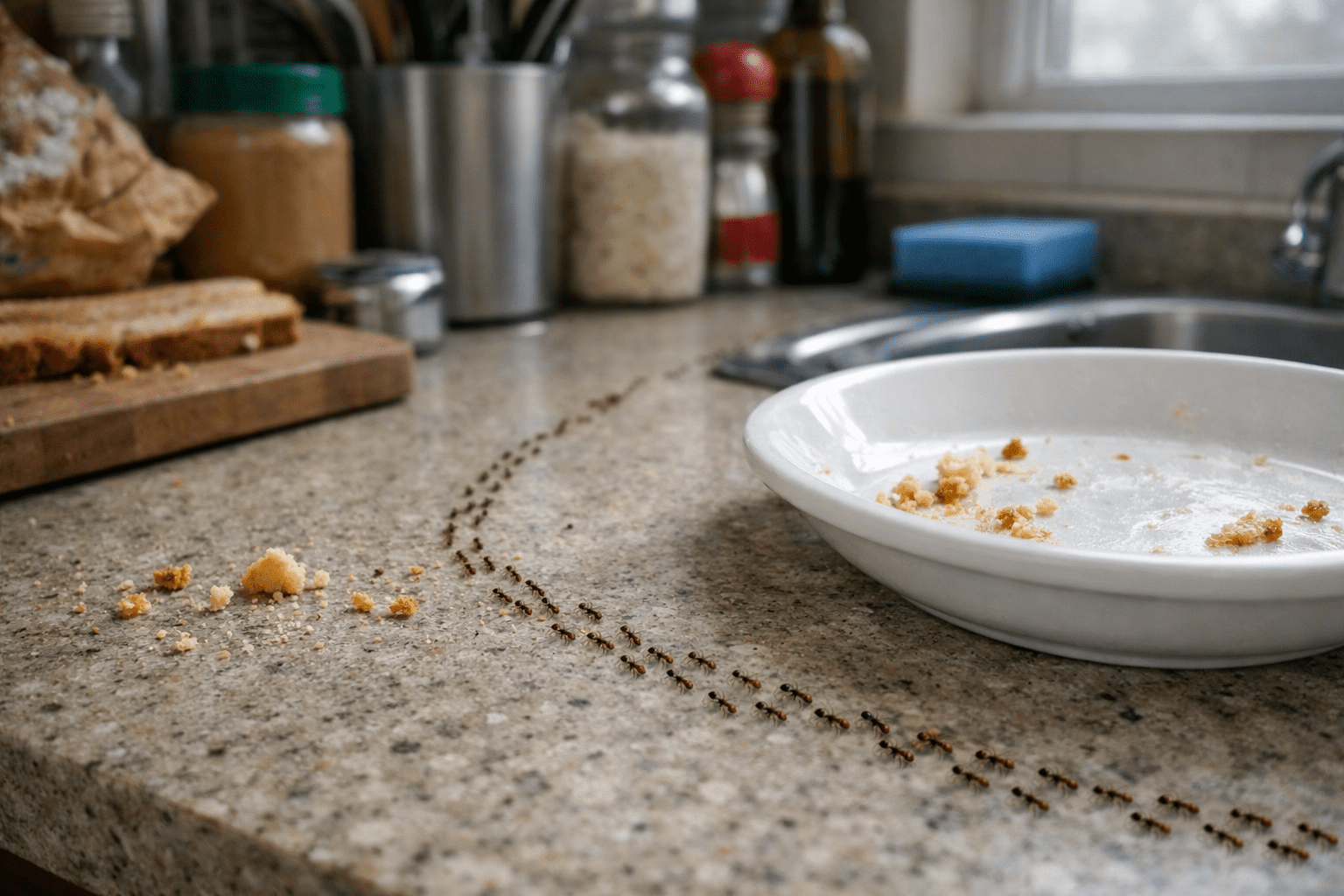
- Typical sign: Long, persistent trails to sweets, grease, and pet food
\
\
\
\
\
\
\
Fast control answer:
\
- \
- Do not spray trails or baseboards. It can split colonies (budding) and spread the problem.
- Do bait on active trails using slow-acting gel or station baits, then monitor and refresh.
\
\
\
How to identify pharaoh ants (with look-alikes)
\
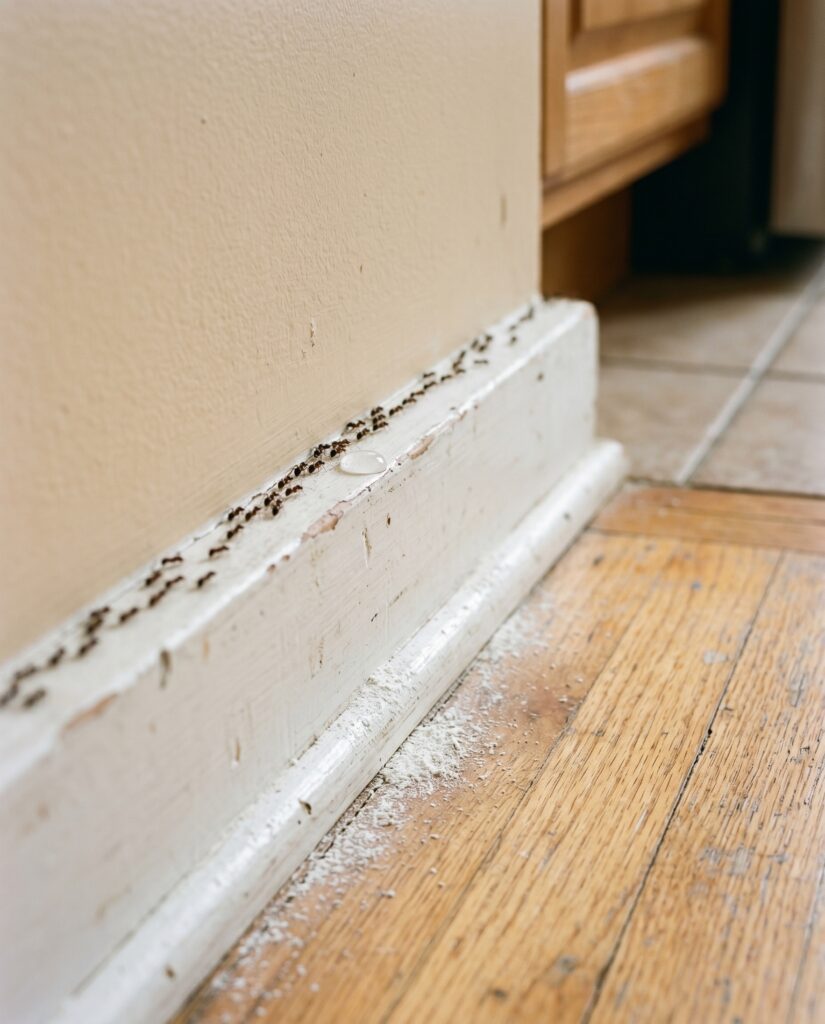
Pharaoh ants are famous for being “small and sneaky,” but you can still identify them with a few consistent traits. Most homeowners first notice the trails: a thin line of ants moving with purpose, often along edges of counters, baseboards, or sink plumbing. That trail behavior is a clue, but the body details are what confirm it.
\
What pharaoh ants look like up close
\
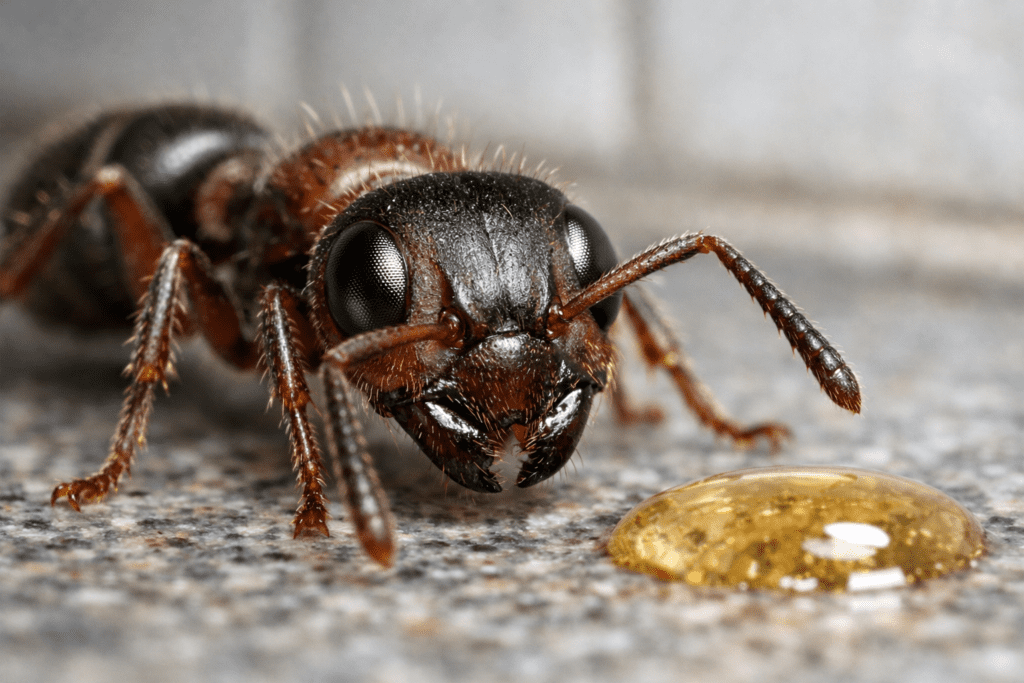
Workers are tiny – 1.5 to 2 mm long – and often appear pale yellow to light brown. Under good light, the abdomen looks darker than the rest of the body. They have a smooth thorax (no spines) and a two-node waist, which helps separate them from several common indoor ants.
\
Queens and males are rarely seen unless a nest is disturbed. Queens are much larger (about 3.6-5 mm) and reddish, while males are darker and winged. The key practical point: these ants expand mostly by budding (splitting nests), not by dramatic swarms.
\
Pharaoh ants vs. thief ants vs. odorous house ants
\
Many “small yellow ants” get mislabeled. Here’s a quick comparison you can use without a microscope.
\
| Feature | Pharaoh ants | Thief ants | Odorous house ants |
|---|---|---|---|
| Worker size | 1.5-2 mm | ~1.5 mm (similar) | 2.4-3.3 mm (larger) |
| Color | Yellow to light brown, darker abdomen | Yellowish to light brown | Brown to black |
| Antennal club | 3 segments | 2 segments | 1 segment (not clubbed like pharaoh) |
| Waist nodes | 2 | 2 | 1 |
| Smell when crushed | No strong odor | No strong odor | Often “coconut-like” odor |
\
If you’re unsure, focus on the 3-segment antennal club and the two-node waist. For a practical, extension-style overview of indoor ant IDs, see guidance from the Ohio State University Extension.
\
Where to look (and what to look for)
\
Pharaoh ants prefer warm, protected spaces close to moisture and food. Common nest areas include:
\
- \
- Behind baseboards and trim
- Inside wall voids near plumbing
- Under sinks and around dishwasher voids
- Near water heaters, HVAC chases, or electrical conduits
\
\
\
\
\
Actionable tip: Place a small dot of honey or peanut butter near the trail. If workers recruit heavily within 15-30 minutes, you’ve found an active foraging line worth baiting.
\
Why pharaoh ants are so hard to get rid of indoors
\
\
\
\
If pharaoh ants behaved like a typical outdoor ant colony, control would be simpler. The challenge is that their social structure and movement patterns are built for indoor survival. Think of them less like “one nest” and more like a network that can split, relocate, and reconnect.
\
One reason they’re persistent is polygyny – colonies can contain many queens (sometimes dozens to hundreds). Another is unicolonial behavior, meaning nearby nests often don’t fight each other. Instead, they can exist peacefully in the same building, which allows infestations to spread across rooms or even units.
\
Budding: the #1 reason sprays make things worse
\
Many ants expand by producing winged swarmers that fly off to start new colonies. Pharaoh ants often do the opposite indoors. When stressed, they can bud: a queen and a group of workers break away to form a new nest in a safer spot.
\
That’s why “quick knockdown” products can backfire. When you spray a trail, you may kill foragers, but you also disturb the colony, which can trigger splitting and relocation. Pest management guidance commonly emphasizes baiting over repellent treatments for this species. Consumer-facing summaries like the Orkin pharaoh ant overview echo the same practical point: baits outperform sprays for long-term control.
\
Their chemical communication is unusually effective
\
Pharaoh ants rely heavily on pheromone trails. Scouts lay persistent “main routes” that branch as food sources change. Research summaries note they can even use a short-lived repellent pheromone to steer nestmates away from poor choices, helping the colony reroute quickly. In plain terms: they’re excellent at traffic control.
\
What this means for you: if you only treat where you see ants, you’re often treating the “highway,” not the “city.” The nest is usually hidden in a wall void or warm cavity, and the colony can reroute around disruptions.
\
Indoor survival advantage: year-round activity
\
In temperate regions, pharaoh ants are primarily indoor pests. Heated buildings give them stable warmth and humidity, so they don’t follow the same seasonal slowdowns you see in many outdoor ants.
\
Practical takeaway: successful control is usually a weeks-long process, not a weekend project. Slow-acting baits need time to circulate through workers and queens.
\
 \
\\
\
Pharaoh ants control guide: what works (and what to avoid)
\
\
\
\
\
\
Raid Ant and Roach Killer, 17.5 oz\
\
\
Raid Ant and Roach Killer 17.5 oz earns a strong 4.6-star rating from over 25,000 Amazon reviews for its reliable contact and residual killing power against ants and roaches, making it a top choice for household pest control at an affordable ~$10 price point. Users praise its effectiveness and ease of use, though the potent odor and precautions around kids/pets are common notes—ideal for quick infestations but ventilate well after use.
\
\
\
\
\
\
The most reliable approach is bait-first integrated pest management: reduce food and water, place the right baits on active trails, and avoid anything that repels or fragments the colony. If you only remember one rule, make it this: don’t turn a bait problem into a budding problem.
\
Step-by-step plan (bait-first, spray-last)
\
Use this sequence to keep the colony feeding on your bait instead of scattering.
\
- \
-
Stop spraying immediately
\
- \
- Avoid aerosol ant sprays, strong cleaners on trails, and “barrier” treatments along baseboards.
- These can repel foragers and encourage budding.
\
\
\
-
Sanitation and moisture control (same day)
\
- \
- Wipe crumbs and sticky residues nightly.
- Store sweets and pet food in sealed containers.
- Fix leaks and reduce condensation under sinks.
\
\
\
\
-
Choose slow-acting, non-repellent baits
\
- \
- Effective actives often include indoxacarb, abamectin, or fipronil in gel or station formats.
- Place bait directly on active trails and near trail edges, not in random corners.
\
\
\
-
Use enough placements
\
- \
- Multiple small placements beat one big blob.
- Refresh as it dries out or gets consumed.
\
\
\
-
Monitor and adjust food preference
\
- \
- Pharaoh ants can switch between sweets, proteins, and fats.
- If a bait is ignored for 48 hours, switch to a different formulation (sweet gel vs. protein/grease-based).
\
\
\
-
Stay consistent for 3-8 weeks
\
- \
- Expect gradual decline, not instant disappearance.
- Full suppression can take 1-3 months in complex infestations.
\
\
\
\
\
\
\
\
\
\
Product selection tip: If you want a deeper breakdown of bait types, placements, and what to buy for different infestation levels, see our Best Ant Killers & Baits: Complete Buyer's Guide.
\
What not to do (common mistakes that prolong infestations)
\
Here’s a quick “avoid” list that matches how these ants behave.
\
- \
- Don’t use repellent sprays on trails
- \
- You may stop activity in one spot while spreading nests elsewhere.
\
\
- Don’t rely on perimeter indoor treatments
- \
- Pharaoh ants often nest deep inside structures, not at entry points.
\
\
- Don’t clean trails with harsh chemicals right after baiting
- \
- Let them keep using the route so they keep feeding on bait.
\
\
- Don’t assume one room equals one colony
- \
- Multi-nest networks are common, especially in apartments and commercial buildings.
\
\
\
\
\
\
\
If you prefer low-toxicity options for temporary relief (not colony elimination), our guide to Best Natural Ant Repellents and Sprays explains where natural products help and where they don’t.
\
When to call a professional (and what to ask for)
\
Professional help is smart when:
\
- \
- You’re in a multi-unit building (apartments, condos, hotels)
- Ants are appearing in multiple rooms daily
- You’ve baited consistently for 4-6 weeks with little change
- The setting is sensitive (food prep areas, medical facilities)
\
\
\
\
\
Ask the company specifically about:
\
- \
- Non-repellent bait programs (gel and stations)
- Monitoring with sticky traps and follow-up visits
- Avoiding broad repellent sprays that can fragment colonies
\
\
\
\
For a plain-language overview of why this species is uniquely challenging, summaries like the Active Pest Control pharaoh ant resource align with extension recommendations: baiting and patience beat quick-kill tactics.
\
Prevention and long-term monitoring (keep them from coming back)
\
\
\
\
\
\
Terro T300B Liquid Ant Bait, 12 Baits\
\
\
This product is highly relevant as it is specifically designed for ant control, including pharaoh ants, using bait that targets the queen.
\
\
\
\
Check Price on Amazon →\
\
\
\
\
\
Even after trails disappear, pharaoh ants can reappear if conditions stay favorable or if a neighboring unit has an active network. Prevention is about making your home less attractive and catching activity early.
\
Home-proofing checklist (simple, high-impact)
\
Focus on three drivers: food, water, and shelter.
\
Food control
\
- \
- Store sugar, cereal, and snacks in sealed containers.
- Rinse recyclables and sticky bottles before binning.
- Feed pets on a schedule and pick up leftovers.
\
\
\
\
Water control
\
- \
- Repair slow leaks under sinks and behind toilets.
- Dry sink basins at night.
- Reduce humidity in bathrooms with ventilation.
\
\
\
\
Shelter reduction
\
- \
- Seal cracks around baseboards and pipe penetrations with caulk.
- Tighten gaps around outlets on shared walls (common in apartments).
- Reduce clutter in warm utility areas.
\
\
\
\
Monitoring that actually tells you something
\
Instead of waiting for a full trail, use simple monitoring:
\
- \
- Place sticky traps near plumbing voids, behind the fridge, and under sinks.
- Check weekly for 3-4 weeks after control.
- If you see a few workers, re-bait immediately on the same route.
\
\
\
\
Here’s a quick “what it means” chart:
\
| What you see | Likely meaning | What to do next |
|---|---|---|
| One or two ants, no trail | Scout activity | Set a monitor trap, check food/moisture |
| Small trail once a day | Nearby satellite nest | Place bait on trail, add 3-5 placements |
| Multiple trails in several rooms | Networked infestation | Building-wide baiting, consider pro help |
\
A note on outdoor treatments
\
Because pharaoh ants are usually indoor nesters, outdoor lawn products rarely solve the problem. If you also battle outdoor ants (pavement ants, Argentine ants, etc.), treat that as a separate issue. For outdoor infestations, see Best Outdoor Ant Killers for Lawns & Gardens.
\
If you’re dealing with large ants and wood damage concerns, that’s a different pest with different tactics. Our Best Carpenter Ant Treatments and Baits guide can help you avoid mixing up control plans.
\
 \
\\
\
Conclusion: the fastest path to fewer pharaoh ants
\
Pharaoh ants are small, but their colony structure makes them a serious indoor nuisance. Identification comes down to tiny size, pale color, a two-node waist, and a 3-segment antennal club. Control comes down to one strategy: slow-acting, non-repellent baits placed on active trails, backed by sanitation and moisture fixes.
\
Your next step: confirm the ID, stop spraying, and set a baiting plan you can maintain for several weeks. If you want help choosing the right format and placements, start with our Best Ant Killers & Baits: Complete Buyer's Guide and keep the Best Natural Ant Repellents and Sprays page handy for short-term, low-toxicity relief while baiting does the real work.
\
As an Amazon Associate, I earn from qualifying purchases. Product recommendations are based on real reviews and independent research.

Pingback: How Do Ant Colonies Work? Social Structure Explained
Pingback: Red Ants vs Black Ants: Key Differences Explained
Pingback: Ant Identification Guide: 20 Common Species With Pictures