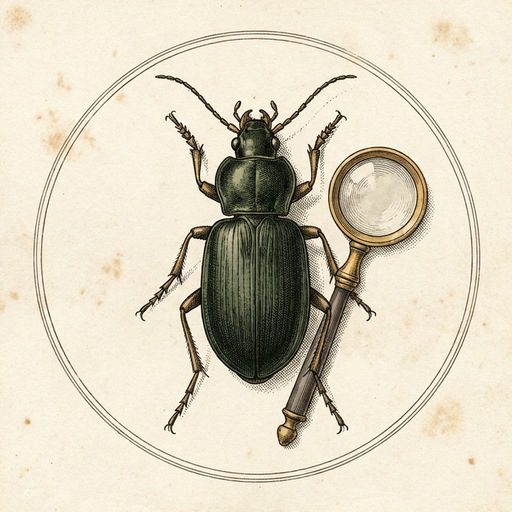
The snout settles it. A long downward-curving projection on the head is a weevil, and no other beetle found in a house has one. After that the location splits the group cleanly: in food they are rice, granary or maize weevils and the packet is the whole problem; outdoors they are vine or root weevils and the damage is notched leaves.
- The snout is the family: visible on anything above two millimetres.
- Found inside dry food: arrived as eggs in the grain, not through a window.
- Semicircular notches on leaf edges: vine weevil adults, and the larvae are in the compost.

Weevils are the one beetle family a person can name confidently from a phone photograph, because the snout is unmistakable and nothing else in the house has one. What the snout does not tell you is which problem you have, and location does that in one step.
The snout, and what it is for
The elongated projection is a rostrum, and it carries the mouthparts at the tip. The female uses it to bore a hole in a seed, a stem or a fruit, lays an egg in the hole, and seals it.
That behaviour explains the thing people find most puzzling about pantry weevils: the larva develops entirely inside a single grain, invisible from outside, until an adult chews its way out. A bag of rice can look perfect and then produce beetles.
The antennae are elbowed and often attached partway along the snout, which is a second check if the snout is short.
The pantry group
Rice weevils and granary weevils are the two most people meet: two to three millimetres, dark reddish brown to near black, sometimes with four paler spots on the wing cases. Maize weevils are similar and slightly larger.
They arrive in the food. Kentucky’s guidance is that stored product infestations usually trace back to a single contaminated item, often something at the back of a shelf that has not moved in a year.
Because the larvae are inside individual grains, a few adults means more are coming. The response is the same as for every other stored product pest and it is the search rather than a treatment:
Everything out of the cupboard. Every packet checked over a white surface. The source binned, in an outside bin. Shelves vacuumed, corners included. Survivors moved to glass or hard plastic with a sealing lid, because weevils chew through paper and thin card without difficulty.
Our pantry pest guide covers the method and the cupboard identification guide covers everything else living in the same cupboard, which is usually the fuller answer.

Bean and pea weevils, which are a naming problem
Bruchids are called bean weevils and are not true weevils: the snout is absent or vestigial. They develop inside dried beans, peas and lentils in the same way, and they are handled identically.
Worth knowing only so that a snoutless beetle in a bag of dried beans does not send you down the wrong search.
The garden group
Vine weevils are the ones that matter in a garden, and the adults announce themselves clearly: semicircular notches cut from the edges of leaves, particularly on rhododendron, euonymus, hydrangea and container shrubs. The notching is cosmetic.
The larvae are the real problem and they are underground. Creamy white, C-shaped, legless with a brown head, feeding on roots in pots and beds. A container plant that wilts and then collapses, and lifts out with almost no root system, is the signature.
The legless part matters for identification: our grub guide covers the C-shaped larvae with three pairs of legs, which are chafers and Japanese beetles, and vine weevil larvae have none. Same shape, no legs, different insect.
Adults are all female in the common species, flightless, and active at night, which is why they are so rarely seen. Checking pots after dark with a torch finds them when daytime searching does not.
Root weevils more broadly behave the same way, and our garden pest identification guide covers the wider set of leaf feeders.
The one that is not a weevil and turns up in hundreds
Worth including because the search leads here. A new build, an extension or a room that got damp filling with very small brown-black beetles is usually the foreign grain beetle, which has no snout.
Kentucky is blunt that these beetles are associated with damp conditions and disappear once the moisture resolves. They feed on surface mould on fresh plaster and damp timber, not on stored food. Insecticide is largely pointless; drying the space is the treatment. Our guide to tiny black bugs covers the pattern.
Telling them apart in practice
Snout present, found in dry food: pantry weevil. Find the packet.
Snout present, found on a leaf edge with notches: vine or root weevil. Check the pots at night, and check the roots.
Snout present, found on a windowsill in ones and twos: likely a garden species that wandered in and will not establish.
No snout, in dried beans: a bruchid, handled like a pantry weevil.
No snout, hundreds at once in a damp new room: foreign grain beetle, and the answer is ventilation.
Our guide to hard-shelled bugs covers the wider beetle families sorted by where they turn up.
Common questions
How did they get into a sealed bag?
Usually they did not get in at all. They were inside the grain as eggs when it was bought, and paper and thin card are not a barrier for the adults either.
Can I still eat the flour?
It is not dangerous in the way people fear, but the quality is degraded and leaving it maintains the population. Bin it.
Will they spread to other food?
Yes, readily, which is why the check has to cover everything in the cupboard rather than the obvious packet.
Do they bite?
No. Neither the pantry nor the garden species bites people or damages anything structural.
Final verdict
Look for the snout: it names the family instantly and no other household beetle has one. In dry food means one contaminated packet, and the fix is an hour with an empty worktop and some glass jars rather than any product. Notches cut from leaf edges means vine weevil adults, and the plant that matters is the one whose roots the larvae are eating underground. And a snoutless swarm in a damp new room is a different beetle entirely, telling you the building is still drying.