\\\
\\\
\\\
\\\
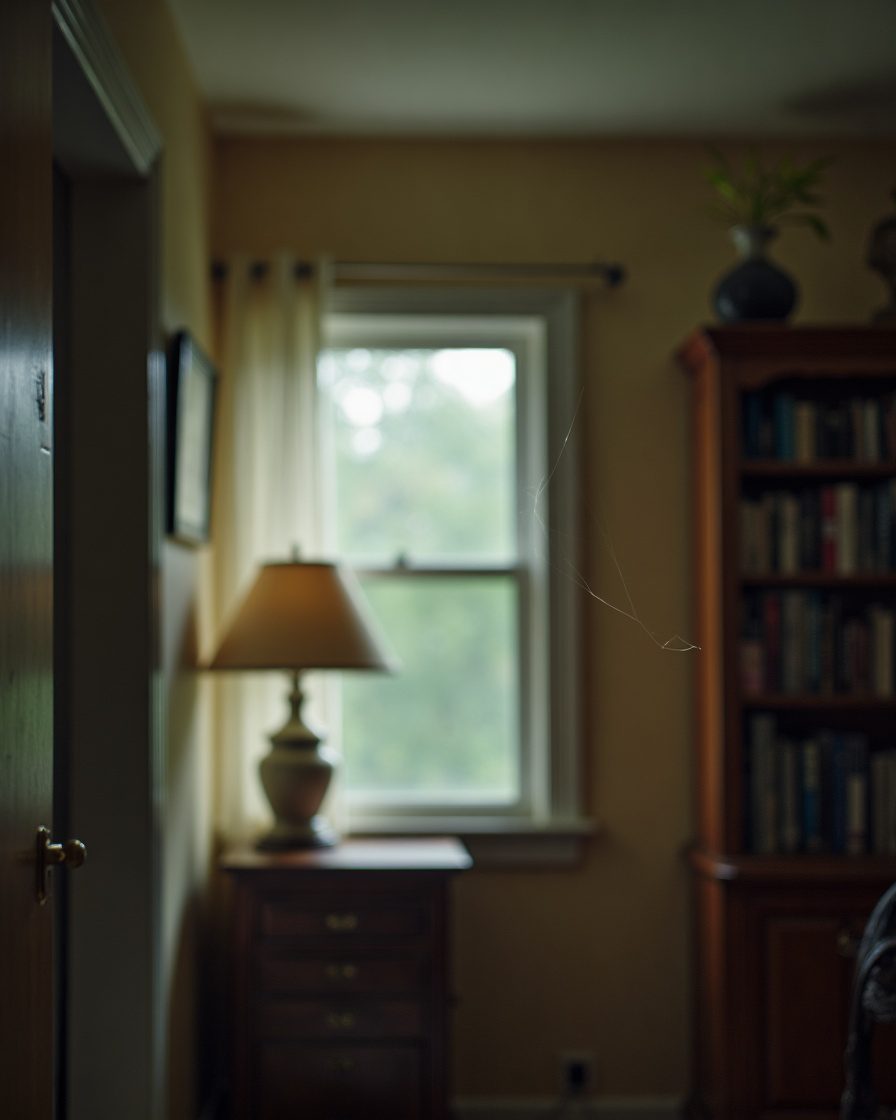
A spider web is a report on your house. Cobwebs in corners mean resident house spiders, funnel-shaped sheets mean lawn spiders that wandered in, orb webs at windows mean flying insects are hitting the glass, and every web sits where insect traffic is heaviest, so the web map shows you where prey is getting in.
\\\
- \\\
- Read it first: Irregular cobweb equals house spider, flat sheet with a funnel equals grass or funnel weaver, wheel-shaped orb equals a window or porch weaver, and no web at all equals a hunter passing through.
- The real message: Webs cluster where insects travel, so a corner that re-webs every week is marking an entry point, a moisture problem, or a light that pulls in prey.
- Do next: Vacuum webs and egg sacs, then seal gaps and switch outdoor bulbs. Spraying alone changes very little.
\\\
\\\
\\\
\\\
\\\
\\\
 \\\
\\\
\\\
Most people look at a spider web and see one thing: a cleaning chore. Look closer and it is a field report written in silk. The shape of the web tells you which spider built it, the location tells you where insect prey is moving through your house, and the amount of dust on it tells you whether anyone still lives there. Late summer and early fall is when this report gets interesting, because this is the season when webs multiply, wandering spiders show up on walls, and homeowners start asking what it all means. Reading the webs before you sweep them away turns a vague creepy feeling into a specific to-do list.\\\
\\\
\
Readers working through this usually open Spider Egg Sac Identification: What’s in That White Ball next.
\
What a web is actually telling you
\\\
\\\
Spiders do not decorate at random. A web is a fishing net, and nets only pay off where the fish are, so every web in your house sits on an insect flight path or crawl route. The UC IPM Pest Note on spiders makes the foundation point plainly: spiders are mostly beneficial because they feed on pest insects, and the ones you see indoors are far more likely to be eating your other pests than threatening you. That means a webby corner is really telling you two things at once. First, which spider you have, since each family builds a recognizably different structure. Second, and more useful, that enough insects pass through that spot to keep a predator fed.\\\
\\\
That second message is the one worth acting on. A house with webs at the basement window, behind the water heater, and over the garage door is a house where small insects are entering at those points and in numbers worth harvesting. The spiders are the symptom. The prey traffic is the story.\\\
\\\
Cobwebs in corners: the roommates you already have
\\\
\\\
The irregular, tangled, slightly sticky mess in the upper corner of a room, behind furniture, or in the angle of a window frame is the signature of the cobweb spiders, the family Theridiidae. The University of Kentucky’s guide to common spiders found around homes describes them building irregular cobwebs indoors and out, typically hanging upside down in the tangle waiting for something to blunder in. The common house spider is the classic example, and it is exactly what its name says: a species adapted to living in buildings, not a wild spider that got lost.\\\
\\\
This is where the biggest autumn myth needs correcting. Every fall I hear that spiders are “coming inside to escape the cold,” and the evidence mostly says otherwise. The species building cobwebs in your corners have been in the building all along, quietly cycling through generations in closets, basements, and wall voids. UKY notes that many of the outdoor spiders people find indoors are accidental invaders that wandered in through doors and windows, and the surge of big spiders on walls in September is largely mate-seeking males on walkabout, not a migration from the yard. The cobwebs were there in July too. You just notice them more when fall cleaning starts.\\\
\\\
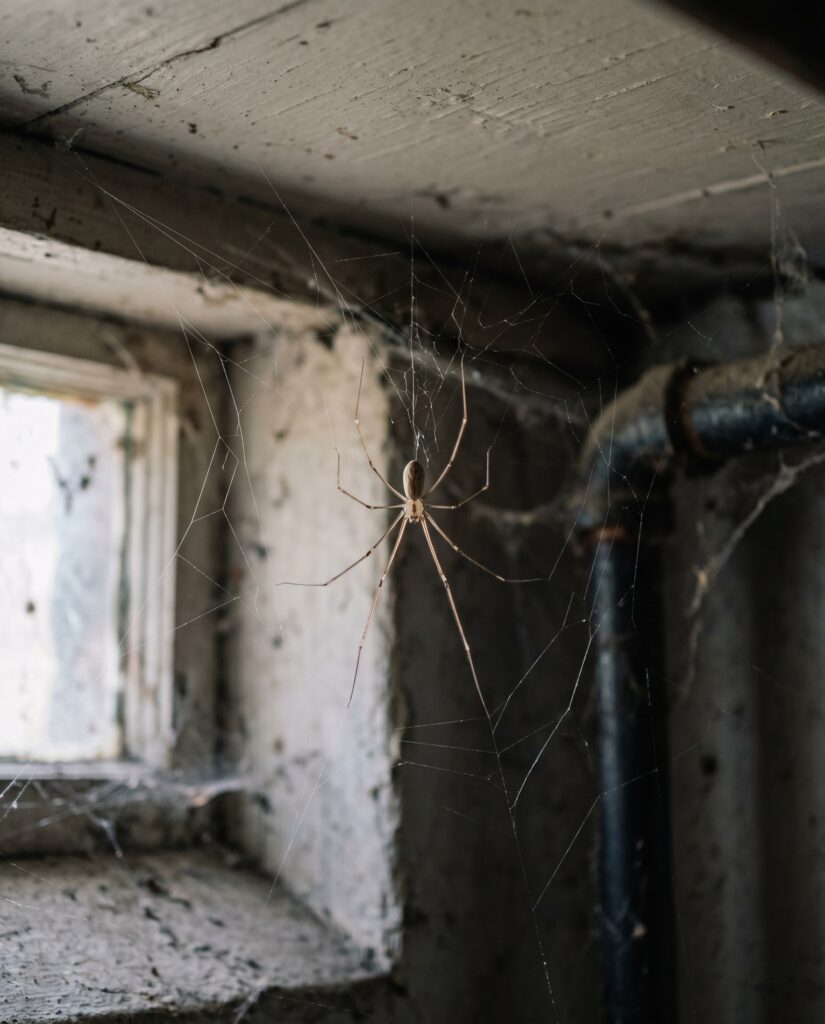
Cellar spiders belong in this corner conversation as well. Those long-legged, trembling spiders in basement ceilings build loose, sheetlike, irregular webs in dark places, and they concentrate wherever damp-loving prey concentrates. If your cellar spider population is thriving, your basement is feeding it something, often the same moisture-loving insects covered in our guide to what silverfish are and how to identify them. A basement full of active webs is a humidity reading as much as a spider problem.\\\
\\\
Funnel-shaped sheet webs: the lawn moved indoors
\\\
\\\
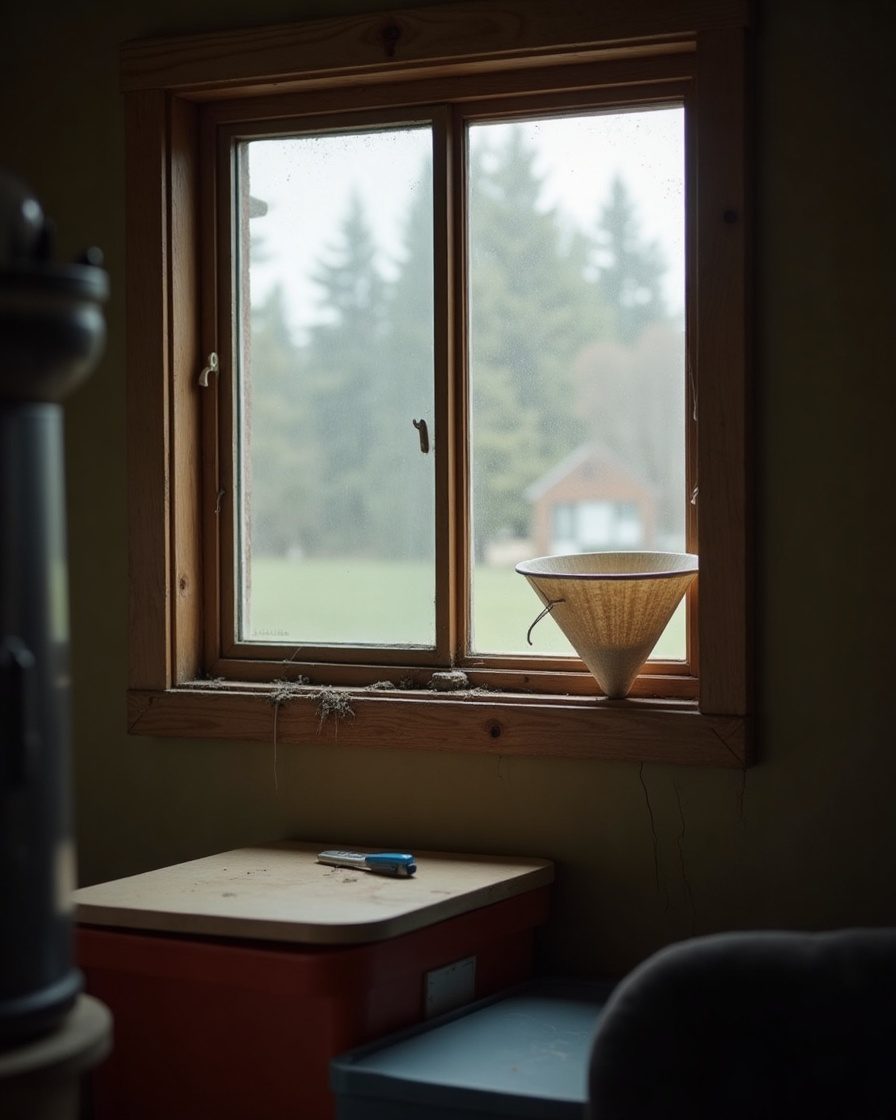
A flat, horizontal sheet of silk with a small tunnel-shaped retreat at one edge is a different builder entirely. UKY describes funnel web spiders, often called grass spiders, constructing a horizontal, sheet-like web with a funnel-shaped retreat where the spider waits. Outdoors these carpets are everywhere on dewy September mornings, stretched across lawns, shrubs, and ivy. Indoors, you find them in garages, window wells, basement window frames, and the gap between the foundation and the bottom of the siding.\\\
\\\
A funnel sheet inside the house carries a specific message: the outdoors is leaking in at floor level. Grass spiders do not want to live in your living room. When one sets up in the corner of a basement window or behind the garage weatherstripping, it is because a ground-level opening let it walk in, and because enough crawling insects use that same opening to make the spot worth netting. These webs are the most reliable arrows in the whole web map. Follow the sheet to the crack it is anchored near, and you have usually found a gap that needs sealing.\\\
\\\
These are also spiders that alarm people, because a grass spider sprinting across a garage floor is fast and leggy. North American funnel weavers are not the dangerous funnel-web spiders of Australian headlines. They are lawn predators that took a wrong turn.\\\
\\\
 \\\
\\\
\\\
Orb webs at windows and porch lights: the light is the story
\\\
\\\
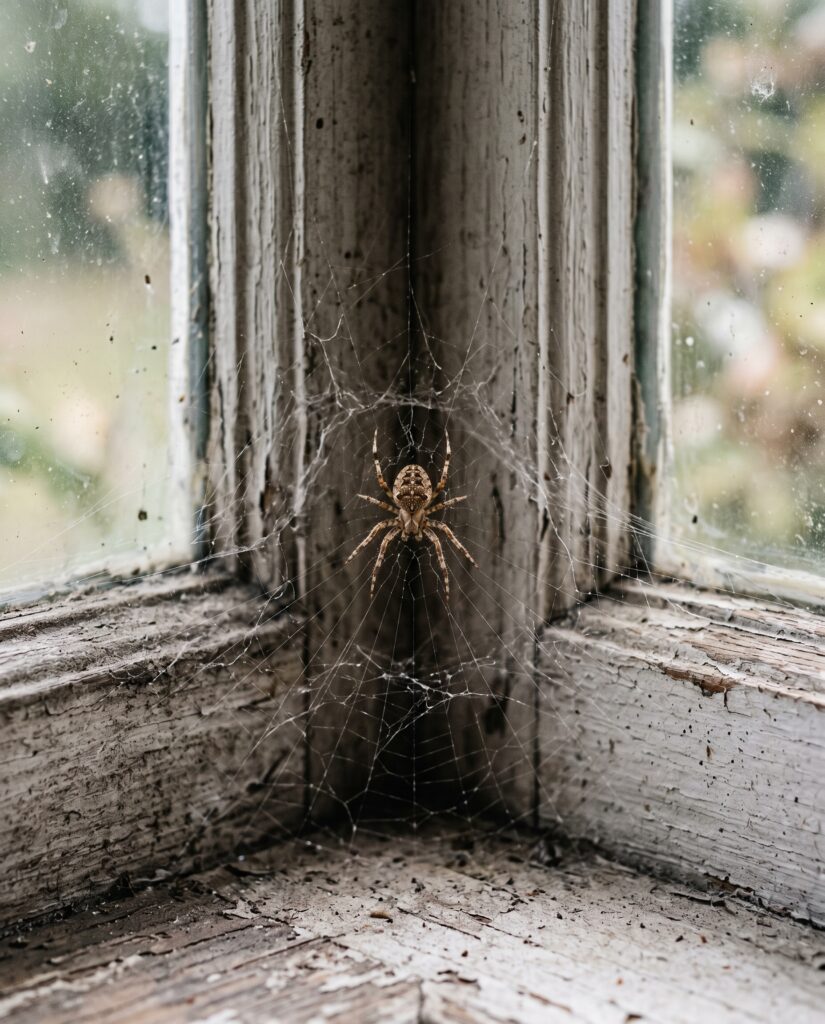
The wheel-shaped web, with spokes radiating from a hub and a spiral running around them, is the orb weaver’s work, and UKY describes these classical webs of rays and spirals as the signature of the family Araneidae. You will almost never find a true orb web deep inside a living space. They show up on the outside of window frames, across porch corners, between the house and a shrub, and around exterior light fixtures, and they peak dramatically in late summer and fall when the big garden orb weavers reach full size.\\\
\\\
An orb web on your window is not really about the spider. It is about the light behind the glass. Night-flying insects orient to your porch bulb and lit windows, and the orb weaver simply strings its net across the flight path. The University of Kentucky’s guide to eliminating spiders around homes and buildings makes the practical point: yellow or sodium vapor bulbs at entrances are far less attractive to night-flying insects than conventional white bulbs, and fewer insects means fewer spiders bothering to build there. Change the bulb and the web moves, usually to your neighbor’s brighter porch. An orb weaver rebuilding across your doorway every night is one of the easiest problems in pest control to solve without touching a single spider.\\\
\\\
No web at all: the hunters on your walls
\\\
\\\
Some of the most startling spider encounters involve no web whatsoever, and that absence is itself an identification. Wolf spiders, jumping spiders, fishing spiders, and crab spiders are hunters that pursue prey on foot. The Missouri Department of Conservation’s field guide to wolf spiders notes that they build no webs at all, running prey down with athletic speed and excellent vision, and that despite their intimidating size the bites of North American wolf spiders are harmless. A big, fast, brown spider crossing the floor in October that you never see in a web is almost certainly a wolf spider or a male of some outdoor species wandering in search of a mate.\\\
\\\
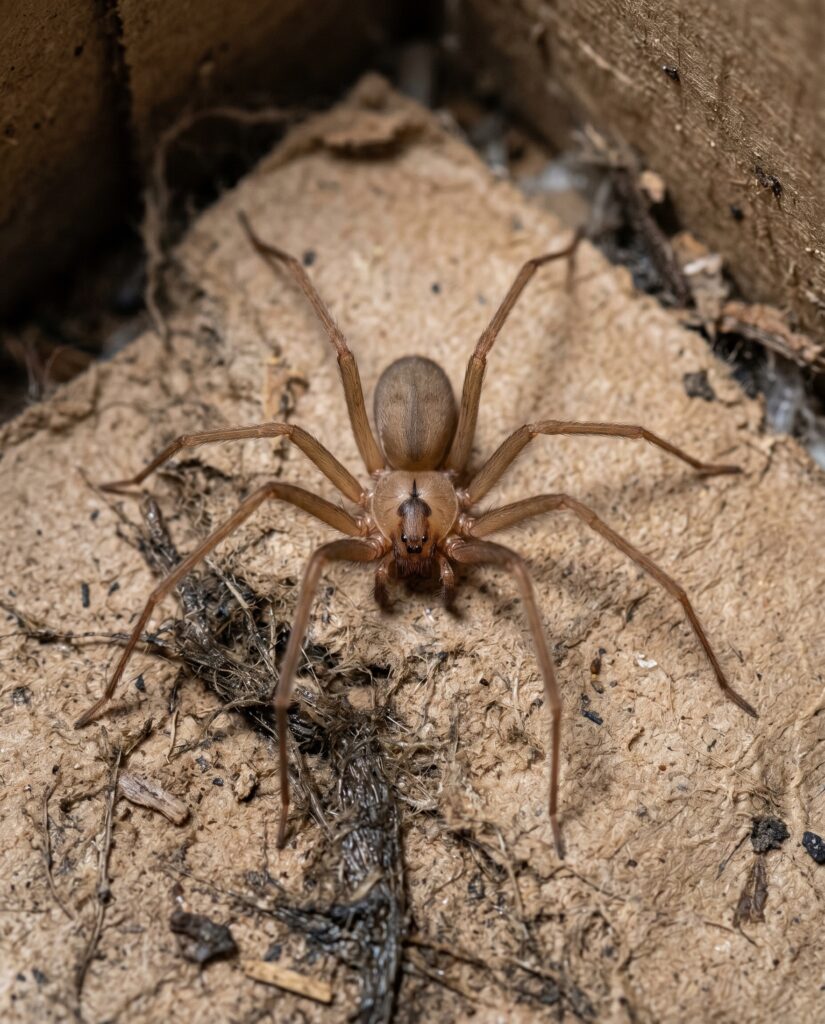
Hunters leave no silk sign, so read them by behavior and season instead. A single large wanderer in fall is a stray, not an infestation, and escorting it out under a cup and a piece of paper genuinely ends the encounter. Jumping spiders, the small fuzzy ones that track your movement and hop, occasionally overwinter indoors and are about as dangerous as a housefly. For the rare cases that matter, a suspected widow or recluse should be identified carefully rather than squashed beyond recognition, and any bite that develops spreading redness, worsening pain, or fever deserves a clinician’s eyes. Our guide to spider bite identification and when to worry walks through the difference between a routine mark and a medical question.\\\
\\\
Here is the whole map in one place:\\\
\\\
| Web type | Likely builder | Where you see it | What it tells you |
|---|---|---|---|
| Irregular tangled cobweb | Cobweb spiders, cellar spiders | Room corners, window angles, basements | Resident house-adapted spiders; steady small-prey traffic in that spot |
| Flat sheet with funnel retreat | Grass and funnel weavers | Garages, window wells, foundation gaps | A ground-level opening is letting outdoor life walk in |
| Wheel-shaped orb web | Orb weavers | Outside windows, porches, eaves | Your lighting is concentrating night-flying insects |
| No web, spider on the move | Wolf spiders, jumping spiders | Floors and walls, mostly in fall | A wandering hunter, often a mate-seeking male, not a colony |
\\\
\\\
Dusty web or working web: is anyone home?
\\\
\\\
Before you assign every web a living owner, check the dust. Silk is sticky when fresh and electrostatic always, so an abandoned web collects lint, dust, and debris within days of its owner leaving. A grimy, sagging, fuzzy web is a ruin, not a residence. Cobweb spiders abandon sites that stop producing prey and build again a few feet away, which is why one neglected corner can hold three generations of dead webs and exactly one working one.\\\
\\\
A working web looks different. The silk is clean and springy, there may be wrapped prey or pale round egg sacs tucked into the tangle, and somewhere in a crevice at its edge sits the builder. This distinction changes the chore. Dusty ruins are pure housekeeping, and no living thing is affected when you sweep them. Clean webs with egg sacs are population control, and this is where UKY’s elimination guidance is emphatic: a vacuum cleaner or broom effectively removes spiders, webs, and egg sacs, and destroying sacs matters because each one can hold dozens to hundreds of young. Vacuuming a fresh web with its egg sacs prevents more spiders than any spray can.\\\
\\\
What the web map says about the rest of the house
\\\
\\\
Now put the readings together, because webs rarely lie about a building. Every occupied web is proof that insects are getting in at rates worth harvesting, and where webs concentrate, entries concentrate. The University of Kentucky’s pest-proofing guide, How to Pest-Proof Your Home, puts numbers on how small those entries are: insects slip through gaps of about a sixteenth of an inch, and a mouse needs only about a quarter inch. That last number should give you pause, because the gap feeding your basement funnel weaver is already most of the way to admitting rodents. If your web map points at the same door gaps and pipe penetrations again and again, walk the same route with our checklist for pest-proofing your home against fall invaders, because the spiders found those openings before you did.\\\
\\\
If the evidence shifts from silk to droppings, treat it as a different problem with different rules. Never dry-sweep or vacuum rodent droppings, since that lofts dust you do not want to breathe; wet them down with a disinfectant solution, let it soak, and wipe with paper towels instead. Trapping and sealing come first, and if you do resort to poison baits, the EPA’s rodenticide guidance requires tamper-resistant bait stations for household use precisely because loose bait endangers children, pets, and the wildlife that eats poisoned mice. Our guide to mouse-proofing your home covers the sealing order in detail. And if the attic sounds are heavier than a mouse, squirrels, bats, and raccoons are jobs for licensed wildlife control operators, not for baits or homeowner improvisation.\\\
\\\
 \\\
\\\
\\\
Cleanup first, sealing second: the order that works
\\\
\\\
The sequence matters more than the products. Start with the vacuum: webs, egg sacs, and any spiders you can reach, corners, window tracks, behind furniture, under the basement stairs. UC IPM notes that spiders rarely survive the trip through a vacuum, and that regular sweeping and vacuuming is the core of indoor spider management. Then reduce the clutter that shelters them, since stacked boxes and undisturbed storage are exactly the quiet crevices cobweb spiders and the occasional wanderer prefer.\\\
\\\
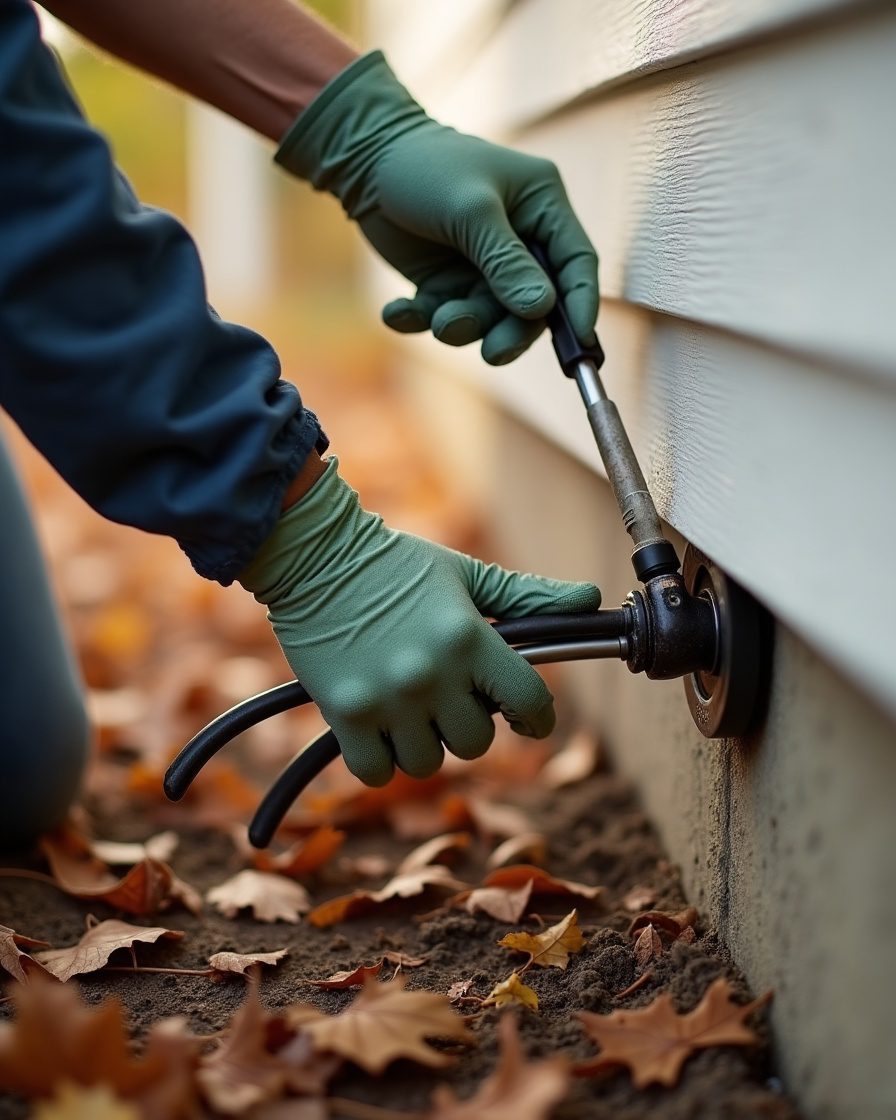
Next, work the outside. Move firewood and debris away from the foundation, trim shrubs and vines off the siding, and swap white entrance bulbs for yellow ones. Then seal what the web map flagged: door sweeps on exterior doors, silicone or acrylic latex caulk around windows and utility penetrations, copper mesh or steel wool stuffed into pipe gaps before caulking, and quarter-inch hardware cloth over attic and crawl space vents. Our step-by-step walkthrough of fall pest-proofing, in order sequences the whole job for a weekend. For monitoring afterward, UKY recommends glue boards placed flush along walls and in corners, which quietly census whatever is still walking your floors at night.\\\
\\\
Notice what is last on the list. UC IPM is blunt that control by spraying is only temporary unless it rides on top of housekeeping and exclusion, and that outdoor spraying should generally not be used against spiders at all. Foggers are seldom effective against spiders either, because the mist never reaches the cracks where they actually sit. A severe or persistent infestation, or anything involving a confirmed recluse population, is a reasonable time to hire a licensed pest control professional. For everything else, the vacuum, the caulk gun, and the light bulb do the real work.\\\
\\\
Common questions
\\\
\\\
Do lots of webs mean my house is infested with spiders?\\\
Not usually. Webs accumulate because old ones are rarely cleaned, so one corner can display months of history built by one or two spiders. Count clean, occupied webs, not dusty ruins. A genuine population boom points at abundant prey, which is the problem actually worth solving.
\\\
\\\
Do spiders come inside in the fall to escape the cold?\\\
Mostly no. The spiders building cobwebs indoors are house-adapted species that live in buildings year round, and the large spiders seen on walls in autumn are typically males wandering in search of mates. Fall feels like an invasion mainly because mature, full-sized spiders are more visible, not because the yard is moving in.
\\\
\\\
Should I knock down webs or leave them, since spiders eat pests?\\\
Outdoors, leaving orb weavers and grass spiders alone is free pest control. Indoors, remove webs and egg sacs with a vacuum and let the occasional hunter be escorted out. Indoor webs signal insect entry points either way, so the more useful response is sealing the gaps the webs point to.
\\\
\\\
Which webs signal a dangerous spider?\\\
Widows build strong, messy cobwebs low in undisturbed spots such as garages, meter boxes, and woodpiles, and recluses build no snare web at all, hiding in boxes and clutter instead. Both are uncommon indoors and bites are rare. Careful identification beats panic, and any bite with spreading redness, worsening pain, or fever should be seen by a clinician.
\\\
\\\
Does spraying for spiders work?\\\
By itself, barely. Extension guidance is consistent that sprays give temporary results unless paired with vacuuming, decluttering, sealing, and lighting changes, and total-release foggers are seldom effective against spiders. Save perimeter treatments for stubborn cases, follow the label exactly, and let exclusion carry the load.
\\\
\\\
Final verdict
\\\
\\\
Spider webs in your house are information before they are a mess. An irregular cobweb in a corner names a resident house spider and a spot with steady insect traffic. A funnel sheet in the garage or a window well points at a ground-level gap where the outdoors is walking in. An orb web across the porch is a comment on your light bulbs, and a webless wanderer in October is a passing male, not a colony. Read the map, then act in order: vacuum webs and egg sacs, cut clutter and moisture, fix the lighting, and seal the gaps the webs kept pointing to, right down to the quarter-inch openings that would eventually admit mice. The spiders were never really the problem. They were the report on it, and most of them were quietly working for you the whole time.\\\
\\\
This article is for information only and is not medical advice.\\\