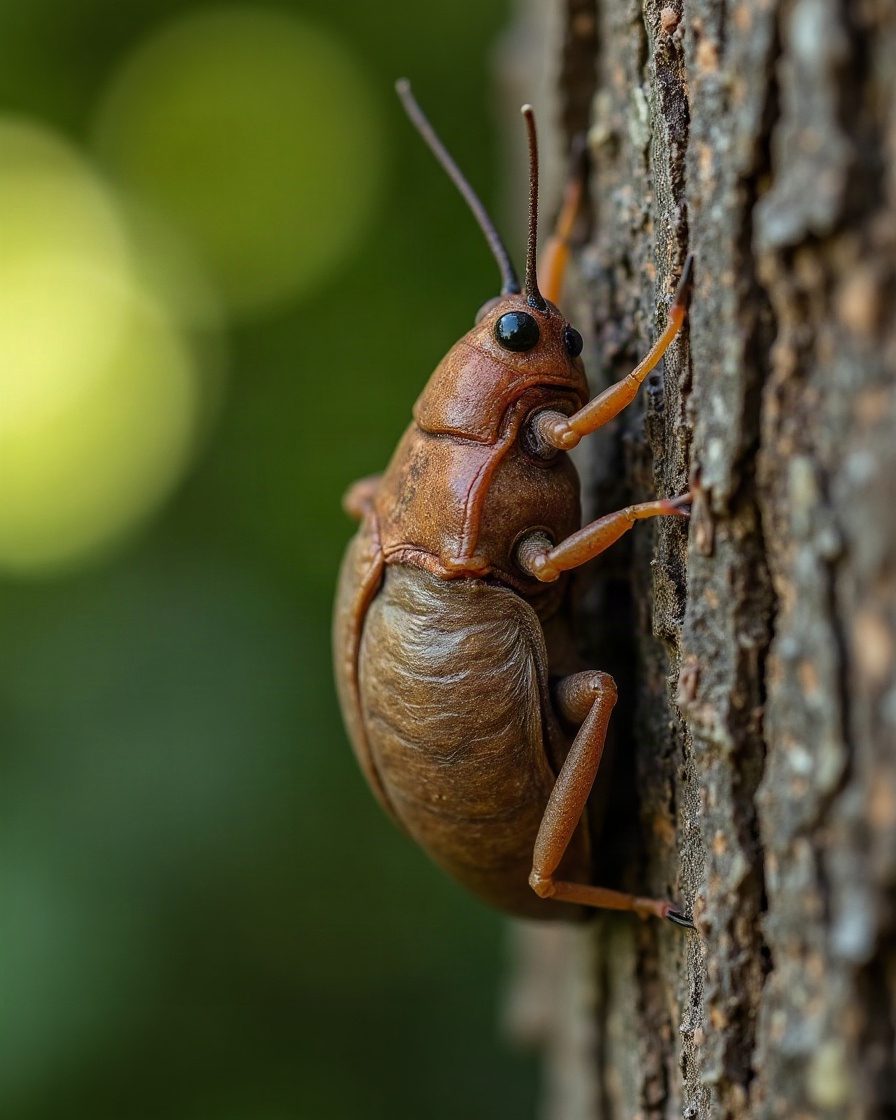
A cicada shell is a moult, not a dead insect. The nymph climbs out of the ground, grips a vertical surface, splits along the back of the thorax and climbs out as an adult, leaving the empty cuticle still hooked in place by its claws. They are brown, roughly 25 to 35 mm, hollow, and entirely harmless. Cicadas do not bite, do not sting, and do not damage a house or a garden in any way worth acting on.
- Empty and split down the back is the signature. The animal left within the hour.
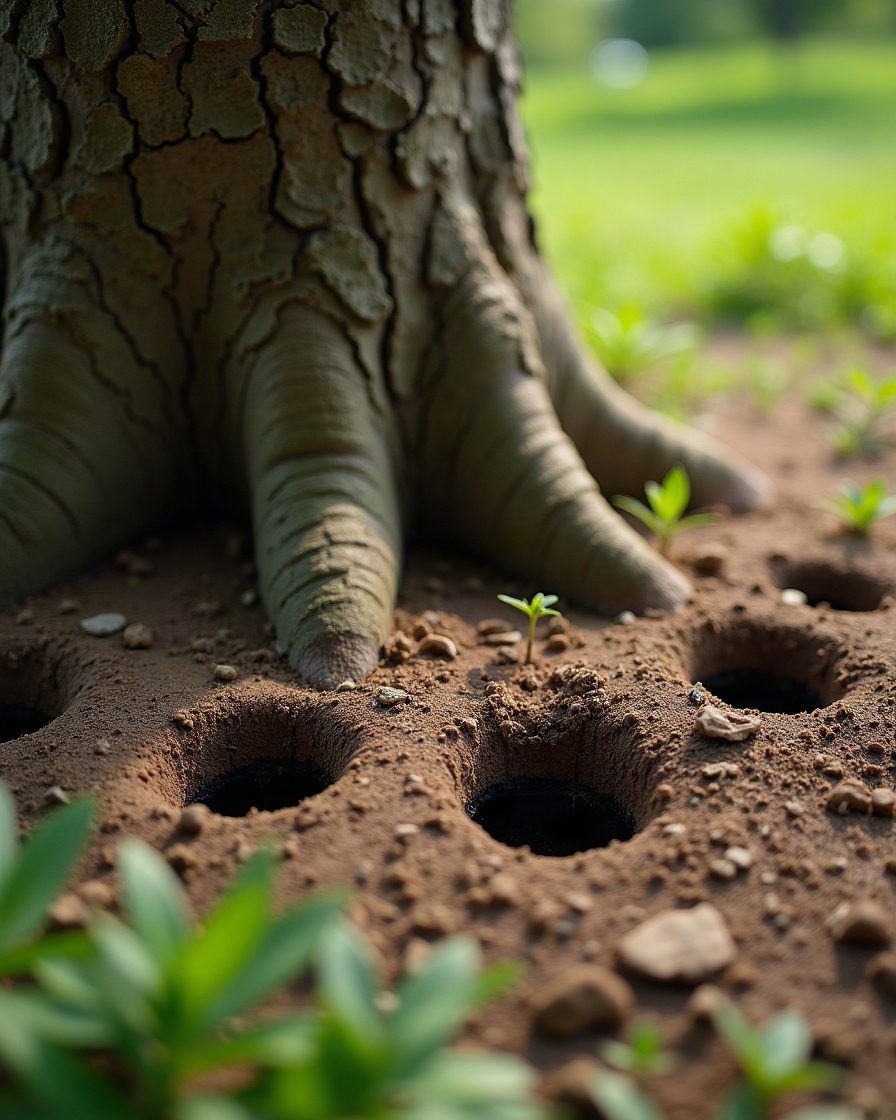
- Finger-width holes at the base of a tree are where they emerged.
- Nothing needs doing. No treatment, no removal beyond preference.
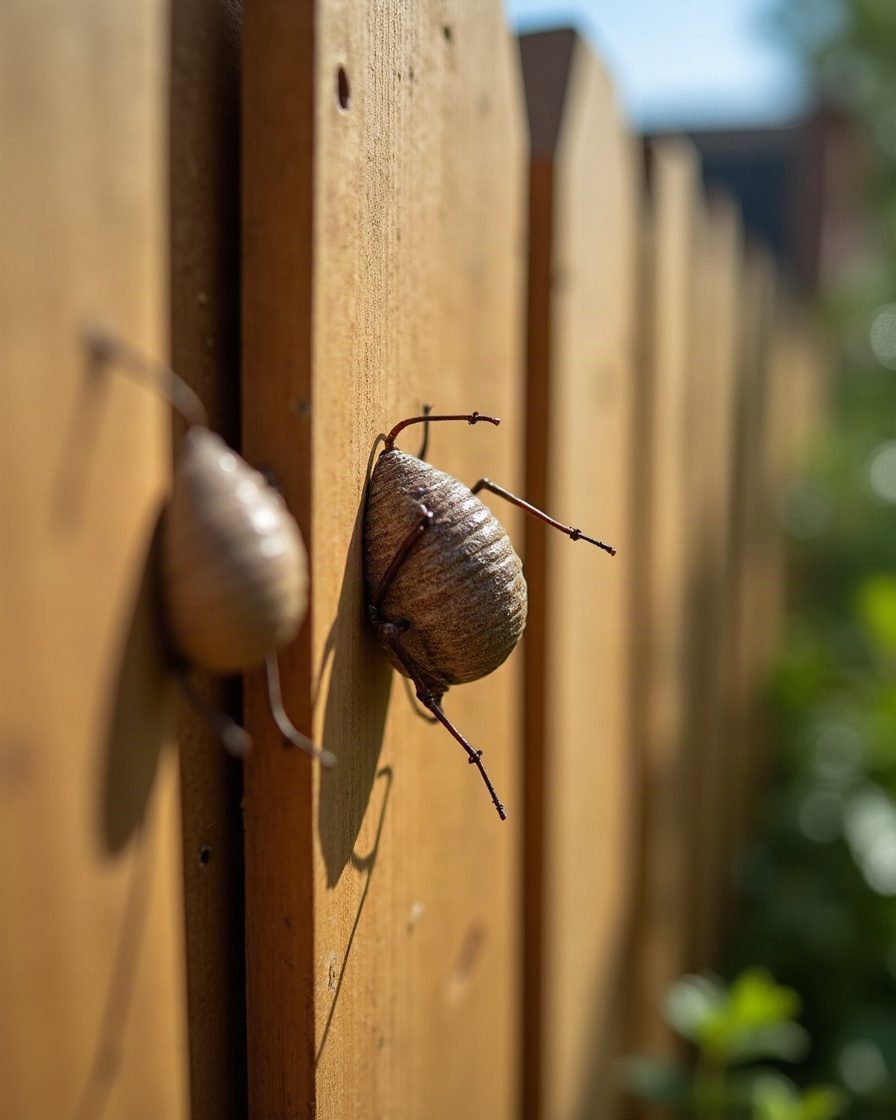
Cicada shells appear suddenly, in numbers, on tree trunks, fence posts, walls and garden furniture, and they look far more alarming than they are. They are among the easiest findings on this site to resolve, and the resolution is that nothing is wrong.
What you are looking at
A moult. Cicadas spend years underground as nymphs feeding on root sap. When a nymph is ready to become an adult it tunnels to the surface, emerges usually at dusk, climbs the nearest vertical surface, and anchors itself with its claws. The cuticle then splits along the back of the thorax and the adult works its way out, expands its wings, hardens over a few hours and flies away.
The shell left behind keeps the exact shape of the nymph: brown, hard, hollow, with prominent front legs adapted for digging, and a clean split running down the back.
The claws are why it stays. They lock into bark or timber, and a shell can remain in place for weeks through wind and rain, which is why they accumulate visibly.
For the general principle, shed insect skins in the house covers the difference between a moult and a corpse, which is the same test everywhere: hollow and complete means a moult.
Distinguishing features
Size. Substantially larger than most insect moults found around a house, typically 25 to 35 mm.
Colour and texture. Mid to dark brown, hard, slightly glossy, tough enough to handle without crumbling.
Front legs. Thickened and clawed, built for digging. This is the clearest single feature.
The split. A clean inverted T or a straight line along the back of the thorax.
Position. Head upward on a vertical surface, still gripping.
Where they come from
Look at the ground around the base of nearby trees. Cicada emergence holes are roughly 10 to 15 mm across, clean edged, and characteristically have no spoil heap around them, because the nymph compacts the soil as it tunnels rather than pushing it out. That absence distinguishes them from ant and worm workings, which is worth knowing since a lawn can carry a great many of them without anything being wrong. Ant mounds and hills covers the workings that do come with spoil, and grubs in soil and lawn covers what else lives down there.
Some species emerge annually in small numbers. Others, the periodical cicadas of the eastern United States, emerge in enormous synchronised broods every 13 or 17 years, which is when the shells become impossible to overlook.
What cicadas do and do not do
They do not bite or sting. They have no sting and their mouthparts are for piercing plant tissue, not skin.
They do not damage buildings. Nothing about a cicada interacts with a structure.
They do not eat leaves. The adults feed lightly on sap, and the nymphs feed on roots underground.
They are noisy. The male song is produced by a pair of ribbed membranes and is among the loudest sounds any insect makes. That is the entire nuisance.
There is one real horticultural effect, and it is limited. Females lay eggs by cutting slits into pencil-thin twigs, which can cause the tips of small branches to wilt and break, an effect called flagging. On an established tree it is cosmetic. On a newly planted sapling during a mass emergence year it is worth preventing, and the way to do that is fine netting over the young tree for the few weeks of emergence, not insecticide. Spraying is ineffective against the numbers involved and unnecessary against the damage, which is the calculation the EPA sets out in its guidance on whether a pesticide is needed at all.
Why so many appear at once
Emergence is synchronised by soil temperature, so a whole local population comes up within a few days. That is a predator-swamping strategy: by emerging together in numbers far beyond what local predators can eat, enough survive to breed.
The same abundance briefly feeds a great deal else. Birds, small mammals and bats all take advantage of an emergence, and in a periodical brood year the effect on local wildlife is measurable. The National Park Service’s material on bats gives context on one of the groups that benefits from insect abundance of this kind.
What to do about the shells
Nothing is required. If you would rather not have them on the porch furniture, brush them off; they are dry, inert and easy to remove.
Two things worth knowing. They are entirely safe to handle, and children are usually delighted by them. And they do not indicate an infestation of anything, so no treatment of the tree, the lawn or the fence is warranted.
If the shells are on or near a house and you are also finding other evidence, the pest evidence chart covers what else leaves traces, and it is worth confirming the two findings are unrelated, which they almost always are.
Common questions
Is it dead? No. It is an empty skin, and the animal flew away hours or weeks ago.
Will they damage my tree? Established trees, no. Very young trees during a mass emergence can suffer twig dieback, preventable with netting.
Why are there dozens? Synchronised emergence. It is normal and it is brief.
They are on the wall of my house. Any vertical surface will do. It means the nymphs came up nearby, nothing more.
Do I need to treat the lawn? No. The nymphs are gone, and the next emergence for a periodical brood is years away.
The bottom line
Hollow, brown, split down the back and still gripping the bark: a cicada moult, and the least consequential finding on this site. There is nothing to treat, nothing to seal and nothing to worry about, and the holes in the lawn will close over on their own.