Finding the right butterfly field guides can feel harder than identifying the butterfly itself. North America alone has roughly 750-800 butterfly species, and the “look-alike” problem gets real fast with skippers, blues, and fritillaries. The good news is that a small, well-chosen set of books plus one or two trusted online tools will cover almost everything you are likely to see. This guide breaks down which butterfly identification books work best for beginners, which ones serious observers carry, and how to build a simple system for accurate IDs in the field.
Quick answer: the best butterfly field guides for most people
If you want one setup that works in parks, backyards, and road trips, use one portable book + one digital checker. Here’s the simplest way to choose butterfly field guides without overthinking it:
- Best single all-around book (North America): A Swift Guide to Butterflies of North America (Glassberg) for broad coverage and lots of photos.
- Best beginner-friendly layout: Kaufman Field Guide to Butterflies of North America (Brock and Kaufman) for clear, field-mark-focused plates.
- Best if you mostly stay in one region: a regional title like Butterflies Through Binoculars (East/West/Florida) plus a state atlas if available.
- Best moth companion (Northeast/Southeast): the Peterson Field Guide to Moths volumes (Beadle and Leckie).
- Best online confirmation: iNaturalist for community review and BAMONA for range maps and species accounts.
A practical rule: if your book doesn’t include range + flight time + similar species notes, add a second resource.
What makes butterfly field guides actually useful in the field?
A guide can be beautiful and still fail you at the moment it matters – when the insect won’t land, the wind is moving the flowers, and you only saw the underside for two seconds. The best butterfly identification books are built for those real conditions, not perfect museum specimens.
The four features that prevent misidentifications
Think of butterfly ID like solving a short puzzle. Photos are only one piece. The strongest butterfly field guides consistently include:
-
Region filters (range maps that match where you are)
- A species can look “right” but be 700 miles outside its typical range.
- Good maps help you rule out options quickly, especially for strays and migrants.
-
Phenology (flight times by month)
- Many confusing species fly at different times.
- If your guide shows May to June for one species and July to September for the other, you just cut the problem in half.
-
Look-alike warnings
- The best guides tell you what it can be confused with and why.
- This is where beginners gain speed fast.
-
Habitat and host plant notes
- Blues near lupine, swallowtails near riparian cottonwoods, skippers in grassy fields – context narrows the choices.
- Moth and butterfly observers who learn host plants often out-identify people who rely on pictures alone.
Photos vs illustrations: which is better?
Photos show natural variation, wear, and lighting. Illustrations can make field marks pop by showing the “average” pattern cleanly. In practice, many people do best with a photo-based guide in the field and a more detailed reference at home.
Here’s a quick comparison to help you pick:
| Feature | Photo-based guides | Illustrated/plate-heavy guides |
|---|---|---|
| Best for | Matching real-life variation | Highlighting specific field marks |
| Common drawback | Lighting and angles can hide key marks | Can feel less “real” to beginners |
| Ideal use | On-the-trail decisions | Confirming tricky groups at home |
A reality check on species numbers
Worldwide, there are an estimated 18,000+ butterfly species. Moths outnumber them by a lot – roughly 160,000 described moth species globally, with many more likely undescribed. That’s why even strong moth books are selective, and why online photo databases matter for moth IDs.
Visual checklist: what to verify before you buy a guide
- Does it cover your state or region clearly?
- Are there range maps and flight times?
- Does it show both wing surfaces (top and underside)?
- Are “similar species” called out in plain language?
- Is it a recent edition or at least taxonomically updated?
Butterfly field guide comparison: which book fits your use case?
Use this table before you buy. The right butterfly field guide depends less on total species count and more on how you will identify butterflies in the field: quick beginner checks, serious North American coverage, regional range narrowing, or moth companion work.
| Guide type | Best fit | Coverage | Photos vs plates | Range help | Field portability |
|---|---|---|---|---|---|
| A Swift Guide to Butterflies of North America | Best all-around North America pick for serious observers | Broad North American species coverage | Photo-heavy, useful for real-world variation | Strong when paired with current range maps | Better as a car or pack guide than a pocket guide |
| Kaufman Field Guide to Butterflies of North America | Best beginner-friendly field layout | North America, with simplified field marks | Edited images and clear comparison layout | Good for narrowing likely species | Portable enough for most day trips |
| Regional guides and state atlases | Best when you mostly watch in one state or region | Narrower but more locally useful | Varies by title | Often the strongest range and flight-time context | Usually fast to use in the field |
| Moth companion guide | Best add-on when night lights or caterpillars expand your interest | Moths by region or family | Usually photo-based | Important because many moths are regional | Use as a home confirmation guide |
For most readers, the practical setup is one beginner-friendly field guide, one deeper North American guide, and one regional resource. That gives you fast field checks without pretending one book can solve every skipper, blue, fritillary, and moth look-alike.
Best butterfly field guides and identification books (by goal and skill level)
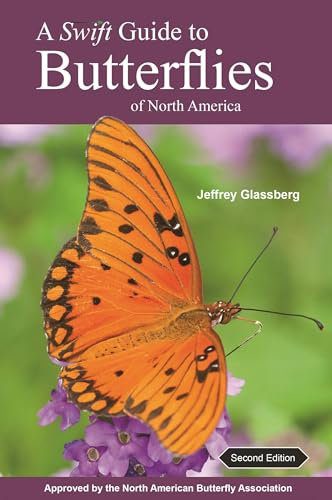
A Swift Guide to Butterflies of North America: Second Edition
This book provides broad coverage and numerous photos, making it an excellent all-around guide for butterfly identification in North America.

Kaufman Field Guide To Butterflies Of North America
This guide is beginner-friendly with clear, field-mark-focused plates, making it suitable for those new to butterfly observation.
Most readers are not trying to become lepidopterists overnight. They want reliable IDs, fewer frustrating dead-ends, and a book that fits in a daypack. The trick is matching the guide to your goal.
Best all-around pick for North America: A Swift Guide to Butterflies of North America
Jeffrey Glassberg’s Swift Guide is widely treated as the modern standard for broad North American coverage. It is photo-rich, focused on field marks, and designed for people who actually watch butterflies outdoors rather than pin specimens.
Why it works well:
- Large set of photos that reflect real variation (sexes, seasonal forms, worn individuals).
- Updated taxonomy compared with many older classics.
- Compact enough to travel with, considering how many species it covers.
Who should choose it:
- Intermediate observers who want one book that keeps working as they improve.
- Motivated beginners who don’t mind a denser guide.
Best beginner-friendly layout: Kaufman Field Guide to Butterflies of North America
Brock and Kaufman’s guide uses “photo-illustrations” that emphasize the marks you should notice first. That design choice helps new observers avoid getting lost in minor pattern differences.
Why beginners like it:
- Clear organization and readable species accounts.
- Strong support for learning habitat, behavior, and common confusion points.
Best when you mostly stay in one region: Butterflies Through Binoculars (East/West/Florida)
Regional guides often feel easier because they reduce the “too many choices” problem. Glassberg’s Butterflies Through Binoculars series is built around what you can see through binoculars or a camera, which mirrors how many people observe butterflies today.
A simple decision chart
| If you mostly butterfly-watch in… | Start with… | Add next… |
|---|---|---|
| Many states or road trips | Swift Guide or Kaufman | iNaturalist or BAMONA |
| One region (East/West/Florida) | Butterflies Through Binoculars | State atlas or local checklist |
| Backyard garden focus | A beginner guide + plant notes | A host plant book or local native plant list |
Actionable tip: pair your guide with a hands-on life cycle activity
If you are learning with kids, it’s easier to remember IDs when you’ve watched the stages up close. For families, classroom projects, or nature centers, see our picks for Best Butterfly Garden Kits for Kids to connect identification with real metamorphosis.
Regional guides, atlases, and why “local” beats “complete”
A common frustration goes like this: you buy a huge book, flip through hundreds of pages, and still feel unsure. That’s not a you problem. It’s a scale problem. Regional resources often outperform big national guides for day-to-day accuracy because they match what is actually flying where you live.
Why regional butterfly books are faster to use
Regional guides usually provide:
- More detail per species (habitat, seasonal timing, local variation).
- Better “similar species” comparisons for your area.
- More realistic expectations about what you can see in a weekend.
If you live in the Northeast, for example, a local recommendation list can save you time and money. The New Hampshire Butterfly Club field guide recommendations show how experienced observers narrow choices to a few dependable titles.
State and provincial atlases: the hidden superpower
Butterfly atlases often include county-level maps, flight-period charts, and status notes that general guides cannot fit. They are especially helpful for:
- Confirming whether a species is expected in your county.
- Understanding early vs late broods.
- Tracking range expansions and conservation concerns.
Many atlas projects are now driven by citizen science and museum records. Distribution datasets are also supported by large biodiversity portals. The Global Biodiversity Information Facility (GBIF) summary statistics describe the scale of occurrence records used by researchers and conservation planners.
How to build a “two-book system” that works
If you want a practical library without going overboard, use this setup:
- One portable field guide (national or regional)
- One local atlas or checklist (state/province or eco-region)
- One online photo database or community ID tool (for verification)
This combo is also the best defense against older names and taxonomic changes. Even excellent older guides may use outdated genus placements or species splits. When names shift, local atlases and active online databases usually reflect updates faster.
Visual: quick “buy order” for new butterfly watchers
- Beginner-friendly field guide
- Regional guide or atlas
- Moth guide (if you start night-lighting)
- Desk reference for deep dives
Moth guides and digital tools that pair best with butterfly books
Sooner or later, most butterfly watchers notice the “other half” of Lepidoptera. Moths are everywhere, and many are striking once you start looking closely. But moth identification needs different tools because there are so many species and many are subtle.
Best moth books for most backyard naturalists
If you live in the eastern half of North America, the two Peterson moth volumes are often the most practical starting point:
- Peterson Field Guide to Moths of Northeastern North America (Beadle and Leckie)
- Peterson Field Guide to Moths of Southeastern North America (Leckie and Beadle)
Why these work:
- They focus on species you are likely to encounter.
- They include photos, flight times, and range information.
- They are designed for real-world observing, including porch lights and sheet setups.
Online moth resources that fill the gaps
Printed moth books cannot cover everything, especially micro-moths. That’s where photo databases become essential.
Two of the most useful companions:
- The Moth Photographers Group at Mississippi State University for extensive North American moth photos and taxonomic organization.
- Butterflies and Moths of North America (BAMONA) for species accounts, photos, and range maps across the US and Canada.
Apps and citizen science: helpful, but not magic
iNaturalist passed 100 million observations by late 2023, and butterflies and moths are among the most photographed insect groups. That volume makes it a powerful ID support tool, especially when your photo is decent and your location data is accurate.
Use AI suggestions as a starting hypothesis, then confirm with your book and range/season checks. Community review is the real strength. You can explore the platform and its ID workflow through the iNaturalist community and observation tools.
Visual: a reliable ID workflow (books + digital)
- Use your field guide to pick the family and likely species
- Check range map and flight time in the guide
- Compare underside photos and key marks
- Upload to iNaturalist for community confirmation
- Verify with BAMONA or a moth photo database if needed

How to use butterfly field guides for faster, more accurate IDs (plus common myths)
Most identification errors come from missing one piece of context: the underside, the habitat, the date, or the scale. A few simple habits make your guide work better immediately.
Step-by-step: what to record before you open the book
When you spot a butterfly, grab these details first:
- Location (park name or GPS, even roughly)
- Date and time (many species have tight seasonal windows)
- Habitat (meadow, woodland edge, desert wash, marsh)
- Behavior (nectaring, puddling, hilltopping, patrolling)
- Size estimate (compare to a known species or note “small/medium/large”)
- Photos of both sides (top and underside)
If you can only get one photo, prioritize the underside for many groups like whites, blues, and several skippers.
Three field-guide tricks that feel like shortcuts
- Start with the family page first. Swallowtails, brush-footed butterflies, whites, gossamer-wings, and skippers each have repeatable “body plans.”
- Use season to eliminate options. If your guide shows a species flying only in early spring, it’s probably not your August butterfly.
- Read the “similar species” note even if you feel confident. Many “easy” IDs have one common trap.
Myth: “Moths are boring brown”
Many moths are vivid – tiger moths, underwings, and luna moths are crowd favorites. The “brown moth” stereotype mostly comes from small, common species that show up around windows. A good moth guide plus a porch light session can change your whole view in a week.
Myth: “One guide will show everything I can encounter”
Even the best books must choose what to include. Local forms, cryptic species, and micro-moths often require online databases, regional checklists, or expert review. That is normal, not a failure of the book.
Myth: “Apps can replace books”
Apps are fast. Books teach you how to notice the right things. The strongest approach is hybrid: book for learning and context, app for confirmation and community input.
Visual: when to upgrade your resources
| You keep running into… | Add… |
|---|---|
| Skippers you can’t settle | A regional guide + underside photo practice |
| “Rare” species suggestions from apps | BAMONA range maps + atlas checks |
| Lots of moths at lights | Peterson moth guide + Moth Photographers Group |
Practical side note for homeowners
If your interest in moths started because of pantry or clothes moths indoors, identification matters for control. Our tested guide to Best Moth Traps for Pantry and Clothes Moths helps you match the tool to the pest species and situation.
Related butterfly and pollinator guides
If you are building a small butterfly setup, pair this field-guide list with our guide to butterfly habitats and mesh cages, the kid-friendly butterfly garden kit guide, and our practical guide to attracting pollinators to your garden. If moths are part of the ID problem, start with the pantry and clothes moth trap guide so indoor pest moths do not get mixed up with outdoor naturalist IDs.
Conclusion: build a small, reliable library and let it grow with you
The best butterfly IDs come from a repeatable system, not a single perfect book. Start with one of the leading butterfly field guides, add a regional resource when you can, and use iNaturalist or BAMONA to confirm tough sightings. You will make fewer misidentifications, and you’ll learn faster because the guide will start to feel like a map rather than a catalog.
Next step: set up your “field kit” for the season. A guide, a phone camera, and a small notebook go a long way. If you’re raising or observing caterpillars at home, pair this article with Best Butterfly Habitats and Mesh Cages to keep viewing ethical, safe, and simple.
As an Amazon Associate, I earn from qualifying purchases. Product recommendations are based on real reviews and independent research.