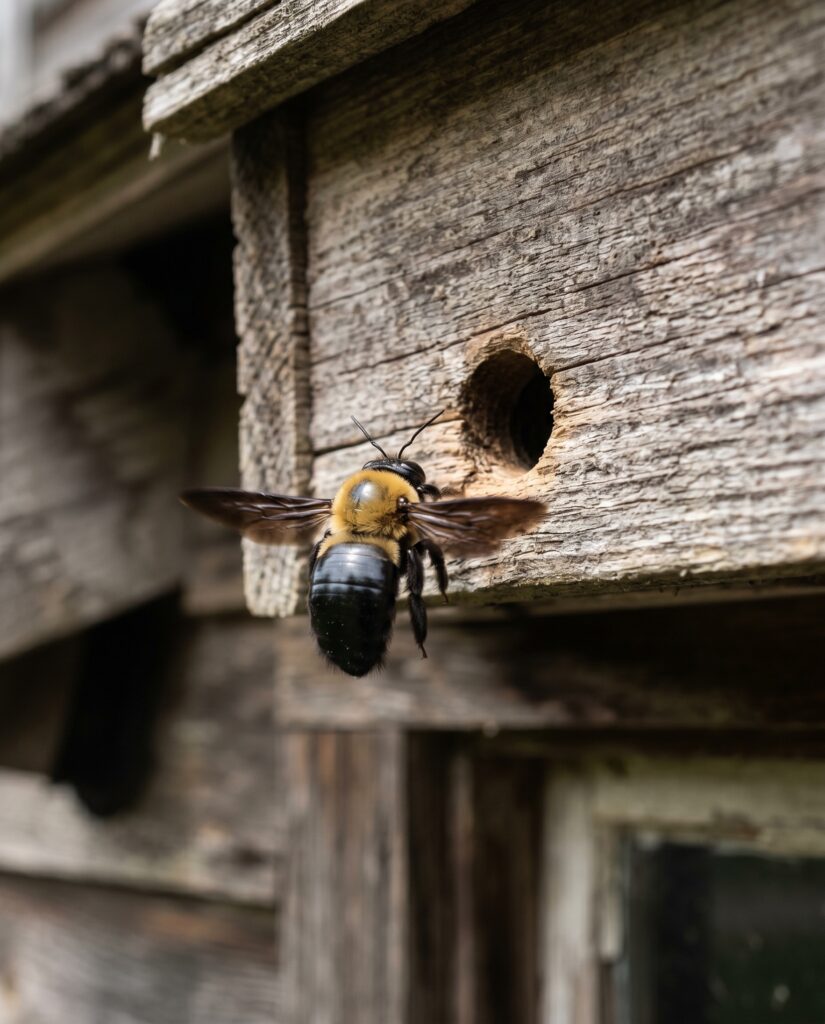
If you found a near-perfect round hole in your deck rail or a fat bee hovering at the eaves, the thing to understand first is that a carpenter bee does not eat your wood, it excavates it. The female chews that round entrance, makes a sharp turn, and tunnels along the grain to build a row of brood cells, so a single season’s gallery is genuinely minor. The reason it stops being minor is the life cycle: the bees come back, reuse the same tunnel, and extend it a little further every year, while woodpeckers tear the wood open chasing the fat larvae inside. That cumulative reuse, not any one hole, is what turns a few entrances into real structural and cosmetic damage.
Carpenter bees do not eat wood, they excavate round galleries to raise young, and the damage is cumulative because the same tunnels get reused and extended for years while woodpeckers widen them chasing larvae.
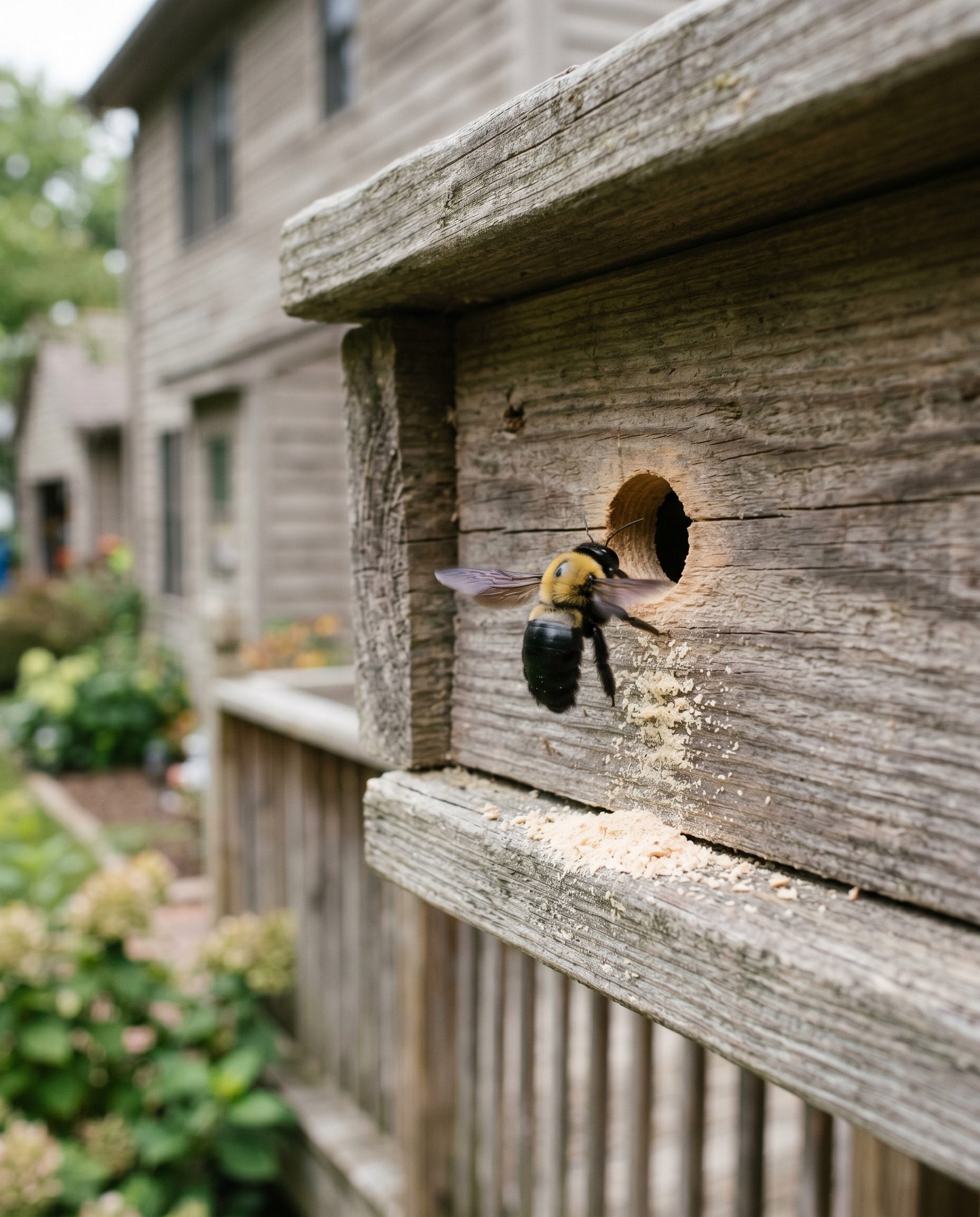
- The confirming sign: A nearly perfect round, pencil-sized entrance hole in bare softwood, often with sawdust below and a yellow stain under it.
- Why it gets worse: One year’s tunnel is small, but reused, extended galleries plus woodpecker excavation compound over seasons.
- What it means: These are native pollinators, so treat only galleries doing real damage, then plug and finish the wood so it is not reused.
What a carpenter bee actually is
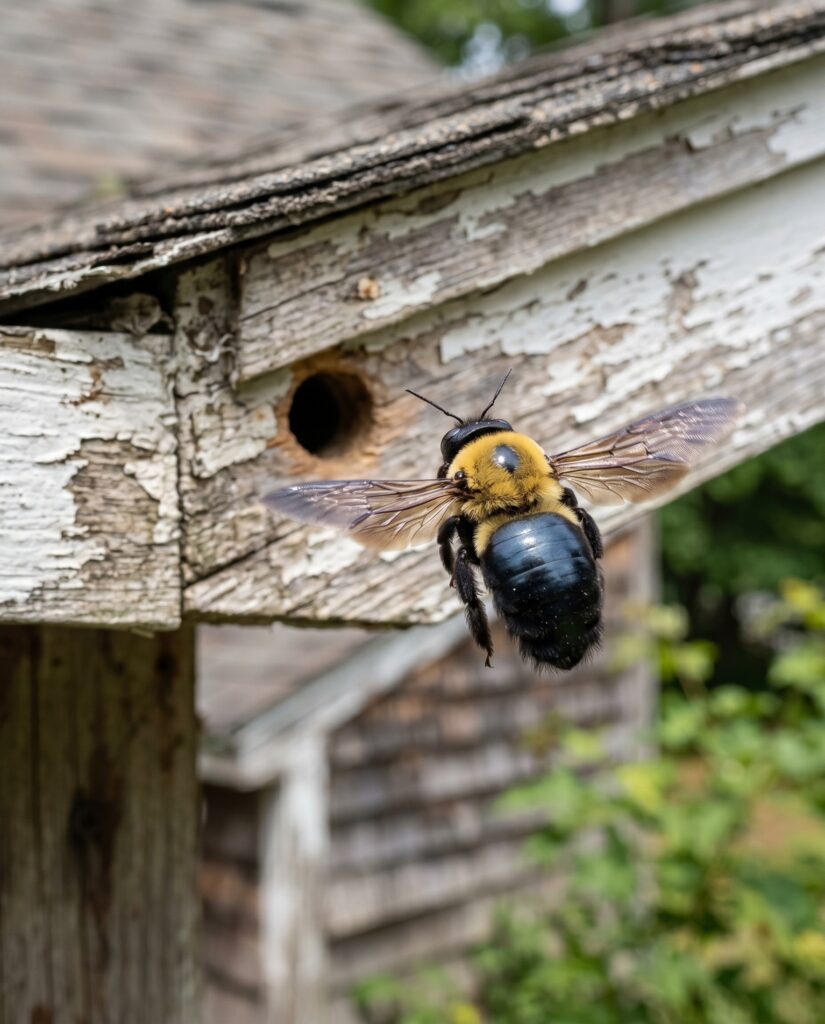
The eastern carpenter bee (Xylocopa virginica) is a large, robust bee that most people meet hovering and dive-bombing around a porch or deck in spring. The fastest way to tell it apart is the abdomen: a carpenter bee has a shiny, mostly hairless black abdomen, while a bumble bee’s abdomen is fuzzy and banded with yellow. Iowa State Extension’s notes on how to tell a carpenter bee from a bumble bee put that bare, polished rear segment at the top of the list, because it settles the confusion in one look.
That hovering aggression at head height is also worth decoding, because it is almost always a male. Males guard a territory and bluff anything that comes near, but a male carpenter bee has no stinger at all, so the bee buzzing your face cannot hurt you. If you want the full side-by-side, our carpenter bee vs bumblebee identification guide walks the body, the behavior, and the nesting habit that separate the two.
The single sign that confirms it
If you are not sure what bored the hole, the shape of the entrance is the tell. A carpenter bee cuts an opening that is strikingly round and clean, close to half an inch across, as if someone touched the wood with a drill bit. Wasps and beetles leave ragged or irregular exits; the carpenter bee’s is geometric, and that roundness is the diagnostic feature University of California’s notes describe when they explain that carpenter bees bore into bare, weathered softwood rather than eating it.
Look just under the hole for the second confirmation. Because the bee is grinding wood into sawdust to make room rather than feeding on it, you will usually see coarse pale frass piled below the entrance, and often a vertical yellow-brown stain running down the board from the bee’s waste. Together the round hole, the sawdust, and the stain are unmistakable.
How the life cycle drives the damage
Here is where the biology explains the destruction. After mating in spring, the female does the real work: she chews the round entrance, then turns and tunnels along the grain, sometimes branching, to hollow out a gallery. Inside that tunnel she builds a line of brood cells, each stocked with a ball of pollen and nectar and a single egg, then walls each one off with chewed-wood pulp. The eggs become larvae, the larvae pupate, and a new generation of adults chews out in late summer, feeds, and overwinters in the old tunnels to start again.
That overwintering-in-place habit is the whole problem. A first-year gallery is only a few inches long and structurally trivial, but the same tunnels are reused and lengthened every year, which is exactly what Penn State Extension documents when it explains that the female reuses and extends old galleries season after season. Decade after decade in the same fascia board or rail, those branching galleries can run a foot or more and honeycomb the timber from the inside, where you never see it until the wood feels soft. Slow but cumulative is the accurate description, and it is the reason a couple of holes are not a reason to panic but also not something to ignore.
Why woodpeckers make it worse
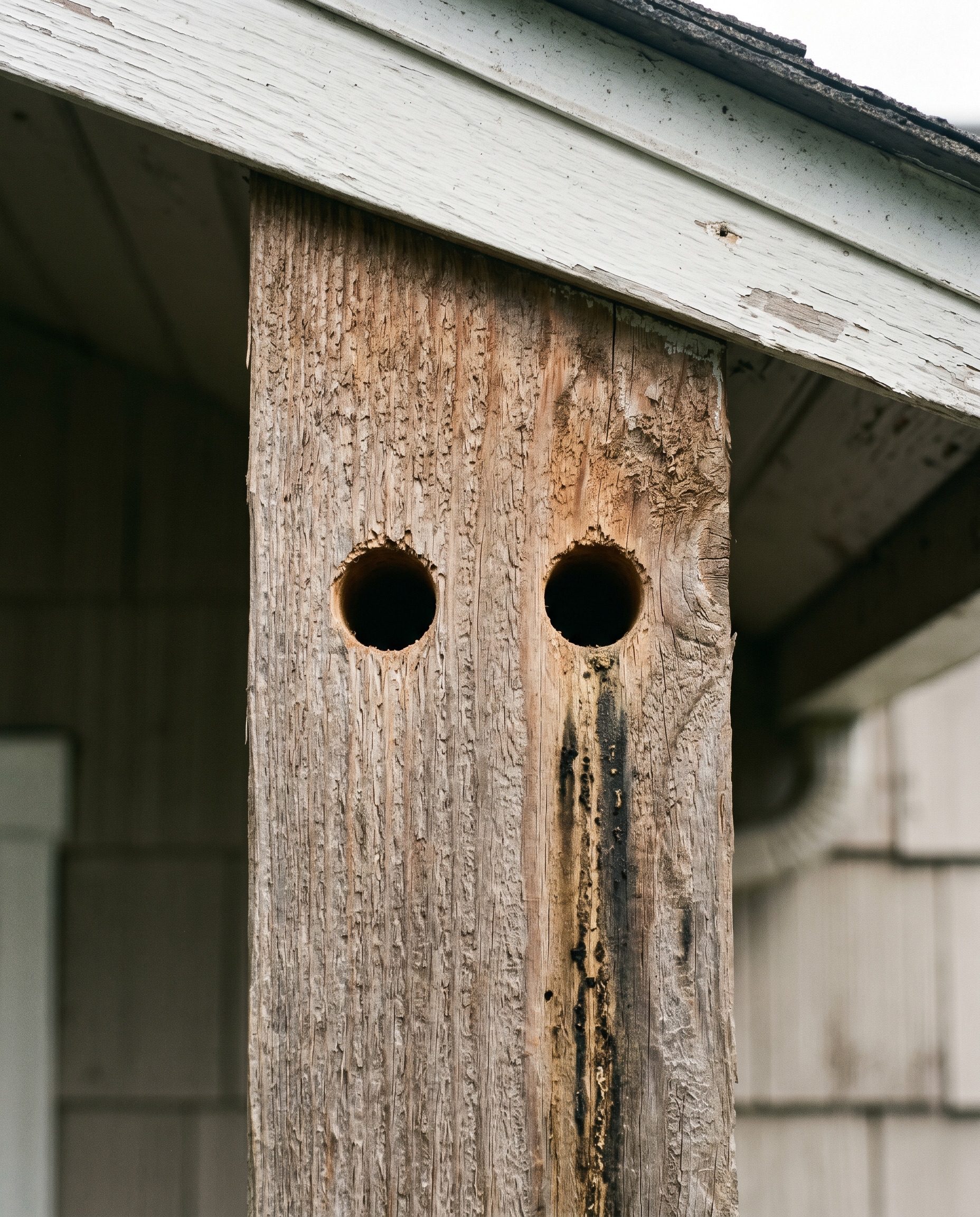
The bees are not the only ones working your wood. Those plump larvae sealed inside the galleries are a rich food source, and woodpeckers will rip the wood open to get them, converting a tidy half-inch hole into a long, splintered trench. This is frequently how a homeowner first notices the problem at all: not the bees, but the fresh excavation a woodpecker left chasing them. The faster you interrupt the cycle, the less of this secondary, far uglier damage you invite.
It is worth keeping the harm in proportion, though. Carpenter bees are native pollinators, not an invading swarm, and the EPA’s framework leans toward the least-disruptive fix first. Their least-toxic, pollinator-protective pest control guidance is the right lens here: protect the structure you actually care about, and tolerate bees nesting in a snag, fence post, or out-of-the-way beam where they are doing no harm.
Galleries vs other wood damage
People lump several very different problems under “something is eating my wood.” The damage patterns separate cleanly once you know what each one leaves behind.
| Cause | What the damage looks like | Where you see it |
|---|---|---|
| Carpenter bee | Round half-inch hole, tunnel along grain, sawdust and a yellow stain below | Bare softwood eaves, rails, decks, fascia, fence posts |
| Carpenter ant | Smooth galleries with no mud, fine shredded “frass” pushed out | Damp or rotting wood, often near leaks |
| Termite | No surface holes, mud tubes, hollow wood packed with soil | Wood near ground contact, foundations |
The giveaway for carpenter bees is that single round entrance plus the sawdust; ants and termites do not leave a clean drilled hole. If the wood is also wet and crumbling, you are likely looking at a moisture-driven ant problem instead.
Stopping the cycle the right way
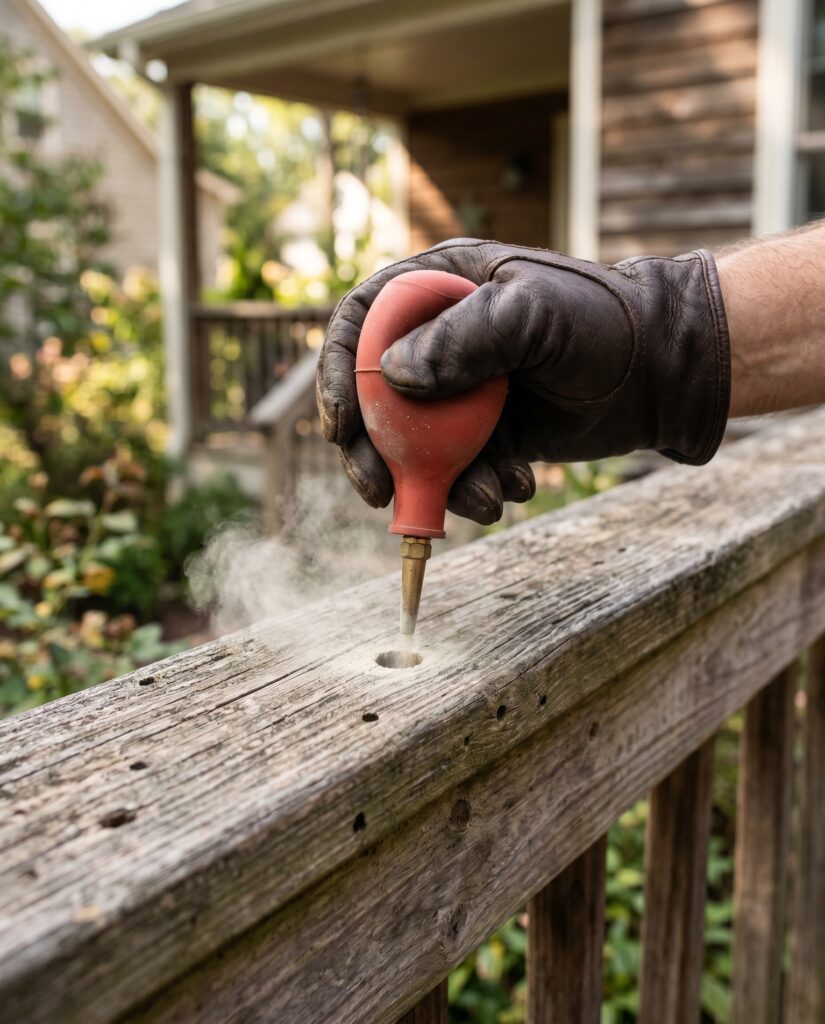
Knowing the life cycle tells you exactly when and how to act. The mistake almost everyone makes is plugging an active hole right away, which traps a live bee that simply chews a fresh exit nearby, leaving you with two holes instead of one. The correct sequence is to treat the open, active gallery first, wait a few days while the returning female carries the dust deeper to the brood, and only then plug and seal it. Surface or air spraying the wood does essentially nothing, because the bees are inside.
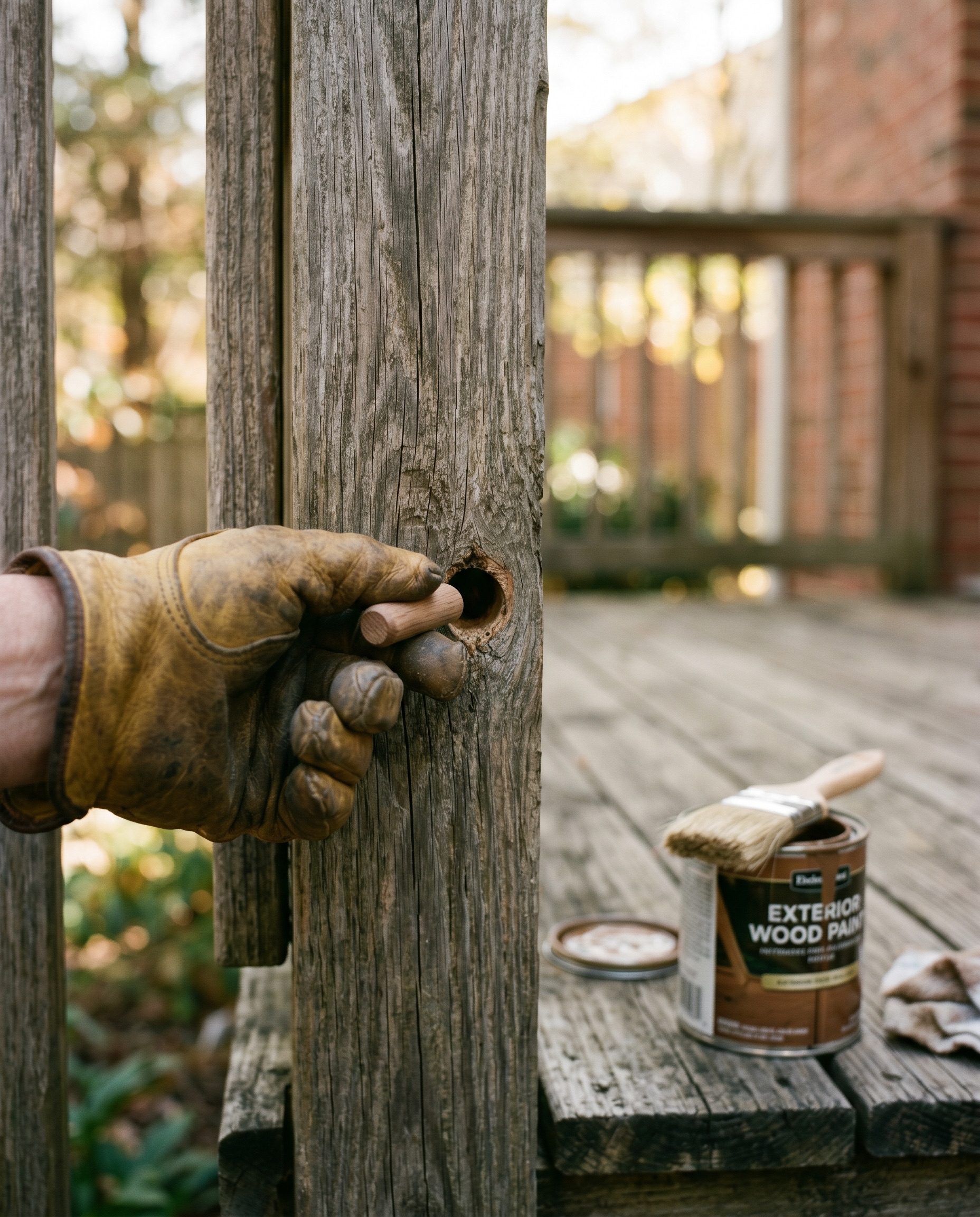
Because the galleries get reused, sealing the old holes is the step that actually matters for the long term, and it pairs with the real prevention: carpenter bees avoid finished wood, so painting, sealing, or staining bare softwood is what keeps them from boring in the first place. University of Kentucky Entomology notes the same order of operations and the reassuring detail that, since male carpenter bees cannot sting at all, the intimidating part of this job is mostly bluff. For the application timing and dust choice, see our guide to getting rid of carpenter bees, and for filling and refinishing the wood properly, our how to repair and seal carpenter bee holes walks the plug-and-paint step that breaks the reuse cycle.
Common questions
Do carpenter bees eat the wood they tunnel into?
No. They excavate it, grinding the wood into sawdust to hollow out a gallery for their young, but they do not digest or feed on it. Their actual food is pollen and nectar, which is why they are pollinators. The sawdust you find below a hole is the leftover material from their digging, not droppings or chewed pulp they consumed.
How much damage can carpenter bees really cause?
One season’s tunnel is minor, often just a few inches. The damage becomes serious because the same galleries are reused and extended for years and can eventually honeycomb a board from inside, and because woodpeckers tear the wood open to reach the larvae. Left alone over many seasons in the same timber, that adds up to real structural and cosmetic harm.
Will carpenter bees sting me?
Male carpenter bees, the ones that hover and chase, have no stinger and cannot sting at all. Females can sting but are docile and almost never do unless handled or trapped. The aggressive dive-bombing around a porch is territorial bluffing by harmless males.
Why are the same holes back every year?
Because new adults overwinter inside the old galleries and reuse them in spring rather than starting fresh. That reuse is why an untreated board collects more and longer tunnels over time, and why plugging and finishing the wood after treatment is what finally stops the pattern.
Should I kill carpenter bees if they are not near my house?
Generally no. They are native pollinators, and bees nesting in a dead snag, fence post, or out-of-the-way beam are doing no structural harm. Reserve treatment for galleries actively damaging wood you need to protect, and let the rest pollinate.
Final verdict
The carpenter bee story makes sense once you stop picturing an insect eating your house and start picturing one quarrying it. The female chews a clean round hole, tunnels along the grain, and raises a row of young, so any single year’s gallery is small. The damage is cumulative because the bees reuse and lengthen those same tunnels season after season, and woodpeckers compound it by ripping the wood open for the larvae. Because reuse is the engine, the smart response is to treat only the galleries doing real harm, wait, then plug and finish the wood so it is never bored again, while leaving these native pollinators alone where they are not hurting anything.
Next steps:
– Treat an active gallery in the right order with our guide to getting rid of carpenter bees.
– Break the reuse cycle for good with our how to repair and seal carpenter bee holes.
– Make sure it is a carpenter bee and not a bumble bee with our carpenter bee vs bumblebee identification guide.