
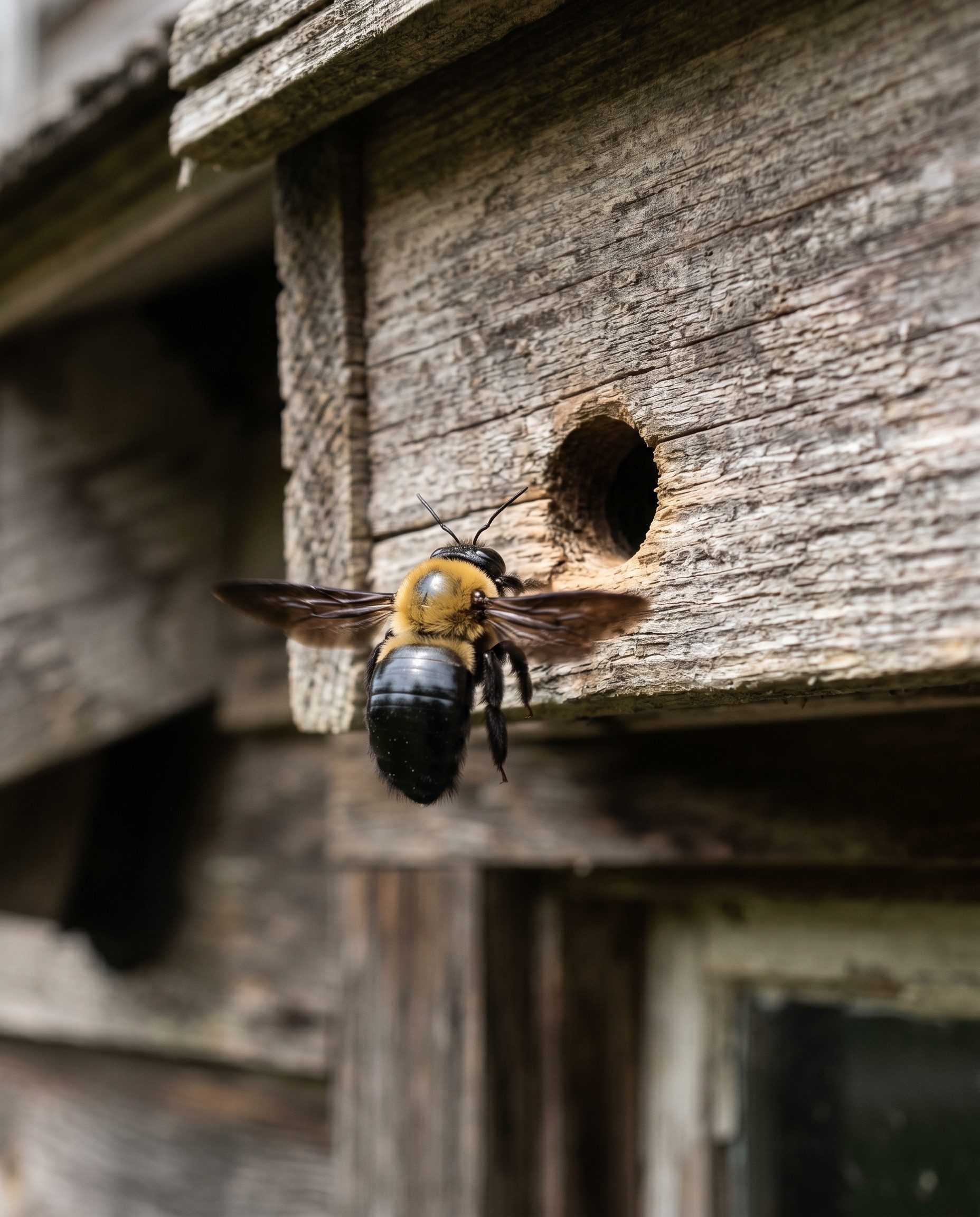
You spot a big, loud bee bumping around the porch eaves in spring and the first question is whether you are looking at a harmless bumblebee or something boring into the house. The fastest way to settle it is the abdomen: a carpenter bee has a shiny, hairless, black abdomen, while a bumblebee’s is fuzzy and banded with yellow. The behavior backs it up, because carpenter bees hover around wood and bore perfectly round holes in it, and bumblebees nest in the ground or an old cavity and never touch your lumber. That one difference is the whole identification, and it decides what you do next: one is a structural pest you may need to manage, the other is a pure pollinator to leave alone.
If the abdomen is shiny, bald, and black, it is a carpenter bee. If it is fuzzy and striped with yellow, it is a bumblebee. The carpenter bee bores round holes in bare wood; the bumblebee never damages wood.
- The confirming feature: A bare, glossy black abdomen means carpenter bee; a hairy yellow-banded abdomen means bumblebee.
- Most-confused look-alike: The eastern bumblebee, separated by its fuzzy striped belly and ground nesting.
- What it means: Both are pollinators, but only the carpenter bee tunnels wood, so manage it only if it is damaging structure.
Quick answer
The bee you want a name for is almost certainly a carpenter bee (Xylocopa virginica in most of the eastern US) or an eastern bumblebee (Bombus impatiens). They overlap in size and both can be black and yellow on top, which is why people swap them. The single feature that tells them apart is the top of the abdomen: turn your attention to the rear half of the body and check whether it is shiny and bare or hairy and striped.
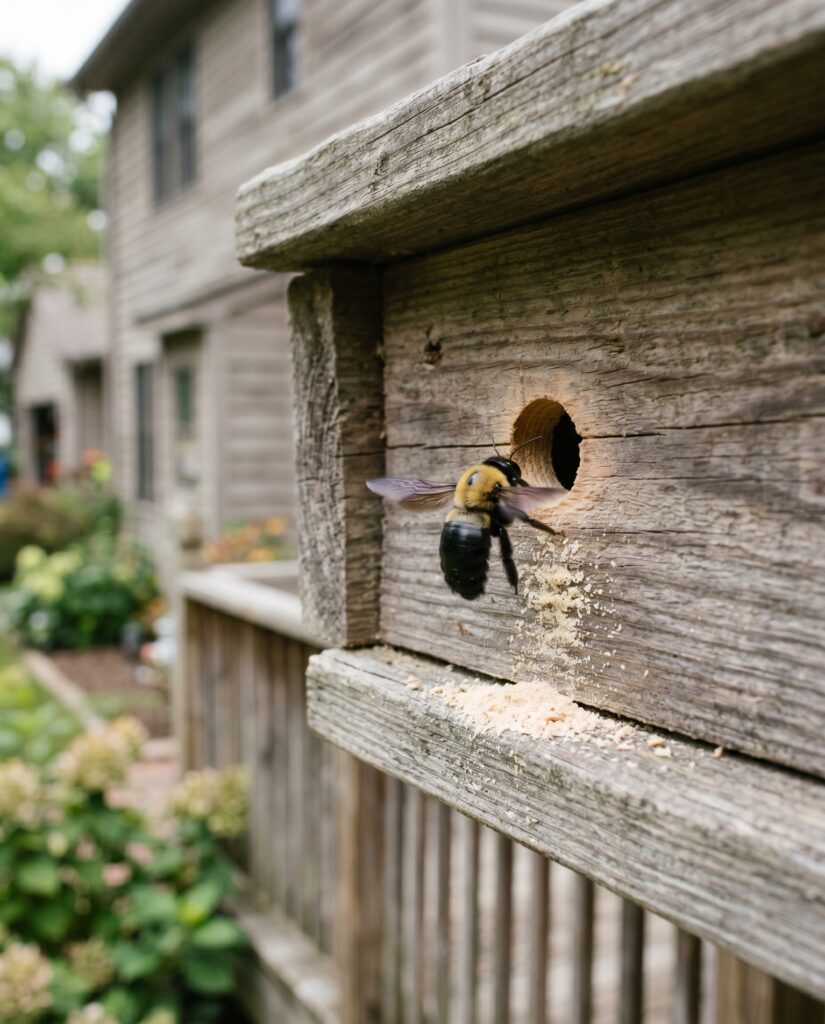
A carpenter bee’s abdomen looks like polished black plastic, with no fur to hide the shine. A bumblebee’s whole body, abdomen included, is covered in dense fuzz with bands of yellow. If you cannot get close, watch where it goes: a bee hovering at your fascia, deck rail, or eave and disappearing into a round hole is a carpenter bee, full stop, because bumblebees never bore wood.
The shiny black abdomen tell
The abdomen is the confirming feature because it never lies, even when color and size do. Carpenter bees have a hairless, glossy black abdomen that reflects light like a bead of obsidian, and that bald shine is the thing no bumblebee has. Iowa State spells out the same diagnostic in Iowa State’s side-by-side of carpenter bees and bumblebees: the abdomen is the reliable separator, not the fuzzy thorax, which both insects share.
Here is the trap to avoid. Both bees often have a fuzzy yellow patch on the thorax, the segment right behind the head, so a glance at the front end makes them look identical. Look past the thorax to the back half of the body. If that rear section is bare and black, you have a carpenter bee; if it carries fur and yellow stripes, you have a bumblebee. On a male carpenter bee you may also see a pale or yellowish patch on the face, which a bumblebee never shows, a small bonus tell when the bee is feeding and holding still.
Full description
Run down the body the way an entomologist would. Size is the first thing people notice and the least reliable, because a big carpenter bee and a big bumblebee are both roughly three-quarters of an inch to an inch long, about the width of your thumbnail. The two look-alikes are genuinely close in bulk, so size alone will not get you there.
Color and texture do the real work. A bumblebee reads as soft and rounded, fuzzy from head to tail, with bold yellow bands across a black body. A carpenter bee reads as half-and-half: a fuzzy front and a smooth, shiny black rear that looks almost armored. Count the legs and segments only to confirm you have a bee at all, since both are true bees with six legs, two pairs of wings, and the head-thorax-abdomen plan.
Behavior fills in the rest of the picture. Male carpenter bees are the ones that hover and dart aggressively at anything that passes, including you, which feels threatening but is bluff. They patrol the nest area and chase rivals, while the females do the actual tunneling. Bumblebees, by contrast, move from flower to flower without staking out a patch of wall, and you will rarely see one hanging in the air by a building.
Look-alikes side by side
People confuse these two because both are large, both can wear black and yellow, and both turn up in yards in spring. The decisive separators are the abdomen and the nest, so the table below puts those next to each other for the three bees readers mix up most.
| Bee | Key feature | Where you find it |
|---|---|---|
| Carpenter bee | Shiny, bare, black abdomen | Bores round holes in bare wood (eaves, rails) |
| Bumblebee | Fuzzy, yellow-banded abdomen | Nests in ground or old cavities, never in wood |
| Honey bee | Slim, amber-and-brown striped body | Hives and managed boxes, much smaller |
The honey bee is the easy one to clear: it is noticeably smaller and slimmer, more amber than black, so it is rarely the real confusion. The carpenter-versus-bumblebee call comes down to that abdomen every time. When in doubt, follow the bee; a carpenter bee leads you to a round hole, and a bumblebee leads you to a hole in the ground or a tuft of grass, which itself confirms the ID.
Where you find each one
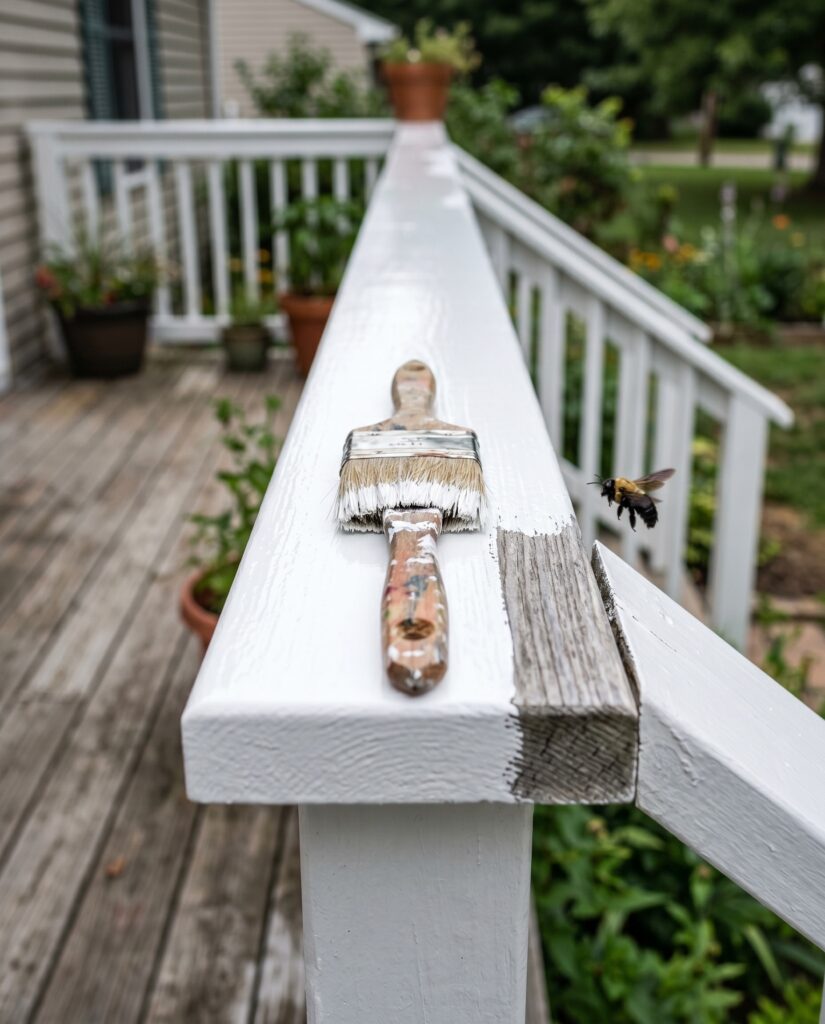
Habitat is itself a clue, and it is one of the cleanest. Carpenter bees want bare, unfinished softwood and you will see them most around the parts of a house people forget to paint: cedar or redwood deck rails, fascia boards, eaves, fence posts, and the undersides of railings. They prefer weathered, unpainted wood, which the UC IPM Pest Notes on carpenter bees note is why painted and sealed lumber so often goes untouched.
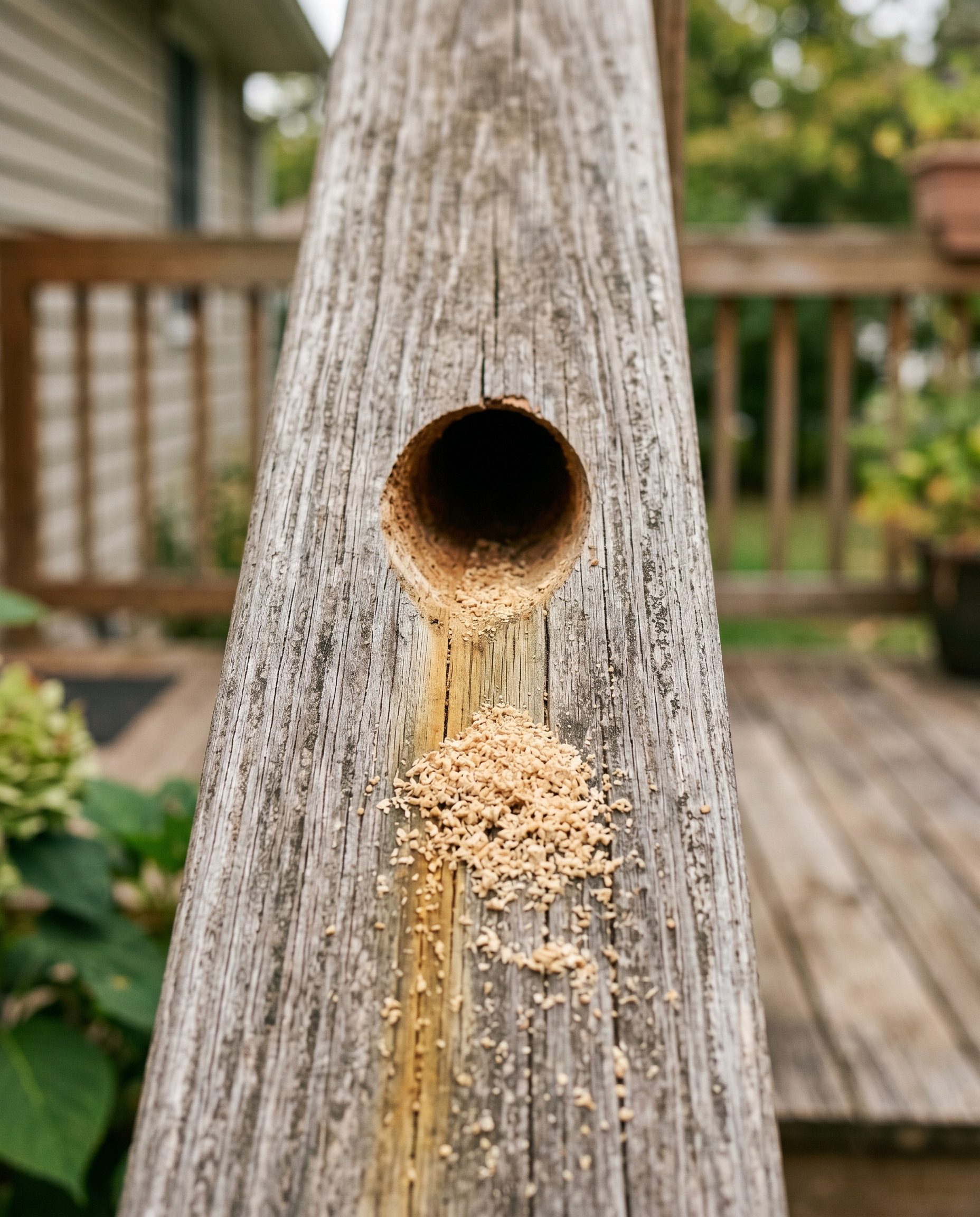
Bumblebees go the opposite direction. They nest in the ground, in abandoned rodent burrows, or in old cavities like a compost pile or a gap under a shed, and they will never excavate your wood. Both bees are spring-active across most of the US, emerging as it warms, so timing will not separate them; the nesting site will. If you found the bee near a neat round hole with a little sawdust below it, the address alone tells you it is a carpenter bee.
Is it a problem?
Here is the part that matters most, and it is reassuring. Both of these bees are native pollinators, and neither is aggressive. Male carpenter bees do all the menacing hovering but cannot hurt you, because University of Kentucky’s note that male carpenter bees have no stinger confirms males physically lack the equipment. Females can sting but are docile and almost never do unless handled. Carpenter bees also do not eat wood; they only excavate galleries to raise young, and they are worth protecting as pollinators, a point our guide on whether carpenter bees are good or bad works through in full.
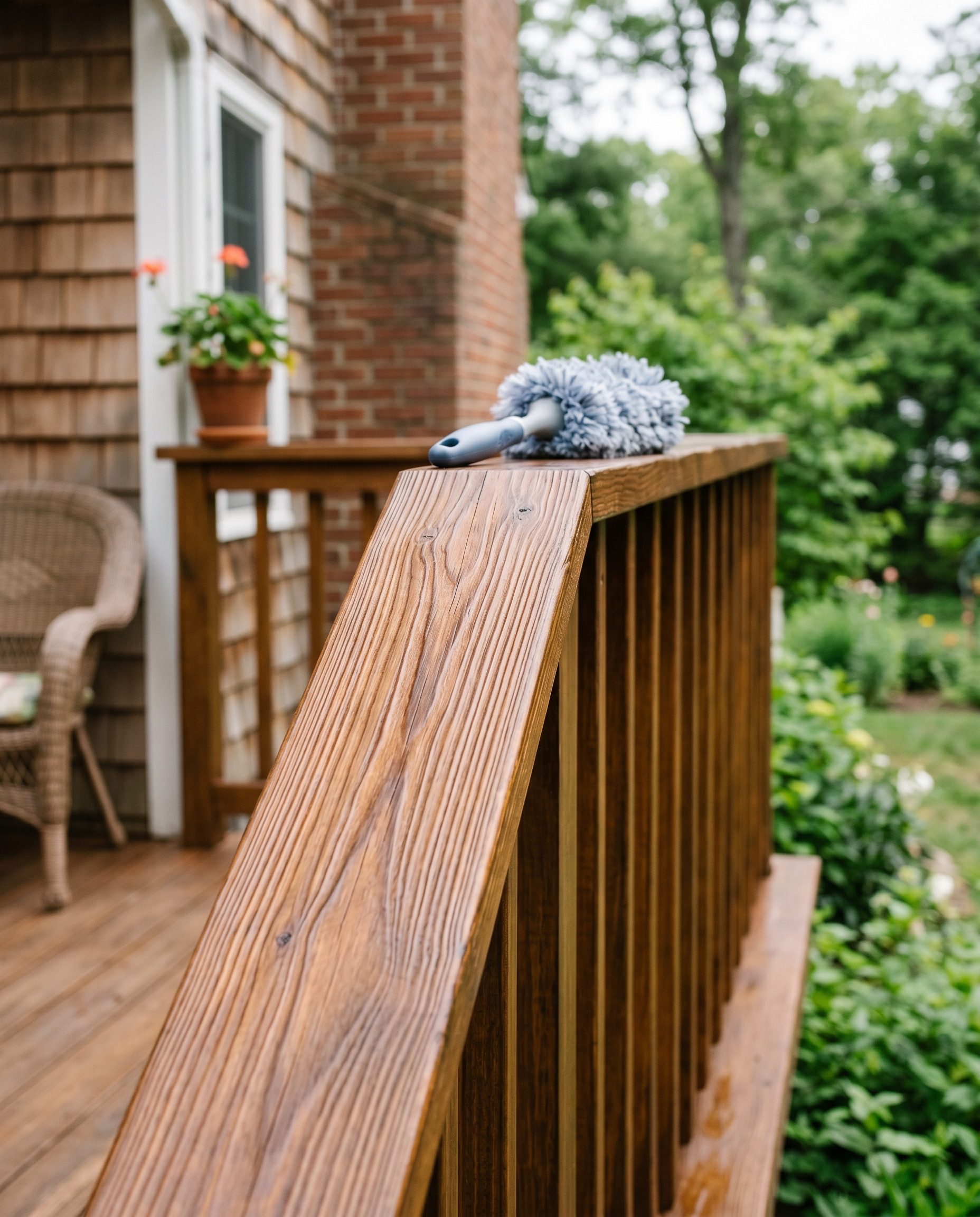
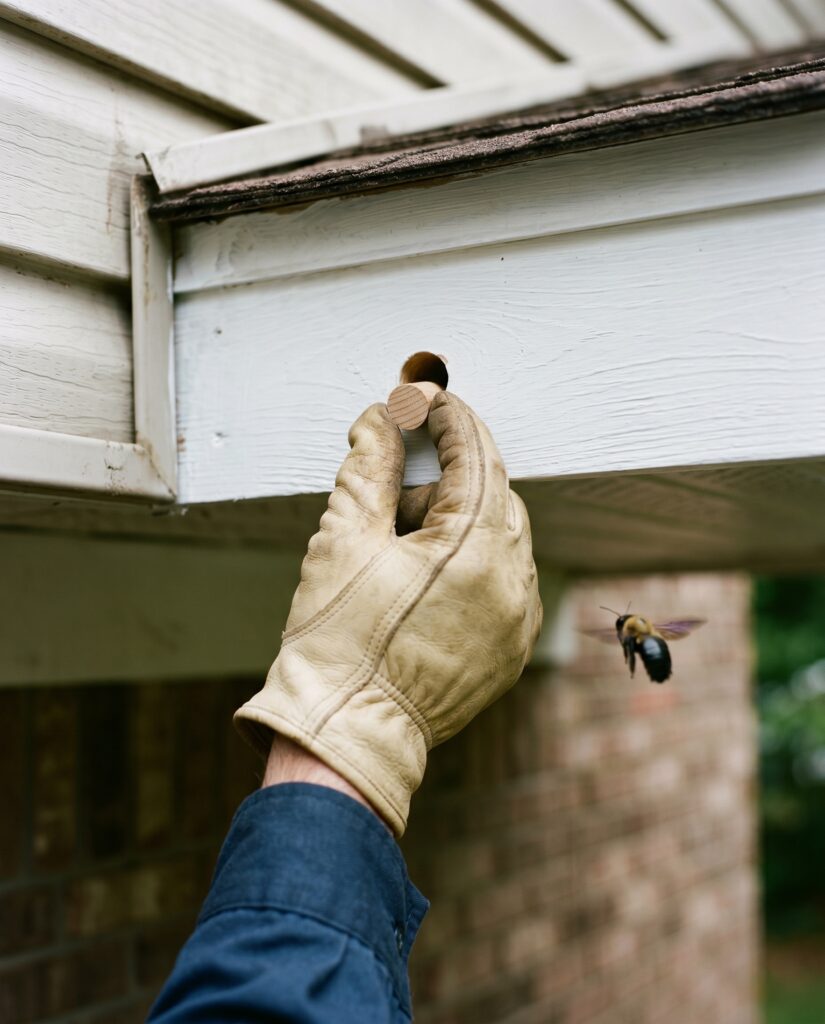
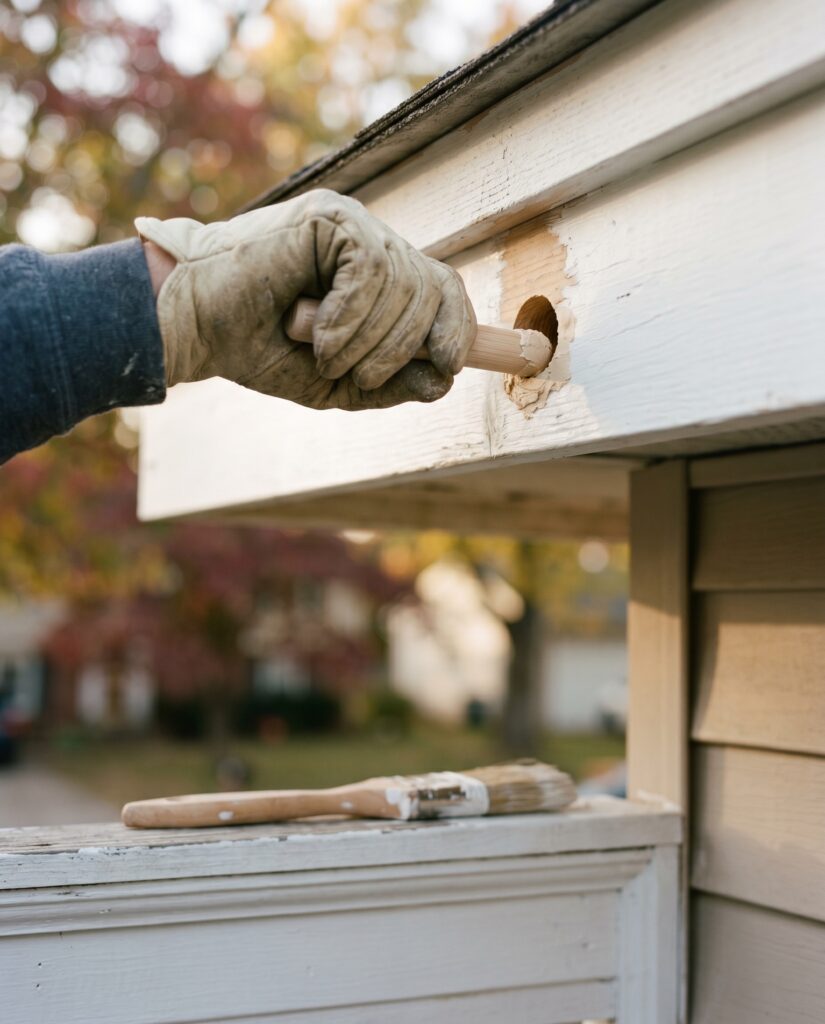
The real concern is cumulative structural damage. Carpenter bees reuse and enlarge the same galleries year after year, and as Penn State Extension on reused galleries and woodpecker damage describes, woodpeckers chasing the larvae can tear those tunnels wide open. So treat only galleries doing genuine harm to structure, and lean on prevention over killing. The standard approach is to puff insecticidal dust into the active tunnel, wait a few days for the returning female to carry it to the brood, then plug and seal the hole; plugging too early just traps live bees that chew a fresh exit. Surface sprays do almost nothing here. Best of all is painting or sealing bare wood so the bees skip it entirely, which fits the EPA’s least-toxic, pollinator-protecting approach of protecting bees and going after only the wood that needs it.
Common questions
Do carpenter bees sting?
Males cannot, because they have no stinger, and the dramatic hovering they do near your head is pure bluff. Females have a stinger but are gentle and sting only if you grab or trap one. For the full picture, see our guide on whether carpenter bees sting and are dangerous.
Do carpenter bees eat the wood?
No. They do not feed on wood the way termites do; they only chew round galleries to lay eggs and raise larvae, then live on flower nectar and pollen. The sawdust under a hole is excavated wood, not eaten wood, which is why the damage is structural rather than digestive.
Why does the same bee come back to my deck every year?
Because carpenter bees reuse old galleries and new females often nest near where they hatched. That is why damage compounds over seasons and why sealing finished tunnels matters. The pattern is laid out in our carpenter bee life cycle and damage guide.
Is the big fuzzy bee in my garden a carpenter bee or a bumblebee?
If it is foraging on flowers and is fuzzy all over including the back end, it is almost certainly a bumblebee, and you should leave it be. If it is hovering by your house and has a shiny black tail, it is a carpenter bee.
Should I kill carpenter bees?
Only when they are actively damaging structure. Both species are valuable pollinators, so the responsible move is to tolerate bees nesting away from buildings, protect bare wood by finishing it, and treat only the galleries causing real harm.
Final verdict
Settle the carpenter bee versus bumblebee question with one look at the abdomen: shiny and bald and black means carpenter bee, fuzzy and yellow-banded means bumblebee. The behavior confirms it, since carpenter bees hover at bare wood and bore perfectly round holes while bumblebees nest in the ground and never harm lumber. Remember that both are native pollinators and neither is out to hurt you, so the goal is not to wipe them out but to protect the bumblebee entirely and manage the carpenter bee only where it is damaging your house. If you do need to act, dust the active tunnel, wait, then seal it, and paint your bare wood so next spring’s bees move along.
Next steps:
– Decide whether the bee is worth protecting with our take on whether carpenter bees are good or bad.
– Understand why the damage repeats in the carpenter bee life cycle and damage guide.
– Calm the sting worry with our guide on whether carpenter bees are dangerous.
Pingback: Wasp Larvae in a Nest: What Is Inside the Cells