
You found a small moth fluttering near the cabinet over the stove, and now you are seeing it everywhere. That is almost always the Indianmeal moth (Pinodia interpunctella), and its life cycle is the reason it feels impossible to get rid of. One female lays a few hundred eggs right on your dry food, the larvae feed and spin silk webbing through the product, then they crawl a surprising distance to pupate up in ceiling corners and along shelf edges, far from where they ate. The fastest tell is the two-toned wing: the half nearest the body is pale tan and the outer half is coppery, like a moth dipped halfway in bronze. See that, plus webbing in the food, and you have your ID, which points you straight at the real job: find the infested package.
If the moth in your kitchen has a tan-and-coppery two-toned wing and you find silk webbing in your dry food, it is the Indianmeal moth, and the fix is to find and discard the infested package, then clean the shelf seams and corners where larvae crawl to pupate.
- The confirming feature: A bicolored forewing, pale tan inner half and reddish-copper outer half, on a moth about 1/2 inch across.
- Most-confused look-alike: Clothes moths, which are plain and golden with no two-tone band and live in closets, not food.
- What it means: A pantry food problem, not a fabric one. Source out the infested package and clean the pupation spots, then read our guide to getting rid of pantry moths.

Quick answer
The Indianmeal moth (Pinodia interpunctella) is by far the most common moth found indoors in North American kitchens. The adult is small, roughly half an inch from wingtip to wingtip, and at rest it folds its wings flat over its body in a slim torpedo shape. The single feature that confirms it is the two-toned forewing: the third nearest the head is whitish-gray to pale tan, and the rest is a coppery reddish-brown, often with a faint dark band where the two colors meet. No other moth you are likely to find raiding the cereal box carries that bicolored pattern.
The adults are the harmless part. The damage is done entirely by the larvae, the cream-colored caterpillars living inside your flour, oats, dried fruit, nuts, birdseed, or pet food. If you can match the bicolored adult to webbing in a food package, you do not need any further confirmation. The one look-alike worth ruling out is the clothes moth, and that one lives in wool sweaters, not the pantry.
The bicolored wing that confirms it
Get the name right before you do anything else, because a pantry moth and a clothes moth call for completely different responses. The Indianmeal moth’s diagnostic feature is its wing, and it reads clearly even on a moth sitting still on the ceiling. Look for the sharp color break across the forewing: pale at the shoulder, coppery toward the tip. Penn State Extension’s profile of the Indian meal moth describes the same two-toned forewing as the key identifier, and it is the feature entomologists lean on first.
If the moth is worn or faded, the band can be hard to read, so back it up with the evidence in the food. Indianmeal moth larvae leave silk webbing, a fine matting that clumps grain, cereal, or dried fruit together and sometimes trails across the surface of the product. That webbing is the giveaway no clothes moth produces in your kitchen, because clothes moths do not feed on dry food at all. Adult Indianmeal moths, for their part, do not feed on your food either. The adults exist to mate and lay eggs, which is why chasing the fliers never solves anything.
Full description and life cycle
Run down the field marks in order. Size: about 1/2 inch wingspan, with a body length closer to a quarter inch, so this is a genuinely small moth. Color and markings: the bicolored forewing already covered, set against a generally drab body. Shape at rest: wings folded flat and tented, giving a narrow, almost cylindrical outline rather than the broad triangle some moths show. Count the legs if you are ever unsure you are looking at an insect at all: six legs, three body segments, one pair of antennae, all of which mark it as a true insect rather than anything else scuttling in the pantry.
The life cycle is what makes this moth stubborn, so it is worth knowing. A female lays her eggs directly on or near a food source, and where the larvae actually feed and how a single female multiplies is the part most people miss: one female can lay a few hundred eggs, and in a warm kitchen the whole egg-to-adult cycle can finish in under two months. The eggs hatch into the cream-colored, brown-headed caterpillars that do all the eating and spinning. The larvae are the destructive stage, not the moths.
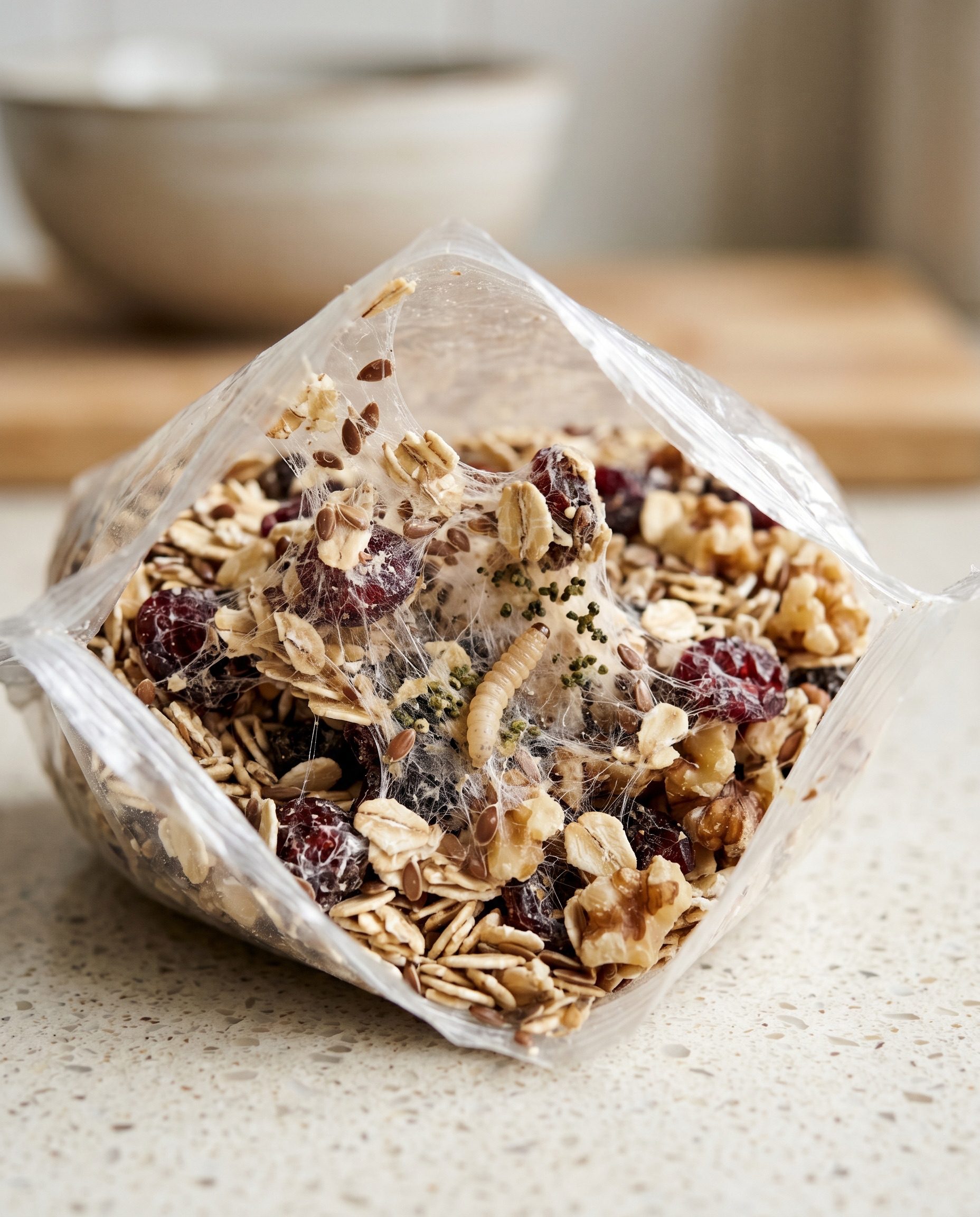
Here is the behavior that throws everyone off. When a larva is full-grown and ready to pupate, it abandons the food and crawls a long way to spin its cocoon, often climbing to where a wall meets the ceiling, into the lip of a cabinet door, or along a shelf seam many feet from the box it hatched in. Iowa State’s Indianmeal moth identification page notes this wandering pupation directly, and it explains why you find cocoons and emerging adults in spots where no food has ever been. If you only clean the shelf where you saw the moths, you miss half the population.
Look-alikes to rule out
People confuse the Indianmeal moth with two things: the small brown clothes moths in their closet and the tiny grain weevils sometimes sharing the same cabinet. The wing pattern settles the moth question instantly, and the body plan settles the weevil one. Our pantry moth versus clothes moth identification guide walks the same comparison in more depth if you are torn between the two.
| Species | Key feature | Where found |
|---|---|---|
| Indianmeal moth | Two-toned forewing, tan and copper; webbing in food | Pantry, dry food, cabinets |
| Clothes moth | Plain golden wing, no band; eats keratin in wool/silk/fur | Closets, drawers, stored wool |
| Grain weevil | Hard-shelled beetle with a snout, not a moth at all | Whole grains, rice, dried beans |
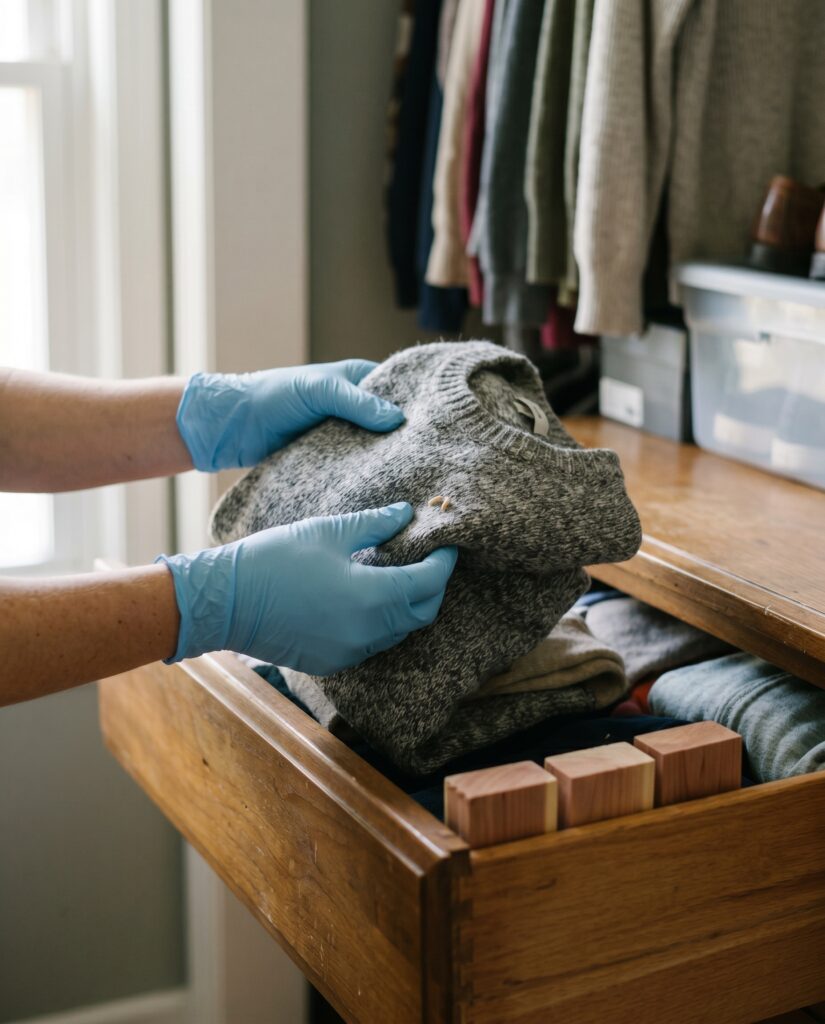
The distinction matters because the cures do not overlap. Clothes moths feed on keratin in wool, silk, fur, and feathers, never on cotton, linen, or polyester, so they answer to cleaning and freezing the garments, not the pantry. Their adults do not even eat, having no working mouthparts. And the two moths use different pheromones, so a pantry-moth trap will not lure a clothes moth and vice versa. They are not interchangeable.
Where you find them and what to do
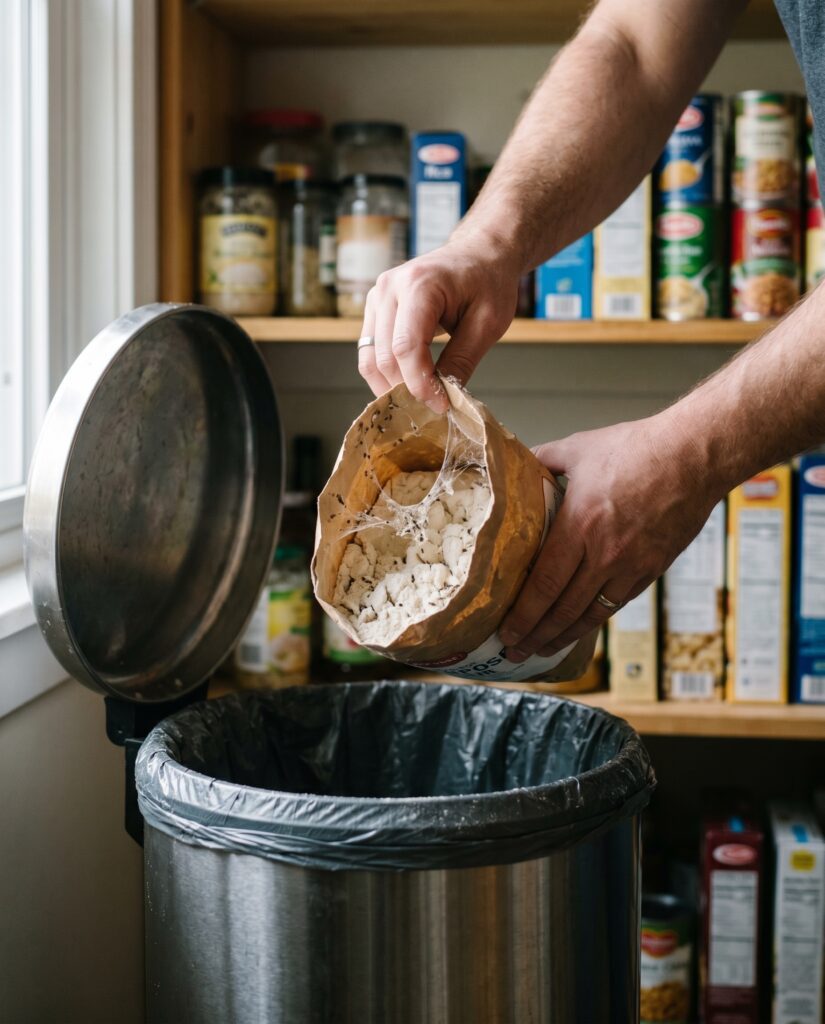
You will see Indianmeal moths most often in late summer and fall, and most often in the kitchen, which is itself a clue: a moth that keeps appearing near the spice rack or cereal shelf is far more likely a pantry moth than anything from the closet. They are found across the United States anywhere dry food is stored warm. The action that ends an infestation is finding and discarding the infested package. Open and inspect flour, cereal, oats, cornmeal, dried fruit, nuts, birdseed, and pet food, and toss anything with webbing or larvae in a sealed bag to the outdoor trash.
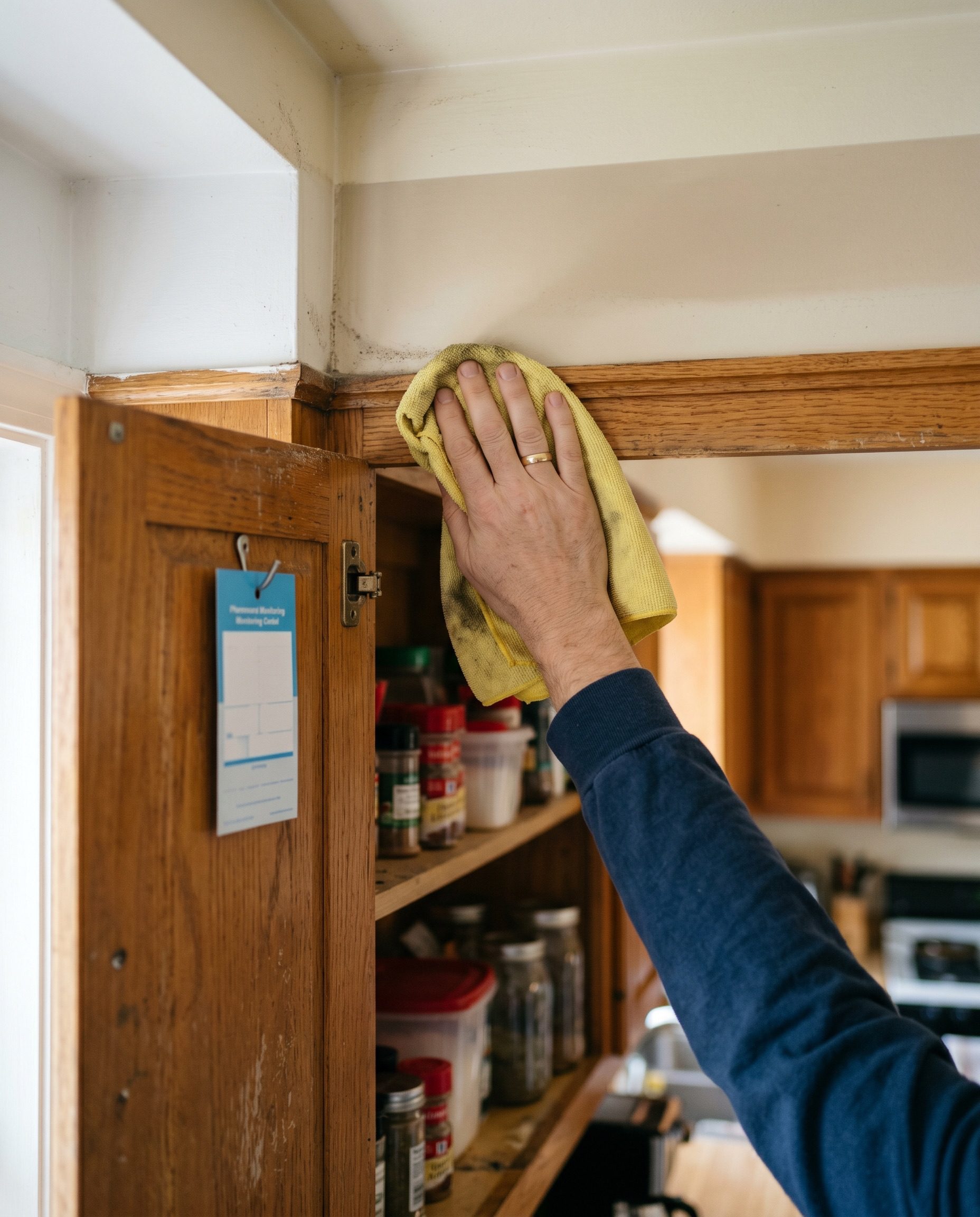
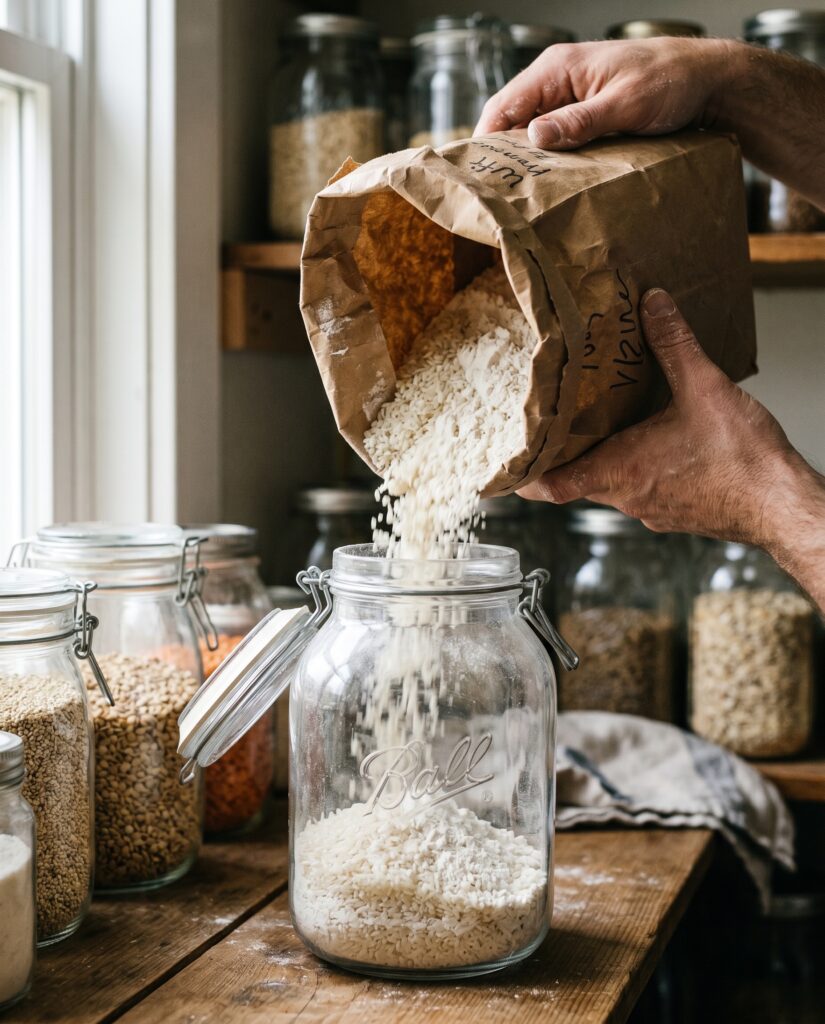
Then clean where the larvae go, not just where they ate. Vacuum and wipe the shelf seams, the cabinet corners, the underside of shelves, and the upper wall-to-ceiling edges where larvae crawl to pupate, following the discard-and-clean approach Iowa State recommends. Going forward, University of Kentucky’s guidance on keeping stored food in airtight containers is the single best prevention step, since glass or hard plastic with a tight seal both keeps new moths out and contains any you bring home. A pheromone trap only catches male moths to disrupt mating and tell you whether the problem is shrinking. It is a monitor, never a standalone cure, which is why the source cleanup has to come first. The EPA’s sanitation-first integrated pest management approach puts that same cleaning-before-chemicals order at the center of household pest control.
Common questions
Are Indianmeal moths harmful to eat?
Accidentally eating a few larvae or eggs in contaminated food is not known to cause harm, and they do not bite or carry disease. The real cost is the spoiled food and the nuisance of the fliers. Still, once you see webbing in a package, discard it rather than sift it out, because the contamination is rarely limited to the part you can see.
Why do I keep seeing moths after I threw out the food?
Because the larvae crawled off to pupate before you cleaned. Full-grown larvae leave the food and spin cocoons in cabinet corners, shelf edges, and the wall-to-ceiling seam, so new adults keep emerging from spots far from any food. Vacuum those seams and corners thoroughly, and the new arrivals stop.
Will a pheromone trap get rid of them?
No. A pantry-moth trap uses a scent that attracts only male moths, so it disrupts some mating and shows you the trend, but the females and the feeding larvae are untouched. Treat it as a monitor and a finishing touch after you have found and removed the infested package, never as the cure on its own.
Do Indianmeal moths eat clothes?
No. They are a stored-food insect, and their larvae feed on dry pantry goods, not fabric. The moths chewing holes in a wool sweater are clothes moths, a different species with a plain golden wing and no two-toned band, and they need a different fix entirely.
Will cedar or herbal sachets stop them?
Not reliably. Cedar and herbal repellents work on adult fliers and fade within months, and they do nothing to the larvae already feeding inside a package. They are not a substitute for finding the source and sealing food in airtight containers.
Final verdict
The moth in your kitchen is almost certainly the Indianmeal moth, and the bicolored forewing confirms it: pale tan at the shoulder, coppery at the tip, on a small moth about half an inch across. Match that to silk webbing in a dry-food package and you have a definite ID. The life cycle is the lesson, though. Because one female lays hundreds of eggs and the full-grown larvae wander far from the food to pupate, the fix is never the fluttering adults you see. Find and discard the infested package, vacuum the shelf seams and corners where larvae crawl to pupate, and seal what is left in airtight containers. A trap is only a monitor.
Next steps:
– Confirm pantry moth versus closet pest with our pantry moth versus clothes moth identification guide.
– Work the full cleanup in our guide to getting rid of pantry moths.
– Set up monitoring the right way with our pantry moth traps overview.
Pingback: Tiny Bugs in Kitchen Cabinets: Identification Guide
Pingback: Bugs Crawling on the Ceiling: What Gets Up There