Measure the hole. Under 2 mm and round, in hardwood, with flour-fine powder: powderpost beetles. Around 2 to 3 mm and round in softwood: common furniture beetle. Around 10 to 12 mm, round, turning at a right angle inside: carpenter bee. Oval rather than round: a different borer family. A slot or an irregular opening with coarse shavings below: carpenter ants. Then ask the more important question, which is whether the hole is fresh.
- Most holes are exits, not entrances. They mark where an insect left.
- Powder below means active. A clean hole usually means finished.
- Pale, sharp-edged rims are new. Weathered rims are old.
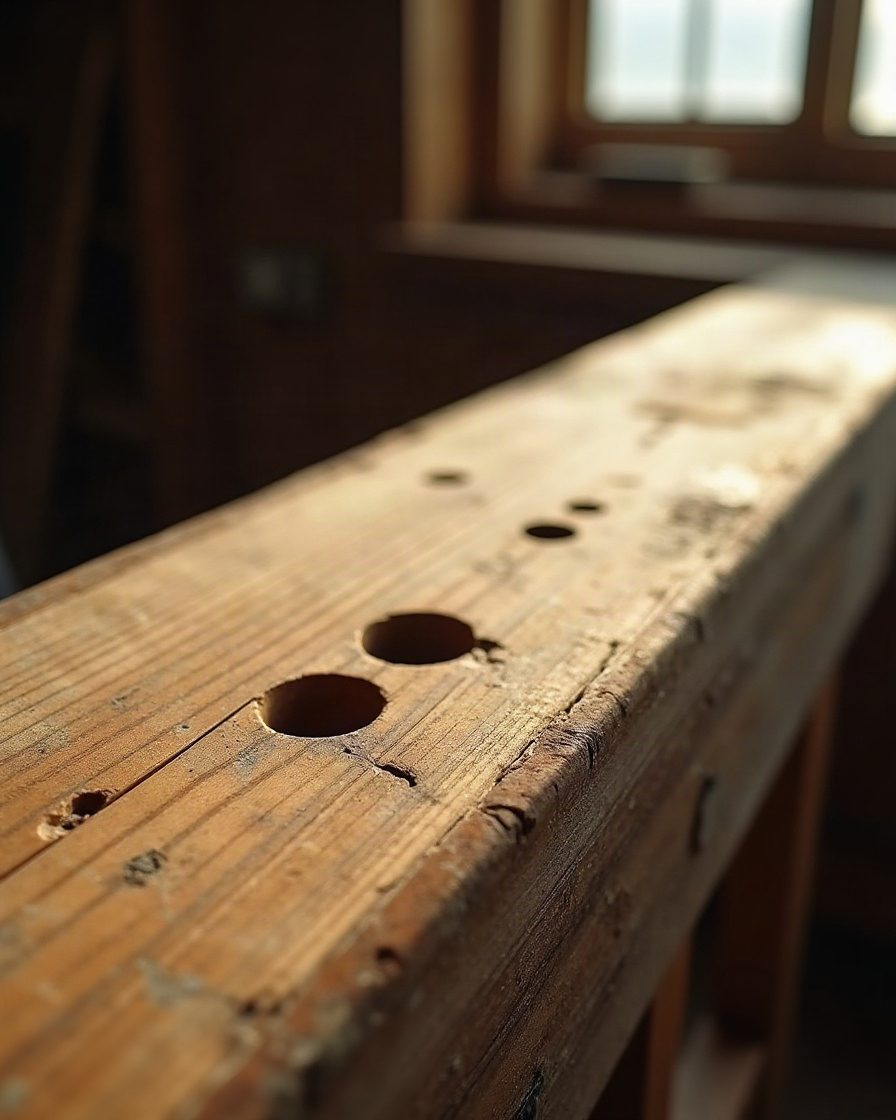
Holes in timber cause more unnecessary worry than almost anything else on this site, because the evidence outlives the insect by decades. Old beams and second-hand furniture routinely carry holes made long before anyone now living owned them.
The measurement narrows the family. The freshness test decides whether it matters. Do both, in that order.
Measure first
| Diameter | Shape | Wood | Likely |
|---|---|---|---|
| under 1 mm | round | any | Ambrosia beetle, historic, or a pinhole borer |
| 1 to 2 mm | round | hardwood | Powderpost beetle |
| 2 to 3 mm | round | softwood, older | Common furniture beetle |
| 3 to 6 mm | round | structural softwood | Anobiid or old house borer |
| 6 to 10 mm | oval | hardwood and softwood | Longhorn beetle family |
| 10 to 12 mm | round, turns inside | softwood, exterior | Carpenter bee |
| slot or irregular | with shavings | damp timber | Carpenter ants |
| 1 to 2 mm with pellets | round, resealed | any | Drywood termite kick-out hole |
A ruler with millimetre markings, held against the wood and photographed, does this job in seconds and removes almost all the ambiguity.
Then look at what is coming out
The debris below the hole is often more diagnostic than the hole itself.
Flour-fine powder that drifts. Powderpost or furniture beetle. See powderpost beetle frass.
Hard granular six-sided pellets. Drywood termites, and the hole will be small and often plugged. See termite frass identification and UC IPM on drywood termites.
Coarse fibrous shavings with insect parts. Carpenter ants, and the opening will be a slit rather than a circle. See carpenter ant frass compared with sawdust.
Coarse sawdust below a large round hole outdoors. Carpenter bee. The University of Kentucky’s guide to carpenter bees covers the nesting behaviour, and our page on the carpenter bee life cycle and the damage they cause covers what to do.
Nothing at all. The usual case, and it points toward a historic infestation.
Sawdust piles indoors compares the four debris types side by side.
Entrance or exit
This confuses people and it is worth being explicit.
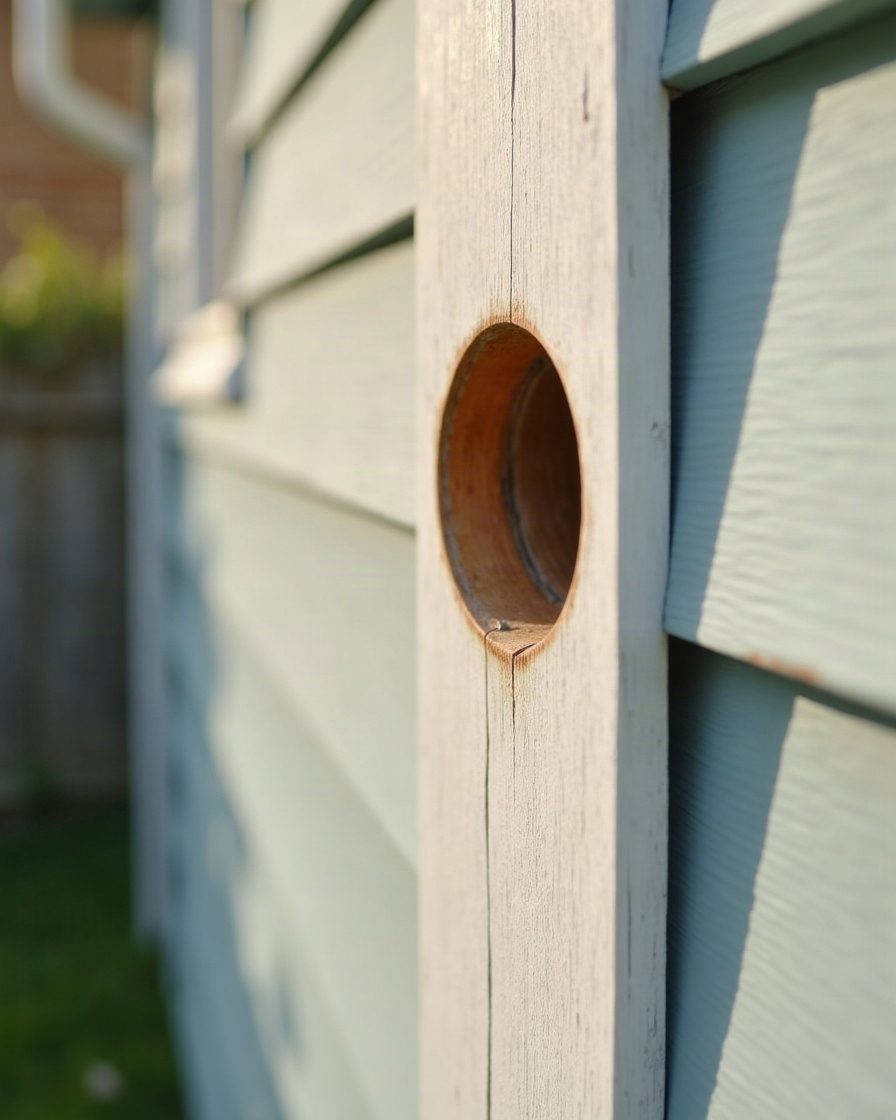
For nearly all wood-boring beetles, the visible round hole is an exit hole, cut by the adult on emerging. The egg was laid in a crack or a pore in the surface, and the larva spent its life tunnelling inside. So the hole marks a departure, not an arrival, and a wall of exit holes records insects that have already gone.
The exceptions are carpenter bees, which drill an entrance and use it repeatedly, and carpenter ants, whose openings are for removing spoil.
This is why the number of holes is a poor guide to the current situation, and why the freshness test carries the whole question.
Fresh or historic
Three signals, and the third is decisive.
Rim colour. A new hole exposes pale, clean wood at the rim, which stands out against a weathered or polished surface. Old holes have darkened, taken on dust and finish, and blend in.
Powder. Loose, pale powder that drifts is recent. Compacted, grey, dust-mixed powder is not.
The clean-and-wait test. Vacuum every trace of powder away, lay dark paper beneath the timber, note the date, and check weekly. Because most emergence happens in spring and early summer, a fair test runs through a full season rather than a fortnight. New powder means active. The powderpost beetle guidance from Kentucky is built around exactly this distinction.
Probing the wood
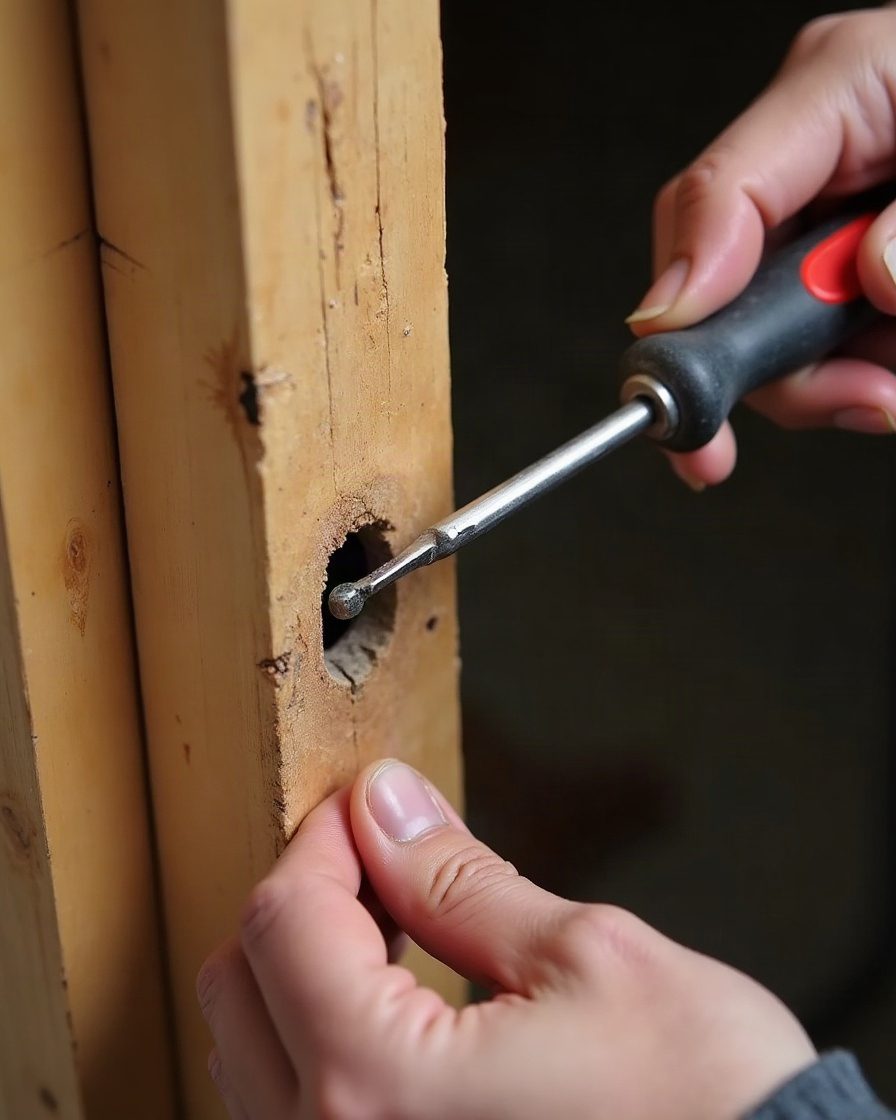
Separately from identifying the insect, find out whether the timber is still sound. Press a flat screwdriver firmly into the surface near the holes.
Firm resistance means the damage is superficial or historic.
The blade sinks in, or the surface collapses into a hollow means substantial internal loss, and that is a structural question regardless of which insect caused it.
Tapping along a beam and listening for a change from solid to hollow does the same job over a longer run.
Where the wood came from matters
Some infestations arrive with the timber and never spread. Firewood is the classic case: beetles emerging from logs stacked indoors are alarming and almost never a threat to the house, because the species involved need bark or high moisture and cannot establish in dry seasoned structural timber. The University of Kentucky covers this under firewood insects, and the practical rule is to store firewood outside and bring in only what will burn that day.
Second-hand furniture is the other common route, and there the infestation can be live.
Common questions
Should I fill the holes? Not before running the freshness test, because filling destroys the evidence. Afterwards, filling is cosmetic and fine.
Is a spray worth it? Surface insecticide does little against larvae inside the wood, and a finish blocks penetration. Borate products work on bare, raw timber. For active structural infestation, this is an assessment rather than a purchase.
The holes are in a floor, not furniture. Then the species question matters more, because structural softwood suggests anobiid rather than lyctid, and those persist.
One hole, nothing else. Very often a nail hole, a knot, or a single historic exit. Measure it and run the test before doing anything.
The bottom line
Measure the diameter, note the shape, look at what is falling out, and then decide freshness with dark paper and a date. That sequence resolves most holes in wood, and the commonest honest answer is that the insect left years ago and nothing needs doing at all.