Rub a pinch between finger and thumb. Coarse fibrous shavings with insect fragments mixed in are carpenter ants. Hard granular six-sided pellets are drywood termites. Flour-fine powder that drifts is powderpost or furniture beetles. Damp, matted pulp with droppings is a rodent. Those four cover nearly every pile of wood debris that appears indoors, and each sends you to look at something different above it.
- Texture before appearance. All four look pale and dusty from two metres away.
- Look straight up. Debris falls vertically, so the source is directly overhead.
- Clear it and date it. That single step separates active from historic.
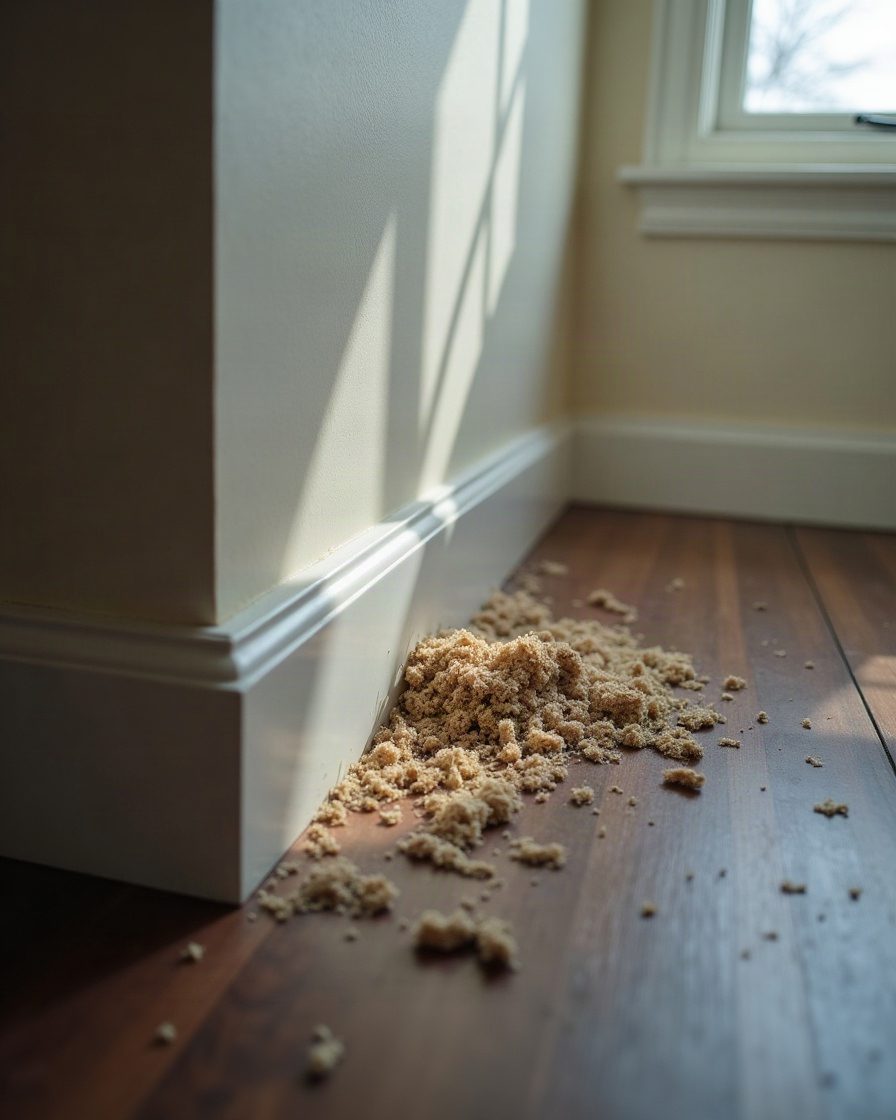
A pile of what looks like sawdust appearing indoors, with no woodwork having been done, is a genuinely useful finding. It is also frequently misread, because the four possibilities look similar at a glance and only one of them is urgent.
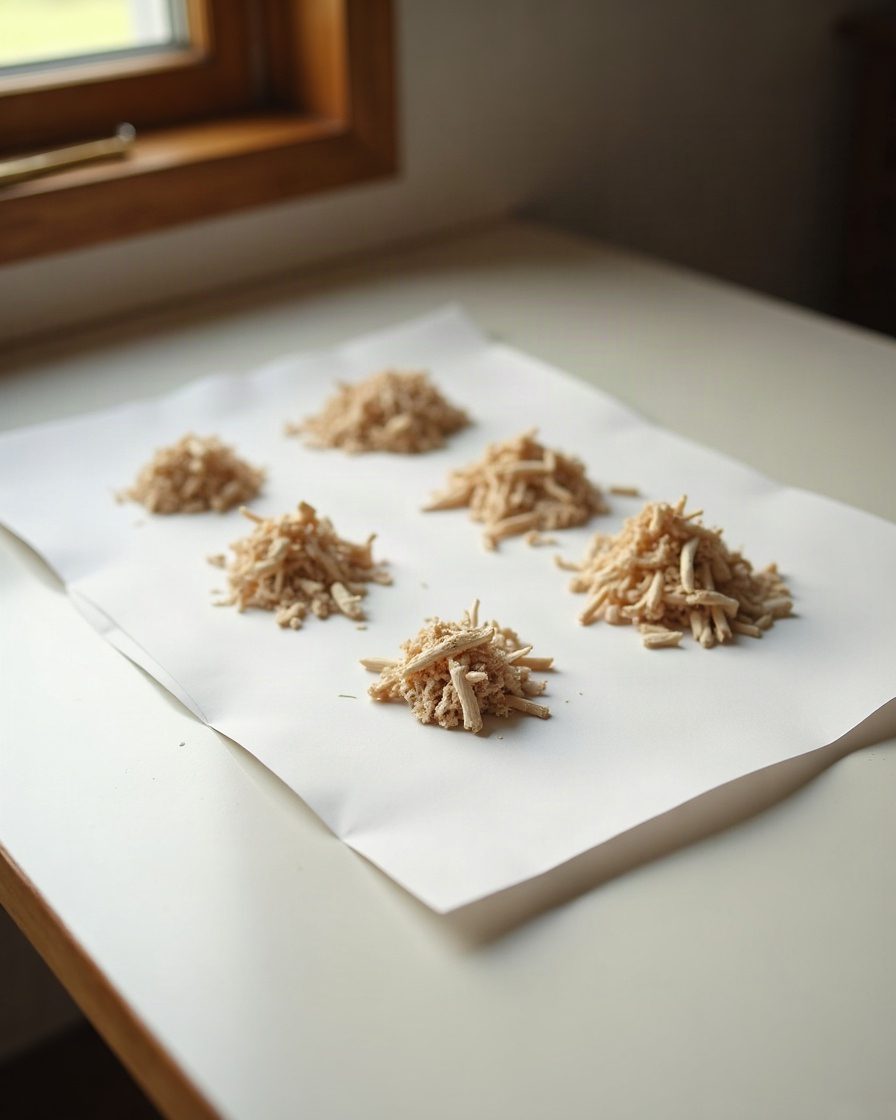
The four, by texture
Coarse fibrous shavings, several millimetres long, that mat when compressed, mixed with dark insect fragments.
Carpenter ants. They excavate galleries and eject the spoil, and because the same opening serves for general nest waste, discarded ant parts and prey remains come out with it. The opening is a slit or an irregular gap rather than a round hole. The University of Kentucky’s guide to carpenter ants covers the behaviour, and carpenter ant frass compared with sawdust covers the identification in detail.
Hard granular pellets, uniform, roughly 1 mm, six-sided, rolling rather than compressing.
Drywood termites. The pile is conical and directly below a small kick-out hole that is often resealed. UC IPM’s guide to drywood termites covers it, and so does termite frass identification.
Flour-fine powder with no grit at all, which drifts when you breathe on it.
Powderpost or common furniture beetles, falling from round exit holes 1 to 3 mm across. See powderpost beetle frass and the powderpost beetle guidance.
Damp, matted, pulpy material, often mixed with paper, insulation fibre or fabric, with droppings nearby.
Not an insect. A rodent has been gnawing structural timber, and the pulp is shredded material for a nest. Reading gnaw marks and shredded paper and nesting material cover it.
Look directly above
Debris falls vertically. The source is a point overhead, not a general area, so a torch held at a low angle and moved slowly across the surface above the pile will usually find it.
What to look for, by candidate: a round hole 1 to 3 mm with powder at the rim; a small resealed hole with pellets caught around it; a slit or gap at a joint with shavings caught in it; or gnawed timber with paired parallel grooves.
If the pile is against a skirting board, the source may be behind it rather than above it, and the same applies to a pile at the base of a door frame.
Ruling out the ordinary
Before any of the above, three mundane explanations account for a large share of these finds.
Recent work. Drilling, sanding or cutting anywhere in the house distributes fine dust much further than people expect, and it settles for days.
Furniture wear. An old chair or table joint working loose grinds wood against wood and produces a small, localised pile that reappears after the piece is moved.
Firewood. Logs brought indoors shed bark, dust and sometimes emerging beetles. Those beetles are alarming and almost never a threat to a dry, seasoned structure, which the University of Kentucky covers under firewood insects. Store logs outside and bring in only what will burn that day.
Active or historic
The same test that decides every other question in this group, and it is worth doing before spending anything.
Clear the pile away completely. Photograph the location, note the date, and lay dark paper or card beneath the spot, because pale debris is almost invisible on a pale floor.
Check weekly. New material means active. Nothing new across a month, and ideally across a spring, means finished.
Emergence for wood-boring beetles concentrates in spring and early summer, so a quiet fortnight in midwinter is not a result. Carpenter ants are similarly seasonal, with activity much reduced in cold weather.
Which of the four is urgent
Ordered by how much the answer should worry you:
Rodent pulp comes first, not because of the wood but because gnawing reaches cabling. Chewed wires and what to do first covers why that outranks everything else here.
Termite pellets come next, because they mean an active colony inside the timber and because the presence of drywood termites is a reason to check the foundation for the mud tubes of the subterranean species, which does the structural damage.
Carpenter ant shavings mean a nest and, almost always, wood that was already wet. The moisture source is the durable fix.
Beetle powder is the least urgent and the most often historic. A great deal of it turns out to be decades old.
Common questions
There are no holes anywhere above the pile. Look for a slit at a joint rather than a round hole, and check behind skirting and architrave. Carpenter ants and rodents do not make neat circular openings.
It reappears only in warm weather. Consistent with insect activity, which is seasonal, and also with a furniture joint that moves with humidity.
Can I identify it without touching it? Photograph it beside a ruler and on white paper. Texture is the best test, but scale and uniformity are visible in a good photograph.
Should I treat before knowing which it is? No. The four require four different responses, and one of them requires an electrician rather than an insecticide.
The bottom line
Feel it before you look at it. Shavings, pellets, powder or pulp separates the four in seconds and each points somewhere different. Then clear the pile, date it, put dark paper underneath, and let a month decide whether you have a current problem or the remains of an old one.