
Ask whether the web is occupied before asking what made it. A grey, dust-laden strand is abandoned and tells you only that a spider passed through at some point; a working web is kept clean and is usually repaired daily. Then read the architecture: a tangled three-dimensional mesh in a corner is a cobweb spider, a flat sheet with a funnel retreat is a funnel weaver, and a classic wheel is an orb weaver. Not all indoor silk is spider silk, and the exceptions matter more.
- Dust is the age test. Silk collects it within days.
- Architecture names the family more reliably than a glimpse of the spider.
- Fine webbing on plants or in food is not a spider. Those are mites and moth larvae.
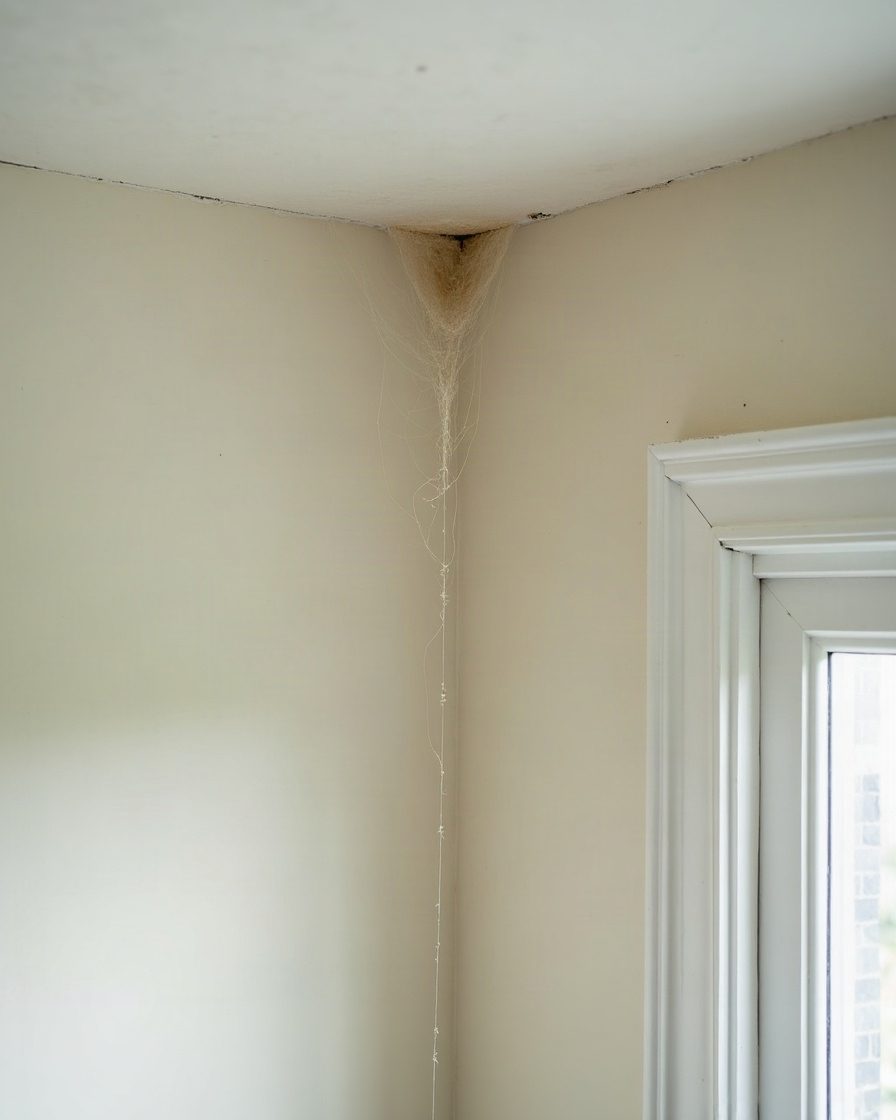
A web in a ceiling corner is the commonest silk finding in a house and usually the least significant. The useful questions are whether it is in use and whether a spider made it at all.
Occupied or abandoned
Abandoned webs collect dust. Silk is slightly adhesive and airborne dust sticks to it, so a neglected web goes grey and fuzzy within days and becomes a visible grey strand within a couple of weeks. That is what most ceiling-corner cobwebs are: the remains of a web whose owner left or died.
Working webs are clean. Spiders maintain their webs, and many orb weavers consume and rebuild the entire structure daily. A clean, taut, well-formed web is in use even if nothing is visible on it, because most species wait in a retreat rather than sitting in the open.
Look for the retreat. A small silk tube or a huddle at one edge, in a crack, behind a picture frame, or in a corner of the frame. That is where the animal actually is.
So the sequence is: clear the webs completely, note the date, and see what comes back over the following fortnight. That distinguishes a house with a resident spider population from a house that has not had the corners dusted.
Reading the architecture
| Web | Where | Built by |
|---|---|---|
| Tangled three-dimensional mesh, no pattern | Ceiling corners, under furniture, cellars | Cobweb spiders |
| Flat horizontal sheet with a funnel at one edge | Grass, shrubs, wall junctions, garages | Funnel weavers |
| Classic wheel with radiating spokes and a spiral | Windows, doorways, garden, outdoor lights | Orb weavers |
| Dense silk retreat under a sill or a lip, no catching web | Skirting, sills, under furniture | Sac and hunting spiders |
| Fine, dusty webbing on plant leaves | Houseplants and garden plants | Spider mites, not spiders |
| Silk binding grains inside a packet | Pantry | Moth larvae, not spiders |
UC IPM’s guide to spiders and the University of Kentucky’s common spiders found around homes and buildings cover the families in more depth. Funnel webs compared with sheet and orb webs takes the architecture question further.
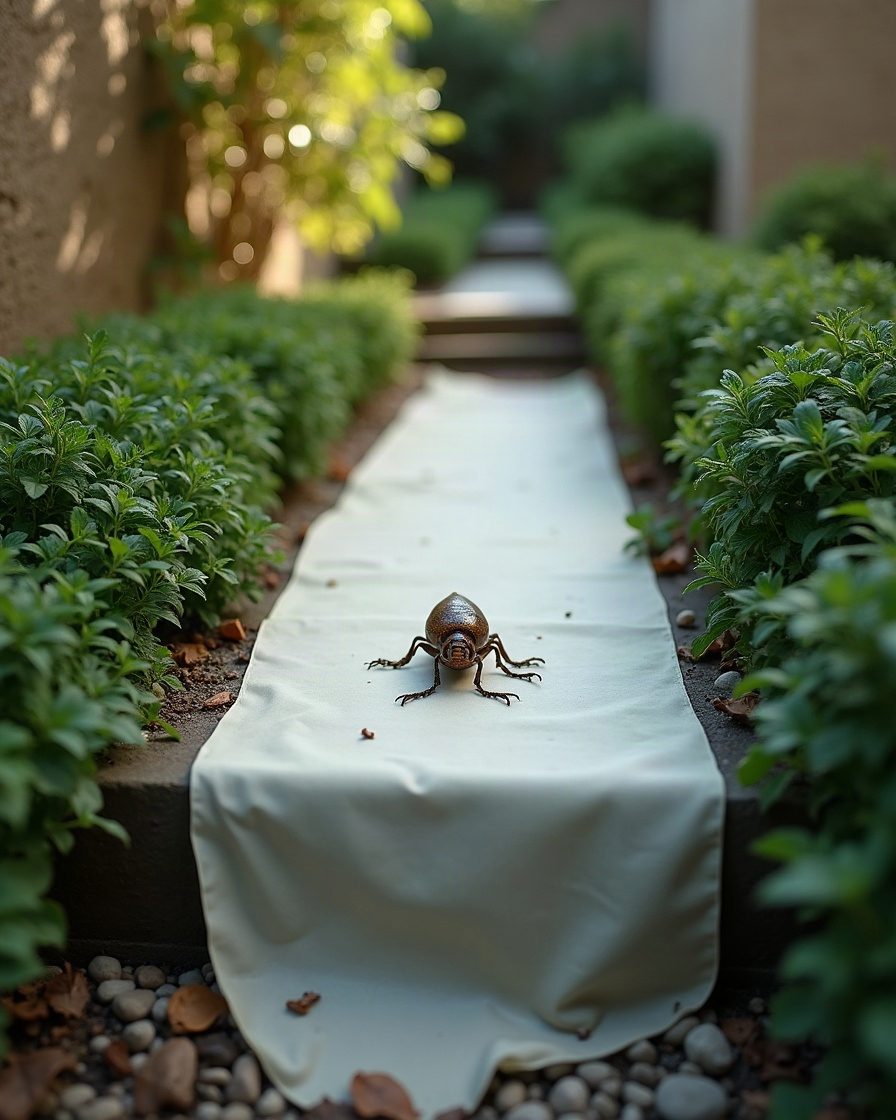
The silk that is not a spider
This is the part worth reading carefully, because these findings have consequences where a cobweb does not.
Fine, dusty webbing on plant leaves, with pale stippling on the leaf surface. Spider mites. They are not spiders and the damage is sap feeding rather than predation. Indoors this affects houseplants; outdoors it worsens in hot dry conditions. See webbing on garden plants.
Silk binding grains together inside a food packet, or a fine mat across the surface of dry goods. Pantry moth larvae. See moth webbing in a pantry.
A small silk tube or case, sometimes moving. Case-bearing clothes moth larvae carry a portable case made of silk and fibre from whatever they have been eating, so it matches the fabric and is very easily missed. See silk tubes and tunnels indoors and clothes moth larvae.
Coarse webbing enclosing whole shoots of a garden plant, with caterpillars inside. Web-forming caterpillars, and a different problem again.
If you are finding webbing and damage together, the pest damage chart is the better starting point than this page.
Why the corners
Spiders build where the airflow brings insects and where a frame exists to anchor silk. In practice that means ceiling corners, window reveals, around external doors, near outdoor lights, in garages and sheds, and in undisturbed low spaces such as under furniture and behind appliances.
An increase in webs indoors is usually a symptom rather than a problem. It means the insect population the spiders eat has increased, and the commonest driver is exterior lighting drawing insects to the building at night. Our page on bugs attracted to light at night covers that, and switching a cool white exterior bulb for a warm one reduces both the insects and, over time, the spiders.
What to do
For most households the honest answer is: remove the webs and leave the spiders alone. House spiders eat the insects that are the actual nuisance, they do not damage anything, and the great majority of species in a home are harmless to people.
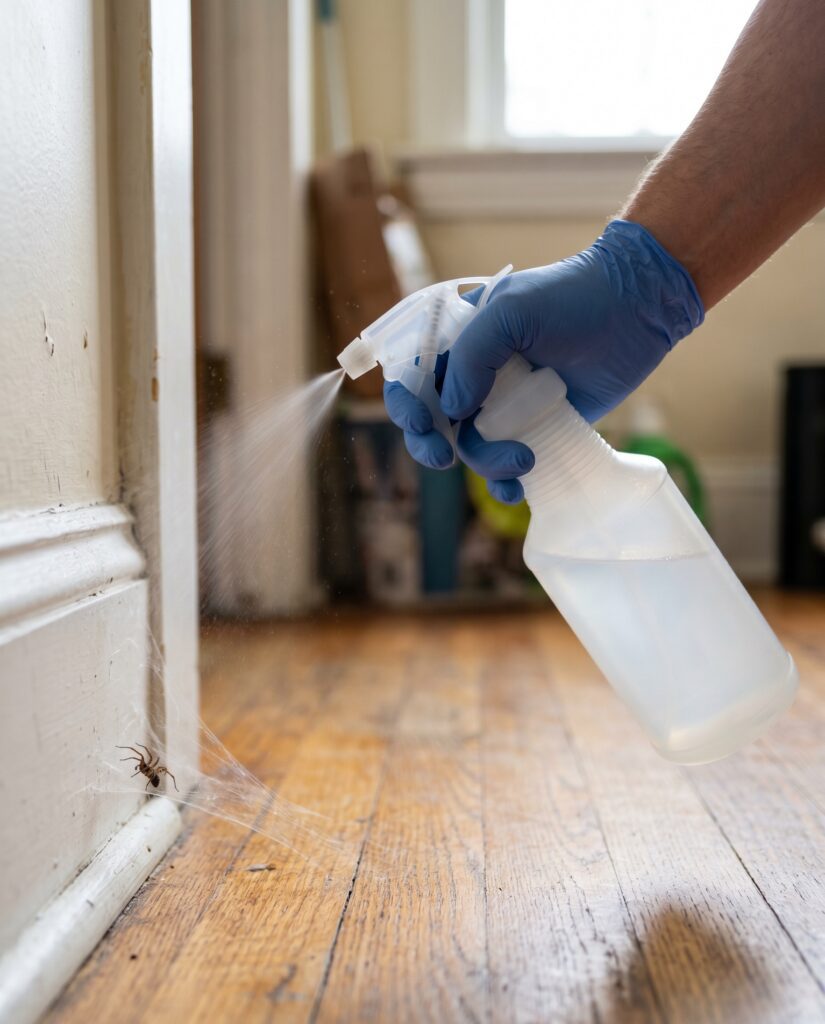
Where reduction is wanted, the effective measures are physical rather than chemical. Vacuum webs and egg sacs regularly, since removing the web repeatedly is what makes a site unattractive. Reduce clutter in garages and cellars. Fit door sweeps and repair screens. Change exterior lighting. The University of Kentucky’s guide to eliminating spiders around homes and buildings is clear that sprays achieve little against spiders compared with exclusion and housekeeping.
Egg sacs are worth removing when found, and spider egg sac identification covers what they look like.
Common questions
The webs come back within a week. That means an active population with a food supply. Look at the exterior lighting and at what is getting in.
There is a web but never a spider. Normal. Most species wait in a retreat at the edge of the web, and many are nocturnal.
Should I be worried about the species? In most regions, no. Where medically significant species occur, they are associated with undisturbed clutter rather than with ceiling corners; the brown recluse guidance covers one such case.
Webs outdoors on the wall in autumn. Seasonal and normal. Populations peak in late summer as spiders reach full size.
The bottom line
Check for dust before checking the shape. A grey laden strand is history; a clean web is a resident. Then use the architecture to name the family, and check that it is silk from a spider at all, because webbing on a plant or inside a food packet is a different animal and a real problem where a ceiling cobweb is not.
Pingback: Funnel Webs vs Sheet Webs vs Orb Webs