Mud tubes are pencil-width tunnels of compacted soil and saliva that subterranean termites build to cross exposed surfaces without drying out. They run up foundations, over concrete, along joists and through voids. This is the most consequential single finding on this site, because subterranean termites cause the great majority of structural termite damage and, unlike drywood termites, they leave no frass to give them away. Break a section, mark the date, and get an inspection.
- Earth, not paper and not silk. A tube of soil on masonry is termites.
- Break a short section and date it. Repaired within days means active.
- No pellets does not mean no termites. This species produces none.
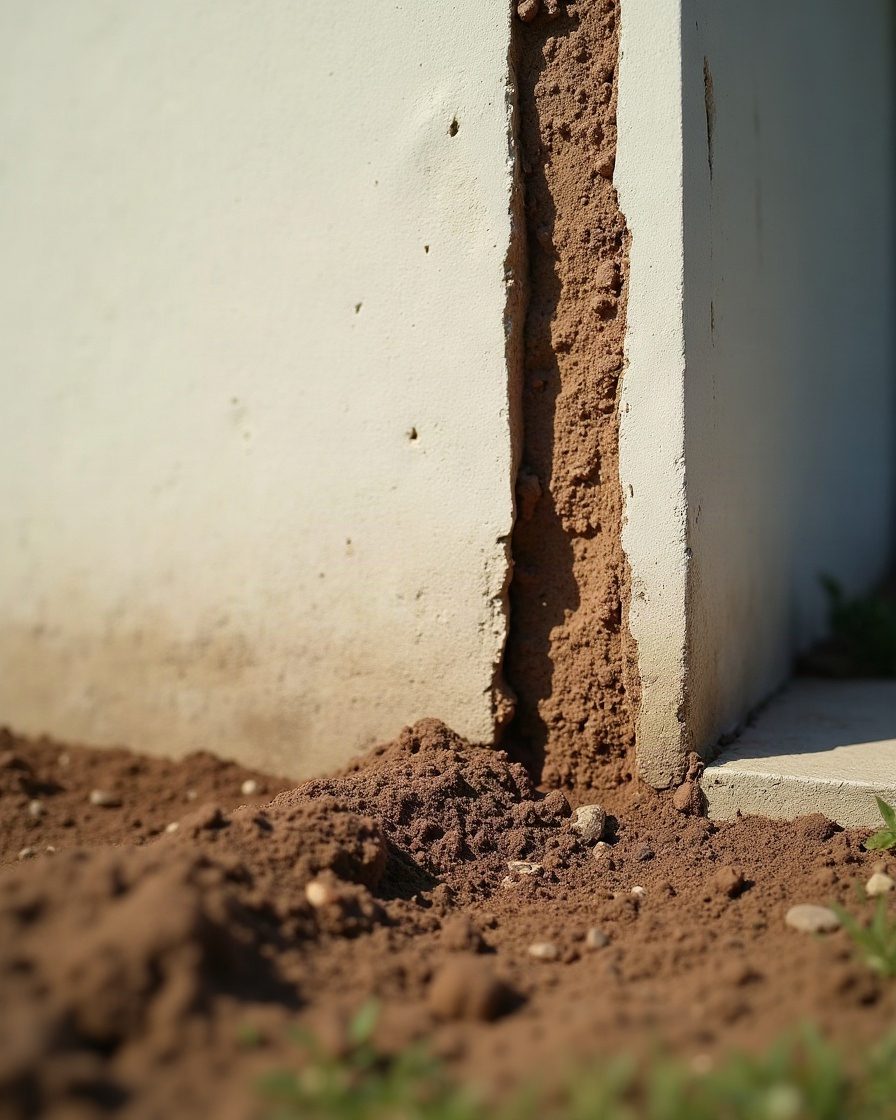
Subterranean termites live in soil and must maintain contact with it, because they lose moisture rapidly in open air. To reach wood above ground they build covered runways out of soil, faecal material and saliva, and travel inside them in a humid, dark, protected environment.
That constraint is the reason mud tubes exist, and it is also the reason they are such reliable evidence: the termites cannot reach the structure without building them.
What they look like
Size and shape. Roughly the width of a pencil, occasionally wider, running in flattened ridges or free-standing tubes.
Material. Compacted soil, mid to dark brown, dry and brittle, crumbling to earth when broken.
Route. Vertically up foundation walls, across bare concrete, over piers, along the underside of floor joists, up the inside of a cavity, and around anything that interrupts the path from soil to timber.
Types. Working tubes running from soil to wood, exploratory tubes that reach upward and stop in mid-air, drop tubes hanging down from timber to soil, and swarm tubes built briefly at the time of a swarm.
The University of Kentucky’s guide to termite control for homeowners covers the inspection in detail.
Why this matters more than pellets
Two termite groups turn up in buildings and they behave differently.
Drywood termites live entirely within the wood, need no soil contact, and periodically eject waste through a small hole, producing the little heaps of six-sided pellets covered on termite frass identification and in UC IPM’s guide to drywood termites.
Subterranean termites pack their waste into the galleries and use it as building material. They eject nothing. So a house can have a substantial subterranean infestation with no frass anywhere, and people who have read that termites leave pellets conclude wrongly that they do not have termites.
Subterranean species account for the large majority of structural termite damage. The mud tube is the sign that replaces the pellet, and it is the one to look for.
Where to look
An inspection that takes twenty minutes and needs only a torch.
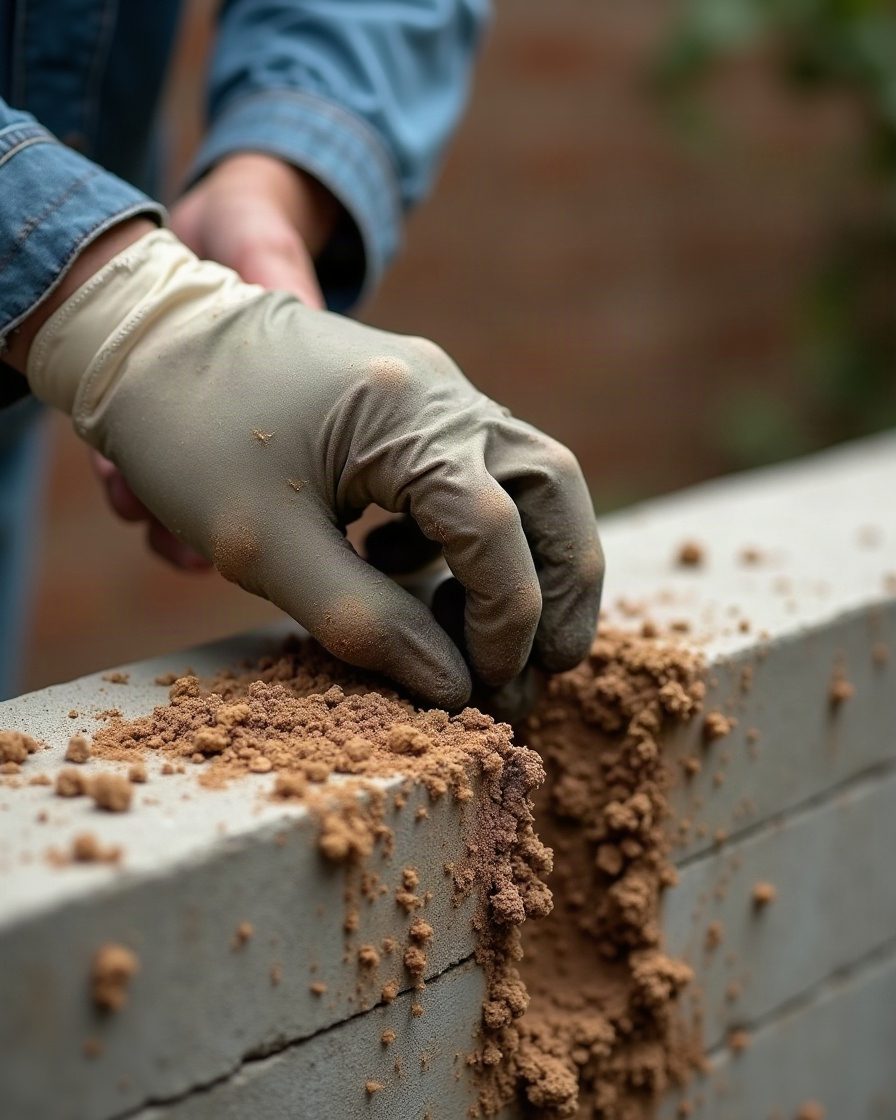
The foundation, all the way round, inside and out. Look at bare concrete and blockwork where a tube would have to be visible.
Anywhere timber meets or approaches soil: porch posts, deck framing, fence posts against the house, timber cladding running down to ground level, and any point where a flower bed or mulch has been built up against the wall.
Inside a crawl space or basement: piers, the underside of joists, the sill plate, and the back of any boarding.
Where pipes and services pass through, since these give a protected route upward.
Behind stored goods stacked against a foundation wall, which is where tubes are most often missed.
Two structural risk factors are worth checking at the same time: soil or mulch piled above the level of the damp course, and any timber in direct contact with soil. Both are the commonest routes in and both are correctable.
The other subterranean signs
Discarded wings in a small pile near a window, a light fitting or a sill, usually in spring. Reproductive termites swarm, fly briefly and shed their wings, and the wings are all of similar size, which distinguishes them from ant wings. Bugs that look like ants covers telling a termite swarmer from a flying ant, which matters because the two are confused constantly.
Timber that sounds hollow when tapped along its length, or that gives under a screwdriver pressed firmly into it.
Blistered or rippled paint over a section of skirting or frame, where the surface has been undermined from behind.
Galleries packed with soil, if timber is opened up. Drywood galleries are clean and smooth; subterranean galleries are muddy.
Establishing whether it is active
Break out a short section of tube, perhaps 50 mm, and mark the date.
Repaired within a few days means an active colony using that route.
Left unrepaired after a couple of weeks means the tube is abandoned. That is not a reason to relax entirely, because termites reroute, but it changes the picture.
Do this in more than one place if there are several tubes. And do not demolish the whole tube: leaving most of it intact gives an inspector something to work with.

What to do
Honestly and without hedging: this is an inspection, not a purchase. Subterranean termite treatment involves soil treatment, barriers or baiting systems around the structure, and it depends on the construction, the soil and the extent of the infestation. There is no consumer product that resolves it, and a partial or amateur treatment can disperse a colony and make detection harder.
What is worth doing yourself, before and regardless: pull soil and mulch back from the wall so the damp course is clear, remove timber in contact with soil, fix leaks and improve drainage so the ground beside the foundation is not permanently wet, and clear stored timber and cardboard away from the foundation.
Common questions
Could this be a mud dauber wasp? No. Mud dauber nests are finger-length tubes attached to a sheltered vertical wall, usually well above ground and often under an overhang, and they are not runways. See mud dauber nests on walls.
Could it be ants? Ants do not build covered runways of this kind, though they do leave soil around nest entrances. Ant mounds and hills covers that.
How urgent is it? Get it inspected within weeks rather than months. Structural damage accrues over years, but the reason to move is that the extent is unknown until someone looks.
I found tubes but no damage. Common, because the damage is inside the timber. The probe test is the way to check, and it is not conclusive.
The bottom line
A pencil-width earth tube crossing bare concrete is subterranean termites, and it is the most serious thing described anywhere in this group of pages. Break a section and date it to establish whether it is in use, pull the soil back from the wall, and book an inspection. And do not be reassured by the absence of pellets, because this species never produces any.