
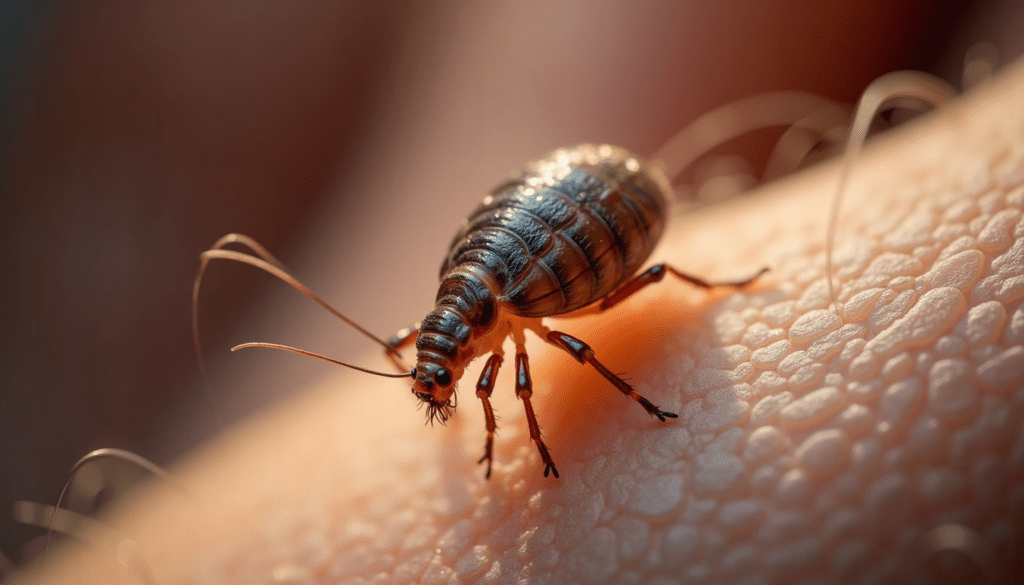
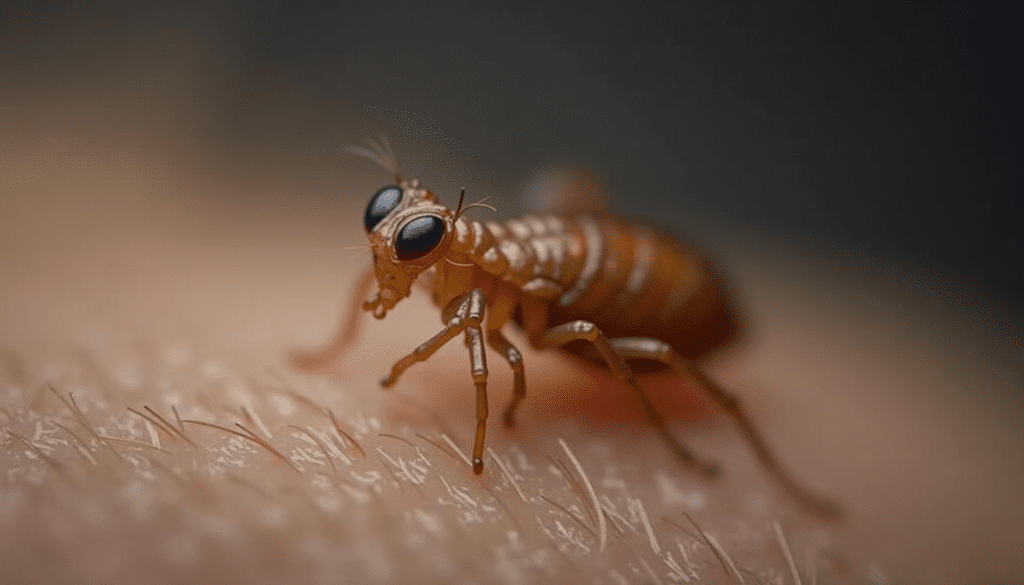
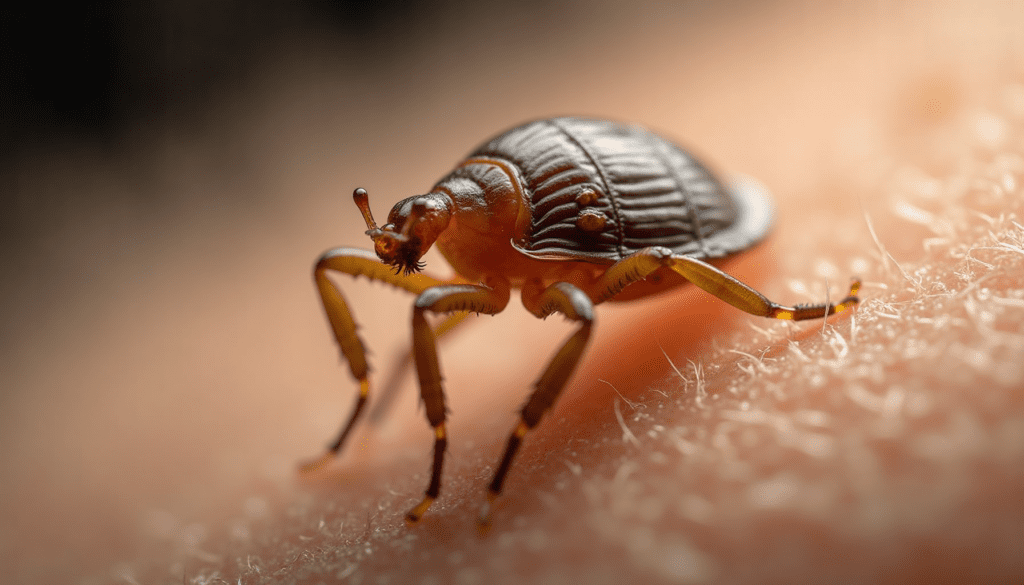
An adult head louse is about the size of a sesame seed, tan to grayish, flattened like a coin, with six clawed legs, and it crawls away fast when you part the hair. A nymph is the same insect at pinhead size. A nit is a smooth, sand-grain-sized oval glued to one side of a single hair, close to the scalp.
- Size anchors: Adult = sesame seed (about 1/8 inch). Nymph = pinhead. Nit = grain of sand.
- Where to look first: Behind the ears and along the neckline, parting hair down to the scalp under a bright light.
- The movement tell: Lice only crawl. Anything that jumps or flies off the head is not a louse.
Adult lice: a moving sesame seed
Start with the biggest form, usually the last one parents actually see. The University of Kentucky’s head lice ENTfact puts the adult at about 1/8 inch, comparable to a sesame seed, with a body flattened like a coin and six legs ending in claws built for gripping hair shafts. The color runs tan to grayish and slightly see-through, exactly the shade range of many scalps and light hair, and that camouflage is not an accident.
Two behaviors round out the picture. Adults feed on blood several times a day and stay close to the scalp to do it, so you will not find them wandering the outer inches of long hair. And they are quick: a parted section under bright light gives you a second or two before an adult scuttles into shade, which is why so many careful checks find eggs but never an insect. An adult can live up to 30 days on a head, but away from one it dies within a day or two.
If a speck the right size sits still indefinitely, be suspicious. Debris does not relocate. A louse does.
Nymphs: pinheads that are easy to miss
Between egg and adult is the stage almost nobody identifies on sight. A nymph looks like a scaled-down adult, the same flattened tan body and six legs, at roughly pinhead size. Nymphs mature into adults in about a week, so an active infestation carries a mix of sizes at any moment, from barely-visible specks to full sesame-seed adults.
Nymphs matter for one practical reason: they are the stage that shows up a few days after a treatment or combing session, hatched from eggs that survived the first pass. A tiny crawling speck on the comb a week later is not a new infestation from school; it is the second act of the old one, and it is why every serious protocol repeats the comb-out over two to three weeks. Our walkthrough of the head lice life cycle maps out those timings stage by stage.
Nits: sand-grain ovals cemented to the hair
Nits are what most parents actually find, and the trickiest to judge. A nit is a louse egg, and the UK ENTfact describes it as a tiny tan oval about the size of a grain of sand, glued firmly to one side of a hair shaft. The MedlinePlus head lice overview compares a nit to a dandruff flake in size, which is honest about why so many false alarms happen.
Three details separate a nit from everything else on a head. First, attachment: a nit is cemented in place and stays put when you brush or shake the hair, where a flake drifts away. Second, position on the strand: nits sit on one side of the hair, not wrapped around it, smooth and uniformly oval rather than flat or crumbly. Third, and most useful, distance from the scalp.
Female lice lay eggs close to the skin, where scalp warmth incubates them, so a fresh, viable egg sits near the root. Hair grows steadily, and an empty hatched shell rides outward with it, which means a whitish speck found well down the strand has usually been there for weeks and is more likely an old shell, or not a nit at all. Color follows the same logic: viable eggs lean tan to coffee-colored, hatched shells look whitish or clear. Pale specks two inches out tell a very different story than dark ovals hugging the skin at the neckline.
How color reads on different hair shades
The insect does not change, but what you can see changes with the hair it sits in. On blond and light brown hair, the tan-to-gray adults and tan nits are close to the background color, so the search leans on shape and grip rather than contrast: look for the smooth oval silhouette at a part line, and trust the slide test over your eyes. On dark hair, it flips. The adults disappear into shadow, but pale hatched shells stand out sharply against dark strands, which is why dark-haired kids are often flagged first by a teacher who spotted white specks.
Two tricks raise contrast on any hair shade. Work under the brightest light in the house, since a strong beam makes the glossy shell of a nit glint differently than a matte flake of skin. And check damp hair: wetting darkens hair a shade, makes strands lie flat and separable, and slows the adults down, which is the logic behind wet combing. Graying hair is the hardest case, since white shells vanish among white hairs; there, the fine-toothed comb over a white paper towel does the finding for you.
The movement test: crawling only, never jumping
Movement sorts lice from most of what parents mistake for them. Both MedlinePlus and the UK entomologists are flat on this: head lice cannot hop, jump, or fly. They crawl, and on a scalp they crawl fast.
That single fact settles several cases at once. Something that springs off your child’s head when you part the hair is a flea or another insect passenger, not a louse. Something with wings is not a louse. A speck that never moves at all, over minutes, under light, is glued product, skin, or an egg, but not an adult insect. The only way this test misleads is speed in the other direction: parents expect a slow bug, are startled by how quickly a louse vanishes into cover, and then doubt what they saw. If a sesame-seed speck moved away from the light on its own, believe your eyes.
Crawling is also why transmission is so head-to-head: lice cross when hair touches hair during play, sleepovers, and huddles over a phone, and only occasionally ride a shared brush or hat. Clean hair grips as well as any other, and pets play no role at all: animals do not carry or spread human head lice.
Lookalikes: dandruff, hair casts, and hairspray beads
Most “we found nits” moments are actually one of three impostors, sorted here by the two tests that matter, grip and position.
| What it is | How it sits on the hair | The giveaway |
|---|---|---|
| Nit (louse egg) | Smooth tan-to-white oval glued to one side of the shaft, usually near the scalp | Resists sliding; stays put when hair is shaken or brushed |
| Dandruff or dry scalp | Flat, irregular flake resting loosely on scalp or hair | Lifts off at a touch, drifts when you shake the hair |
| Hair cast | Thin white cylinder wrapped all the way around the shaft | Encircles the hair instead of sitting on one side, and slides freely along it |
| Product residue | Pale beads of dried gel, spray, or dry shampoo at random heights on the strand | Random distances from the scalp; crumbles or slides under a pinch; gone after a clarifying wash |
The pinch-and-slide test resolves nearly all of these in seconds: pinch the speck lightly and try to move it down the strand. Only a nit grips. If dandruff is your main suspect, our side-by-side on telling lice from dandruff goes deeper.

Where to look, and what to do next
Knowing the shapes only pays off if you look in the right places: the scalp itself, most often at the neckline and behind the ears, the warm, sheltered zones where eggs concentrate. The MedlinePlus encyclopedia’s checking method is worth copying: part the hair all the way down to the scalp in very small sections, work under a bright light, and use a magnifying glass if you have one.
A fine-toothed lice comb turns that from an eye test into a physical one, catching insects your eyes miss and dragging nits into view against the teeth. If tonight’s kitchen-light look raised your suspicion, the full step-by-step lives in our parents’ guide to checking for lice. That check is the real next step; this page only tells you what you are looking at once you find it.
Not head lice? Body and pubic lice look different
Three different lice live on humans, and appearance plus address separates them. Body lice are close cousins at a similar sesame-seed size, tan to grayish-white, but the MedlinePlus body lice entry notes they live in the seams and folds of clothing, visiting skin only to feed. Itching that concentrates where clothing presses, with nothing on the scalp, points that direction; our breakdown of body lice versus head lice covers both.
Pubic lice are the odd ones out visually. The MedlinePlus pubic lice entry describes the crab-like build that earned the nickname, a wider, rounder body than the elongated head louse, found in coarse body hair. A crab-shaped louse on a child’s eyelashes or eyebrows is a find to bring to a clinician, not the drugstore shelf.
If you found the real thing
First, breathe. Head lice are a nuisance, not a danger, and finding them says nothing about your home or your child’s hygiene.
The treatment logic is simple. Over-the-counter products are built on two active ingredient classes, permethrin 1% and pyrethrins, and the entire instruction is to follow the package label exactly, including its retreatment timing, since first applications often spare unhatched eggs. Mechanical removal is the backbone either way: a fine-toothed comb pass every two to three days until no live lice have appeared for about two weeks catches the nymphs that hatch after any treatment. Our head lice removal guide runs the sequence day by day.
Two honest caveats. Some lice populations resist the OTC ingredient classes, the so-called super lice problem, so correct treatment that still leaves live lice after two label-directed rounds is a signal to stop repeating it; a clinician can prescribe alternatives, and our explainer on super lice covers that conversation. Some situations skip the drugstore aisle entirely: children under two, pregnancy or nursing, scalps with open sores, spreading redness, crusting, or fever, and any genuine treatment failure all belong with a clinician or pharmacist. Home remedies like mayonnaise, tea tree, or coconut oil lack solid evidence in the medical and extension sources, and MedlinePlus warns never to use kerosene or gasoline, which are dangerous and flammable.
Common questions
Can you see head lice with the naked eye?
Yes, all three stages, though nymphs and nits sit at the edge of it. A magnifying glass and bright light make the difference between guessing and knowing, and a fine-toothed comb finds what eyes miss.
What color are lice eggs?
Viable nits run tan to coffee-colored; hatched, empty shells look whitish or clear. Because hair grows, the pale old shells end up farther from the scalp while fresh tan eggs sit close to the skin.
I found nits but no bugs. Do we actually have lice?
Maybe. Adults are fast and often escape notice, so nits alone are common in real infestations. Judge by position and color: tan ovals glued near the scalp suggest a current problem, while whitish specks far down the strand are likely old shells. A slow wet-comb check settles it.
Do lice look different on blond hair versus dark hair?
The lice are identical; the contrast changes. Tan insects and eggs blend into light hair, so rely on the slide test and shape. On dark hair, pale nits and shells stand out while the gray-tan adults hide. Bright light and damp hair improve the odds on every shade.
Can something that jumped off my child’s head be a louse?
No. Head lice can only crawl; a jumper is far more likely a flea. Fast crawling away from light, close to the scalp, is the louse signature.
Final verdict
Lice identification comes down to three anchors and two tests. The anchors: an adult is a tan, coin-flat sesame seed; a nymph is the same insect at pinhead size; a nit is a smooth sand-grain oval. The tests: real lice crawl fast and never jump, and real nits grip one side of a hair near the scalp and refuse to slide. Specks that lift away are dandruff, cylinders that encircle the strand are hair casts, and beads at random heights are yesterday’s styling product. If what you found matches the real thing, move straight to a methodical wet-comb check, and treat only what a careful look confirms.
This article is for information only and is not medical advice.
Pingback: Bugs That Look Like Lice: Nits, Dandruff and Impostors
Pingback: Tiny White Bugs in the House: What You Are Looking At