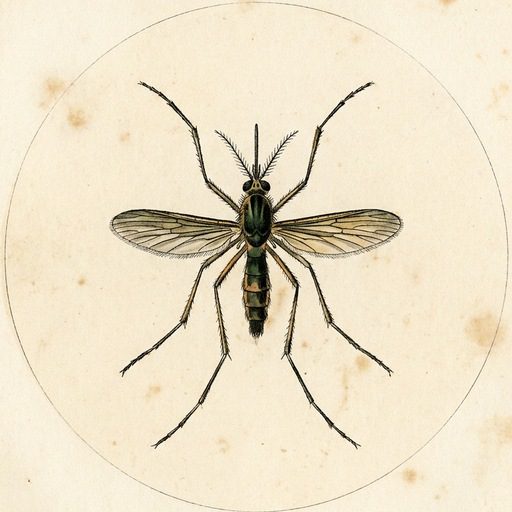
Some of these really are near-invisible arthropods: scabies mites, chigger larvae, bird mites and straw itch mites are all at or below the limit of what most people can see. Others feel identical and are not insects at all, including dry skin, folliculitis, contact reactions, nerve and medication effects. The distinction matters because the two groups need completely different help, and only a clinician can settle it.
- Intense itch, worse at night, in finger webs, wrists and waistline: ask a clinician about scabies. It is treatable and needs a prescription.
- Clustered welts after sitting on grass: chiggers, which drop off on their own within hours.
- Sensation with nothing visible and no rash: take it seriously and take it to a doctor, because many real medical causes feel exactly like this.

This is a difficult topic to write about honestly, because two things are true at once. There are genuine arthropods too small to see that cause exactly these symptoms, and there are also common medical conditions that produce an identical sensation with no insect involved at all. Being told either one is “all in your head” is unhelpful and often wrong. The sensation is real in both cases.
What follows is the honest list, in both directions.
The arthropods that really are too small to see
Scabies mites burrow into the outer layer of skin and are around a third of a millimetre, so they are effectively invisible. The CDC describes scabies as an infestation of the skin by a burrowing mite, causing intense itching, and MedlinePlus notes the characteristic pattern of itching that is often worse at night.
The pattern is what makes it identifiable without seeing anything: itching that is severe and worse at night, a rash concentrated in finger webs, wrists, elbows, armpits, waistline and around the belt line, sometimes with thin irregular burrow tracks. It spreads through prolonged skin to skin contact, so household members are often affected.
Scabies does not resolve on its own and does not respond to ordinary anti-itch products. It needs a prescription treatment, and household contacts are usually treated at the same time. If the description fits, this is the single most useful thing to raise with a doctor.
Chigger larvae are around a quarter of a millimetre and are picked up outdoors from grass, brush and woodland edges. They attach, feed for a few hours through a hardened feeding tube, and drop off. The itch peaks a day or two later, which is why people search after the insect has already gone.
The signature is location: clusters where clothing pressed against skin, around sock lines, waistbands and behind the knees. They do not burrow and do not lay eggs in skin, despite the persistent story. Our guides to chigger bites and whether they burrow, what chiggers actually are and how to treat the bites cover it.
Bird mites and rodent mites are real and genuinely cause this presentation. They live on birds or rodents, and when a nest in an eave, a soffit, a chimney or a loft is abandoned, the mites disperse into the building looking for a host. They cannot sustain themselves on people, so the problem is self-limiting once the nest is removed, but it can be miserable in the meantime. The clue is a nest, so it is worth checking eaves, vents and lofts. Our bird mite guide covers the identification and removal.
Straw itch mites come from stored grain, hay, straw and occasionally from insect-infested materials indoors. Exposure produces itchy welts, often on covered areas, and it resolves once the source is removed.

What it is almost certainly not
Dust mites do not bite. This is worth stating plainly because it is one of the most common misunderstandings in the whole subject. Kentucky’s factsheet on house dust mites is clear that they feed on shed skin and do not bite people. They cause allergic reactions, not bites. Our dust mite allergy guide and dust mites versus bed bugs cover the difference.
Bed bugs are visible. Adults are apple seed sized and leave dark spotting on mattress seams. An invisible biter is not a bed bug, though our inspection guide is worth ten minutes to rule it out.
Fleas are visible and jump. They also require an animal.
Springtails cannot bite and cannot live on a person, despite turning up in bathrooms in numbers.
The non-insect causes, which are common and real
If nothing can be found, and particularly if there is a sensation without a rash, these deserve serious consideration rather than dismissal.
Dry skin. By far the most common cause of persistent itching, especially in winter, in heated homes, and with age. It often produces a crawling sensation rather than a defined itch.
Folliculitis. Inflammation of hair follicles produces small itchy bumps that look convincingly like bites. MedlinePlus covers folliculitis and its causes, and it is a frequent explanation for what people photograph and send as insect bites.
Contact dermatitis. New detergent, fabric softener, a new fabric, a cosmetic, or residue from a cleaning product. The pattern often follows where the material touches.
Fibreglass and mineral wool. Loft insulation, new construction and DIY work leave fine particles that cause an intense crawling itch that is very hard to distinguish from insects.
Medication effects, nerve conditions and other medical causes. Several medications, thyroid conditions, iron deficiency, liver and kidney conditions, diabetes and nerve conditions all cause itching or crawling sensations. Some are straightforward to test for. This is a real reason to see a doctor rather than a pest controller.
Carpet beetle contact. Worth naming because it sits between the two categories: the larval bristles genuinely irritate skin, producing bumps that are not bites and come from an insect nobody sees on themselves. Our guide to carpet beetle rashes covers it, and if there is fabric damage in the house, our carpet identification guide is worth checking.

What to actually do
Stop hunting and start recording. A note of when the sensation occurs, where on the body, what you had been doing and what is nearby is worth more to a clinician than any amount of searching. Patterns emerge that are invisible day to day.
Collect anything you find, properly. Clear tape on a sheet of white paper, or a sealed bag. Do not scrape skin, and do not use household chemicals on skin to try to kill something.
Check the building once. Eaves, soffits, loft and chimney for an abandoned bird or rodent nest, which is the one environmental cause that genuinely produces this and is genuinely fixable.
See a clinician, and lead with the pattern rather than the conclusion. Describing where and when it itches, and what the skin looks like, gets further than naming a suspected insect. Scabies in particular is common, treatable, and frequently missed for months.
Be careful with what you apply. Repeated treatment of skin with insecticidal or household products causes irritation that makes everything harder to interpret, and can itself become the cause.
Common questions
Nobody believes me.
The sensation is real regardless of the cause, and there is a long list of genuine medical explanations for it. That is the case to make to a doctor: not that there are definitely insects, but that something is causing this and it is worth investigating.
Can I see mites with a phone camera?
Scabies mites, no, they are too small and inside the skin. Chiggers, only just, and usually after they have already dropped off. Absence of a photograph proves nothing either way.
Should I call a pest controller?
Only if there is evidence in the building, such as a nest, or visible insects. A pest controller cannot diagnose a skin condition, and treating a house with no infestation adds chemical exposure without addressing anything.
Final verdict
Some of these are real and invisible. Scabies is the one to raise with a doctor first, because the pattern is recognisable, it does not resolve on its own, and it is straightforwardly treatable. Chiggers explain clustered welts after time outdoors, and bird mites explain a sudden onset with a nest somewhere in the structure. If none of those fit and nothing can be found, the non-insect causes are common, genuine, and worth investigating properly rather than being dismissed. In either direction the next step is the same: write down the pattern and take it to a clinician.