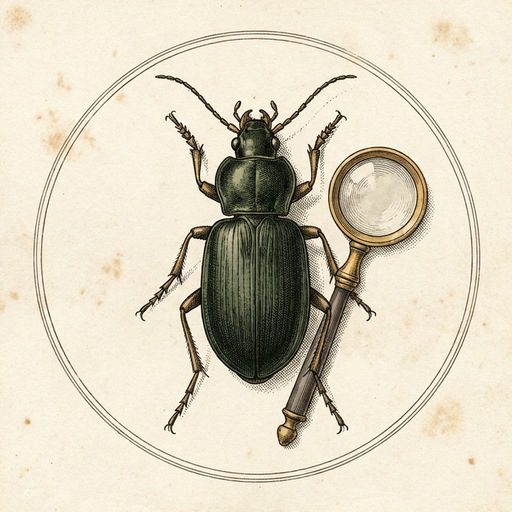
A hard glossy shell almost always means beetle, and gloss narrows things faster than colour because most household insects are matte. Ground beetles are the common indoor answer, spider beetles the one that gets mistaken for a spider, and iridescent green or blue means something that came in from the garden and will not stay.
- Glossy black, fast, running along a wall at night: ground beetle, in from outside under a door.
- Round, shiny, long-legged, in a dark corner: spider beetle, pointing at a forgotten food source.
- Iridescent green, blue or bronze: a garden insect that blundered in. Open a window.
Shine is a better clue than most people give it credit for, because the insects people fear are not shiny. Bed bugs are matte and leathery. Cockroach nymphs are dull. Carpet beetle larvae are bristly. A hard reflective surface points at a beetle, and beetles indoors are mostly harmless.
Why gloss narrows it
A beetle’s forewings are hardened into cases that meet in a straight seam down the back, and in many species that surface is smooth and reflective. Nothing soft-bodied achieves it.
Look for the seam. Two halves meeting in a line down the middle confirms beetle and eliminates the things people are actually worried about. Our guide to hard-shelled bugs covers the wider group and sorts them by where you found them.
Ground beetles, the usual answer
Dark, often intensely glossy black, five to twenty millimetres, and they run in determined straight lines along a wall rather than wandering. They are nocturnal predators that hunt in gardens and come indoors by mistake, usually under a door, and usually in numbers after heavy rain.
They feed on nothing in a house, do not breed indoors, and do not damage anything. A large one can pinch if handled and does no harm.
This is a perimeter question rather than a pest one. A door sweep, a sealed threshold and less leaf litter against the wall end it. Our guide to fast crawling bugs covers the behaviour that identifies them, and the autumn pest proofing guide covers the sealing work.
Spider beetles, the round shiny one
Two to four millimetres, round, glossy, dark reddish brown, with long legs and long antennae held forward. At a glance in poor light they read as a small fat spider, which is where the name comes from.
They are scavengers on dried organic material: old grain, dried fruit, spilled pet food, dead insects, accumulated debris in a loft or under floorboards. Harmless, and they do not bite.
Their value is as an indicator. A spider beetle usually means an undisturbed food source somewhere nobody has looked, and Kentucky’s point about stored product infestations tracing to a single item applies even when that item is not in a kitchen. Our guide to spider look-alikes covers the confusion and the pantry pest guide covers the search method.
The iridescent ones, which are all outdoor
If the colour is genuinely metallic green, blue, bronze or copper rather than glossy black, it came in from the garden.
Japanese beetles and other chafers are metallic green and bronze, feed on foliage outdoors, and blunder indoors through open windows in early summer. Our garden pest identification guide covers the ones that matter to plants.
Cuckoo wasps are brilliant metallic green or blue, small, and among the more striking things a person will find on a windowsill. They are parasitic on other wasps and bees, cannot sting people meaningfully, and are entirely harmless.
Flea beetles are small, shiny, often metallic, and jump strongly when disturbed. They live on plants, and their damage is distinctive: many small round holes as though a leaf had been peppered with shot. Our guide to bugs that jump covers them alongside the other jumpers.
Carpenter bees are large, and the abdomen is shiny black and hairless rather than fuzzy, which is the check that separates them from bumblebees. They bore into unpainted timber to nest. Kentucky’s guidance on carpenter bees covers the damage question, and our carpenter bee versus bumblebee guide covers what to do about a nest hole.
The shiny ones that are not beetles
Cockroaches are glossy rather than metallic, and the large outdoor species in particular have a distinct sheen. The behaviour separates them instantly: they scatter for cover the moment a light comes on. Our species guide covers the difference between a wanderer and a breeding population.
Carpet beetle adults are shiny but small and mottled rather than uniform, and Kentucky notes that the larvae feed on wool, fur and feathers, which is why finding one on a sill is a prompt to search a wardrobe. Our identification guide covers them.
Ants are semi-glossy and unmistakable once you see the pinched waist and elbowed antennae. Our guide to ant look-alikes covers the checks, including the termite comparison that is worth getting right.

What to do
For almost everything on this page, very little.
Ground beetles, chafers and cuckoo wasps need a door sweep, a window screen, and nothing else. They cannot establish indoors.
Spider beetles need the source found. Loft, shed, back of a cupboard, under a floor.
Carpet beetles need the wool or feather source found, which is the only item on this list that involves actual damage to your things.
Nothing here needs spraying. A residual treatment against insects that arrive nightly from outside treats the wrong side of the wall.
Common questions
It is very shiny and very fast. Cockroach?
Check the light response. A cockroach heads for a crack immediately. A ground beetle keeps running along its line and ignores you.
Metallic green, quite large, in early summer.
Almost certainly a chafer that came in through an open window. Let it out.
They keep appearing after rain.
Classic ground beetle behaviour. Their outdoor habitat floods and they move to the nearest dry shelter, which is the gap under your door.
Final verdict
Look for the seam and then for the colour. Glossy black and running purposefully along a wall is a ground beetle that came in under the door and will die there. Round and shiny with long legs is a spider beetle pointing at a food source somebody forgot. Genuinely metallic green or blue is a garden insect that took a wrong turn. And matte rather than shiny takes you off this page entirely and toward the things people are usually worried about.