
Four things move fast enough indoors to be described as running. House centipedes are the fastest and look the worst. Cockroach nymphs run for cover the instant a light comes on. Silverfish wriggle from side to side. Ground beetles blunder in from outside and head for a wall. Only the cockroach means you have a problem that will grow.
- Many long legs, appears to flow across a wall: house centipede. Harmless, and hunting other insects.
- Runs for a gap the second the light goes on: cockroach nymph. Act now rather than later.
- Fish-like wriggle along a skirting board: silverfish. A damp and starch problem.
Speed is underrated as a clue. Most people try to identify an insect from a shape they barely saw, when the way it moved is often more distinctive and easier to remember. These four move in genuinely different ways.
House centipedes, the ones that flow
If something crossed a wall or a bathroom floor with what looked like far too many legs and a rippling, flowing motion, this is a house centipede. They have fifteen pairs of very long legs, a body two to four centimetres long, and they are among the fastest things you will see indoors.
They frighten people badly and deserve none of it. They are predators, and what they are hunting is everything else on this page: cockroach nymphs, silverfish, spiders, ants and flies. A house centipede is a sign that there is enough prey to sustain one, which is the more useful piece of information.
They can bite defensively if handled, which is uncommon and comparable to a bee sting at worst, and they do no damage to a building. Our house centipede guide covers the risk honestly, centipedes versus millipedes covers the confusion with the slow coiling relative, and if you want them out, the removal guide starts with reducing what they eat.
Cockroach nymphs, the one that matters
This is the sighting to take seriously, and it is regularly dismissed because a young cockroach does not look like the pictures. German cockroach nymphs are small, brown, wingless and extremely fast.
The behaviour is diagnostic and nothing else on this page does it: they run for cover the moment a light comes on, heading for a gap, a crack or the underside of something rather than out across open floor. Adults do the same. If you flick a kitchen light at night and something scatters, this is almost certainly what you saw.
UC IPM notes that cockroaches are most active at night and hide in cracks and crevices during the day, and Kentucky is direct that German cockroaches are the species most likely to infest homes and apartments and that populations grow quickly.
Early action genuinely changes the outcome here. Our baby cockroach identification guide shows the stages so you can be sure, and the cockroach species guide matters because a large outdoor species that wandered in through a drain is a far smaller problem than a German cockroach breeding behind a fridge. What attracts cockroaches covers the conditions worth removing.
Silverfish, which wriggle rather than run
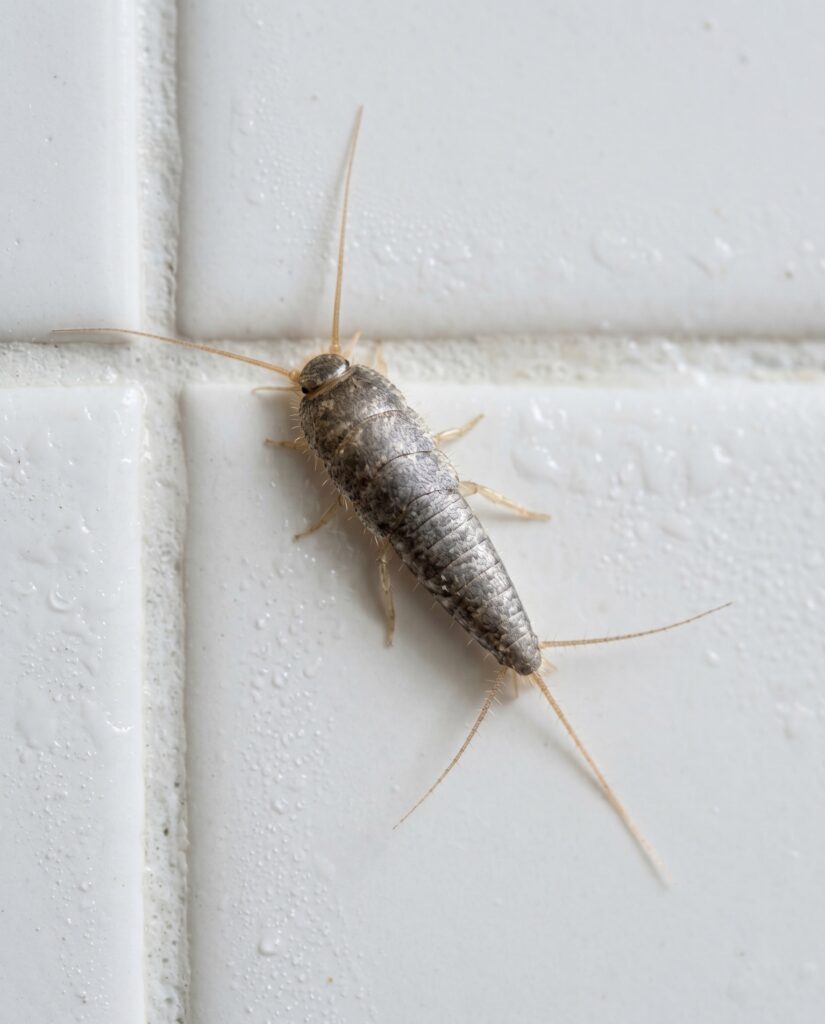
Silverfish move quickly but differently: a side-to-side wriggle, close to the surface, usually along a skirting board or stranded in a bath or basin where the smooth sides defeated them. They are ten to fifteen millimetres, tapered, covered in silvery scales, with long antennae and three tail filaments.
They eat starch and polysaccharides, which means paper, book bindings, wallpaper paste, cardboard and dried food residue. They need humidity and they are long-lived and slow to breed, so populations build over months rather than weeks.
They do not bite and carry no disease. Our silverfish identification guide covers the biology, whether silverfish bite answers the usual worry, and what attracts silverfish covers the damp and stored paper that sustains them. There is also a near-identical relative that prefers hot dry places such as airing cupboards, covered in silverfish versus firebrats.
Ground beetles, the accidental visitors
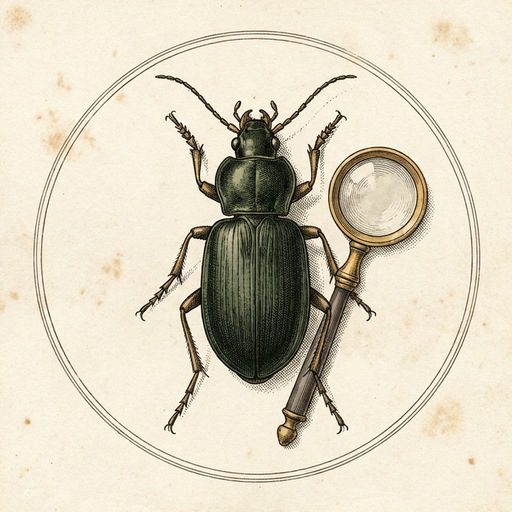
Ground beetles are dark, hard-shelled, often shiny black, and they run in straight determined lines, usually along a wall, having come in under a door. They are outdoor predators that hunt at night and end up indoors by mistake, often in numbers after rain.
They do not feed on anything in a house, do not breed indoors, and do not bite in any meaningful way. Finding one is a perimeter question: a door without a sweep, a gap at a threshold, or exterior lighting drawing insects to the doorstep at night. Our guide to autumn pest proofing covers the sealing work, which handles this whole category at once.
What speed rules out
Bed bugs are not fast. They crawl steadily and do not dart. Anything that ran across a floor is not a bed bug, which is often the reassurance people are looking for. If the bed is the real concern, our inspection guide is the page.
Carpet beetle larvae are not fast. They creep and curl. Our carpet beetle guide covers them.
Fleas do not run, they jump. A flea vanishes rather than travels, and our flea bites guide is the right page if there is an animal in the house.

Common questions
It ran up the wall. Does that narrow it?
Vertical surfaces suit house centipedes and cockroaches well and silverfish and ground beetles poorly. A fast climber with visible long legs is almost always a house centipede.
Only ever at night. Is that meaningful?
All four are nocturnal, so it narrows nothing on its own. What matters is what happened when the light came on: scattering for cover points strongly at cockroaches.
Should I kill a house centipede?
That is a preference rather than a pest control decision. It is eating things you like less. If they are numerous, that is the signal worth acting on, because it means the prey population is large.
Final verdict
Watch how it moved rather than what it looked like. Flowing across a wall with many long legs is a house centipede, and it is on your side. Scattering for a gap when the light came on is a cockroach nymph, and that is the one to act on this week rather than next month. A side-to-side wriggle along a skirting board is a silverfish and a damp reading. A dark beetle running the length of a wall came in under a door and needs nothing but a door sweep.
Pingback: Bugs Attracted to Light at Night: Why and What to Do