Long and thin covers five very different animals, and two checks separate them: how many legs, and what is at the back end. Six legs and three tail filaments is a silverfish. Six legs and pincers is an earwig. Many legs moving fast is a centipede. Many legs moving slowly is a millipede. Six legs and a short wing case over a long body is a rove beetle.
- Silver scales, wriggles like a fish, three tails: silverfish, and a damp reading.
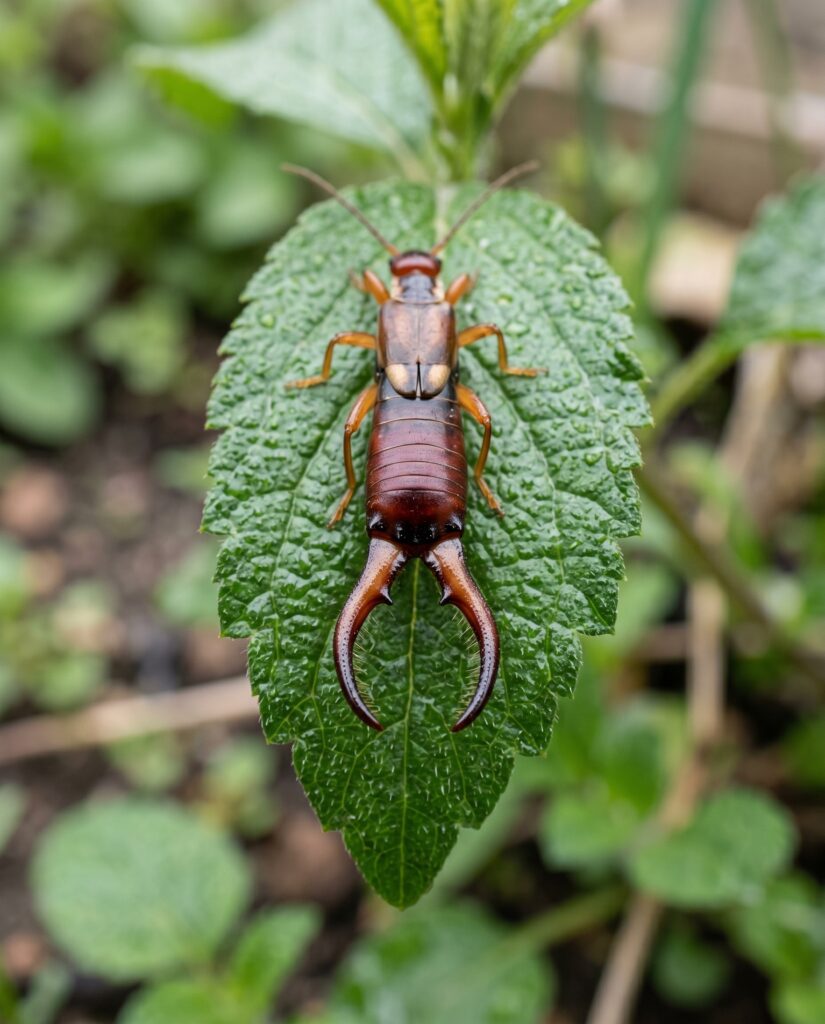
- Visible pincers at the rear: earwig, which came in from outside and cannot hurt you.
- Very fast, very many legs, on a wall: house centipede, which is hunting the others.
Shape is a weaker clue than most people expect, because elongation solves the same problem for several unrelated animals: getting into narrow gaps. The useful details are at the two ends, and both are visible without magnification.
The two checks
Count the legs, roughly. Six means an insect. More than about fifteen pairs means a centipede or a millipede, and they are worth separating from each other. Eight means an arachnid, which puts you in different territory.
Look at the back end. Three thin tail filaments means silverfish or firebrat. A pair of hard curved pincers means earwig. Nothing distinctive means beetle or centipede.
| Legs and tail | What it is | Behaviour |
|---|---|---|
| Six legs, three tail filaments, silver scales | Silverfish or firebrat | Side-to-side wriggle, low along a skirting |
| Six legs, rear pincers | Earwig | Often still, hides in tight gaps |
| Many legs, very fast | House centipede | Flows across walls, one pair per segment |
| Many legs, slow, coils flat | Millipede | Two pairs per segment, rippling motion |
| Six legs, short wing cases, tail curls up | Rove beetle | Runs fast, may raise its abdomen |
Silverfish and firebrats
Ten to fifteen millimetres, tapered from head to tail, covered in silver-grey scales, with long antennae and three tail filaments. The movement is unmistakable once you have seen it: a rapid side-to-side wriggle, close to the surface.
They eat starch and polysaccharides: paper, book bindings, wallpaper paste, cardboard, dried food residue. They need humidity, are slow to mature and long-lived, so a population builds quietly over months rather than exploding.
The classic sighting is one stranded in a bath or basin, because the smooth sides defeat them. That is not evidence of drains: they fell in while foraging. Our silverfish guide covers the biology and the firebrat comparison covers the near-identical relative, which prefers hot dry places such as airing cupboards and boiler rooms rather than damp ones.
They do not bite, which our guide to whether silverfish are harmful covers.
Earwigs
Ten to fifteen millimetres, dark reddish brown, with a pair of curved pincers at the rear that look considerably more dangerous than they are. They can pinch if handled and it does not break skin.
They are outdoor insects that shelter in tight damp gaps, and they come indoors through door thresholds, under siding and around window frames, usually in numbers after wet weather. They do not breed indoors, do not damage buildings and do not feed on anything in a house.
Our earwig identification guide covers the species, the ear myth deals with the story everyone has heard, and whether they help or hurt a garden covers the more interesting question, which is that they eat aphids as well as seedlings.
Centipedes and millipedes
The distinction matters because one is a predator and one is a decomposer.
Centipedes have one pair of legs per body segment, move fast, and hunt. The house centipede is the one people meet indoors: fifteen pairs of very long legs, a body two to four centimetres, and a rippling motion across a wall that unsettles people badly. It is hunting cockroach nymphs, silverfish, spiders and flies, which makes it useful. It can bite defensively if handled, comparable to a bee sting at worst.
Millipedes have two pairs per segment, move slowly, coil flat into a spiral when disturbed, and eat decaying plant matter. They cannot survive indoors and turn up in autumn migrations along the base of a wall.
Our centipede versus millipede guide covers the pair, the house centipede guide covers the risk honestly, and the guide to bugs that curl covers the millipede alongside pill bugs, which Kentucky groups as crustaceans requiring moist conditions to survive.
Rove beetles, the one nobody names
Elongated, dark, with wing cases that cover only the front part of the body so the abdomen is exposed and looks segmented. They run quickly and some raise the tail end like a scorpion when disturbed, which is a bluff.
They are predators of other small invertebrates, come in from gardens and compost, and do not feed on anything indoors. Finding one is a perimeter question. Our garden pest identification guide covers the outdoor context.

The common thread
Four of the five are moisture-linked, and none of the five breeds indoors in a dry house. UC IPM makes the same point about springtails, which turn up alongside them: these are harmless organisms whose presence indicates excess moisture.
So the productive work is the same regardless of which one you have: find the damp, pull mulch and leaf litter back from the wall, fit a door sweep, and ventilate the room that never dries. Our guides to bathroom insects and the cupboard under a sink cover the two rooms where this list concentrates.
Common questions
It was in the bath. Did it come up the drain?
Almost certainly not. A working trap holds water and blocks that route. It fell in and could not climb out.
Which of these bite?
Only the centipede, defensively, if handled, and it is uncommon. Silverfish, earwigs, millipedes and rove beetles do not bite people.
They keep coming back after I spray.
Because the population is outdoors or in a damp cavity, and spraying a surface treats neither. The perimeter and the humidity are the levers.
Final verdict
Two checks finish this. Six legs with three tail filaments and a fish-like wriggle is a silverfish, and it is telling you about damp and stored paper. Six legs with pincers is an earwig that came in under a door. Many legs moving fast is a house centipede eating the rest of the list. Many legs moving slowly and coiling flat is a millipede that will be dead by morning. And a long body with short wing cases is a rove beetle that wandered in from the garden.