Cockroach droppings look like coarsely ground black pepper, and up close they have blunt ends and ridges running along the sides rather than a smooth surface. Under 1 mm means German cockroach; 2 to 3 mm cylinders mean one of the larger species. They collect where the insect rests rather than where it feeds, so a concentration of specks points at a harbourage within a few feet, usually somewhere warm, dark and rarely disturbed.
- Ridged sides, blunt ends. People expect smooth grains and that expectation misleads them.
- The specks mark the harbourage, not the food. Search outward from the heaviest deposit.
- Wipe damp, never sweep dry. Dried droppings are a recognised indoor allergen.
Cockroach droppings are one of the more useful findings in a kitchen, because they are produced constantly, they accumulate where the insect actually lives, and they are difficult to confuse with anything else once you know what to look at. The confusion that does happen is with coffee grounds, black pepper, mouse droppings and ordinary drawer grit, and each of those is separable.
What they actually look like
At the scale most people see them, they are small dark specks. Under magnification, which a phone camera provides adequately, three features show.
Blunt ends. Not tapered, not pointed. This is the first thing that separates them from mouse droppings, which come to a point at one or both ends.
Ridges along the length. The sides are longitudinally ridged, giving a faceted rather than a smooth appearance. This is the most diagnostic feature and the one people do not expect.
Consistent size within a deposit. As with all droppings, uniformity is what distinguishes them from debris.
Colour is dark brown to black, and they darken as they dry.
Size names the species
| Size | Appearance | Species |
|---|---|---|
| under 1 mm | ground pepper, almost dust | German cockroach |
| 2 to 3 mm | small ridged cylinders | American, Oriental, smokybrown |
That distinction is worth making because the two groups behave differently. German cockroaches are indoor specialists, breed fast, and live in kitchens and bathrooms in tight numbers. The larger species more often come in from outside, from drains, or from a basement, and their presence indoors can be a smaller problem than it looks. UC IPM’s guide to cockroaches around the home covers the species differences that follow from that.
If the specks are on the larger side and you are also finding an oval, purse-shaped capsule, that is an egg case, and what cockroach eggs look like covers what it means about the population.
What is not cockroach droppings
Mouse droppings are far larger, 3 to 7 mm, and taper. If there is any doubt on size, a ruler removes it. See the droppings identification chart for the full size ladder.
Coffee grounds are irregular in size and shape and crumble differently under a fingernail.
Mouse or rat urine staining is not granular at all.
Ordinary black grit in a drawer joint or along a skirting board is the commonest false alarm on this subject. It varies in size, which droppings do not. Tiny black specks and what they turn out to be covers the wider set of candidates.
Where they are tells you where to look
This is the practical value of the finding. Cockroaches defecate where they rest, and they rest in aggregations, so the deposit is a map.
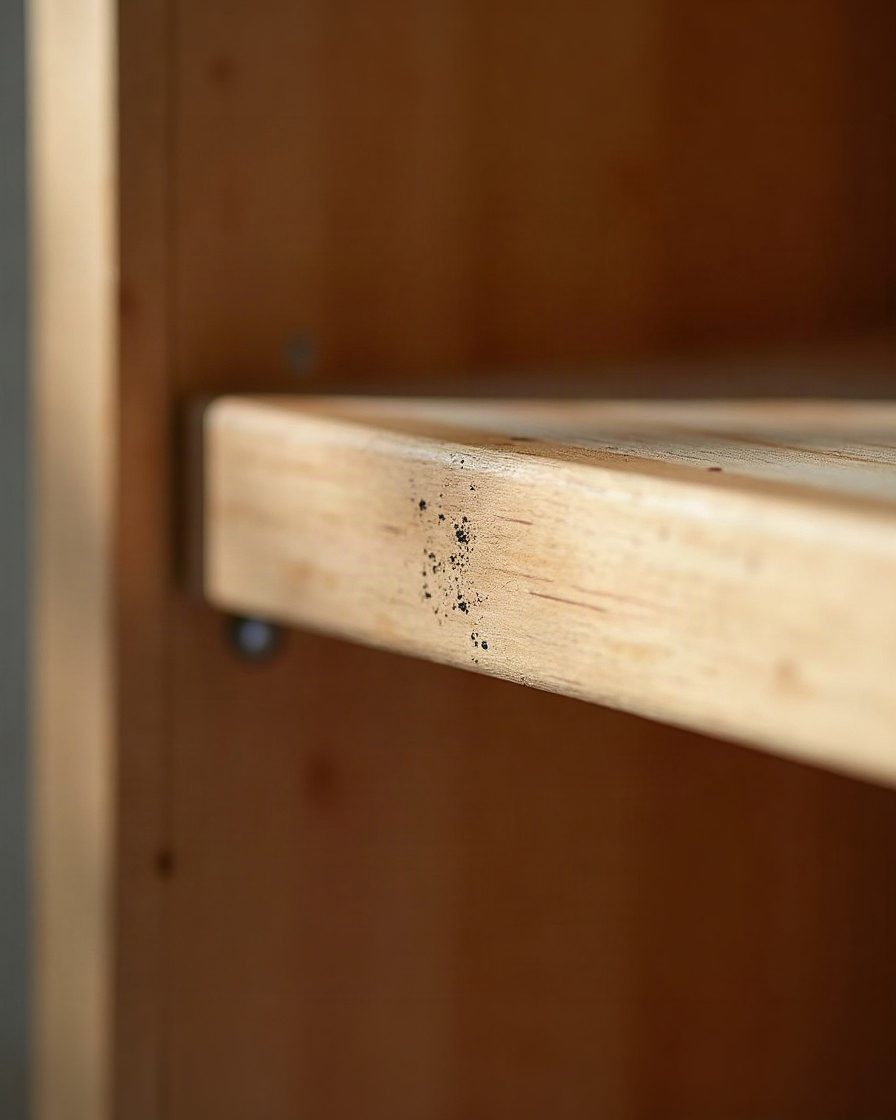
Heaviest concentrations sit in warm, dark, enclosed places within a short distance of water and food. In practice: the gap behind and beneath a fridge, the motor housing of any appliance, the underside of a sink cabinet, hinge recesses and the corners of cupboard shelves, the void behind a kickboard, and the space around pipe penetrations.
A smear or a dark staining rather than discrete specks indicates a heavily used harbourage and usually a longer-established population.
Two pages cover the search itself: what lives behind the fridge and under the kitchen sink. Both are the places this evidence sends you.
The health point, stated plainly
Cockroach droppings, shed skins and body fragments contain proteins that are a well-documented indoor allergen and a recognised asthma trigger, particularly for children in multi-unit housing. The CDC’s page on cockroaches and health sets out the association.
The practical consequence is narrow but real: do not dry-sweep or dry-vacuum an accumulation, because that is what puts the particles into the air. Dampen the surface, wipe with a disposable cloth, bag it, and wash your hands. A vacuum with a sealed HEPA filter is acceptable; a brush and dustpan is not.

Reading the age of a deposit
Fresh droppings are dark, slightly moist and shiny. They dry within a day or two to a dull matt black and become brittle. A deposit that is uniformly dull and dusty, with nothing new appearing, may be historic.
The clean-and-wait test is decisive and free. Wipe an area completely clean, note the date, check in three days. New specks mean current activity and a harbourage nearby. Nothing new over a week is a different and much smaller problem.
Common questions
How many cockroaches does this represent? Not calculable from droppings. A single German cockroach produces a great many, so quantity is a poor guide to population. The presence of droppings in several separate locations is a better indicator of a spread population than a single heavy deposit.
Do they smell? A heavy, established German cockroach population produces a distinctive musty, faintly oily smell. A few droppings do not.
They are on a shelf but the food is sealed. That is normal and does not mean the food is safe to ignore. Cockroaches feed on residue, spillage and grease as readily as on stored food, so the shelf itself is the meal.
Can I identify the species from droppings alone? Only to the size group, not to the species. Size separates German from the larger cockroaches reliably; it will not separate American from Oriental.
The bottom line
Ridged sides and blunt ends identify them, size sorts them into two groups, and location points at the harbourage. Then treat the deposit as an allergen rather than as dirt: dampen it, wipe it, bag it. And before doing anything else, clean one area completely and look again in three days, because that single test separates an active infestation from the traces of an old one.