If a patch of dust appears to be moving, it usually is. Three things explain almost every case: mould mites, which are so small that only the mass movement is visible; carpet beetle larvae, which collect lint and look like it; and booklice on damp surfaces. All three mean the same thing, which is that something is holding moisture.
- A patch that shimmers or creeps as a whole: mould mites, and there is mould feeding them.
- A piece of fluff that moves on its own: a carpet beetle larva wearing lint and shed skins.
- Slow pale specks on damp plaster or paper: booklice, harmless and a humidity reading.
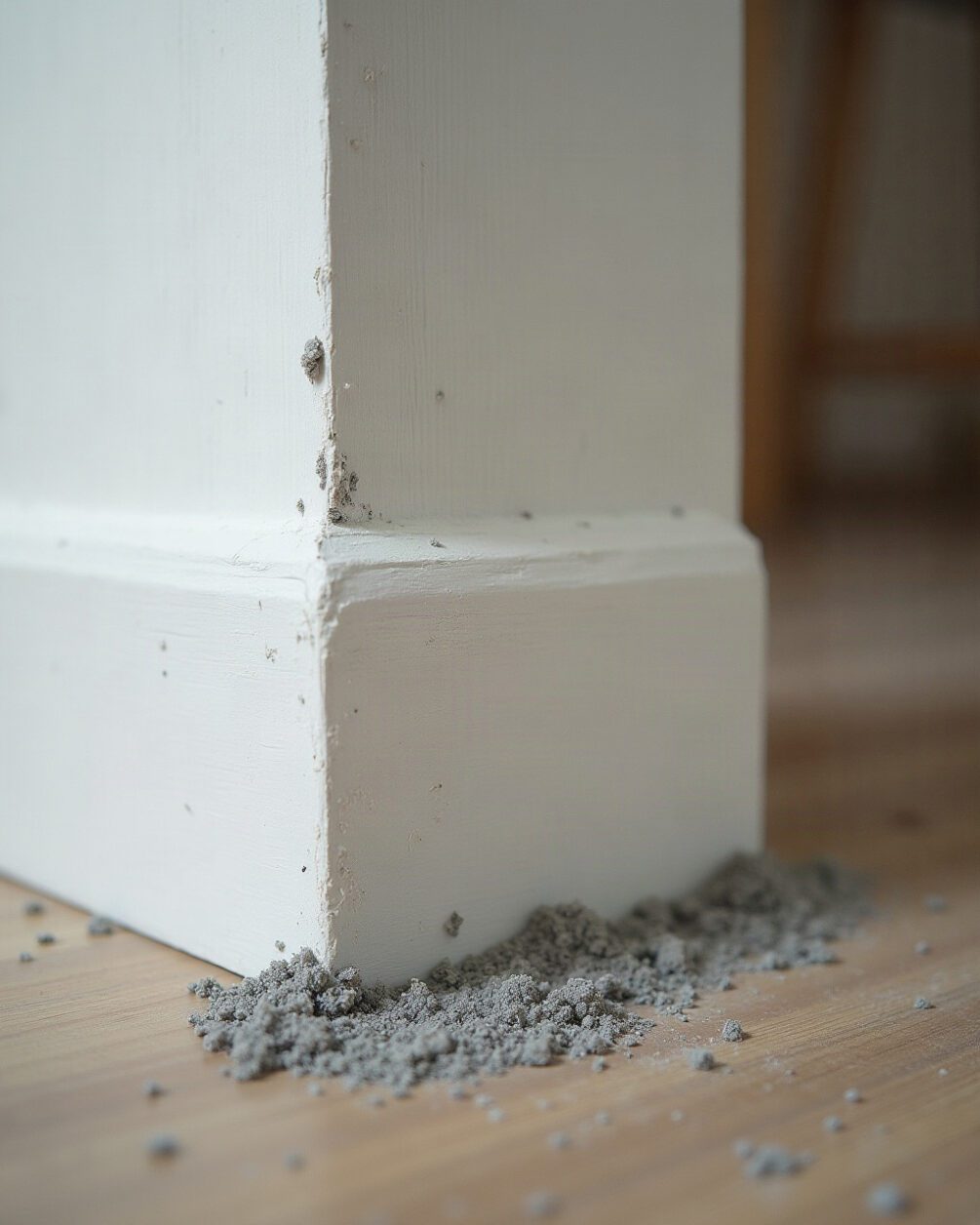
This is one of the more unsettling things to notice in a house, partly because the first reaction is to doubt your own eyes. It is worth saying plainly that the observation is usually correct: dust does not move on its own, and at a certain size a population is more visible than an individual.
The test
Tip a pinch onto a sheet of white paper, put it in good light, and photograph it with a phone in macro mode.
Moving dust resolves into individuals at that magnification, usually pale and rounded, and the movement becomes clearly directional rather than a shimmer.
Lint that moves resolves into a bristly larva dragging fibre with it.
Real dust stays still, and looks like fibre, hair and mineral fragments rather than anything with a shape repeated across the sample.
Mould mites, the shimmering patch
Mould mites are around a fifth to a half of a millimetre, pale, soft, and they occur in large numbers on anything with visible mould growth: damp plaster in a new or repaired building, food that has been forgotten, the surface of stored packaging in a humid cupboard, and around leaks.
At that size no individual is visible, so what you see is the patch behaving like a surface that is very slowly flowing. People describe it as dust that shimmers, or grey powder that has spread since yesterday.
They are harmless to touch and do not bite. Large populations can trigger reactions in people with allergies, in the same way dust mites do, and Kentucky notes that house dust mites are microscopic and do not bite, which is the useful comparison: neither of these is an insect that attacks you, and both are managed by humidity and cleaning rather than by pest control. Our dust mite allergy guide covers the approach.
The mould is the actual finding. Mites cannot live without it, so the question is what got wet.
Carpet beetle larvae, the lint that walks
This is the one people find genuinely eerie, because the thing that moves looks exactly like a fragment of fluff.
Carpet beetle larvae are bristly and slow, and they accumulate fibre, dust and their own shed skins around themselves as they feed. In a corner behind a door, under a bed or along a skirting board, the result is a small grey mass that is mostly lint with a larva inside it.
Kentucky notes the larvae feed on wool, felt, fur, feathers and other animal products, so the lint is not incidental: it is where they are living and often what they are eating. The shed skins are the giveaway, bristly empty husks that hold the shape of the larva and usually outnumber the live ones.
Our carpet beetle identification guide covers the species and the carpet guide covers where they concentrate, which is edges rather than open floor.

Booklice, the slow pale specks
Under two millimetres, pale grey to translucent, soft and slow. They turn up on damp plaster, the back of wallpaper, old paper, cardboard, and the surface of packaging in a humid cupboard.
Despite the name they are unrelated to head lice and cannot live on a person. They eat the microscopic mould growing on damp surfaces, which puts them in the same category as the mites: a reading rather than a problem. Our guide to tiny white bugs covers them, and Penn State’s description of springtails feeding on mould in moist conditions applies to the same family of causes.
A new build or a recently repaired room filling with these over a few weeks is a drying building, and it resolves on its own.
When it really is dust
A fair share of these observations end here, and there are two honest explanations worth knowing.
Air movement. A patch of fine dust on a smooth surface near a vent, a door gap or a radiator convection current genuinely does move, in a drifting rather than a creeping way. The test is whether it moves when the air is still.
Static. Fine fibres on plastic or a screen shift with static charge, which looks alive and is not.
And a third that is worth naming because it causes real distress: a persistent sensation of things moving on skin, with nothing found. That has a long list of genuine non-insect causes and deserves a proper look rather than more searching. Our guide to tiny bugs on skin you cannot see covers both the real arthropods and the honest alternatives, and says clearly when the right step is a clinician rather than a pest controller.

What to do
The three living explanations share one cause, so they share one fix.
Find the moisture. A leak, a cold wall behind furniture, a bathroom that does not vent, an overwatered plant, a cupboard with a weeping pipe. Our under-sink guide covers the most common hidden one.
Remove the mould rather than the mites. Killing a generation of mites on a mouldy surface achieves nothing, because the food source is untouched.
Vacuum the edges for carpet beetles, and find the wool or feather source they are working on. Along skirting boards, under heavy furniture, in wardrobes and inside anything stored.
Do not spray. None of the three responds to it usefully, and two of them are not insects in the sense a household insecticide is designed for.
Common questions
Can mould mites bite?
No. Skin irritation in a room with a mould problem is far more often a reaction to the mould, or to dryness, than to anything biting.
It is on my food packaging. Is the food ruined?
Mites on the outside of packaging usually mean the cupboard is humid rather than that the contents are infested. Check inside the packets, because pantry beetles and meal moths are a different problem living in the same cupboard, and our cupboard guide covers that search.
It came back a week after cleaning.
Then the damp is still there. Every explanation on this page regenerates from moisture, and cleaning removes only what is currently visible.
Final verdict
Trust the observation and then test it: a pinch on white paper under a phone macro resolves the question in a minute. A shimmering patch is mould mites and the finding is the mould. A fragment of fluff that walks is a carpet beetle larva and the finding is the wool it is eating. Slow pale specks on damp plaster are booklice and the finding is the humidity. In all three cases the insect is the symptom, and drying the place out is the treatment.