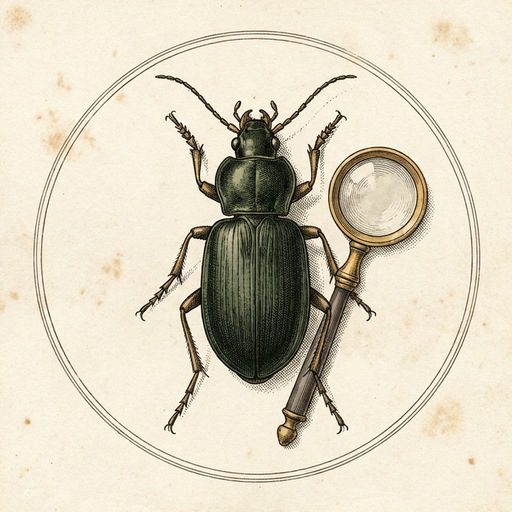
Brown is the least useful colour in insect identification, because most household insects are some shade of it. What actually narrows it down is the combination of where you found it, its size, and whether it was in food, in fabric, or just passing through. Four groups cover almost every case: pantry beetles and weevils, carpet beetle adults, cockroach nymphs, and bed bugs.
- Found inside a food packet: a pantry beetle or a weevil. The packet is both the diagnosis and the solution.
- Flat, broad, near where you sleep: treat as a possible bed bug and check the mattress seams before anything else.
- Fast, glossy, running from light in a kitchen: a cockroach nymph, which is small and brown before it is large and dark.

Search for a small brown bug and you get a wall of species, because brown is where most household insects live. The way through is not a better photograph. It is answering three questions about the circumstances, which between them eliminate most of the list.
The three questions that do the work
Was it in food, or near food? In is decisive. Pantry pests are found inside the packet. Something walking across a worktop is a different problem.
How did it move? Fast and low, avoiding light, means a cockroach nymph or a ground beetle. Slow and clumsy means a pantry beetle or a weevil. Not moving at all, on a windowsill, usually means it is dead and is telling you what has been in the room recently rather than what lives there.
Was it flat or round? Flatness is the bed bug tell. Roundness points at beetles. This is easier to judge from the side than from above, which is why the photograph everyone takes is the least helpful angle.
| Where and how | Most likely | Rules it out |
|---|---|---|
| Inside flour, rice, cereal or pet food | Weevil, drugstore or sawtoothed grain beetle | Never found in sealed glass |
| Fast, glossy, kitchen at night | Cockroach nymph | Does not stay still to be photographed |
| Flat and broad, near the bed | Bed bug | Leaves dark spotting on seams |
| Round, on a windowsill, often dead | Carpet beetle adult | Larvae are the ones in the wardrobe |
| Long, segmented, damp bathroom | Silverfish or firebrat | Moves in a fish-like wriggle |
| Round, shiny, long-legged, dark corner | Spider beetle | Only six legs despite the look |
Pantry beetles and weevils, the largest single group
If the bug came out of a cupboard, open the packets before doing anything else. Kentucky’s guidance on stored product pests is that infestations usually trace to one contaminated item, frequently something old at the back that nobody has moved in a year.
Weevils are the easiest to name because of the snout: a long downward-curving projection on the head that no other household beetle has. Rice and granary weevils arrive in grain products and can be found in sealed paper and thin card, which they chew through.
Drugstore beetles, cigarette beetles and sawtoothed grain beetles are all a few millimetres, brown, and rounded. Distinguishing between them matters far less than finding the packet. Every one of them is solved the same way: locate and bin the source, vacuum the shelf, and store the survivors in glass or hard plastic. Our pantry pest guide covers the search pattern, and if there are also small moths in the same cupboard, the Indian meal moth guide is the companion piece.

Cockroach nymphs, which do not look like cockroaches
This is the identification most people get wrong, because a young cockroach does not resemble the adult in the pictures. German cockroach nymphs are small, brown, wingless and fast, and they are often the first sign of a problem long before anything large appears.
Kentucky is direct that German cockroaches are the species most likely to infest homes and apartments and that populations build quickly. The behavioural tell is unmistakable once you know it: they run for cover the moment a light goes on, and they head for gaps rather than out into the open. Nothing else on this page behaves that way.
If that description fits, our baby cockroach identification guide shows the stages, and the cockroach species guide covers which one you are dealing with, which changes the approach.
Carpet beetle adults, and why they are on the windowsill
The larvae do the damage and live in fabric. The adults feed on pollen outdoors and are drawn to light, which is why the ones you find are usually on a windowsill and often dead. They are two to four millimetres, rounded, and mottled brown, black and cream depending on species.
Kentucky notes that carpet beetle larvae feed on wool, fur, feathers and other animal products. So an adult on a sill is a prompt to look in the wardrobe, under heavy furniture and along carpet edges, not a problem in itself. The carpet beetle identification guide covers the species differences, and getting rid of carpet beetles covers what to do once you find the source.
When brown does mean bed bug
Brown is the correct colour for a bed bug, so this one deserves a proper check rather than reassurance. Kentucky describes adults as brownish, oval and flattened, about the size of an apple seed.
The two features that separate a bed bug from every beetle on this page are flatness in profile and location discipline. Bed bugs stay near where people sleep. They hide in mattress seams, frame joints, headboard backs and the screw holes of a bed frame. A brown insect in a kitchen cupboard is not a bed bug. A flat brown insect in a mattress seam, with dark spotting nearby, very likely is. Work through our bed bug inspection guide before spending money on anything.
Common questions
It has a long snout. What is that?
A weevil. The snout is diagnostic and no other common household beetle has one. Check grain, rice, pasta and birdseed.
Do any of these bite?
Of the main list, only bed bugs feed on people. Carpet beetle larvae can irritate skin on contact, which is not the same thing, and we cover that in our guide to carpet beetle rashes. Pantry beetles, weevils, spider beetles and cockroach nymphs do not bite.
They only appear at night. Does that narrow it?
It points toward cockroaches, silverfish and centipedes, all of which are nocturnal and light-avoiding. It does not point toward bed bugs as strongly as people assume, because bed bugs are responding to a sleeping host rather than to darkness.
Final verdict
Brown on its own eliminates almost nothing, so stop trying to match a colour and answer the circumstantial questions instead. In the food means a pantry beetle or weevil, and the packet is the whole problem. Fast and light-shy in a kitchen means a cockroach nymph, which is worth acting on early. Flat and broad near a bed means checking the seams properly for spotting. Round and dead on a sill means looking for fabric damage elsewhere. Four checks, and almost every case lands in one of them.